chinese warehouse robots
|

Chinese warehouse robots reshape UK retail as automation gathers pace

Chinese made robots are playing an increasingly important role in Britain’s retail industry as major companies turn to automation to improve efficiency, speed up online orders, and tackle ongoing labour shortages. From supermarkets to clothing retailers, robotic systems are becoming a common sight inside warehouses that process thousands of customer purchases every day.

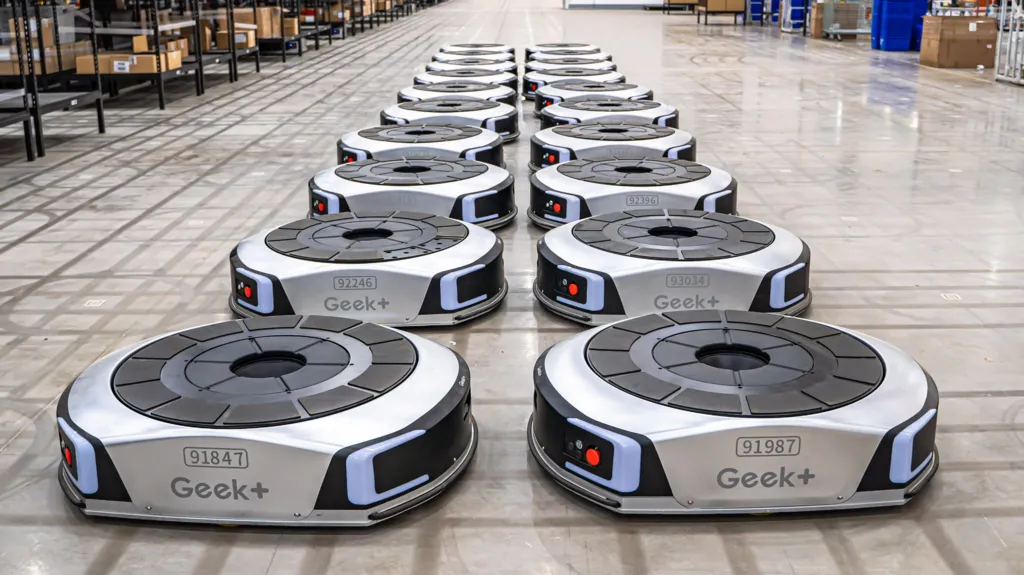
Many online orders in the UK now begin with small autonomous robots moving beneath storage shelves, lifting them, and transporting them to warehouse workers. These machines are produced by Chinese robotics company Geek+, which manufactures and tests its equipment at a factory in Hefei before exporting it to customers around the world.

Several leading British retailers, including Tesco, Asda, and Next, have adopted the company’s technology. According to Geek+, the robots help businesses process orders faster, improve storage capacity, and reduce mistakes by automating repetitive tasks that would otherwise require significant manual labour.

Unlike traditional warehouse automation systems that depend on fixed conveyor belts and expensive infrastructure, these mobile robots move independently using floor markers and safety barriers. This allows companies to introduce automation more quickly and with less disruption to existing warehouse operations.

Geek+ has grown into the world’s largest supplier of autonomous mobile robots and expanded its international presence after listing on the Hong Kong stock exchange last year. Britain has become the company’s biggest European market, with its UK partner MotionTech deploying more than 2,000 robots across 10 warehouse sites.

MotionTech says demand for automated warehouse technology continues to rise as businesses seek faster order processing while dealing with persistent labour shortages. Company representatives say customers want solutions that increase storage capacity, improve picking speeds, and reduce reliance on large workforces without sacrificing efficiency.

The growing use of robotics comes as the United Kingdom continues to struggle with weak productivity growth. Economists have argued that wider adoption of automation will be necessary if businesses are to remain competitive in the years ahead.

A recent report by the Organisation for Economic Co operation and Development found that Britain has been slower than many other advanced economies in adopting robotics, despite its long industrial history. While British companies have embraced many digital technologies, the report said automation and robotics remain underused across much of the economy.

Labour organisations have urged businesses to introduce new technology responsibly. The Trades Union Congress has argued that automation should improve working conditions and productivity rather than simply reduce employment. It has called for workers to be involved in decisions about automation and for companies to provide retraining opportunities as technology changes the workplace.

China’s rapid progress in robotics reflects a broader national strategy aimed at strengthening advanced manufacturing. President Xi Jinping has identified robotics as one of the country’s key future industries, with automation expected to offset the effects of a shrinking working age population and support long term economic growth.

Analysts say China’s leadership in robotics has benefited from its success in electric vehicle manufacturing. Many of the same technologies used in electric cars, including batteries, motors, cameras, sensors, and semiconductors, are now being applied to robotic systems, creating a strong industrial network that accelerates development.

Chinese electric vehicle manufacturer XPeng is among the companies expanding into robotics. The company has introduced a humanoid robot called Iron as part of its strategy to transform from a traditional carmaker into a broader technology company. Industry experts believe China’s robotics industry could follow a similar path to its electric vehicle sector by combining large scale manufacturing with rapid innovation.

At the same time, competition in robotics has become increasingly tied to global politics. This week the United States announced restrictions on imports of new advanced foreign made robots, citing national security concerns. China criticised the decision, accusing Washington of using trade measures for political purposes.

Looking ahead, Geek+ says it wants to move beyond transporting goods and eventually create fully automated warehouses where robots handle picking, moving, and packing products with minimal human involvement. While companies across China are investing heavily in humanoid robots capable of performing more complex tasks, experts believe these machines are still several years away from widespread commercial use.

For now, wheeled warehouse robots remain the most practical solution for retailers. As British businesses continue searching for ways to improve productivity and overcome staffing shortages, warehouses across the country are becoming an important testing ground for China’s rapidly expanding robotics industry.

Similar Posts

  • | |

    Indian activist Sonam Wangchuk says he remains ali…

    Indian activist Sonam Wangchuk says he has lost 11 kilograms during a 26 day hunger strike but remains alive, as his protest continues to fuel a wider youth movement demanding education reforms in India. Wangchuk, known widely as Sonam sir, has become the central figure in a youth led campaign organized by the Cockroach Janta Party, which is calling for sweeping education reforms and the resignation of Education Minister Dharmendra Pradhan. He was removed from the group’s protest site at Delhi’s Jantar Mantar on Saturday and taken to a hospital, where he has continued his fast. Despite his removal from the demonstration site, thousands of supporters have kept returning to Jantar Mantar, even after a heavy handed police response to a march toward parliament earlier in the week left numerous protesters and police officers injured. That crackdown has intensified public anger and energized opposition parties, creating a growing political challenge for Prime Minister Narendra Modi’s government. Modi has not addressed the protests directly or met with demonstrators, but he issued a statement on social media that many interpreted as an effort to connect with students angered by repeated leaks of exam papers. He wrote that the welfare of the country’s youth matters above all else and said the government would establish fast track courts to deliver swift punishment for those responsible for the leaks. A spokesperson for the Cockroach Janta Party, Ashutosh Ranka, responded that the government’s plan addressed the aftermath rather than the root cause, saying the movement wants to know why the leaks keep happening and who profits from them. He indicated in a video statement that protesters intend to continue their campaign until their demands are met. Even though Wangchuk is no longer physically present at the protest grounds, his fast has become a symbolic centerpiece of the movement, with demonstrators displaying placards and artwork referencing his hunger strike. Before he was hospitalized, he spent 21 days enduring intense summer heat while consuming only salt and water. Medanta Hospital in Gurugram said in a statement that Wangchuk was admitted to intensive care and is being monitored by a team of specialists. The hospital described his condition as stable and said his vital signs remain within normal ranges, adding that all treatment is being given with his consent. On Wednesday, senior figures including Cockroach Janta Party founder Abhijeet Dipke, along with opposition lawmakers, activists and public personalities, again urged Wangchuk to end his fast. Health Minister JP Nadda, who visited the hospital on Tuesday night, said he too had asked the activist to stop and rejoin efforts to guide young people, adding that the government remains willing to discuss the issues he has raised. Wangchuk has so far rejected these appeals. In a video statement recorded from his hospital bed on Wednesday night, he said he wants to end his fast because his work matters to him, but added that he would only do so once the government guarantees no force or retaliation will be used against students. He said he would end the strike immediately if that assurance comes, and would continue if it does not. He also praised the students involved in Monday’s confrontation with police, saying they showed remarkable composure even while being beaten with sticks, and said their restraint under pressure led him to keep going with his fast. Neither Wangchuk’s latest statement nor an earlier letter he sent to government ministers he met on Tuesday mentioned Pradhan’s resignation directly, though the Cockroach Janta Party maintains that the demand has not changed. Dipke told supporters that the protest at Jantar Mantar will continue until Pradhan steps down, and said the movement would not let Wangchuk’s sacrifice or the injuries suffered by students go without result. The standoff reflects a broader pattern seen in past protest movements across South Asia, where a single high profile figure’s personal sacrifice becomes a rallying point that sustains momentum long after the initial spark fades. Hunger strikes in particular have a long history in Indian political life as a tool for applying moral pressure on governments, dating back to independence era activism, and their effectiveness often depends on sustained public attention and the government’s willingness to negotiate before a health crisis forces the issue. As the standoff continues, the government faces mounting pressure to address both the immediate demand for accountability over exam paper leaks and the broader question of how education policy is managed, while doctors continue to monitor Wangchuk’s condition inside the hospital.

  • |

    Tom Chadbon, Game of Thrones and Doctor Who actor, dies at 80

    British actor Tom Chadbon has died at the age of 80, leaving behind a career that touched some of the UK’s most beloved television franchises, including Game of Thrones, Peep Show, and Casino Royale. News of his death was shared by Fantom Events, an organization known for running Doctor Who fan conventions where Chadbon frequently appeared as a guest. In their statement, the company remembered him warmly, describing him as easy to work with and offering their sympathies to his loved ones. Chadbon’s path into acting began far from the screen. Raised in Luton, Bedfordshire, he pursued formal training at the Royal Academy of Dramatic Art, one of the UK’s most respected drama schools. He stepped onto a professional stage for the first time in 1967, marking the start of a career that would stretch across nearly six decades. Rather than sticking to one medium, Chadbon built a reputation as a versatile performer. He took on roles at major theatrical institutions, including the Bristol Old Vic and the National Theatre, while also appearing in numerous West End productions. This theatrical grounding fed into a long and steady run on British television, where he became a familiar face across a wide range of popular series. Over the years, viewers would recognize him from shows like Casualty, Holby City, Heartbeat, Silent Witness, Midsomer Murders, Father Brown, The Bill, Blake’s 7, and Taggart. That breadth of work helped establish him as one of Britain’s most dependable and respected character actors, the kind of performer whose face was instantly familiar even if his name wasn’t always known. Two roles, though, stand out as particular fan favorites. Back in 1979, Chadbon played detective Duggan alongside Tom Baker’s incarnation of the Doctor in the classic Doctor Who serial “City of Death,” a story still fondly remembered by longtime fans of the show. Decades later, he stepped into the world of Westeros, taking on the role of High Septon Maynard in the seventh and final season of Game of Thrones in which he appeared. In the wake of his passing, tributes have poured in from fans and fellow actors alike, many taking to social media to reflect on his decades of contributions to British theatre and television, and to celebrate the warmth he brought both on-screen and off.

  • |

    FBR GST and excise collections rise by Rs 45 billion

    The Federal Board of Revenue (FBR) recorded a net increase of 45 billion rupees in revenue generated from Federal Excise Duty (FED) and General Sales Tax (GST) during the 2025-26 fiscal year. According to official sources, total combined collections from FED and GST reached 329 billion rupees for FY2025-26, compared to 284 billion rupees collected during the preceding 2024-25 fiscal year. The overall tax collection figures reflect broader gains, with FBR’s total revenue reaching 357 billion rupees, an increase of 42 billion rupees over the previous year’s total.

  • | |

    FCC refuses to halt inquiry against former NAB DG

    ISLAMABAD: The Federal Constitutional Court (FCC) has declined to suspend inquiry proceedings against former National Accountability Bureau (NAB) Director General Saleem Shehzad, allowing an investigation into his alleged unlawful appointment and promotion to continue. The decision came during a hearing of an appeal filed by Shehzad challenging a show-cause notice issued against him. He had requested the court to stay the inquiry until the case was decided, but the bench refused to grant interim relief. A two-member bench headed by Justice Hassan Azhar Rizvi heard the appeal and directed the federal government to submit its response within three weeks before further proceedings. The case revolves around allegations that Saleem Shehzad’s appointment and subsequent promotion within the National Accountability Bureau were made in violation of applicable rules and procedures. Authorities had earlier issued him a show-cause notice seeking an explanation over the alleged irregularities. Before approaching the Federal Constitutional Court, Shehzad had challenged the notice in the Islamabad High Court. However, after his petition was dismissed, he filed an appeal before the FCC, seeking legal protection against the inquiry. During the hearing, the court did not interfere with the ongoing investigation, effectively allowing the relevant authorities to continue examining the allegations while the constitutional appeal remains pending. Legal experts say the ruling does not determine Shehzad’s guilt or innocence but indicates the court’s reluctance to halt administrative proceedings before hearing the case in detail. The federal government’s reply is expected to play an important role in the next stage of the proceedings. The case has attracted attention because it involves the appointment of a senior official in Pakistan’s top anti-corruption watchdog. Any findings from the inquiry could have broader implications for accountability, transparency and the process of appointments in public institutions. With the inquiry set to continue and the government directed to file its response within three weeks, the Federal Constitutional Court is expected to take up the matter again after reviewing the submissions of both sides. The outcome could shape the future course of the legal challenge brought by the former NAB official.

  • | |

    Republic Policy unveils Federal democratic governa…

    ISLAMABAD: The Economic Policy and Business Development Think Tank, founded by former Prime Minister Anwar-ul-Haq Kakar, Gohar Ejaz and Sir Ahmed Nawaz Sukhera, hosted a policy session showcasing the Republic Policy Governance Model, a proposed federal and democratic framework aimed at reforming Pakistan’s existing system of governance. The session brought together policy leaders and prominent figures to discuss four books authored by Republic Policy: Fixing the Executive, Fixing the Legislature, Fixing the Judiciary, and The Bureaucratic Coup. A New Federal Democratic Governance Model According to Republic Policy, the proposed model seeks to establish a governance framework aligned with Pakistan’s federal constitutional structure, democratic representation, parliamentary supremacy and principles of effective public administration. The think tank said the initiative goes beyond criticism of the existing governance system and seeks to offer a practical alternative based on constitutional supremacy, democratic accountability, federalism and stronger parliamentary institutions. The model also addresses longstanding debates surrounding decentralisation, bureaucratic influence and the balance of power among the executive, legislature and judiciary. Reform Agenda Draws Appreciation Sources attending the event said the governance model and the four books received appreciation from participants, including former Prime Minister Anwar-ul-Haq Kakar, Gohar Ejaz and Sir Ahmed Nawaz Sukhera. A representative of Republic Policy said fundamental reforms in Pakistan’s governance system would need to become a central part of the national debate on the country’s future. “The encouragement we received is immensely encouraging for us,” the representative said, stressing the importance of continuing discussions on structural governance reforms. Focus on Constitutional Governance The Economic Policy and Business Development Think Tank was established to promote policy dialogue on economic and governance issues in Pakistan. The presentation of the Republic Policy Governance Model adds a new dimension to discussions on institutional reform, decentralisation, bureaucratic overreach and parliamentary empowerment. Republic Policy maintains that strengthening democratic institutions and ensuring governance within the framework of the Constitution are essential for improving the effectiveness and accountability of the Pakistani state.

  • |

    14 cities bid to host T20 World Cup 2028 matches

    Fourteen cities across Australia and New Zealand have expressed interest in hosting matches during the ICC Men’s T20 World Cup 2028, highlighting strong enthusiasm for the tournament that will be jointly staged by the two neighboring nations. Tournament organizers invited cities to submit bids for hosting rights, and a total of 14 cities responded with proposals to stage matches during the global event. However, only eight to ten cities are expected to be selected as official host venues, meaning several bidding cities will ultimately miss out. The ICC Men’s T20 World Cup 2028 is scheduled to take place during October and November and will mark another major cricket event jointly hosted by Australia and New Zealand. Both countries have extensive experience organizing ICC tournaments and are expected to provide world-class venues and infrastructure for teams and fans. According to reports, organizers will evaluate each bid based on the International Cricket Council’s hosting guidelines. A key factor in the selection process will be logistics, with officials aiming to create a tournament schedule that minimizes unnecessary travel while ensuring smooth operations throughout the competition. The governing body is expected to prioritize a balanced distribution of venues that allows teams to move efficiently between matches without excessive travel. A more compact tournament structure is also expected to improve scheduling, simplify event management, and provide a better experience for supporters traveling across both countries. Reducing the number of host cities is seen as an important part of the planning process. With Australia and New Zealand separated by the Tasman Sea and both countries covering vast geographical areas, organizers are seeking to strike the right balance between showcasing multiple regions and maintaining practical travel arrangements. Officials believe that selecting fewer venues will help streamline tournament operations, reduce travel demands for participating teams, and make it easier for fans to follow their favorite sides throughout the competition. The bidding process also reflects the continued popularity of international cricket in both nations. Many cities view hosting World Cup matches as an opportunity to attract visitors, boost local tourism, and generate significant economic activity through hotels, restaurants, transportation, and entertainment. Meanwhile, Melbourne Cricket Ground (MCG) is expected to host the final of the 2028 T20 World Cup. The iconic stadium has a rich history of staging major international cricket events and is widely regarded as one of the sport’s most prestigious venues. If confirmed, the MCG would once again provide the stage for the tournament’s biggest match. The final list of host cities is expected to be announced after organizers complete their evaluation of the bids and finalize venue arrangements in line with ICC requirements. Once confirmed, preparations will begin for upgrading facilities, coordinating logistics, and developing match schedules ahead of the tournament. The ICC Men’s T20 World Cup 2028 is expected to feature the world’s leading cricket nations and attract thousands of traveling fans, making it one of the biggest sporting events on the international cricket calendar. With significant interest from host cities and careful planning underway, Australia and New Zealand are preparing to deliver another memorable edition of the tournament.

Leave a Reply

Your email address will not be published. Required fields are marked *