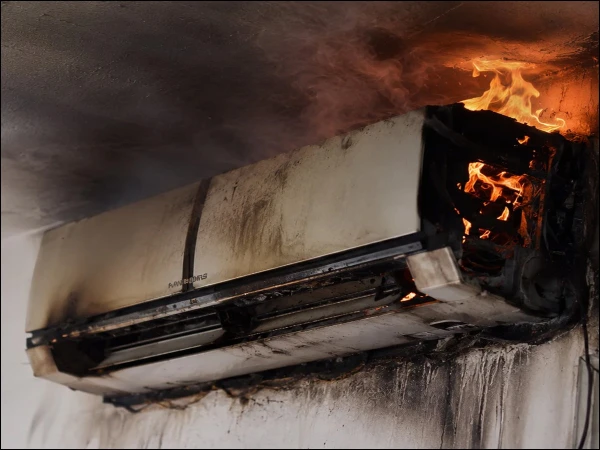
danger signs your

Danger signs your air conditioner needs repair

As temperatures rise many people buy old or low cost air conditioners to save money.

However experts warn that aging AC units can become dangerous if problems are ignored.  Small faults may turn into serious issues including electrical short circuits fires or costly damage.

According to experts older air conditioners often develop worn out wiring damaged electrical parts faulty motors and overheating.

These problems may seem minor at first but can become dangerous if they are not repaired in time. One of the biggest warning signs is a burning smell or the odor of melted plastic when the AC is switched on.

Experts say this could mean the internal wiring motor or insulation has been damaged increasing the risk of fire.  If this happens turn off the unit immediately and have it checked by a qualified technician.

Unusual sounds such as rattling grinding or loud noises are also signs that something is wrong.

These noises may be caused by a loose part a damaged fan or a compressor problem.  Ignoring them could lead to a complete system failure.

If the air conditioner becomes unusually hot while running it may indicate an electrical fault inside the unit.  Overheating can increase the risk of a short circuit or fire

making immediate inspection and repair important. Experts also advise not to ignore weak cooling.

Reduced cooling may be caused by low refrigerant a faulty compressor or a clogged air filter.  These issues usually mean the AC needs servicing or repairs.

Another serious warning sign is seeing sparks near the voltage stabilizer or electrical wires. This may indicate loose connections or damaged wiring, which can quickly become a fire hazard if not fixed.

Experts recommend turning off the air conditioner immediately if you notice any of these warning signs and contacting a qualified technician for a full inspection. Timely repairs can help prevent bigger damage and keep your home and family safe.

They also advise that if an air conditioner keeps breaking down and needs frequent repairs replacing it with a newer safer and more energy efficient model may be a smarter and more cost effective choice.


Similar Posts

  • How to stay positive during difficult times

    Life is full of both success and failure. Sometimes our hard work brings rewards while at other times we face criticism disappointment or feelings of failure. How we respond to these difficult moments can shape our future. Some people hold on to anger and negative thoughts which only increase their stress. Others choose to learn from their struggles and use them as motivation to grow stronger and achieve their goals. Experts say that turning negative energy into positive energy means using your mental emotional and physical strength in healthy ways. This can help you build a happier calmer and more successful life. Here are some simple ways to develop a more positive mindset. •Recognize your feelings Negative emotions often begin with our thoughts. If you feel sad angry or stressed try to understand what caused those feelings. Remember that difficult emotions are usually temporary and can be managed. •Practice meditation or yoga Meditation and yoga can help calm the mind reduce stress and improve emotional balance.  Even a few minutes of daily practice can make a difference. •Be thankful Gratitude is a simple but powerful habit. Taking time to appreciate the good things in your life can improve your mood and help you focus on the positive. •Stay physically active Regular exercise is good for both your body and your mind. Physical activity releases natural chemicals called endorphins which help reduce stress and improve happiness. •Do things you enjoy Spend time on activities that make you happy such as learning a new skill reading books or enjoying a favorite hobby. These activities can help replace negative thoughts with positive ones. •Use positive self talk The way you speak to yourself matters. Instead of saying, “I can’t do this,” remind yourself, ” I can improve,” or “I will keep trying.” Positive words can build confidence and reduce negative thinking. •Stay away from negative people The people around you can influence your mood and mindset. Try to spend more time with supportive and positive people who encourage you to grow. Building a positive mindset takes time but small daily habits can help you become stronger more confident and better prepared to handle life’s challenges.

  • Justice Delayed, Safety Denied: Why Women Still Fear Reporting Violence

    “How Social Stigma, Institutional Challenges, and Delayed Justice Continue to Discourage Women from Reporting Violence in Pakistan” For many women in Pakistan, reporting violence is not simply the first step towards justice, it is often the beginning of another struggle. While laws have evolved to provide greater protection against domestic violence, sexual assault, workplace harassment, acid attacks, and other forms of gender-based violence, countless women continue to hesitate before approaching the police or the courts. Their reluctance is not always born out of ignorance of the law; rather, it stems from fear of social stigma, institutional barriers, prolonged legal proceedings, and uncertainty about whether justice will ever be delivered. This reality raises an important question: if legal safeguards exist, why do so many women still fear reporting violence? The Constitution of the Islamic Republic of Pakistan provides a strong foundation for the protection of women’s rights. Article 9 guarantees the right to life and liberty, Article 14 safeguards the dignity of every individual, Article 25 ensures equality before the law and prohibits discrimination on the basis of sex, while Article 34 directs the State to ensure the full participation of women in all spheres of national life. These constitutional guarantees are reinforced by various legislative measures, including the Anti-Rape (Investigation and Trial) Act, 2021, the Protection Against Harassment of Women at the Workplace Act, the Acid Control and Acid Crime Prevention laws, and provincial domestic violence legislation. Together, these laws demonstrate that Pakistan has made significant progress in recognizing and protecting women’s rights. However, legislation alone cannot guarantee justice. The effectiveness of any legal framework depends upon its implementation. For many survivors, the greatest obstacle is not the absence of legal remedies but the fear of navigating the justice system itself. Reporting violence often means facing uncomfortable questions, social judgment, pressure from family members, financial hardship, and emotional trauma. In many cases, victims worry that their complaints will not be taken seriously or that the legal process will take years to reach a conclusion. Such concerns discourage many women from seeking legal protection altogether. The problem is further aggravated by the slow pace of criminal proceedings. Delayed investigations, repeated adjournments, and prolonged trials can force survivors to relive traumatic experiences for years. Justice delayed not only prolongs suffering but also weakens public confidence in the legal system. When victims believe that reporting a crime will expose them to further hardship without a timely or meaningful remedy, silence often appears to be the safer option. In this sense, delayed justice becomes a denial of safety, discouraging others from coming forward and allowing perpetrators to act with greater confidence. Several high-profile incidents have highlighted both the urgency of reform and the limitations of existing mechanisms. The Motorway rape case in 2020 sparked nationwide outrage and prompted important legislative reforms, including the enactment of the Anti-Rape (Investigation and Trial) Act, 2021. While these reforms strengthened the legal framework, they also reminded the nation that effective implementation, victim-sensitive investigations, and timely prosecution remain equally essential. Similarly, acid attacks and cases of so-called honour based violence have continued to expose the gap between legal protections and the realities faced by many women, particularly in rural and underserved communities. Legal reforms must therefore be accompanied by institutional reform. Police officers, prosecutors, judges, and medico-legal professionals require continuous training to handle cases involving gender-based violence with professionalism, sensitivity, and respect for victims’ dignity. Fast-track procedures for serious offences against women should be implemented effectively to reduce unnecessary delays. Victim and witness protection mechanisms must be strengthened so that survivors feel safe throughout the judicial process. Equally important is ensuring that legal aid and psychological support are readily available to those who seek justice. Beyond the courtroom, society itself has a crucial role to play. Victim-blaming, social stigma, and cultural stereotypes remain among the greatest barriers preventing women from reporting violence. Questions such as “Why did she report it now?” or “What was she doing there?” unfairly shift attention away from the offender and onto the survivor. Such attitudes discourage reporting and perpetuate a culture of silence. A justice system can function effectively only when society supports victims rather than subjects them to suspicion and criticism. Protecting women’s rights is not solely a legal obligation; it is a constitutional, moral, and social responsibility. Laws are meaningful only when they inspire confidence in those, they are designed to protect. A woman should never have to choose between her safety and the fear of navigating the justice system. She should have confidence that her complaint will be heard fairly, investigated promptly, and decided without unnecessary delay. Pakistan has undoubtedly taken important legislative steps to combat violence against women. The challenge now lies in translating those legal guarantees into practical realities. Stronger enforcement, efficient investigations, timely trials, greater institutional accountability, and increased public awareness are essential to restoring confidence in the justice system. Justice cannot be measured merely by the number of laws enacted; it must be measured by the willingness of victims to seek its protection without fear. A society where women hesitate to report violence is a society where justice remains incomplete. The true success of any legal system is not reflected in the statutes it enacts but in the trust it inspires. Until every woman feels secure enough to report violence without fear of stigma, intimidation, or delay, the promise of equal justice will remain only partially fulfilled. Justice delayed is not merely justice denied it is safety denied. A legal system earns public confidence not when it promises protection, but when it delivers it.

  • | | |

    Ducky bhai questions parents’ role in children?…

    Pakistani YouTuber Ducky Bhai has questioned the growing criticism of YouTubers over their alleged negative influence on children, arguing that parents must also take responsibility for their children’s upbringing and online activities. In his recent remarks, Ducky Bhai rejected the idea that YouTubers alone are responsible when children are exposed to inappropriate or negative content. He questioned where parents are when children are spending significant amounts of time online and consuming digital content. According to Ducky Bhai, content creators should make an effort to keep their videos clean and appropriate. However, he stressed that YouTubers cannot be expected to act as parents for every child watching their content. He argued that parents have a key role in deciding what their children watch and how much time they spend online. Monitoring internet activity, setting boundaries and discussing appropriate content with children, he suggested, should be part of responsible parenting. Ducky Bhai also referred to his own childhood while explaining his perspective. He recalled that his father encouraged him to focus on his studies and used rewards, including the promise of a PlayStation for good performance, as motivation. He further revealed that his father had installed security measures on his computer that allowed him to monitor his activities. According to Ducky Bhai, this close supervision helped his parents remain aware of what he was doing online. His comments have renewed discussion about the responsibilities of parents and digital content creators in an age when children have easy access to YouTube and other online platforms. While creators can influence young audiences through the content they publish, Ducky Bhai believes parents cannot simply shift the entire responsibility onto YouTubers. Instead, he says families should actively monitor children’s digital activities and guide them toward appropriate content. The debate highlights a broader challenge for modern families: balancing children’s access to entertainment and technology with parental supervision. As online platforms continue to become an important part of children’s daily lives, both content creators and parents face increasing pressure to ensure that young viewers are exposed to safe and suitable material.

  • MIT robot can fly and swim

    Researchers at the Massachusetts Institute of Technology (MIT) have created a unique robot that can both fly through the air and swim underwater just like diving birds. The lightweight robot costs around $300 and was designed by MIT’s AeroAquatic Robotics team.  Scientists believe it could one day help monitor oceans study marine life and support environmental protection. The robot was inspired by diving birds which use the same wings to fly in the air and move through water.  While scientists have studied these birds for years building a robot that can perform both tasks efficiently has been a major challenge. To solve this the MIT team carefully studied how diving birds move and used those findings to design the new machine. The robot called the Flapping Aerial Aquatic Vehicle weighs only 250 grams.  It runs on a battery powered motor and has nylon wings and a tail coated with water resistant nanoparticles to protect them from moisture. According to the researchers the robot is programmed to flap its wings at a specific frequency allowing it to move smoothly in both air and water without changing its basic movement. It can fly at speeds of up to 13.4 miles per hour and swim at about 2.2 miles per hour. On a single battery charge it is designed to fly as far as 6 kilometers or swim up to 2 kilometers. The robot was tested for about one year first in a water tank in Massachusetts and later in Lake Geneva Switzerland where researchers evaluated its performance in real world conditions.

  • Japan launches cooling shirt with built in fans

    Japan is finding a new way to deal with extreme summer heat.  A Japanese clothing company has introduced a formal looking shirt with built in fans that can help keep people cool while they are outside. The company, Yofuku no Aoyama has launched a short sleeved shirt fitted with two small fans. The fans circulate air inside the shirt helping cool the wearer while walking or traveling. At first glance the shirt looks like a normal office shirt. However it has a small cooling system hidden inside. The fans are placed near the lower back and push air through the shirt to reduce heat and discomfort. Cooling clothes with built in fans have become popular in Japan over the past few years. They were mainly used by construction workers garbage collectors, security staff and other outdoor workers.  Most of these products looked like jackets or work vests rather than regular office clothing. With summers becoming hotter demand for cooling clothes is now growing among office workers and other people who spend time outdoors. To meet this demand Yofuku no Aoyama developed the shirt in partnership with FZN a company that specializes in fan powered clothing. The shirt comes with two fans and a rechargeable battery. The company has tried to keep the cooling system as light as possible. Each fan weighs around 95 grams, while the battery pack weighs about 165 grams. The fans are visible from the back but the designers have kept the rest of the system as discreet as possible so the shirt still looks suitable for an office environment. The company has not provided specific information about how loud the fans are so they may not be  completely silent. The shirt is mainly designed for traveling rather than meetings. Most offices and meeting rooms already have air conditioning so there is little need to use the fans indoors. However the cooling system can be useful when employees walk between meetings travel by public transport or spend time outside in hot weather. It may also help workers arrive at their destination without becoming heavily sweaty reducing the need to change clothes before continuing their work. Price and Availability The Coochowear Short Sleeve Shirt is being sold as a complete cooling package for 17,490 Japanese yen. The package includes the shirt two fans a rechargeable battery pack and a charging cable. The shirt is available in blue and gray with medium large and extra large sizes. The product is now available through the company’s stores and online shop.

  • Political Crisis in Pakistan

    By Granaz Assa A nation cannot move forward when its leaders are divided. Political stability is the backbone of every successful country, but when conflict, corruption, and power struggles become more important than public welfare, a nation begins to suffer. Unfortunately, Pakistan has faced a political crisis for many years. A political crisis is a situation in which a country’s political system becomes unstable, making it difficult for the government to run the country properly. It is mainly caused by conflicts between the government and the military, political disagreements, corruption, and weak leadership, which lead to instability, loss of public trust, and slow development in the country. Pakistan’s future depends on strong and fair leadership, but the ongoing political crisis is slowing the country down. Moreover, the people are facing hardships because of this. As a result, Pakistan is experiencing an economic slowdown, a poor international image, and low development. When leaders fight for power and control, it divides the country and creates confusion. Corruption also makes the situation worse because some leaders misuse public money for their own benefit instead of serving the citizens. If the government is weak, it cannot make good decisions or effectively help the people. A political crisis has many negative impacts on the country. It creates instability, weakens the economy, increases prices, and raises unemployment. Development projects such as schools, hospitals, and roads may be delayed. Public services can also be affected. As a result, the country’s overall progress becomes slow, and the daily lives of citizens become more difficult. In this way, a country cannot move forward. To solve the political crisis in Pakistan, some important steps are needed. First, corruption must be reduced, and leaders should work honestly for the people. Moreover, the country needs strong and fair leadership to make good decisions and guide the nation. Political parties should work peacefully and respect one another instead of engaging in conflicts. These steps can bring stability, improve the country’s economy, and build a better future for Pakistan. The political crisis is a serious problem that affects the country in many ways. The country needs to promote peace and unity among its people. Pakistan can overcome this crisis if all political parties and their leaders work together for the country instead of pursuing their personal interests. Free and fair elections, respect for the Constitution, and peaceful dialogue can help resolve political disagreements. The government must focus on the needs of the people. Citizens should also vote responsibly and support peace, unity, and democracy. By working together, the country can achieve political stability, economic growth, and a brighter future.

Leave a Reply

Your email address will not be published. Required fields are marked *