total darkness then
| |

Total darkness, then sunset as full eclipse wows spectators in Spain

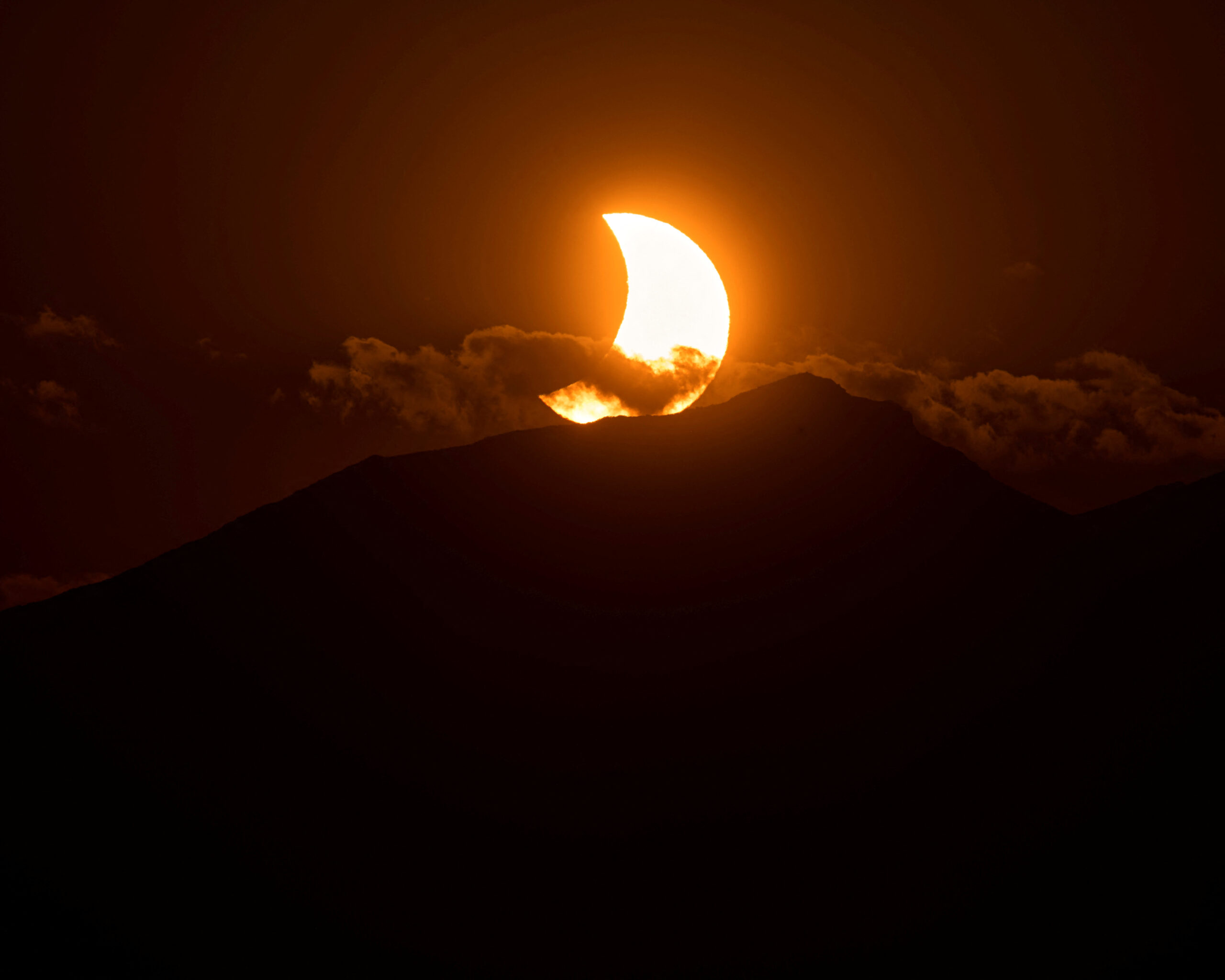
MADRID, Spain – Spectators across Spain watched in wonder, some whipping off their protective glasses and rising to their feet in unison, as a rare total solar eclipse swept across the north of the country on Wednesday evening, plunging it into darkness.

Spain deployed a massive police contingent and set up special viewing spots across rural areas that offered the best views of the spectacle.


Total darkness, then sunset as full eclipse wows spectators in Spain

Viewers in Buitrago de Lozoya, a rural district north of Madrid, clapped and cheered as the sky dimmed and Baily’s beads – bright points of sunlight that shine around the edge of the moon during a total eclipse – glistened on the horizon just after 8:30 pm (1830 GMT), lasting barely a minute.

“It’s impressive how the colors return little by little after totality – first the reds, then the blues – just like at dawn and sunset, totally deceiving your brain,” said economist Diego Fernandez, 32.

Rafael Jiménez, 50, a resident of Madrid, said the event felt like science fiction. “It was an absurd scene; we even got soaked when the garden sprinklers kicked in,” he said. “And then, just like that, we were watching the sunset again.”

Spain’s turn with the eclipse followed shortly after a less remarkable spectacle over much of overcast Iceland, although a break in the clouds in the far west of the Nordic country allowed holidaymakers and locals a glimpse of the celestial phenomenon. The eclipse was hidden behind clouds in central Reykjavik although the darkness of the totality was still evident.

“It was like a whole day just came at once and I felt goosebumps because it just made us think about … the shortness of life, how time can be different and it depends on your perspective,” lawyer Eduarda Ortiz, 33, told Reuters in the Icelandic capital.

Millions of people gathered in Iceland and northern Spain to witness Western Europe’s first total solar eclipse in 27 years.

Brian May, former guitarist for the rock band Queen, was among them. He travelled to an observatory in Spain’s Teruel province and chronicled the experience on his Instagram page.

“Here we go, the sun is disappearing. It’s amazing,” he said as the eclipse reached its climax and bystanders burst into cheers and applause after a countdown.

In Spain, authorities were expecting up to 6 million visitors in mostly rural areas under the eclipse’s path across the north of Spain and the Balearic Islands.

Police, planes and helicopters on standby

The Iberian Peninsula last witnessed a total solar eclipse in 1912, but another is due on August 2, 2027, and an annular eclipse will follow in January 2028, completing the so-called “Iberian Eclipse Trio”.

The uncanny sensation when day briefly turns to twilight and some animals fall quiet, while the moon passes directly between Earth and the sun, has often been seen through history as an omen of cosmic struggle or a sign of divine power.

For Spain, the event has been a chance to showcase its less-traveled regions and draw tourists from its overcrowded beach resorts. Some seized the opportunity to get married, according to local press reports.

The eclipse took place in one of the country’s highest-risk periods for wildfires, with emergency crews fighting various fires on Wednesday, including a large one in the southern Andalucia region.

Authorities rolled out a large-scale police operation and public safety campaign to make sure the crowds did not set off wildfires.

A small fire erupted near an eclipse viewing point in the town of Peñíscola, in the Valencia region, local authorities said. The fire began in a vehicle and spread to 33 more before firefighters brought it under control, they said. Emergency crews, including aircraft, were dispatched to the area.

The authorities dispatched 25,000 police officers to guarantee security around the eclipse observation sites and deployed nearly 100 planes and helicopters.

As of late Wednesday, no wildfire incident tied to eclipse chasers was reported.

Eclipse fever in the land of sagas

In Reykjavik, glasses that allow spectators to view the phenomenon without damaging their eyes have been sold out for days, as the country of roughly 400,000 people welcomed up to 80,000 visitors.

Totality reached Iceland’s westernmost coast at about 5:44 pm (1744 GMT), casting the far west of the island nation into total darkness for up to 2 minutes and 13 seconds.

The event has drawn both casual observers and “eclipse chasers,” enthusiasts who crisscross the globe to be in the path of totality whenever and wherever an eclipse occurs.

In Spain, 43-year old Gema, who did not give her last name, said as she left the Buitrago de Lozoya viewing point: “Everybody tells you about it, but it is more beautiful than you imagine.” – Rappler.com

Similar Posts

  • |

    Trump says Kim Jong Un responds to outreach

    US President Donald Trump says North Korean leader Kim Jong Un has responded to his recent efforts to reopen direct communication with Pyongyang. Trump made the statement after announcing plans to reduce the scale of joint military exercises between the United States and South Korea. A reporter asked Trump why Kim had not responded to his attempts to establish contact. Trump replied that the North Korean leader had responded, but he did not disclose what Kim had said or provide details about the communication. The White House did not immediately provide further information. North Korea’s mission to the United Nations also did not issue an immediate response. Trump has recently adopted a softer tone toward North Korea. He described the country as “unthreatening and respectful” and said Kim had always treated him with respect. The US president said he understood Kim and believed the North Korean leader understood him as well. Trump’s latest comments have revived speculation about a possible meeting between the two leaders. The pair held historic summits in 2018 and 2019 during Trump’s first presidency. Those talks eventually collapsed over disagreements about North Korea’s nuclear weapons programme and the sanctions imposed on Pyongyang. North Korea has since expanded its military capabilities. It has also strengthened its ties with Russia while maintaining close relations with China. The country has faced international sanctions over its nuclear programme and ballistic missile development. North Korea has also provided military support to Russia during the war in Ukraine. Ukrainian officials have accused Russia of using North Korean-made missiles in attacks on Ukrainian targets. Trump’s administration has criticised Pyongyang’s military cooperation with Moscow. Despite this, Trump has continued to speak positively about his personal relationship with Kim. The US president’s decision to reduce military exercises with South Korea has also attracted attention. Trump said the exercises were expensive and argued that they sent an inappropriate and hostile message to North Korea. Pyongyang has long condemned US-South Korean military drills. North Korea considers the exercises preparation for a possible attack. The proposed reduction could therefore create additional space for diplomatic engagement. However, analysts caution that a new summit may not happen immediately. Victor Cha of the Center for Strategic and International Studies said North Korea could take its time before responding more openly to Trump’s approach. He also suggested that Trump may see renewed engagement with North Korea as a way to shift attention from other foreign policy challenges, while still genuinely wanting to meet Kim again. Other analysts believe Kim could benefit from another meeting with the US president. Andrew Yeo of the Brookings Institution said Kim had little to lose from holding talks with Trump. He argued that North Korea’s strengthened relationships with Russia and China could give Kim greater confidence in negotiations. Yeo said another meeting could also enhance Kim’s international status and reputation. Former US National Intelligence Officer Sydney Seiler noted that Trump had taken a similar approach during his first term. In 2018, the US president suspended major military exercises with South Korea as part of efforts to encourage dialogue with Pyongyang. Meanwhile, North Korea has continued to strengthen its relationship with Russia. Russian Foreign Minister Sergey Lavrov recently reaffirmed Moscow’s close ties with Pyongyang. North Korean state media said Russia and North Korea were working together toward what they described as a new world order. For now, Trump has provided no details about Kim’s reported response. The nature of the communication and whether it could lead to renewed high-level negotiations remain unclea

  • |

    Brasilia reduces diplomatic presence in Buenos Aires following verbal attacks by Argentine leadership

    Brazil has formally downgraded its diplomatic representation in Argentina to the level of chargé d’affaires following renewed verbal insults directed by Argentine President Javier Milei toward Brazilian President Luiz Inácio Lula da Silva. The Ministry of Foreign Affairs confirmed that Brazilian Ambassador Julio Bitelli will not be returning to his post in Buenos Aires. The decision was triggered after Milei referred to the Brazilian head of state using derogatory terms, including calling him corrupt and an ex-convict, during a television interview with Argentine broadcaster LN+. Bitelli had initially been recalled late last month after Milei openly criticized Lula while appearing in São Paulo alongside opposition candidate Flavio Bolsonaro during the formal launch of his presidential campaign. Argentine Ambassador Daniel Raimondi was officially notified of the administrative downgrade in Brasília. The move marks a formal escalation in the deteriorating relations between South America’s two largest economies, whose leaders have not held a formal bilateral summit since Milei assumed office.

  • | |

    US commander warns troops over social media posts

    The top US military commander overseeing American forces in the Middle East has warned troops that photos and videos shared on social media could help Iran quickly assess the damage caused by attacks on US bases. According to Reuters, US Central Command chief Admiral Brad Cooper made the warning in a July 28 letter to service members. He said Iran was using media reports, along with images and videos posted by US troops, to determine whether its attacks had succeeded or failed. Cooper urged military personnel to follow operational security rules more strictly, although he did not outline any specific measures in the letter. Reuters reported that some US troops stationed in Jordan have been told that authorities could take away their mobile phones in the coming days. Another source said officials were also considering similar measures elsewhere in the region, although no final decision has been made.   US Central Command spokesman Captain Timothy Hawkins said the message aimed to remind troops about the importance of operational security. The warning followed the appearance of a video on social media earlier this month that showed a US service member recording himself while heading toward a bunker during an Iranian attack on Jordan’s Muwaffaq Salti Air Base. Cooper said the soldier recorded the video using Meta smart glasses, potentially giving Iran information about the troops’ location and their response to the attack. He said that without publicly available images, videos and reports, Iran would have a harder time determining whether its strikes hit their intended targets. However, such material can effectively provide Iran with a free assessment of battlefield damage. According to Reuters, 18 US service members have been killed and more than 600 injured since the conflict with Iran began on February 28. The US Department of Defense has limited the release of information about the attacks and military casualties due to security concerns.

  • |

    US senator demands answers over USS Abraham Lincoln deployment

    WASHINGTON: US Senator Richard Blumenthal has called on the Pentagon to explain why the USS Abraham Lincoln has remained at sea for more than 250 days, raising concerns about the health, safety and readiness of thousands of sailors and Marines aboard the aircraft carrier. Blumenthal, a member of the Senate Armed Services Committee, sent a letter to Defence Secretary Pete Hegseth and Acting Navy Secretary Hung Cao seeking detailed information about the carrier’s prolonged deployment. The senator said the USS Abraham Lincoln left Naval Base San Diego on November 21, 2025, for what was originally expected to be a seven-month mission. Its deployment was scheduled to end in May but has since been extended, with no publicly announced date for its return. According to Blumenthal, the carrier has spent more than 200 consecutive days without a port visit, setting a record for the length of time it has remained at sea without such a stop. The prolonged deployment has triggered concerns about conditions aboard the carrier, including reported shortages of basic supplies, water contamination, plumbing problems and difficulties with mail deliveries. Blumenthal also raised concerns about the mental health and morale of crew members, as well as deck safety and general living conditions. He said reports of fatigue, deferred maintenance and limited opportunities for rest could increase the risks faced by personnel working aboard an aircraft carrier. The USS Abraham Lincoln carries around 5,000 sailors and Marines and operates in an environment involving aircraft, fuel, weapons, heavy machinery and complex electrical systems. Blumenthal warned that prolonged exposure to these conditions could create additional safety risks if crews are exhausted or equipment maintenance is delayed. The senator asked the Pentagon to provide information about reported habitability problems aboard the carrier, including issues involving hygiene supplies, mould, toilets, laundry facilities and water systems. He also requested details about the Navy’s measures for monitoring crew fatigue, morale, mental health and operational readiness. Blumenthal wants officials to disclose whether the extended deployment has been linked to increases in safety incidents, medical problems or disciplinary cases. Reports cited by US military publications have also described incidents in which sailors aboard the carrier allegedly attempted to go overboard during its prolonged deployment, intensifying concerns about the psychological pressure on personnel. The senator has asked the Navy to explain what measures are being taken to address such concerns and protect the wellbeing of the crew. The extended deployment comes as the United States continues military operations and maintains a significant naval presence connected to tensions involving Iran and the wider Middle East. Blumenthal questioned the Pentagon about the strategic purpose of keeping the carrier deployed for such an extended period. He asked officials to explain the military objectives linked to the Lincoln’s continued presence in the region and how the Navy determines whether the carrier remains operationally necessary. The senator also sought details about every extension of the carrier’s deployment, including who approved the extensions and what operational requirements were cited. He further questioned whether the Navy’s existing fleet structure and deployment system can maintain the current demand for aircraft carriers without undermining crew welfare, equipment readiness and future maintenance requirements. Blumenthal warned that maintaining a high operational tempo for an extended period could create a readiness problem in the future if the impact on personnel and equipment is not properly addressed.

Leave a Reply

Your email address will not be published. Required fields are marked *