doe scraps coal
| |

DOE scraps coal bid, plans rebid in weeks as Semirara contract nears expiry

MANILA, Philippines – The Department of Energy (DOE) scrapped its 2026 coal bid round but plans to launch a new auction within weeks, resetting the race for the country’s biggest coal-producing area less than a year before the existing contract of Semirara Mining and Power Corporation (SMPC) expires.

In an advisory on Tuesday, September 15, Energy Secretary Sharon Garin terminated the bidding covering three pre-determined areas offered for development and production coal operating contracts.

The DOE cited concerns raised during pre-submission conferences, as well as developments affecting Semirara Island in Antique province, including “continuing water seepage” and unspecified “legal considerations.”

“We’ll rebid in a few weeks,” Garin told Rappler when asked whether terminating the auction this close to SMPC’s contract expiration could make it harder for another operator to prepare for a takeover.

“New rules, new bidding,” she added on Thursday, September 17.
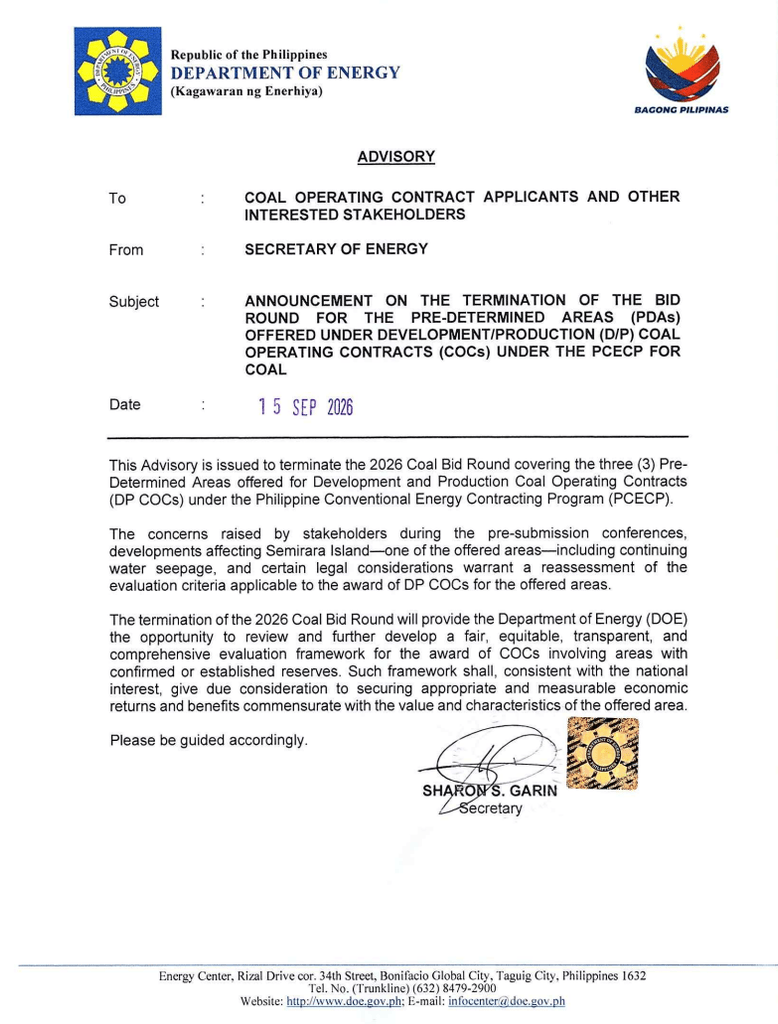
Image from Department of Energy

In its advisory, the department said the termination would allow it to develop a “fair, equitable, transparent, and comprehensive evaluation framework,” particularly for areas with confirmed or established coal reserves.

The most consequential part of the aborted auction involves 10 coal blocks on Semirara Island currently operated by Consunji-led SMPC. Its Coal Operating Contract No. 5 expires on July 14, 2027, after the government rejected the company’s bid to extend its decades-long tenure and instead decided to open the area to competition.

The auction has already faced repeated delays. In July, Garin said changes to the bidding rules could be finished within “a few weeks,” according to a BusinessMirror report. 

SMPC has also challenged parts of the bidding process in court. In July, it sought protection from DOE demands for detailed asset inventories and proprietary technical information intended to be made available to prospective bidders. – Rappler.com

Similar Posts

  • | |

    Pakistan exports rise 13.1% to $3.94 billion in Ju…

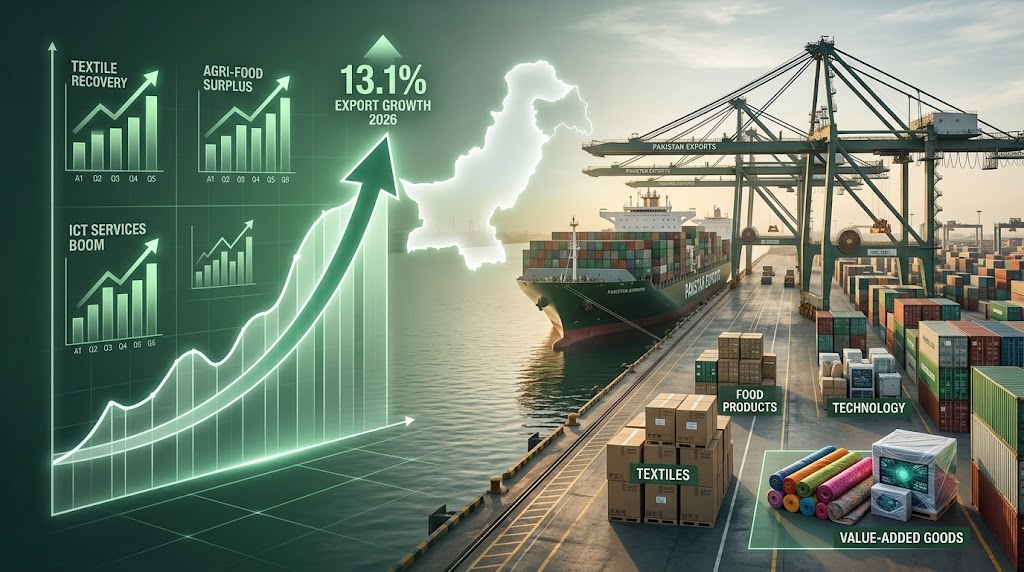
    ISLAMABAD: Pakistan’s exports of goods and services rose by 13.1 percent year-on-year to $3.94 billion in July 2026, providing an encouraging start to the new fiscal year and signalling continued improvement in the country’s external sector. Federal Minister for Planning, Development and Special Initiatives Ahsan Iqbal shared the figures on Saturday while presenting the Monthly Development Update for August 2026. He said exports stood at $3.48 billion in July 2025, meaning the latest increase reflects stronger performance across several major export categories. According to the minister, merchandise exports increased by 9.4 percent to around $3 billion in July 2026 from $2.8 billion a year earlier. When services exports are included, the combined figure reached approximately $3.9 billion, compared with $3.5 billion in July last year. Key export sectors show growth Ahsan Iqbal said the improvement in exports was supported by higher shipments across several important sectors. Surgical goods recorded the strongest growth among the highlighted export groups, increasing by 16.3 percent. Food exports rose by 8 percent, while leather goods registered growth of 7.8 percent. Textile exports, one of Pakistan’s largest sources of foreign exchange, also increased by 3.9 percent during the month. The minister said the figures indicated that Pakistan’s external sector had started the new fiscal year on a positive trajectory, although maintaining this momentum would require continued reforms, improved competitiveness and greater diversification of export products and markets. Manufacturing sector stages strong recovery The positive external-sector performance coincided with a broad-based recovery in domestic industrial activity. According to Ahsan, Large-Scale Manufacturing (LSM) expanded by 5 percent during fiscal year 2025-26, reversing a 0.74 percent contraction recorded in the preceding fiscal year. He said the recovery was spread across the industrial sector, with 16 of the 22 LSM sectors registering positive growth. The automobile sector posted the highest increase at 57.8 percent, followed by transport equipment at 42.4 percent. Electrical equipment production grew by 14.3 percent, tobacco by 12.6 percent and food manufacturing by 7 percent. The figures, he said, reflected an improvement in industrial activity and could provide support to investment, employment and overall economic growth if the recovery remains sustained. FBR collection, remittances improve The government also reported improvement in tax revenues at the beginning of FY2026-27. Federal Board of Revenue tax collection increased by 8.4 percent to Rs820.9 billion in July 2026, according to the minister. He said stronger revenue mobilisation, together with fiscal discipline, was helping improve the country’s overall financial position. Workers’ remittances also remained a major source of support for Pakistan’s external account. Remittance inflows reached $3.63 billion in July 2026, up 13 percent from approximately $3.2 billion in the same month of 2025. Ahsan said the latest increase followed record remittances of $41.6 billion received during the previous fiscal year. He noted that remittances not only strengthened Pakistan’s foreign exchange position but also provided direct financial support to millions of households across the country. Current account deficit remains contained Despite continued pressure on the external account, the current account deficit remained relatively contained. The deficit stood at $328 million in July 2026, compared with $529 million during the same month of the previous year. The minister described the development as another indication of improved external-sector stability. He also highlighted the growing contribution of Pakistan’s technology sector. Information and Communication Technology exports reached $417 million in July 2026, underlining the increasing role of digital services in generating foreign exchange. The government has been seeking to expand technology exports as part of a broader strategy to diversify Pakistan’s sources of external earnings beyond traditional sectors such as textiles and agricultural products. Inflation moderates Ahsan Iqbal also pointed to a moderation in consumer price pressures at the start of the new fiscal year. Consumer Price Index inflation eased to 9.2 percent in July 2026, compared with 11.7 percent in May 2026. The minister said the decline suggested that inflationary pressures were beginning to moderate. He added that changes in the year-on-year inflation rate were also influenced by base effects as well as the impact of international food and energy prices. The government is aiming to maintain price stability while supporting economic activity and protecting the purchasing power of households. Fiscal position strengthens The planning minister said Pakistan’s fiscal position had also improved significantly during FY2025-26. The fiscal deficit narrowed to 2.6 percent of GDP from 5.4 percent in FY2024-25. According to Ahsan, this represented the lowest fiscal deficit recorded in two decades. He said stronger fiscal management would remain essential during FY2026-27 as the government seeks to maintain macroeconomic stability while creating room for development spending and economic expansion. Development spending and job creation Public investment is another major component of the government’s economic strategy. Projects approved during July 2026 are expected to create around 7,851 direct jobs and 14,053 indirect employment opportunities across different sectors. The minister said employment generation would remain an important objective of development planning, particularly as the country seeks to create greater opportunities for its young population. He said Pakistan had undergone a difficult period of economic adjustment and that the stability achieved in recent years had required significant effort. Under the government’s URAAN Pakistan initiative, the next phase would focus on converting macroeconomic stability into long-term economic transformation, with exports positioned as a key driver of growth. According to Ahsan, higher exports could help generate employment, increase household incomes, expand opportunities for young people and improve living standards. Rs211.3 billion authorised for development projects The Ministry of Planning authorised Rs211.327 billion, equivalent to 21.1 percent of the relevant allocation, during July 2026 to facilitate timely financing for priority development projects. The minister said the move was aimed at ensuring that strategically important schemes received funding without unnecessary delays. During July, the Central Development Working Party (CDWP) also reviewed a number of development proposals. It approved nine projects, three position papers and one concept clearance proposal, while nine projects were recommended for consideration by the Executive Committee of the National Economic Council (ECNEC). Three projects were deferred, while

  • | |

    Trump hits back at Canada as tariff war escalates

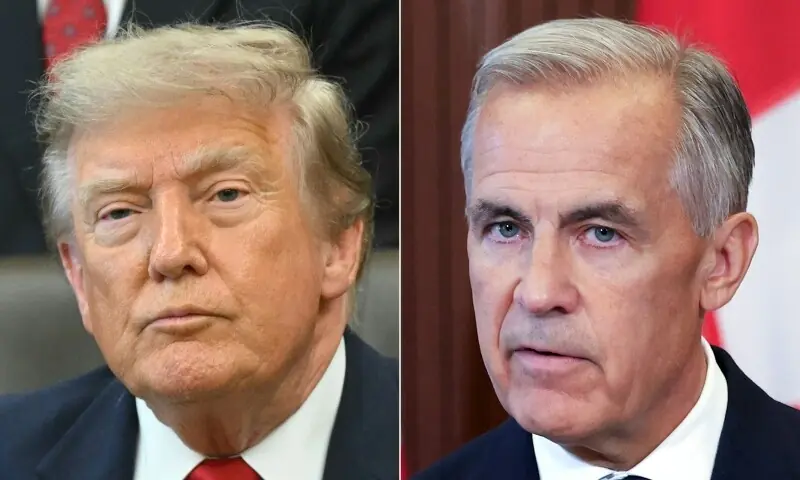
    WASHINGTON: US President Donald Trump has lashed out at Canada after Prime Minister Mark Carney announced retaliatory tariffs on American goods, deepening a trade dispute that threatens to further strain economic ties between the two neighbouring countries. Trump responded sharply on Sunday after Canada confirmed that new tariffs targeting US products would take effect on September 8. “Canada wants the benefits of being a state, without being one!!!” Trump said in a post on Truth Social, while also accusing Canada of imposing heavy tariffs on American farmers for years. The latest escalation follows the introduction of new US tariffs covering around $20 billion worth of Canadian goods. The measures, which took effect on Saturday, impose tariffs of up to 50 per cent and affect products ranging from hockey sticks and cement to other Canadian exports. Carney announced Canada’s response a day earlier, saying Ottawa would impose new tariffs particularly targeting American steel and dairy products. The Canadian prime minister described the situation in unusually forceful terms, saying the country had effectively been “attacked” and was responding accordingly. The confrontation follows the collapse of recent trade negotiations between Washington and Ottawa. Earlier discussions had appeared more constructive, with Trump saying he believed the United States could reach an agreement with Canada and pointing to his positive relationship with Carney. But Carney said the latest US demands had crossed a line. According to the Canadian leader, Washington proposed terms that were “uneconomic” and “unfair” while undermining the benefits Canada expected from a potential agreement. Ottawa ultimately rejected the proposal. US Trade Representative Jamieson Greer offered a different account of the negotiations. He told The New York Times that Washington had offered to reduce tariffs on Canadian steel, aluminium and automobiles while also removing a recently imposed tariff on Canadian lumber. Greer said the proposed measures would have provided Canada with exceptionally favourable treatment compared with other US trading partners. However, the offer failed to produce a breakthrough. Greer also told Fox News that Washington was preparing measures in response to Canada’s retaliation, signalling that the dispute could escalate further rather than return immediately to the negotiating table. A senior US official described the latest talks as candid but not acrimonious, suggesting that despite the increasingly hostile public statements, both sides had maintained communication during negotiations. The economic stakes are significant. The United States and Canada share one of the world’s largest trading relationships, with businesses and consumers on both sides relying heavily on cross-border commerce. The latest tariffs could therefore raise costs for companies, disrupt supply chains and put additional pressure on industries already facing uncertainty. With Canadian counter-tariffs scheduled to take effect in September, attention will now turn to whether Washington and Ottawa can find a compromise before the measures trigger a wider trade confrontation.

Leave a Reply

Your email address will not be published. Required fields are marked *