economic freedom begins

Economic freedom begins with constitutional govern…

The recently published PRIME Plus report, An Assessment of the FY2026–27 Federal Budget Through the Lens of Economic Freedom, deserves appreciation for shifting the debate beyond conventional budget arithmetic. Rather than asking merely whether taxes have increased or decreased, it examines whether the budget enlarges or restricts the freedom of individuals and businesses to produce, invest, trade and innovate. That alone makes it a valuable contribution to Pakistan’s policy discourse.

The report of Policy Research Institute of Market Economy (PRIME) correctly observes that Pakistan’s formal economy bears a disproportionate tax burden while much of the informal sector remains outside the effective tax net. It questions tax expenditures exceeding Rs 2.35 trillion, highlights the crowding out of private investment by government borrowing, welcomes tariff rationalisation and criticises regulatory uncertainty. These issues deserve much wider public attention.

PRIME’s analysis also points towards a deeper weakness in Pakistan’s reform discourse: we discuss economic freedom without first securing constitutional governance. The distinction is fundamental.

International indices commonly measure economic freedom through taxation, trade openness, government spending, financial markets and regulatory efficiency. These indicators matter. Lower barriers to enterprise can promote investment, innovation and competition. They answer only part of the question.

Why do countries with similar tax rates produce very different economic outcomes? Why do investors accept higher taxation in some jurisdictions while avoiding countries with lighter tax burdens? Why do some economies flourish with relatively large governments while others stagnate despite repeated concessions? The answer lies primarily in institutions.

James Buchanan argued that public finance cannot be analysed independently of the constitutional rules under which governments operate. Douglass North demonstrated that long-term development depends upon institutions that reduce uncertainty, enforce contracts and create predictable incentives.

Centuries earlier, Ibn Khaldun linked prosperity with justice, moderation in taxation and restraint upon arbitrary power. Excessive intervention, unpredictable fiscal demands and rent-seeking, he observed, ultimately weaken both economic activity and state revenues. These intellectual traditions converge on one central proposition: economic freedom is not created simply by lowering tax rates. It emerges from constitutional governance.

Pakistan’s experience illustrates this clearly. Successive governments have offered tax holidays, created special economic zones, reduced customs duties and announced investment facilitation mechanisms. Investment nevertheless remains subdued.

Investors do not merely compare tax rates; they compare legal systems. They ask whether contracts will be enforced within a reasonable time, whether regulations will survive political transitions, whether tax liabilities can be altered retrospectively and whether executive discretion outweighs parliamentary certainty. These are questions of constitutional governance rather than fiscal engineering.

The same principle applies to taxation. Pakistan’s problem is frequently described as one of high taxation. That diagnosis is incomplete. The deeper problem is unequal taxation.

The salaried class in formal sector is fully documented, its tax is deducted before income reaches employees, and its compliance burden continues to rise. Large segments of commerce, services and agriculture operate under very different fiscal realities. The issue is not merely how much tax is collected, but whether equal citizens are governed by equal fiscal rules.

A system built around withholding taxes, presumptive taxes, minimum taxes and sector-specific exemptions creates unequal citizenship before the law. It also encourages informality. Businesses do not remain undocumented only because rates are high. Formal participation imposes greater compliance costs while offering few institutional benefits. Documentation without trust becomes compulsion rather than reform.

The PRIME report also notes that government borrowing crowds out private investment because banks prefer sovereign lending over commercial risk. This is not simply a banking failure. When governments repeatedly finance deficits through domestic borrowing, banks act rationally by purchasing government securities. Financial markets are responding to distorted fiscal incentives created by public policy.

Interest payments and defence together consume nearly 94 percent of net federal revenue, leaving little fiscal space for education, healthcare, scientific research, digital infrastructure, justice administration and productive public investment. The challenge is not merely that government spends too much; it is that public priorities have become distorted.

Expenditure that strengthens courts, education, digital infrastructure, research, public health and efficient regulation expands future economic freedom because it reduces uncertainty and lowers transaction costs. Spending absorbed by debt servicing and institutional inefficiency does not. Constitutional Political Economy therefore distinguishes between the size of government and the quality of government.

Fiscal federalism is another neglected dimension. The Constitution (Eighteenth Amendment) Act, 2010 reshaped the distribution of fiscal powers. Provincial sales taxes, fragmented administrations and overlapping jurisdictions now influence business decisions daily. Economic freedom cannot be assessed through the federal budget alone. The constitutional structure governing taxation matters as much as the annual Finance Act itself.

Pakistan’s economic challenge is consequently larger than budget reform. Markets flourish where laws are predictable, taxation is neutral, contracts are enforceable, property rights are secure and governments remain subject to constitutional restraints. These conditions cannot be created through a single Finance Act. They require a durable commitment to constitutional governance.

The value of the PRIME report lies in encouraging this broader conversation. The next step is to recognise that economic freedom rests upon a stronger constitutional foundation. Where constitutional governance is weak, economic reforms remain temporary. Where it is strong, markets can generate prosperity without constant discretionary intervention.

Pakistan’s recurring fiscal crises are symptoms rather than the disease. The underlying ailment is institutional. Budgets can redistribute resources, but only constitutional governance can establish equality before law, predictable taxation, secure property rights and meaningful limits on arbitrary state power.

Economic freedom, therefore, is neither the starting point of development nor a concession to be distributed through annual Finance Acts. It is the outcome of a constitutional order in which taxation rests on representation, public borrowing is subject to accountability, contracts and property are protected, and executive power remains bounded by law.

In a rent-distributing state, freedom is rationed through exemptions, influence and discretion; in a constitutional state, it is secured for all through equal rules. Unless Pakistan reforms the institutions that determine who is taxed, how public money is spent, who bears the cost of debt and how state power is restrained, every budget will continue to rearrange the symptoms of crisis while leaving its causes untouched. The real measure of reform is not another incentive, levy or revenue target. It is whether the State itself is finally made answerable to the Constitution.

____________________________________________________________________

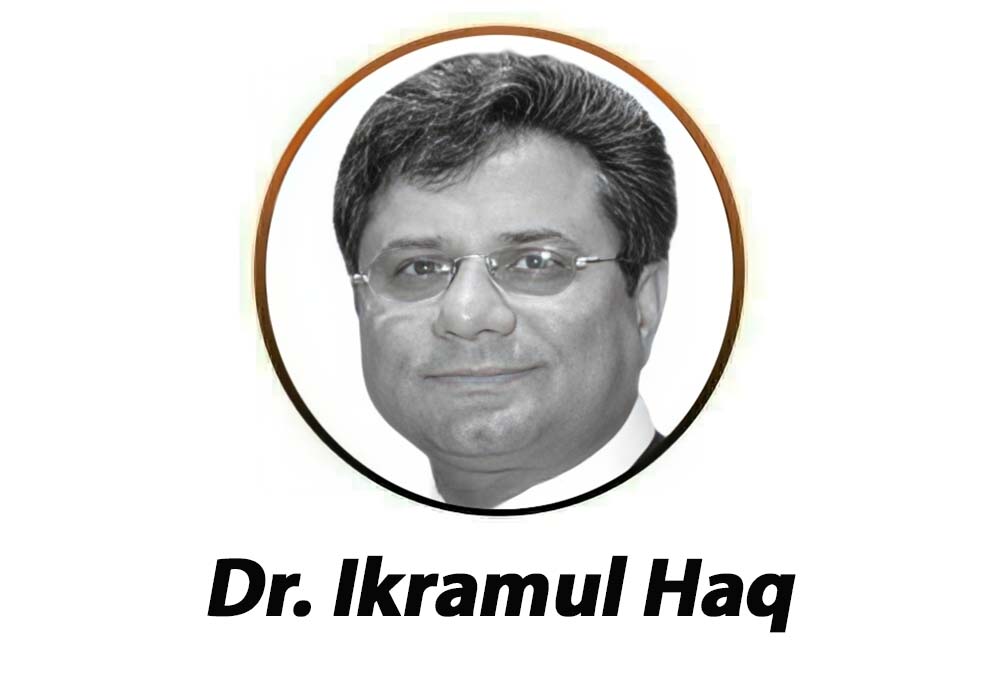
Dr. Ikramul Haq, Advocate Supreme Court, Adjunct Faculty at Lahore University of Management Sciences (LUMS), member Advisory Board and Visiting Senior Fellow of Pakistan Institute of Development Economics (PIDE), holds an LLD in tax laws. He was full-time journalist from 1979 to 1984 with Viewpoint and Dawn. He also served Civil Services of Pakistan from 1984 to 1996.

Similar Posts

  • Four provinces can no longer govern 240m people

    Regions with structural problems need structural fixes, not more funding formulas. Pakistan’s administrative map was drawn for a country that no longer exists. We have four provinces today, the same number we had 55 years ago, while East Pakistan, which used to be one province, now has eight administrative units and 64 subdivisions or districts. Since then Pakistan’s population has multiplied several times over, but the map has not moved an inch. That mismatch is the primary reason why resources never reach the people who need them. Pakistan’s approach when it comes to managing resources is wrong for a country this size. The population crossed 241 million in 2023, with density around 260 people per square kilometre. On its own, this is a sign of a healthy, growing country, just until we look at how that population is actually distributed. In the last six years alone, the country has added roughly 35 million people, which is a 16 percent increase. Sixty-one percent of that population lives in rural areas, 39 percent in cities like Islamabad, Lahore and Karachi. The alarmingly undeniable fact is that the trend keeps moving one direction, in which young people keep leaving villages for urban areas because those are the only places where jobs, universities and hospitals reliably exist. This migration is certainly not a lifestyle choice. This is bound to happen when four provincial governments are asked to administer a population that is five times larger than the one they were built for. Punjab alone holds 59 percent of the country’s population. It is administered as a single unit, but its population is more than most countries on earth. No provincial government, no matter however competent it is, can deliver electricity, healthcare and education evenly across a population that size from a single provincial capital. The same problem exists in reverse in Balochistan, which covers 48 percent of Pakistan’s landmass but accommodates only 11 to 12 percent of the population, and has absorbed six of the last six years’ 16 points of national population growth despite having the country’s thinnest infrastructure. These two provinces tell the story of two completely different failures. The cause, however, is common: the administrative unit is the wrong size for the job. The numbers underneath this are national rather than regional. Eighty-two percent of Pakistanis have electricity, but that average hides the gap between urban grids and rural darkness; hence urbanisation. The list of problems does not stop here. Take Balochistan, where one doctor serves 10,000 to 10,500 people. Sixty percent of the province lacks clean water, and filtration plants are scarcer still. Moreover, 70 percent of rural communities nationwide lack adequate education, and 44 to 45 percent of people in those communities never reach middle school. The human cost of that distance is specific and repeats itself in province after province. Young doctors trained in these regions leave for Punjab, Sindh and Islamabad. The biggest reason is safety, since their lives can be at risk in remote postings. The second is that a health facility 30 kilometres from the nearest paved road, unable to stock full equipment, offers nothing to build a career on. Vocational training institutes exist in these areas but sit locked, not for lack of funding but because there is no administrative capacity to operate them. These are not Balochistan’s problems alone. They can happen anywhere a provincial government is too large, too centralised, or too distant to reach its own population. Balochistan simply shows the extreme case. If it were split into three or four provinces, governments could actually reach people there. Then there is this issue of financial distribution, and this is where the case for new provinces stops being administrative and becomes constitutional. Pakistan’s own constitution ties resource revenue to the province that produces it. Sindh generates around 70 percent of national revenue and receives back only 24 to 25 percent. Similarly, Balochistan sits on gas fields and mineral wealth that fund the federation, while its own communities remain unconnected to piped gas or reliable power. Calling this a technical funding gap would be wrong because the problem is structural. Provinces too large to manage internally are also too large to track what they are owed, let alone claim it. Regions with structural problems need structural fixes, which again brings us to the dire need for carving out more provinces instead of introducing more funding formulas layered onto the same four units. How many provinces should there be is debatable. There are four now, and making that six or eight is better than staying at four. That would certainly put administration close enough to reach a village 30 kilometres off the highway, and close enough that Punjab’s 59 percent isn’t governed as a single bloc or Balochistan’s 48 percent of the map isn’t governed as an afterthought. Balochistan’s neglect, Punjab’s congestion, Sindh’s revenue grievance, the pressure on Karachi and Lahore are not four different crises but one. And this crisis will not be solved by anyone currently governing under the old map.

  • Netanyahu’s Dependence on Hamas

    The word “terrorism” was not used for the same purposes in the 1970s for what it is used today. Back in those days the word terrorism was often related to insurgencies that were driven by concrete grievances rather than being a form of immoral intentions. The main entertainer driving the word “terrorism” to a whole new evil definition was none other than Benjamin Netanyahu- a man born in Isreal and raised in the United States of America, son of a Hebrew teacher.   This was the beginning of the international propaganda that would take place for decades to come and permanently shift the image of millions of muslims worldwide- a stamp of “terrorists” being posted on them. Benjamin Netanyahu was well aware of how the rising media worked, going on numerous podcasts, interviews and convincing people watching him from all continents on how the Palestinians deserved no state. He was the bridge between Zionists in Israel and English speaking jews in America for he was raised as an English speaker and knew how to convince otherwise. His biggest breakout was his brother Johnathan being the only one killed in war, and allowing him to use his blood and name to open non profits and involve himself in politics.    If you have been chronically online for the past few years you must have come across statements like “self defense against Hamas”, and may have wondered what on earth did Hamas do that resulted in the death of millions of children and women alike? For starters,Hamas is a Palestinian Sunni Islamist political and militant organization that has governed the Gaza Strip. However, it has grown into something much deeper.    A video surfaced of Benjamin Netanyahu having a conversation and indicating how keeping Hamas in power allows them to “justify” their attacks on Palestine, as far as admitting how crucial it is to have a body to blame and continue with his war crimes. “Benjamin Netanyahu is a war criminal” said Zohran Mamdani the mayor of New York in his recent instagram post. This much the whole world agrees on. The horrors committed in Palestine are often compared to the Nazi regime and even the war crimes of Genghis Khan.    However, recently his attacks on Lebanon have made him unpopular among his allies sitting in the white house as well as most of the European nations who already were past enduring him. Apart from the global allies, his seat at his own parliament is losing its grip as more and more corruption cases involving him are piling up. It is expected that he will end up in jail or exile. Can he use his motives with Hamas and create more blinding propaganda to rest his case- that much we do not know. What we do know is that both the right wings and left wings are tolerating the same old Hamas self defense story.   It feels really ironic how according to Netanyahu all the Hamas headquarters are hidden under schools and hospitals which makes it crucial to bomb them, not as much ironic how they pass on flyers indicating citizens in Palestine to leave their homes hence they survive the upcoming bombings. No matter how hard the narrative is pushed that it is a war, and no matter how much the defination of “genocide” is discussed, it is evident that this is a brutality being committed in the twenty first century where every narrative can be clearly seen and every horrific crime witnessed.   In every Palestinian and Lebanese house is sitting an Anne Frank whose story will never come out since everything is burned and any aid coming is met with closed borders and brutal IDF opposition. No matter how much funding they spend on anti palestinian propaganda or call the saving of children in gaza as being “anti semitic”- it is known that this is no “war”.  

  • The Perfect Human: Prophetic Biography and the Sci…

    The boundless and dynamic history of Seerah—the prophetic biography—bears witness to how every era’s intellectual currents, scholarly demands, and civilizational pressures have played a pivotal role in shaping the style of this sacred literary genre. In the earliest biographical periods, the primary objective was the preservation of prophetic traces and historical continuity, which later evolved during the medieval age into polemical, defensive, and theological debates. Up until the mid-twentieth century, the major goal of Seerah writing remained a reasoned defense against Western Orientalist objections alongside historical verification. However, in this fast-paced, technology-driven, and metaphysics-averse scientific age of the twenty-first century—where the prevailing trend is to test every narrative against data, logic, and objective criteria—there has been an intense, growing need to present the Seerah of the Prophet (PBUH) with an intellectual cadence that steps outside traditional rhetoric to directly appeal to the modern scientific mind and international academic paradigms. To bridge this intellectual gap, Dr. Ashfaq Ahmed—a distinguished professor of computer science and engineering at the University of Texas at Arlington and director of the Center for Advanced Computing Systems—authored a valuable English work titled The Perfect Human, Muhammad (PBUH). To bring this book into the broader Urdu sphere and facilitate access for intellectual and academic circles, Saqlain Shaukat translated it into Urdu under the title Bashar-e-Kamil: Muhammad ﷺ, an endeavor that undeniably holds a prominent and esteemed place in our intellectual world. The most distinctive quality of this book is that its author is not a traditional graduate of a religious seminary or a conventional orator, but rather a scientist accustomed to weighing every phenomenon through algorithmic precision, systematic models, and multi-level bibliographies. The undertaking of Seerah by a computer science professor with such meticulousness—weaving historical events into a fact-based narrative—bestows upon the account a rare academic and objective validity. Abandoning traditional emotional hyperbole, the author adopts a methodology of historical and documentary evidence that convinces the reader the life of the Prophet (PBUH) is not merely a scattered collection of emotional episodes, but rather the most authentic and actionable code for human evolution and global civilizational formation. The first part of the book comprises fifty-three detailed chapters, presenting a continuous historical narrative of the Prophet’s (PBUH) life. The true uniqueness of this section lies in how the author intertwines nearly fifteen hundred Quranic verses and authentic references from other heavenly scriptures into the text with such skill that the Quran itself becomes the speaker of the Seerah. In particular, the critical analysis applied to the Constitution of Medina (Mithaq-e-Madinah), the documentary treaties of the Medinan state, and other political and social conditions offers rich intellectual nourishment for students of international law, modern political science, and sociology. The second part of this scholarly masterpiece represents an entirely novel and unique chapter in the history of Seerah writing. This section encompasses comprehensive research statements based on one hundred distinct human attributes extracted from the individual, collective, and moral life of the Prophet (PBUH). Each attribute is connected to the historical and Quranic evidence of the first part in such a way that it ceases to be mere verbal advice and instead becomes a living, dynamic model of action. For today’s globalized world—which suffers from materialism, moral decline, and severe intellectual chaos—these one hundred attributes serve as a Magna Carta fully capable of restoring the fractured equilibrium of modern man. The most significant aspect distinguishing this work from traditional Seerah books is its systematic model and algorithmic framework. As an engineering professor, Dr. Ashfaq Ahmed has transitioned the study of Islamic history and the Seerah away from traditional narrative and into a structured system and source code. The one hundred attributes listed at the end of the book are essentially a reverse engineering of the Seerah, providing modern humanity, the corporate world, and academic institutions with a moral source code that any organization in the world can implement to achieve professional success—provided it is applied independently of its colonial and unjust frameworks. Furthermore, the balanced academic perspective that Dr. Ashfaq Ahmed establishes to foster interfaith harmony and intellectual tolerance acts as a robust intellectual bridge for the new generation living in the West and for non-Muslim academies. However, when this book is examined critically through the lens of objective, deep Islamic thought and history, certain fundamental contradictions become apparent in its methodology and narrative, limiting its universal utility to a degree. It is most important to clarify here that Islam is by no means opposed to science or objective research. Throughout Islamic history, illustrious Muslim scientists such as Ibn al-Haytham, al-Khwarizmi, and al-Biruni enlightened humanity precisely by integrating faith with scientific reasoning. Therefore, Dr. Ashfaq Ahmed’s methodology is not an inherent intellectual deviation; rather, its true tragedy lies in the fact that, in its scramble to satisfy the modern scientific mind, it sidelines Islam’s divine and metaphysical essence. The understanding of the prophetic Seerah in Islam is not merely a dry collection of historical events, political treaties, or social algorithms. It is built upon a spiritual equilibrium of divine revelation from heavenly sources, miracles that transcend intellect, and a profound love for the Divine—elements that cannot be entirely imprisoned within the mold of computer science source codes. When an author begins to present the Seerah as a corporate model, they inadvertently weaken the metaphysical beauty of the religion, which offers humanity deep spiritual fulfillment alongside intellectual satisfaction. The second critical observation regarding this assessment is that, in attempting to satisfy the modern scientific mind, the author occasionally reduces historical events to material causes, effectively rendering the original element of miraculous and divine succor either entirely absent or marginalized. An authentic Muslim intellectual perspective maintains that while the material causes of Islamic history hold their proper place, the operational force behind them is divine will and unseen support—the fundamental catalyst without which the entire narrative of the Seerah feels incomplete and lifeless. The book’s assertion that the Magna Carta of the Prophet’s (PBUH) attributes serves as a source code for the

  • Beyond Public Finance: Towards  Constitutional Po…

    Pakistan has never lacked economic advice. Since independence, successive governments have experimented with socialist planning, import substitution, nationalisation, structural adjustment, privatization, fiscal decentralisation, value added taxation, documentation drives, digital governance and, most recently, artificial intelligence in tax administration.  Almost every reform has been presented as the missing ingredient that would place the country on the path of sustained prosperity. However, Pakistan continues to oscillate between balance-of-payments crises, external dependence, fiscal instability and repeated recourse to the International Monetary Fund (IMF). This persistent failure raises a more fundamental question. Is Pakistan’s crisis primarily economic, or are economists asking the wrong questions? For decades, the dominant explanation has remained remarkably consistent. Pakistan is said to suffer from a narrow tax base, inadequate domestic resource mobilisation, weak public institutions, poor governance and inconsistent implementation of otherwise sound policies. According to this view, if taxes were broadened, exemptions withdrawn, administration digitalised and markets allowed to function efficiently, sustainable growth would eventually follow. There is much truth in these observations. They identify many of the symptoms. But they do not fully explain why technically sound reforms repeatedly fail in Pakistan while producing very different outcomes elsewhere. The reason, as suggested in earlier writings, is that Pakistan cannot be understood through the conventional assumptions of public finance alone. Economic policy does not operate in a constitutional vacuum; it reflects the incentives created by the political and legal institutions within which governments function. Orthodox economics generally assumes a constitutional order within which governments seek, however imperfectly, to maximise public welfare. Fiscal policy, taxation and expenditure are analysed as instruments for correcting market failures, financing public goods and promoting economic growth. Political constraints are acknowledged but usually treated as external distortions rather than integral components of economic analysis. Pakistan presents a different reality. Here, constitutional arrangements, political incentives, strategic considerations and informal institutions have shaped fiscal outcomes as much as, and often more than, economic policy itself. Taxation has frequently reflected the distribution of political power rather than principles of efficiency or equity.  Public expenditure has often been determined by strategic imperatives rather than developmental priorities. External assistance has repeatedly substituted for difficult domestic reforms. Elite bargains have preserved privilege while transferring the burden of adjustment to documented businesses, salaried individuals and ordinary consumers. These outcomes cannot be adequately explained by models that assume an impartial state pursuing coherent economic objectives. The analytical framework itself, therefore, requires reconsideration. This series proceeds from a simple but powerful proposition: before analysing taxes, budgets or debt, one must first understand the constitutional rules that shape political incentives. This is the central insight of Constitutional Political Economy (CPE).  Unlike conventional public finance, CPE begins not with taxes or budgets but with the constitutional rules, institutional incentives and political structures that determine how economic decisions are actually made. It asks a prior question: Who designs the rules under which economic policy operates, whose interests do those rules serve, and how do they shape incentives for both governments and citizens? Once that question is asked, many of Pakistan’s recurring puzzles begin to appear less mysterious. Why do technically sound tax reforms repeatedly fail? Why do successive governments rely on indirect taxation while avoiding politically influential sectors? Why has documentation remained elusive despite extraordinary advances in digital technology? Why does every external crisis quickly become a fiscal crisis? Why has debt expanded despite repeated stabilisation programmes? The answers lie not merely in economics but in the constitutional and political environment within which economics operates. This series proposes a different approach. Rather than examining taxation, debt or fiscal federalism as isolated subjects, it will analyse them as interconnected manifestations of Pakistan’s constitutional political economy. Future parts will explore how colonial legacies, post-independence constitutional choices, geopolitical dependency, elite capture, federal arrangements, judicial interpretation and administrative incentives have combined to shape Pakistan’s economic trajectory. The purpose is not to reject orthodox economics. Public finance remains indispensable. Sound taxation, efficient expenditure and macroeconomic stability are essential for any modern state. However, these instruments cannot achieve their intended objectives when the institutional environment within which they operate generates incentives that systematically frustrate reform. Pakistan’s crisis is not simply a fiscal crisis. Nor is it merely a crisis of governance. It is, more fundamentally, a crisis of constitutional political economy. Unless that deeper reality is understood, technical reforms, however well designed, will continue to produce disappointing results because they address the symptoms rather than the constitutional incentives that generate them. In the next part, we shall examine why the assumptions of orthodox public finance differ fundamentally from those of constitutional political economy, and why that distinction matters profoundly for understanding Pakistan. [To be continued]  ____________________________________________________________________ Dr. Ikramul Haq, Advocate Supreme Court, Adjunct Faculty at Lahore University of Management Sciences (LUMS), member Advisory Board and Visiting Senior Fellow of Pakistan Institute of Development Economics (PIDE), holds an LLD in tax laws. He was full-time journalist from 1979 to 1984 with Viewpoint and Dawn. He also served Civil Services of Pakistan from 1984 to 1996. 

  • Nine Days and Five Months: Open-Source Evidence, t…

    By Aleena Saif Ullah The writer is an MPhil Scholar in International Relations, specializing in global defence and security, University of the Punjab, Lahore. On February 28, the first day of Operation Epic Fury, a strike hit the Shajareh Tayyebeh girls’ elementary school in Minab, in Iran’s Hormozgan province. Iranian state media reported that 168 children and 14 adults were killed. Anadolu reported two strikes roughly forty minutes apart. President Trump said on March 7 that in his opinion Iran had done it, citing Iranian inaccuracy with munitions. Bellingcat had already established otherwise. Its researchers identified a Tomahawk cruise missile — a munition no other belligerent in the conflict fields — in footage released by Iran’s Mehr agency, and geolocated the strike sequence. The New York Times, the Associated Press and CNN reached compatible conclusions through independent satellite and video analysis. By March 11, NPR reported that a preliminary Pentagon assessment had determined the United States was at fault. Five months later, the accountability failure is not the one I described when I first wrote about this case, and the actual failure is more instructive. A process was initiated. On March 13, Secretary Hegseth announced a formal command investigation, with CENTCOM appointing a senior officer from outside the command to lead it — the correct procedural choice. Lawmakers have said that officer submitted an initial report in April. CENTCOM has held it since. On May 19, Admiral Brad Cooper told lawmakers under oath that the investigation was complex, near completion, and that “I’m fully committed to transparency” once it concluded. No findings have been published. Then in July, CNN reported the detail that reframes the case. Within a week of the strike, the first two stages of the battle damage assessment were complete, establishing that American forces had hit the location. The third stage — the standard review in which Defense Intelligence Agency analysts examine the full body of satellite imagery and intelligence to determine holistically what occurred — had not been ordered as of early July. One source familiar with the matter told CNN there had been no detailed analysis and that CENTCOM had locked down the investigation. NBC reported that preliminary findings pointed to outdated intelligence as the likely cause. This is a different kind of institutional failure from the one international lawyers usually describe, and it is worse. An absent process can be demanded. A process that ran, produced a document, and stopped is much harder to move, because officials can accurately say an investigation took place. The context makes it harder still. On May 13 the Pentagon’s own Inspector General found that the Department had systematically failed to implement its Civilian Harm Mitigation and Response Action Plan, with all eleven objectives reclassified as at risk and the legally mandated Civilian Protection Center of Excellence lacking key staff and leadership. The architecture built specifically to prevent and account for incidents like Minab had been allowed to decay before the war that tested it. Congress has asked the right questions and been ignored. A letter led by Senator Chris Van Hollen and signed by more than forty senators asked Secretary Hegseth directly whether American forces conducted the strikes, what the intended target was, whether AI tools were used in targeting, and whether a no-strike list was established before operations began. Answers were requested by March 18. More than 150 House members signed a parallel letter on the broader civilian toll. The comparison the Pentagon itself invites is unflattering. As NBC noted, the Department has publicly disclosed its role in comparable incidents before: a special forces raid in Yemen, a bombing in Iraq that killed more than a hundred civilians, the strike on an Afghan hospital that killed at least forty-two, a drone attack in Afghanistan that killed ten. Disclosure in those cases was not generous, but it happened. What Minab demonstrates is that the binding constraint on accountability is not evidence. Volunteer open-source investigators, working entirely from public material, established the essential facts within nine days. The state that conducted the strike established them internally within seven. The constraint is that no mechanism exists to compel publication of a report a government has decided not to publish — not the Rome Statute, to which the United States is not a party; not the Security Council, where it holds a veto; and not the Inspector General, who can find institutional failure but cannot release another command’s findings. One lever remains, and it is domestic rather than international. Congress can require declassified release of the findings through the National Defense Authorization Act. Whether it does will indicate more about the state of accountability for civilian harm than any further open-source analysis. The evidence is not missing. The report is not missing. Both exist. Neither can be read.    

  • Empty Classrooms, Digital Classrooms: Reimagining …

    By Engineer Arshad Hameed Abbasi, International Energy, Climate Change and Water Security Practitioner and Engineer Idrees Abbasi, Former Consultant, World Bank,  and Mr. Amjad Butt, Writer; Secretary General, Murree Literary Council, resident of [address].    There is a particular kind of grief in watching an institution outlive its usefulness while still drawing a salary, still cutting ribbons, still issuing degrees that mean less each year they are printed. That is where Pakistan’s higher education system stands today, and it is time someone said so plainly: the paradigm has already shifted, quietly, without anyone in Islamabad’s marble offices noticing. It shifted on YouTube, on TED, on edX and Udemy and Khan Academy, in a thousand free lecture halls that never asked a single Pakistani student for tuition, a hostel fee, or four years of their life. The only people who have not caught up are the ones still running the old one. There is a particular kind of grief in watching an institution outlive its usefulness while still drawing a salary, still cutting ribbons, still issuing degrees that mean less each year they are printed. That is where Pakistan’s higher education system stands today, and it is time someone said so plainly: the paradigm has already shifted, quietly, without anyone in Islamabad’s marble offices noticing. It shifted on YouTube, on TED, on edX and Udemy and Khan Academy, in a thousand free lecture halls that never asked a single Pakistani student for tuition, a hostel fee, or four years of their life. The only people who have not caught up are the ones still running the old one. For decades, the deal offered to a Pakistani student was simple: surrender your time, your family’s savings, and your twenties to a physical campus, and in exchange receive knowledge you could not get anywhere else. That deal is dead. A seventeen-year-old with a smartphone and a working internet connection can now watch a Nobel laureate explain quantum mechanics, follow a structural engineer walk through a seismic design calculation line by line, or sit in on a Stanford lecture on macroeconomics — all free, all on demand, all taught by people who are, in most cases, simply better at their subject than the men and women drawing a professor’s salary in the classroom down the road. The tragedy is not that this content exists. The tragedy is that almost no one in a position of authority ever told the students it was there. For decades, the deal offered to a Pakistani student was simple: surrender your time, your family’s savings, and your twenties to a physical campus, and in exchange receive knowledge you could not get anywhere else. That deal is dead. A seventeen-year-old with a smartphone and a working internet connection can now watch a Nobel laureate explain quantum mechanics, follow a structural engineer walk through a seismic design calculation line by line, or sit in on a Stanford lecture on macroeconomics — all free, all on demand, all taught by people who are, in most cases, simply better at their subject than the men and women drawing a professor’s salary in the classroom down the road. The tragedy is not that this content exists. The tragedy is that almost no one in a position of authority ever told the students it was there. Ask yourself honestly: when was the last time a Vice Chancellor stood in front of a first-year class and said, “Before you trust anything I teach you, go watch the version of this lecture that MIT put online for free, and come back and tell me if I taught it better”? It has not happened, and it will not happen, because the entire architecture of Pakistani higher education depends on students not asking that question. It depends on the fiction that a degree is the same thing as an education, that a seat in a lecture hall for four years is the same thing as understanding, and that an institution’s worth can be measured in acres of campus rather than in what a graduate can actually do when the exam is over and the job begins.Ask yourself honestly: when was the last time a Vice Chancellor stood in front of a first-year class and said, “Before you trust anything I teach you, go watch the version of this lecture that MIT put online for free, and come back and tell me if I taught it better”? It has not happened, and it will not happen, because the entire architecture of Pakistani higher education depends on students not asking that question. It depends on the fiction that a degree is the same thing as an education, that a seat in a lecture hall for four years is the same thing as understanding, and that an institution’s worth can be measured in acres of campus rather than in what a graduate can actually do when the exam is over and the job begins. We do not need to guess what an alternative looks like, because the world has already built it. Universities that were once measured by the size of their footprint are now measured by the depth of their content and the reach of their delivery. Institutions like the National University of Singapore have shown that a compact, space-efficient campus married to serious digital delivery outperforms sprawling, underused infrastructure every time. Meanwhile, in Pakistan, students still find themselves inside partially built mega-campuses, sitting in half-used lecture halls, being taught by professors whose most recent research contribution was a maintenance grant, while the actual global classroom — free, current, taught by the best minds alive — sits one browser tab away, untouched, unmentioned, unrecommended by the very people whose job it was to point students toward it.We do not need to guess what an alternative looks like, because the world has already built it. Universities that were once measured by the size of their footprint are now measured by the depth of their content and the reach of their delivery.

Leave a Reply

Your email address will not be published. Required fields are marked *