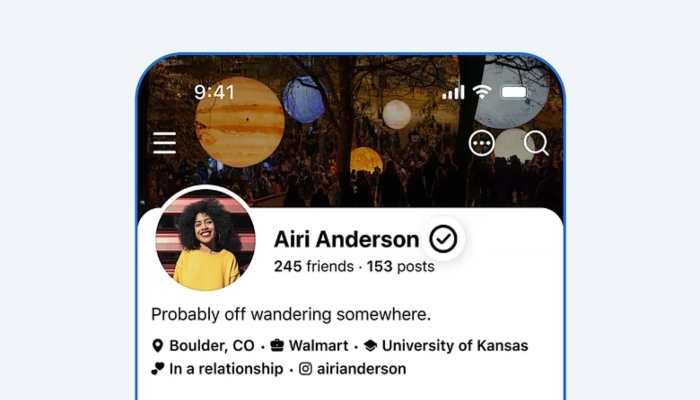
facebook introduces free

Facebook introduces free verified badge with selfie verification

Meta announced in February 2023 that Facebook and Instagram users could obtain a verified account (blue checkmark) by paying a monthly subscription fee. Since then, users around the world have been able to subscribe to receive the blue verification badge.

However, Meta has now introduced a new way for users to receive a free verification badge on their Facebook profiles, making the process much more accessible. The company has launched a new Facebook Verified program that uses a selfie-based facial recognition check along with a review of the user’s current profile photos.

According to Meta, the entire verification process takes only a few minutes to complete. The program is available only to users who are 18 years of age or older. Once a user successfully passes the selfie verification, a verified badge will appear next to their profile name across various Facebook services.

Unlike the paid blue checkmark, this free badge simply confirms that the profile belongs to a real person. It does not certify the person’s credibility or trustworthiness. The best part is that this verification badge is available free of charge.

Similar Posts

  • Google hits record search traffic during FIFA World Cup match

    Google, the world’s most popular internet search engine processes more than 99,000 searches every second and nearly 9 billion searches every day. However, during a match at the 2026 FIFA World Cup, Google experienced the highest search traffic in its history. According to the company, the Round of 16 match between Argentina and Egypt set a new record for internet search activity. Nick Fox, Head of Google’s Knowledge and Information division said that on July 7 (July 8 in Pakistan Standard Time), search traffic reached its highest level in the company’s 28-year history immediately after Argentina scored the decisive goal. Although Google did not disclose the exact figures, a company spokesperson said that the winning goal triggered a record number of searches per second. The spokesperson added that, at that moment, it seemed as though the entire world was searching for the same thing online. The 2026 FIFA World Cup concluded with Spain defeating defending champions Argentina 1-0 in the final securing the country’s second World Cup title and its first in 16 years.

  • |

    7 easy tricks to boost internet speed on Android phones

    We all experience this: trying to load a webpage, stream a video or open an app on our Android phones. However, sometimes the internet becomes so slow that it feels like it is crawling. Slow internet on a phone affects downloads and uploads, websites take longer to open and videos may remain stuck instead of playing smoothly. Fortunately, Android phones offer several tools and tricks that can help improve internet speed. Clear background apps Apps running in the background use data, processing power and internet connectivity. Clearing or disabling unnecessary background apps can prevent them from affecting internet speed. For this purpose, go to Settings and disable unnecessary apps running in the background. Clear cache for faster internet When you use apps or visit websites on an Android phone, the device stores some data known as cache. These files are designed to help apps and websites run more efficiently and can be useful in the short term. However, when too many cache files accumulate, they may affect performance and internet speed. Therefore, clearing an app’s cache can help improve the device’s performance. To do this, go to Settings, select Apps, open the relevant app’s information page then select Storage and tap Clear Cache. Update operating system and apps Outdated operating systems and apps can affect performance and internet speed. Keeping your software and apps updated can help maintain better speed while also improving the overall performance of your phone. Use fast browser A web browser can directly affect your browsing experience and internet performance. Browsers such as Google Chrome and Firefox are regularly updated and their performance is continuously improved. Adjust Airplane Mode Airplane Mode on smartphones is primarily designed to disable radio-frequency signal transmission. When Airplane Mode is turned on, Wi-Fi, Bluetooth and cellular signals are switched off, stopping wireless communication. However, this feature can also be used to refresh your internet connection. Smartphones connect to nearby mobile towers for cellular signals. When you move around throughout the day, your phone may not always connect to the best available tower. Resetting the connection through Airplane Mode may help improve internet speed. Simply turn Airplane Mode on and wait for a short while before turning it off again. This may allow your Android phone to reconnect to a better mobile tower and improve internet speed. Restart your phone or router Restarting devices can also improve their performance. Restarting your smartphone or router may clear temporary errors and can sometimes help improve internet speed. Move closer to router Distance is important when using a Wi-Fi connection. If possible, move closer to your router. This can improve the signal strength and may result in a faster and more stable internet connection.

  • WhatsApp tests button to make searching old messages easier

    Finding old messages on WhatsApp can often feel like a difficult task. However, WhatsApp appears to be working on a solution to this common problem in the form of a new button. According to a report by WABetaInfo, the new button will take users directly to search mode without requiring them to leave the chat. The new feature has been spotted in a new beta version of WhatsApp for iPhone. How will it work? Currently, finding an old message in WhatsApp chats on iPhones requires several steps. Users have to open an individual or group chat, tap the name at the top to open the Chat Info screen and then tap the search button which takes them back to the chat in search mode. Although the feature works, the process may not be convenient for everyone. That is why WhatsApp is reportedly introducing a new feature that will place a search button directly within the chat screen. The button will not remain visible all the time. Instead, it will appear when users scroll upward through older messages. Although this may seem like a minor change, it could make searching for old messages much easier and save users considerable effort. As the feature has so far only been spotted in a beta version, it is difficult to say when WhatsApp will officially make it available to all users.

  • NCA and PUCAD unite in ‘Ra’naai-e-Khayal-o-Khat’

    LAHORE — On the afternoon of August 14, 2026, Lahore’s main cultural pivot along The Mall became a two-part gallery circuit. It’s because two of Pakistan’s most valued art institutions: the National College of Arts (NCA) and the College of Art & Design, University of the Punjab (PUCAD) opened their doors to a historic joint exhibition titled Ra’naai-e-Khayal-o-Khat (The Beauty of Thought and Line). The inauguration began at 3:30 PM by Chief Guest Prof. Dr. Niaz Ahmad Akhtar, Chairman of the Higher Education Commission (HEC). The collaborative display marks a rare institutional symbiosis arranged under the leadership of Vice Chancellor NCA Prof. Dr. Murtaza Jafri, Vice Chancellor Punjab University Prof. Dr. Muhammad Ali and Principal CAD PU Prof. Dr. Samina Nasim. This exhibition took place across two physical sites. Part 1 is hosted at PUCAD’s Allama Iqbal Campus and Part 2 is taking over the galleries of NCA. The exhibition which runs through September 3, 2026 forces observers into an active pedestrian dialogue between both historic campuses. The atmosphere felt energetic with a distinct focus on tactile exploration, material experimentation and personal commentary while walking through the gallery spaces. It’s far from a conventional student thesis. The works on display demonstrate a meticulous engagement with raw textures, physical mediums and thematic intensity. One of the most captivating pieces in the gallery space is Silent Voice (2026) by Syedah Adeela Ijaz Naqvi. This piece neatly sits on the white wall with a modest print label: the 2” x 3” work entirely relying on hair on canvas. The tactile quality of the piece is intuitive. There are fine strands of human hair intricately arranged to compose two emotive faces. One of the faces is posing a silent scream and the other is gazing outward with quiet resignation. The physical texture of the woven fiber creates a three-dimensional depth. The artwork captures abstract emotional distress in the immediate reality of human bodily material. Nearby, Zaheer Chaudhry’s Shadow Has No Choice (2022) offers an abrupt photographic counterpoint. The large-format 36” x 25” black-and-white print captures the web-like shadow of tree branches cast against a weathered wall. Chaudhry’s deliberate work turns simple light exposure into a study of urban architecture, restraint and organic silhouette. This artwork emphasizes on physical grain of the surfaces upon which shadows fall. The exhibition moves fluidly between interiority and observational realism. In an extraordinary mixed-media work, an artist utilizes actual transparent MRI and CT scan films as a physical substrate. The cross-sectional images of the human spine and skull form the internal structure of a curled human figure. The scan is overlaid with swirling patterns reminiscent of cellular forms or neural pathways. The artwork physically merges medical technology with existential vulnerability. In contrast to these monochromatic psychological investigations stands a large botanical painting depicting green parakeets clustered within a canopy of lychee trees. The piece revels in the lush sheen of ripening fruit and light filtering through leaves. The painting is executed with meticulous brushwork. It celebrates regional flora and fauna with precision. Elsewhere, a surrealist monochrome composition presents a reclining figure intertwined with reptilian and avian wildlife. There’s a frog resting on patterned cloth while a bird hovers close to an open beak-like mouth. This piece of art blurs the line between human anatomy and raw natural ecology. The exhibition’s opening on Independence Day preserved national identity and historical homage. The central hall sculpted spaces render tributes to Quaid-e-Azam Muhammad Ali Jinnah. A heavily dark bronze bust of Jinnah presents prominently before the official insignias of Punjab University and NCA. Its rough tactile surface catches the ambient overhead lighting. Nearby, a tonal portrait executed in high-contrast graphite and airbrush tones captures Jinnah’s likeness in quiet contemplation.   Ra’naai-e-Khayal-o-Khat sets a significant precedent for academic art institutions in Pakistan by uniting NCA and PUCAD. The two institutions have created a unified platform that foregrounds artistic integrity and field research. The exhibition will remain open to the public at both venues until September 3, 2026.

  • Google lets users remove Gemini AI image watermarks

    Google’s Nano Banana image generator is considered a powerful artificial intelligence (AI) model for creating images based on users ideas and prompts. However, many people do not like using it because images generated by Nano Banana contain a prominent watermark in the bottom-right corner. Images generated by ChatGPT’s latest model do not contain such a visible watermark. Google is now giving users the option to remove the visible watermark. For this purpose, a new setting is being added to Gemini and Flow and the option will also be available in the AI Mode of Google Search. Using this setting, users will be able to remove the watermark from images generated by Nano Banana. In fact, the feature will not be limited to images. Users will also be able to remove visible watermarks from videos generated by Gemini Omni. However, this setting will not be available to users in countries where laws require the presence of visible watermarks. According to Google, while the visible watermark can be removed, an invisible watermark embedded within the image or video will remain intact.

  • YouTube launches thumbnail editing tool for Shorts

    YouTube has introduced a new feature that users have been requesting for a long time. The platform has launched new tools that make it easier for creators to edit and customize the thumbnails of their videos. However, the feature is currently available only to users who are part of the YouTube Partner Program those who earn money from their videos. Eligible creators can now upload custom thumbnail images for their YouTube Shorts. This will allow their short videos to attract more viewers by displaying more eye-catching thumbnails. Creators will also be able to change the thumbnails of their previously uploaded Shorts by using YouTube Studio on a desktop or laptop computer. According to YouTube, the feature will be expanded to more users in the near future. On desktop, creators will be able to choose one of three suggested video frames as the thumbnail. This option has long been available for regular videos and is now being extended to Shorts. On the mobile app, users will continue to be able to select any frame from the video as the thumbnail. YouTube also said that the suggested thumbnails will be generated based on the video’s theme and overall style.

Leave a Reply

Your email address will not be published. Required fields are marked *