shehbaz kuwaiti discuss
| | |

PM Shehbaz, Kuwaiti FM discuss regional peace, bil…

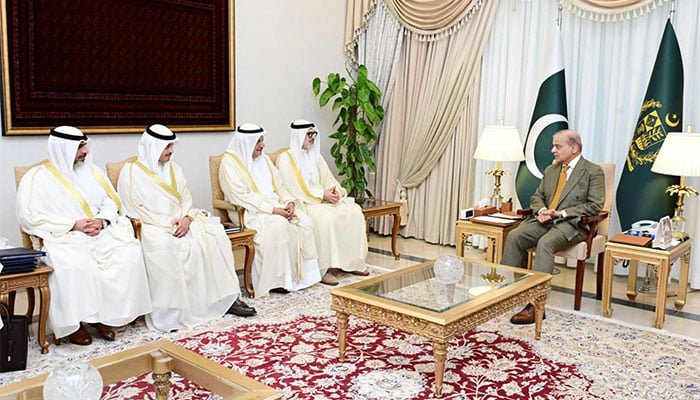
Prime Minister Shehbaz Sharif met Kuwaiti Foreign Minister Sheikh Jarrah Jaber Al-Ahmad Al-Sabah in Islamabad on Wednesday. The meeting focused on Pakistan-Kuwait relations, regional developments and ways to expand cooperation between the two countries.

Deputy Prime Minister and Foreign Minister Ishaq Dar also attended the meeting. Federal ministers for defence, commerce, national food security, communications, maritime affairs and petroleum were present. Advisers to the prime minister also joined the discussions.

Prime Minister Shehbaz conveyed his best wishes to Kuwaiti Emir Sheikh Meshal Al-Ahmad Al-Jaber Al-Sabah and Crown Prince Sheikh Sabah Al-Khaled. He said Pakistan and Kuwait shared close and brotherly relations.

The prime minister said the relationship was built on shared values, mutual trust and longstanding ties. He added that both countries had supported each other during difficult times.

The regional situation was a major part of the discussion. Shehbaz reaffirmed Pakistan’s solidarity with Kuwait’s leadership and people.

He strongly condemned attacks on Kuwait and other friendly Gulf countries during the ongoing regional conflict. He said Pakistan stood with its brotherly Gulf partners during the challenging situation.

Shehbaz said Pakistan remained committed to promoting peace and stability in the region. He said Islamabad was playing the role of an honest and sincere mediator and facilitator in efforts to ease tensions.

The prime minister stressed the importance of dialogue and diplomacy. He said peaceful engagement was essential for resolving regional disputes and preventing further escalation.

The two sides also reviewed the progress in Pakistan-Kuwait relations. Shehbaz expressed satisfaction with the growing cooperation between the two countries.

He called for further expansion of bilateral ties in key economic and strategic areas. These include trade, investment, energy, agriculture and information technology.

Cooperation in maritime affairs and human resource development was also discussed. The prime minister said stronger economic links could create new opportunities for both countries.

Shehbaz thanked the Kuwaiti government for its hospitality towards the Pakistani community. He also praised the contribution of Pakistani citizens to Kuwait’s social and economic development.

The Kuwaiti foreign minister conveyed the best wishes of Kuwait’s leadership to Prime Minister Shehbaz. He expressed his country’s desire to strengthen cooperation with Pakistan in areas of mutual interest.

The minister appreciated Pakistan’s efforts to promote dialogue and diplomacy in response to the regional crisis. He also thanked Pakistan’s leadership and people for their continued support for Kuwait during difficult circumstances.

Both sides stressed the importance of regular consultations. They agreed that closer communication would help further strengthen bilateral relations.

Pakistan and Kuwait also agreed to facilitate high-level exchanges in the near future. Such visits are expected to improve coordination and expand cooperation between the two countries.

Similar Posts

  • |

    Kajol expresses gratitude to her parents in heartfelt post

    Actor Kajol shared an emotional message on social media to mark National Parents’ Day, reflecting on how becoming a mother transformed her understanding of love, responsibility, and the sacrifices parents make for their children. The actor, who is married to Ajay Devgn, said that parenthood gave her a deeper appreciation of the unconditional support and care she received from her own parents while growing up. National Parents’ Day, observed on the fourth Sunday of July in the United States, inspired Kajol to express gratitude for the people who raised her while also acknowledging how raising her own children has changed the way she views family. Taking to Instagram, Kajol shared that the true meaning of being a parent is something that can only be understood after experiencing it firsthand. She explained that becoming a mother brought a quiet yet profound shift in her perspective, helping her recognize the depth of a parent’s unconditional love and the countless sacrifices made for their children. In her post, she wrote, “#Happyparentsday .. We are all parents now and the sheer responsibility of being a parent is something that u truly don’t understand till it happens to you.. and u never know how much ur parents love u and have sacrificed for u till it happens to u.” Kajol said that raising her two children, daughter Nysa Devgan and son Yug Devgan, has given her a new perspective on the constant encouragement and unwavering support she received throughout her life. She described the message as a heartfelt note of gratitude, saying that motherhood had helped her better understand the selfless nature of parental love. According to the actor, becoming a parent revealed the emotional depth behind the care, patience, and guidance that parents provide every day, often without expecting anything in return. Expressing her appreciation, Kajol thanked her parents for always standing by her and for surrounding her with unconditional love. She ended her message by acknowledging how fortunate she feels to have received such unwavering support. She wrote, “So this is a gratitude post to all my parents for loving me so much. I’m so very loved and therefore so very blessed.” Kajol’s heartfelt post resonated with many of her followers, who praised her honest reflections on parenthood and family bonds. Fans responded with messages celebrating parents and sharing their own experiences, making the occasion a reminder of the enduring love and sacrifices that define family relationships. The actor is known for frequently sharing glimpses of her personal life and family moments on social media. Her latest post once again highlighted the importance of gratitude, reminding people to appreciate the love and dedication of parents while celebrating the responsibilities and joys that come with raising the next generation.

  • | |

    Iran says Oman deal nears completion but insists U…

    Iran said on Sunday that a deal with Oman establishing new shipping lanes through the Strait of Hormuz has entered its final stages, though Tehran maintained the critical waterway will remain closed until Washington satisfies a broader set of conditions tied to the ongoing standoff between the two countries. A US official told Reuters on Friday that an agreement between Iran and Oman appeared close and could soon lead to the reopening of the strait, a passage that carried roughly a fifth of global oil and liquefied natural gas shipments before Iran shut it down in response to American and Israeli military strikes earlier this year. Iranian Foreign Minister Abbas Araqchi confirmed on Sunday that negotiations over the strait, which sits between Iran and Oman, had reached their final stages. However, he repeated comments made a day earlier stressing that the waterway would not reopen unless additional conditions set by Tehran were met first. Iran’s Mehr news agency quoted Araqchi as saying the emerging agreement would establish the new shipping lanes to be used once the United States fulfils those conditions and the strait formally reopens. Araqchi said Iran and the United States are not currently engaged in direct talks and that Tehran has no plans to begin them as long as Washington continues to breach an interim agreement the two countries signed in June. He added that messages between the two sides are being exchanged through intermediaries rather than direct contact. Iran demands compensation and sanctions relief The United States launched air strikes against Iran in late February, saying the campaign aimed to prevent the Islamic Republic from acquiring nuclear weapons or using missiles and regional proxy forces to threaten the wider Middle East. Washington and Tehran agreed to a ceasefire in June, but the United States reimposed a blockade on Iranian shipping in the Gulf in July, a move Iran characterised as a violation of a truce that had already shown signs of collapse. A US official, speaking to Reuters on condition of anonymity, said the blockade on Iranian ports would lift once a deal restoring unimpeded commercial shipping is formally announced. The official added that any American actions would remain directly tied to Iran fulfilling its own commitments under the emerging agreement, pointing to a carefully sequenced approach that both sides appear to be navigating cautiously. The arrangement under discussion appeared, according to sources who previously spoke to Reuters, to grant Tehran a degree of control over vessels entering the Gulf through the strait, an arrangement that shipping industry sources have said would be difficult to implement in practice. The precise current status of the agreement remained unclear on Sunday, and Iran’s latest statements suggested several additional factors could still complicate its finalisation. Araqchi said the strait’s reopening would depend in part on the United States providing compensation to Iran for what Tehran describes as widespread attacks on its territory and interests. Mohammad Baqer Zolqadr, secretary of Iran’s top national security body, outlined a broader list of demands, including an end to US threats against Iran, a halt to what Tehran calls aggression against its allies in Lebanon, the Palestinian territories, Yemen and Iraq, the lifting of the shipping blockade and broader sanctions, and the release of frozen Iranian financial assets. Supreme Leader’s condition remains unclear Ultimate decision making authority in Iran rests with Supreme Leader Mojtaba Khamenei, who has not appeared in public since an air strike killed his father and predecessor on February 28, the first day of the joint US and Israeli air campaign against Iran. State media reported on Sunday that Iranian President Masoud Pezeshkian met with Khamenei in late July, and a paramilitary leader promised that footage of the supreme leader would soon be released publicly. Khamenei was reportedly injured in the same strike that killed his father, according to earlier reporting. Separately, the United Arab Emirates said on Saturday that Iran had attacked a vessel affiliated with its state oil company. Iran did not immediately respond to the allegation. The country’s powerful Revolutionary Guards have attacked commercial vessels in the past, arguing that ships transiting the strait without coordinating their passage with Iranian authorities are not protected from such action. Houthi attacks widen regional shipping crisis Iran’s strikes on shipping in the Strait of Hormuz have coincided with intensified attacks from its Yemen based allies, the Houthis, who have targeted vessels at a separate chokepoint located between the Red Sea and the Gulf of Aden on the opposite side of the Arabian Peninsula. The Houthis declared a naval blockade against Saudi Arabia in the Red Sea last month, framing the move as retaliation for what they described as a Saudi imposed siege in Yemen, an accusation the Saudi government has firmly denied. Riyadh continues to back Yemen’s internationally recognised government in the country’s ongoing conflict. The group claimed responsibility for an attack on Saudi Aramco’s Jazan refinery on Sunday, coming just two days after the kingdom signed a defence pact with fellow Sunni Muslim majority nations Turkey and Pakistan amid growing concern over regional instability stemming from the US and Israeli military campaign against Shiite led Iran. Saudi Arabia’s energy ministry confirmed that a fire broke out at the refinery following the attack but was later extinguished without causing any injuries, and that authorities were continuing to manage the aftermath of the incident. The ministry did not specify a cause for the blaze. Houthi military spokesperson Yahya Saree said on social media platform X that the group used a drone to strike the facility. The Houthis have targeted Aramco sites in Jazan before, a refinery that processes approximately 400,000 barrels of crude oil daily in southwestern Saudi Arabia. It remains unclear whether or to what extent Pakistan or Turkey would participate in any Saudi response to the latest attack. Turkish Foreign Minister Hakan Fidan said the newly formed alliance between the three countries was not directed against Iran or any other nation, describing it instead as a general commitment to

  • | |

    Jenna Ortega reveals the hidden pressure she faced…

    Jenna Ortega is reflecting on an uncomfortable part of growing up in Hollywood, revealing that her determination to succeed sometimes led her to ignore basic needs while working on set. The Wednesday and Beetlejuice Beetlejuice actress recently spoke with Esquire about her childhood career and the pressure she placed on herself to avoid becoming a burden to anyone around her. Ortega began acting professionally as a child and said she was so grateful for every opportunity that she wanted to make sure she was always easy to work with. (EW.com⁠) Ortega wanted to stay out of the way Looking back at her early years, Ortega said she struggled to think of mistakes she had made as a young performer. She explained that she was extremely focused on maintaining her “game face” because she was excited to be working. That mindset came with an unexpected cost. Ortega recalled that she would avoid asking for things on set, including food and water, because she did not want to interrupt anyone or appear demanding. She explained that there were days when she would go without eating or drinking because she was determined not to be “in the way.” Ortega now sees that behavior differently, suggesting that failing to look after herself may have been the mistake she overlooked at the time. (EW.com⁠) The pressure of childhood stardom Ortega’s experience highlights a less visible side of being a young performer. Child actors can face long working days, unfamiliar environments and pressure to perform professionally despite still being children. For Ortega, the desire to prove herself appears to have been particularly strong. She had wanted to act from a young age after being inspired by Dakota Fanning’s performance in Man on Fire. Her mother eventually helped her pursue auditions, including long drives between their California home and Los Angeles. (Vanity Fair⁠) Her career eventually grew through projects including Jane the Virgin and Disney Channel’s Stuck in the Middle before she became a global star through Wednesday. Learning to care for herself Ortega’s comments show how her perspective has changed with age. What once felt like dedication now looks more like an example of how badly she wanted to avoid disappointing people. Her story also serves as a reminder that young performers should not have to sacrifice their basic needs to prove they deserve opportunities. Adults responsible for productions have an important role in making sure children are supported and cared for while working. Today, Ortega is in a very different position professionally. With major projects including Klara and the Sun and The Great Beyond ahead, she has the experience to approach her career with a greater understanding of her own boundaries and needs. (people.com⁠)i

  • | | | |

    Top National Thailand Stories From the Past Week: Bangkok Pub Fire Death Toll Reaches 34, and More

    Here is a look at the top NATIONAL Thailand stories, chosen by our Pattaya News/TPN National team, from last week, Monday, July 13th to Sunday, July 19th. They are not in any particular level of importance but are listed in the order of date of publication. A massive fire ripped through a well-known beer pub […]

  • |

    Buleha” faces suspension as Senate demands name change and removal of Bulleh Shah dialogue

    Islamabad: A controversy over the Pakistani film “Buleha” after a Senate committee questioned whether the movie damaged the image of legendary Sufi poet Baba Bulleh Shah by showing a character connected with violence, weapons and personal justice. During a heated discussion, Senator Pervaiz Rashid questioned how a film carrying the name of a famous symbol of peace and love was approved despite scenes and dialogues that critics said were opposite to Bulleh Shah’s teachings. The controversy intensified when members of the Censor Board admitted that some important points were overlooked during the approval process. Dr. Sultan Azam Taimuri, a senior member of the board, accepted responsibility and said the concerns raised about the connection between the fictional character and Baba Bulleh Shah should have been discussed more carefully. The committee argued that Baba Bulleh Shah was known for promoting peace, humanity and love, while the film appeared to show a character using force and weapons to fight criminals. Members questioned whether such a portrayal could create confusion among young viewers about the real message and personality of one of Punjab’s most respected Sufi poets. The debate became intense when a Senator Pervaiz Rashid asked if a film about another respected poet, such as Khushal Khan Khattak or Ghalib, showed that personality in a completely opposite way, would the Censor Board approve it. A censor board member admitted that such a film would not be acceptable and said it would be wrong to show a historical personality against their actual beliefs. The committee then questioned why the same standard was not applied to “Buleha.” The Censor Board defended its decision by saying the movie was not a biography of Baba Bulleh Shah. Officials explained that the character in the film was fictional and had no direct connection with the real life of the Sufi poet. They said the board considered the movie a fictional story and believed the name alone was not enough reason to stop its release because Bulleh Shah himself used the word “Bullah” in his poetry. However, the committee pointed out that the board’s explanation created confusion. Members questioned how the film could have no connection with Bulleh Shah but still use a name and dialogue strongly linked with him. The discussion became more serious when Dr. Sultan admitted that the committee’s concerns had a point. He said the board did not discuss this angle properly at the time of approval and accepted responsibility. He also admitted that a dialogue in the film where the character compares himself with Bulleh Shah could be controversial. Another Censor Board member, Syed Farooq Hassan, also accepted that the board overlooked this perspective. He said the board knew Baba Bulleh Shah’s teachings were completely different from the violence shown in the film, but members believed the character was fictional and not based on the actual life of Bulleh Shah. The board members also explained that Pakistan’s film industry was already struggling, and they wanted to support local movies within acceptable limits. They said promoting cinema was also one reason behind their decision. The committee, however, questioned whether supporting the film industry should come before protecting the image of respected cultural and historical figures. During the meeting, criticism was also directed at the writer of the film. Members questioned whether being a successful film writer was enough qualification to handle the story of a major historical and spiritual personality. They argued that the writer’s fame came mainly from action based films and said success in commercial cinema does not automatically mean expertise in history, culture or the lives of national figures. One committee member strongly criticised the idea of approving a film simply because it was written by a famous writer. He said the writer was known for introducing violent action elements in films but was not known as an expert on Sufi personalities or Pakistan’s cultural traditions. The committee also rejected the argument that other provincial censor boards had already approved the film. Officials said Punjab and Sindh censor boards had approved the movie without cuts, and it had also been aired on Local TV. However, committee members said approval by other boards did not remove the responsibility of reviewing the film’s impact. The discussion also raised questions about the knowledge and background of Censor Board members. Members suggested that people approving films about major personalities should have knowledge of history, literature, culture and society. They said the selection criteria for board members should ensure they understand how films can influence children and families. The committee argued that showing respected personalities incorrectly could affect how younger generations understand their history. At the end of the meeting, the committee made a strong recommendation regarding the film. The committee suggested that the film name should be changed and the dialogue in which the character calls himself Bulleh Shah should be removed. It further recommended that the film’s exhibition licence should remain suspended until these changes are made and that online versions should also be removed if available. The Senate Standing Committee on Information and Broadcasting has also included the film “Buleha” issue in its upcoming agenda, calling Censor Board members and producers to explain the certification process and the discussions behind the film’s approval.

  • | |

    PM Shehbaz orders probe into PIMS CTA failure

    Prime Minister Shehbaz Sharif has taken notice of the failure to conduct a CT angiography (CTA) test at the Pakistan Institute of Medical Sciences (PIMS) after PTI founder Imran Khan was taken to the hospital for a medical examination. The prime minister has formed an inquiry committee to investigate why the recommended cardiac test could not be performed and determine whether the required facilities were available at the hospital. The committee will be headed by the secretary of the Establishment Division and will include senior officials and medical experts from the National Health Services ministry, Armed Forces Institute of Cardiology (AFIC) and PIMS. The inquiry will examine whether PIMS had the technical capacity to conduct CTA scans since 2022. It will also determine whether the necessary equipment, software and trained staff were available when the test was recommended. The committee will review hospital records to establish how many CTA procedures have been conducted at PIMS since 2022 and whether patients requiring the test were routinely referred to private medical facilities. The investigation will also examine coordination between the cardiology and radiology departments and determine whether administrative shortcomings contributed to the failure to conduct the test. According to hospital officials, Imran Khan was brought to PIMS in the early hours of Friday for a medical check-up. His CTA was recommended, but the test was not carried out and he was subsequently taken back to Adiala Jail. The issue has raised questions about the availability and use of diagnostic facilities at the public-sector hospital. Officials said a CTA machine in the cardiac centre had remained out of service for years, while another machine in the radiology department was reportedly operational. The inquiry will specifically determine whether hospital staff were aware of the functioning radiology facility and why the patient was not referred there for the required examination. The committee will also investigate whether poor coordination, mismanagement or a misunderstanding between departments caused the failure and whether any officials should be held responsible. It has further been tasked with examining referrals to private hospitals, including whether any particular private facility was repeatedly preferred and whether such referrals resulted in the diversion of patients and revenue from the public hospital. Prime Minister Shehbaz has directed the committee to conduct a comprehensive review of all relevant records and facts and submit its findings. Further action will be taken on the basis of the inquiry report and in accordance with the law.

Leave a Reply

Your email address will not be published. Required fields are marked *