former chinese premier
|

Former Chinese premier Zhu Rongji dies at 97

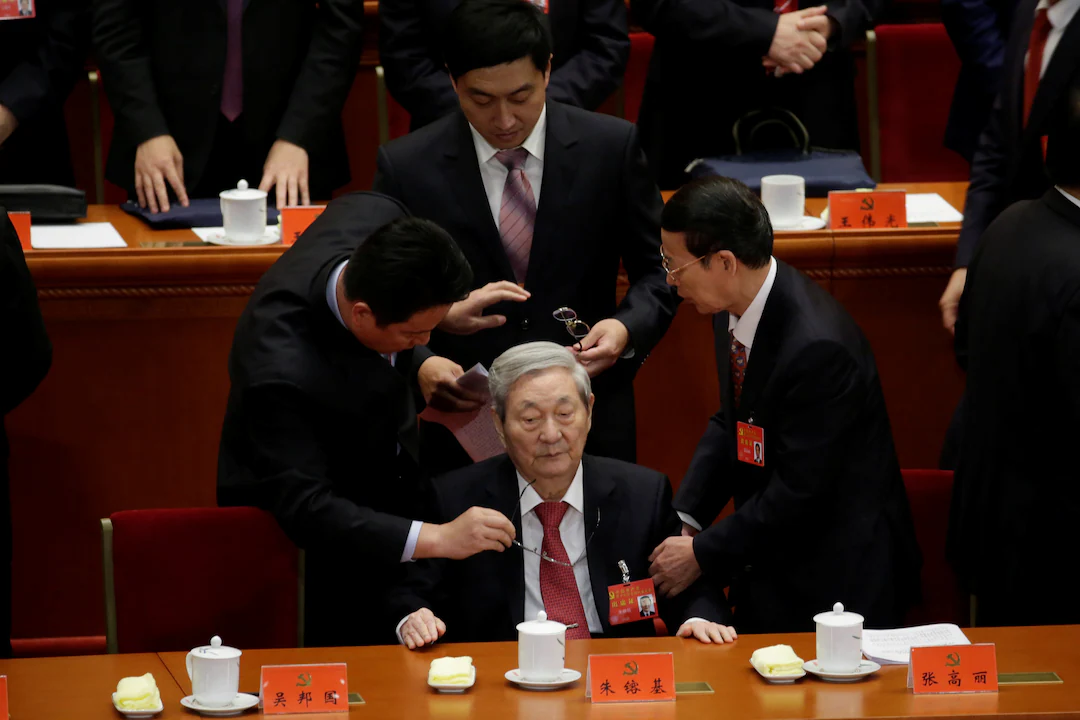
BEIJING: Former Chinese Premier Zhu Rongji, a key figure in the country’s economic transformation during the 1990s, has died at the age of 97.

Zhu was known for his direct speaking style and his strong support for economic reform. His tenure was marked by major changes aimed at restructuring China’s state-dominated economy and opening it further to global markets.

He served as China’s vice premier from 1991 to 1998 before becoming premier, a position he held until early 2003.

Zhu’s political career began decades earlier. He graduated from Tsinghua University and joined the Communist Party in 1949.

During the Cultural Revolution, he was sent to work in the countryside and experienced a period of political hardship. He was later rehabilitated and gradually returned to senior government positions.

In 1987, Zhu became mayor of Shanghai. During his tenure, he helped guide the city through early economic reforms and development that eventually contributed to its emergence as a major international financial centre.

He moved to Beijing in 1991 after joining the central government. As vice premier and later premier, Zhu became closely associated with efforts to tackle economic overheating, inflation and financial instability.

His government introduced wide-ranging reforms to state-owned enterprises. Many inefficient state companies were closed, restructured or privatised, while large numbers of workers were laid off.

Zhu also strengthened the central government’s control over taxation and introduced reforms that encouraged private home ownership. Those changes played a major role in reshaping China’s housing market.

One of his most significant achievements was helping China secure membership of the World Trade Organization in 2001, following years of difficult negotiations. China formally joined the organisation in December that year.

The WTO accession accelerated China’s integration into the global economy and helped expand international trade and investment.

However, Zhu’s reform programme also had critics. Some observers argued that changes to agricultural policy, tax arrangements and state-owned enterprises created difficulties that later governments had to address.

Despite those criticisms, Zhu remained widely regarded as one of the most influential economic reformers in modern Chinese history.

His reputation for blunt remarks became particularly prominent after a collection of his speeches was published in 2011. The books contained unusually candid assessments of corruption, government debt, banking problems and weaknesses in public administration.

The speeches attracted significant public attention because they addressed many of the economic and social challenges facing China at the time.

Zhu warned about corruption, inequality and problems created by local officials. His comments continued to attract interest among reform-minded officials, academics and members of the public long after he left office.

His death marks the passing of a leader who played a central role in one of the most consequential periods of China’s economic development.

Zhu’s legacy is closely linked to the difficult reforms of the 1990s, when China moved towards a more market-oriented economy while maintaining the political control of the Communist Party.
Similar Posts

  • | |

    Senate Committee rebukes FBR official over failure…

      A subcommittee of the Senate Standing Committee on Interior reprimanded a Federal Board of Revenue (FBR) official during a meeting after the official failed to provide the records and details sought by the committee. During the meeting, Committee Chairman Saifullah Abro expressed strong displeasure over the FBR official’s failure to submit the required information. Questioning the official’s position, Abro asked, “Are you even above the prime minister?” He further warned the official not to attempt to avoid the committee’s questions by giving explanations about the board’s internal procedures.   Abro made it clear that the committee expected the FBR to provide the requested information instead of offering excuses or referring to internal matters. He stressed that parliamentary committees have the authority to seek information from government departments when investigating matters of public importance. The chairman particularly sought details regarding certificates issued by the FBR to cigarette manufacturing companies. He said the committee should be provided with complete information about the certificates issued by the tax authority and the companies that received them.   “Details of the certificates issued by the FBR to cigarette companies must be provided,” Abro said during the meeting. He indicated that the committee wanted to examine the record and determine the circumstances under which the certificates had been issued. The matter came under discussion as the committee reviewed information concerning cigarette companies and the relevant government records. The failure to provide the requested documentation prompted the committee leadership to take a tougher stance toward the concerned officials. During the meeting, the committee also issued directions to officials of the Federal Investigation Agency (FIA). The committee instructed FIA authorities to initially issue notices to 108 companies as part of the proceedings. The notices are expected to seek information and clarification from the companies regarding matters under investigation by the committee. The move indicates that the committee intends to broaden its examination and obtain information directly from the companies concerned rather than relying solely on government departments. Abro also warned the officials against forcing the committee to escalate the matter to the highest level of government. Addressing the authorities, the committee convener said, “Do not force us to write to the prime minister.” His remarks reflected the committee’s frustration over what it considered a lack of cooperation from the relevant authorities. The chairman emphasized that government institutions should respond to parliamentary oversight mechanisms and provide the information requested by lawmakers. The committee’s proceedings highlight the role of parliamentary oversight in examining the functioning of government departments and ensuring transparency. By seeking details of certificates issued to cigarette companies and directing the FIA to issue notices to 108 companies, the subcommittee appears to be pursuing a broader inquiry into the matter. The committee is expected to review the information obtained from the FBR, FIA and the companies concerned in subsequent meetings. Further action could be considered after the requested records and responses are submitted. The strong remarks by Saifullah Abro also signal that the committee may escalate the issue if government departments continue to withhold or delay the provision of information. For now, the FIA has been directed to proceed with notices to the 108 companies, while the FBR is expected to provide details of the certificates issued to cigarette manufacturers.

  • |

    Role Model reveals how Dakota Johnson joined his new song

    Role Model has revealed that he never intended to involve his girlfriend, Hollywood actress Dakota Johnson, in his music. However, things changed naturally when she visited the recording studio during the making of his latest track, Love I You, from his upcoming album Chuck Timely & The Hourglass. The singer-songwriter, whose real name is Tucker Pillsbury, recently shared the story behind Johnson’s surprise voice cameo in the song. He explained that the team had been considering different people for the spoken part, but the unexpected opportunity arose when Johnson stopped by the studio. According to Role Model, guitarist and producer Mason Stoops suggested that Johnson should record the dialogue. At first, the singer was hesitant because he preferred to keep his professional work separate from his personal relationship. He admitted that he initially resisted the idea, believing that mixing work and romance was something he wanted to avoid. Despite his concerns, Johnson quickly volunteered to participate. Without hesitation, she stepped into the recording booth and delivered the lines with ease. Her performance exceeded everyone’s expectations, leaving the team impressed by how naturally she fit into the track. Role Model said that once he heard the final recording, he realized it was the perfect addition to the song. He described Johnson’s appearance as an incredible cameo that enhanced the emotional atmosphere of the track. Her spoken dialogue adds a playful and flirtatious element during the bridge, creating a memorable moment that has already caught the attention of fans. The singer also addressed his relationship with the actress, explaining why they prefer to keep their romance away from the public eye. While confirming that they are together, he emphasized that maintaining privacy has become increasingly important. He believes that once personal relationships become the focus of public discussion, attention shifts away from the music itself. Role Model noted that online audiences often analyze every detail of celebrities’ personal lives, turning simple moments into endless speculation. For that reason, he prefers to let his work speak for itself while keeping his relationship as private as possible. Even so, Johnson’s contribution to Love I You has generated significant excitement among fans. Clips featuring the pair’s charming exchange have circulated widely on social media, especially after footage from a live performance appeared on TikTok. The playful interaction has fueled anticipation for the full studio version of the song. Love I You is one of the standout tracks from Role Model’s upcoming album, Chuck Timely & The Hourglass, which is scheduled for release on August 7. The project explores themes of loneliness, emotional vulnerability, and the desire for meaningful connection. Johnson’s brief but impactful appearance complements those themes, adding warmth and authenticity to the song’s storytelling. As fans eagerly await the album’s release, the unexpected collaboration between Role Model and Dakota Johnson has become one of its biggest talking points. While the couple remains committed to keeping their relationship private, their creative partnership has offered listeners a rare glimpse into their chemistry, making Love I You one of the album’s most anticipated tracks.

  • | |

    Sophie Turner names fan-favorite hair color from h…

    Sophie Turner is looking back at the many hair colors she has worn throughout her career, revealing which shade gets the most positive reaction from fans. The 30-year-old actress became internationally famous as Sansa Stark on Game of Thrones, a role that transformed her career and made her auburn-red hair one of her most recognizable features. Turner began dyeing her naturally blonde hair red at just 13 after landing the role in 2009. Since then, she has experimented with several different shades, including platinum blonde, auburn and brunette. (People.com⁠) From natural blonde to Sansa’s signature red Turner’s hair transformation was closely connected to her Game of Thrones journey. Her natural blonde hair had to be changed to an auburn-red shade for Sansa, creating a look that audiences quickly associated with the character. Over the years, Turner has spoken positively about the red color because of what it represents in her career. In a previous interview, she explained that the shade was especially meaningful because it was the first major hair transformation she experienced for a professional role. She also associated red hair with the strong characters she had played. (Allure⁠) However, red is no longer the only color connected to Turner. She has repeatedly returned to blonde, experimented with darker shades and even appeared as a brunette for her upcoming role as Lara Croft in Amazon’s Tomb Raider series. (People.com⁠) Blonde gets the biggest reaction In a recent interview with The Sydney Morning Herald, Turner reflected on how people respond to her different hair eras. According to the actress, blonde has received the most positive reactions. Red, meanwhile, can create strong reactions but does not generate them as consistently. She also explained that brunette hair can make her feel more anonymous because people are less likely to recognize her. The comments show how dramatically hair color can influence the way Turner is perceived. After spending much of her teenage years and early adulthood associated with Sansa’s red hair, returning to blonde has offered her a different sense of identity. A career defined by transformation Turner’s changing hair colors have become a visual timeline of her career. From the red-haired Sansa Stark to her blonde looks and latest brunette transformation, each era has accompanied a different stage of her professional life. While fans may have their own favorite shade, Turner’s latest comments make one thing clear: blonde currently wins when it comes to the most positive public reaction.

  • | |

    Police officer took his own life after leading dou…

    An investigation has found that a police officer who died by suicide in May carried out a series of rapes and attempted murders targeting women over a period of at least fourteen years while serving as an officer. PC Alan Greer’s earliest known victim was a woman he raped inside her own home in Glasgow in 2012, shortly after she had contacted police to report an unrelated crime. The woman came forward late last year to report the assault, a disclosure that triggered one of the largest anti corruption investigations in Police Scotland’s history. Detectives have since identified eight additional victims, five of them sex workers who were attacked while Greer was off duty. Investigators have also established that Greer paid for sex from hundreds of women throughout his career and expect further victims to come forward as the inquiry continues. Assistant Chief Constable Lynn Ratcliff, who is leading the investigation, described the findings as deeply disturbing. She said the officer had abused his position of authority by returning to target a woman he had first encountered through his police duties. Ratcliff said the woman’s decision to come forward and speak with investigators became the catalyst that launched the wider inquiry. Her confirmation of the investigation followed months of reporting into Greer’s conduct. A source close to the case said the scale and nature of the case draws comparisons to the conviction of Wayne Couzens, the London police officer sentenced for the rape and murder of Sarah Everard five years ago, suggesting the Greer case could represent a similarly significant reckoning for Police Scotland. Greer was born in Australia in 1978 and moved to the United Kingdom at age six. He joined Strathclyde Police in 2009, and continued serving after the force merged into Police Scotland in 2013, building what appeared to be an unblemished seventeen year career. He initially worked as a uniformed response officer in Glasgow before moving into an officer safety training role based in Coatbridge around 2016, a position that involved training probationary officers and refreshing the skills of more experienced colleagues. Greer was 47 years old when he died in May, and was married with a child. Those close to him, including his family and police colleagues, are understood to have had no knowledge of his pattern of violence. Senior officers have said there were no clear opportunities that would have allowed the force to identify his offending earlier. The investigation traces back to a woman in her late thirties who walked into a Glasgow police station late last year to report the assault. She described how, in 2012, she had called officers to her home after a disturbance, only for one of the responding officers to later attack her. Cases involving police officers who abuse their positions of trust to target victims, particularly vulnerable women and sex workers, have prompted broader scrutiny of vetting and oversight procedures within UK police forces in recent years. Investigations of this kind often expose gaps in how forces monitor off duty conduct and respond to complaints against serving officers, and they tend to renew public pressure for independent oversight mechanisms capable of identifying patterns of abuse before they escalate over many years. The investigation into Greer’s offending remains active, and Police Scotland has said it anticipates identifying more victims as the inquiry proceeds.

  • | |

    KP sets 60% enrolment target for school dropouts

    The Khyber Pakhtunkhwa government has launched a major initiative to bring millions of out-of-school children into the education system. The provincial government has started work on a comprehensive plan. The initiative will identify children who are not attending school and provide them with suitable educational opportunities. Officials from the education, local government, health and social welfare departments have signed a memorandum of understanding for the programme. Khyber Pakhtunkhwa Chief Minister Muhammad Sohail Afridi was also present at the signing ceremony. Officials gave a detailed briefing on the initiative. They said a province-wide survey would be conducted to identify out-of-school children. The government will also develop a “One Map” system. The system will identify the number of children who are out of school. It will also show their locations. This data will help the authorities plan enrolment drives in areas where the need is greatest. According to figures presented during the briefing, around 4.9 million children in KP were out of school according to the 2023 census. The provincial education department has estimated the number at around 2.6 million. The government has set an initial target of bringing 60% of out-of-school children into the education system during the first phase. Officials said children under the age of five would also be included in the data collection process. Their information will help the government prepare future education plans and estimate upcoming enrolment needs. The programme will use different forms of education. Government schools will be used where possible. Community schools will also play a role. Double-shift schools will be introduced or expanded in areas facing limited capacity. Digital platforms will also be used to reach children who cannot easily access conventional schools. Poverty has been identified as one of the major reasons children leave school. The government plans to provide financial support to vulnerable families. Scholarships, Zakat funds and other assistance will be used to encourage children to remain in education. Scholarship payments will be linked to attendance. Officials said students would need to maintain at least 75% attendance to qualify for the scholarship payments. The programme will also focus on skills development. Children will receive technical and vocational training under the United Nations’ Generation Unlimited programme. The initiative is aimed not only at increasing school enrolment but also at improving the future employment prospects of young people. The government has also planned independent verification of the survey data. An independent organisation will verify 5% of the collected data to improve transparency and ensure that the figures accurately reflect the situation on the ground. Authorities said the survey would provide a clearer picture of the out-of-school population in the province. The data will then be used to design targeted education programmes.

  • |

    30 children geared to have been conceived using wrong IVF donors

    At least 30 children, most of them believed to be British, may have been conceived through IVF treatment in northern Cyprus using sperm or egg donors different from those selected by their parents. The allegations have emerged from an investigation into fertility clinics in the region, raising serious concerns about the treatment of international patients and the regulation of fertility services. The parents involved say they carefully chose anonymous donors before undergoing treatment. Their decisions were based on detailed information provided by clinics, including the donors’ medical backgrounds, physical appearance, education, personalities, interests and hobbies. However, after their children were born, some parents began to question whether the donors they had selected were actually used during their IVF procedures. The latest investigation has identified at least 30 cases in which parents believe the wrong sperm or egg donors may have been used. This is a significant increase from the seven cases . Around half of the children were reportedly conceived following treatment at Dogus IVF Centre, a fertility clinic in northern Cyprus. Several individuals involved in the treatment of these patients have come under scrutiny, including doctors Firdevs Uguz Tip and Sevket Alpturk, as well as patient coordinator Julie Hodson. One mother, identified as Rachel, said she recently discovered that the sperm donor used during her treatment may not have been the donor she had chosen. She described the situation as extremely shocking and unacceptable. The parents have raised concerns that staff members at the clinic may have provided misleading information about the donors. Dr Firdevs Uguz Tip has denied any wrongdoing. The investigation has also uncovered information about the relationship between Dogus IVF Centre and Cryos International, one of the world’s largest sperm banks. Cryos placed Dogus on its blacklist in 2016, adding another concern surrounding the clinic’s practices. Northern Cyprus has become a popular destination for British and other international patients seeking fertility treatment. The region offers relatively low treatment costs, reportedly high success rates and access to a wide selection of sperm and egg donors. However, its regulatory system is significantly different from that of European Union countries. Northern Cyprus is internationally recognised only by Turkey, and EU laws do not apply there. Fertility clinics in the territory have been described as operating under relatively loose regulation, raising questions about oversight and accountability. According to previous reports on the emerging allegations in March, when seven parents came forward with concerns that they may have been misled about the donors used in their treatments. Following those reports, the Ministry of Health in northern Cyprus said it had opened an official investigation. However, the ministry has reportedly failed to provide further information. Many parents said clinics had promised them donors who had undergone health screening and were from Western European backgrounds. Their suspicions reportedly grew after their children were born. DNA testing has provided further evidence that has intensified these concerns. Eleven of the 30 children have undergone commercial DNA tests, with results indicating genetic ancestry connected to Turkey or nearby regions. According to the investigation, these results may suggest that the donors selected by the parents were not the individuals whose genetic material was ultimately used. The allegations have caused distress among affected families, many of whom travelled abroad believing they were receiving carefully selected fertility treatment. The growing number of cases is now raising serious questions about donor identification, patient information, clinic accountability and the regulation of fertility services in northern Cyprus.

Leave a Reply

Your email address will not be published. Required fields are marked *