
ghost projects growth
| |

From ghost projects to growth slump, Marcos now faces a spending dilemma

MANILA, Philippines – After spending months cleaning up the mess left by questionable infrastructure projects, the Marcos administration now finds itself with quite the opposite problem. It needs the government to spend faster.

President Ferdinand Marcos Jr. is counting on a rebound in public spending to help pull the Philippine economy out of its slump in the second half of the year. But even as he pushes agencies to catch up, Marcos acknowledged there is only so much money they and their contractors can realistically put to work at once.

“The growth rate is heavily dependent on public spending. And that has been delayed,” Marcos said, speaking at a Foreign Correspondents Association of the Philippines forum on Friday, August 14.

Part of that delay was self-imposed. After controversies surrounding public works spending, particularly flood-control projects, the government subjected the budget and infrastructure pipeline to closer scrutiny. Contracts that, normally, would have been bid out before the start of the year were instead put out only toward the end of the first quarter, Marcos said.

The uncertainty surrounding the infrastructure clean-up also spilled over into investment. The World Bank has said reviews of public infrastructure projects and heightened domestic policy uncertainty spooked investors and contributed to the country’s slower growth.

Now Marcos wants the government to make up for lost time. The President expects the government to make up for that spending for the rest of the year, adding that he was “confident” public spending would catch up with and eventually exceed the previous year by the last quarter. But still, he acknowledged that there’s only so much that they can spend on prudently.

“What we are running into very much is the absorptive capacity, not only of the government agencies, but also of the contractors. They can only do so much work,” Marcos said.

“So throwing money at the problem simply doesn’t solve it, doesn’t make anything better.”

Must Read

PH’s 12% VAT yields no more than Thailand’s 7%; World Bank urges collection fix


PH’s 12% VAT yields no more than Thailand’s 7%; World Bank urges collection fix

Spend faster, but more carefully

After the Philippine economy grew by a measly 2.3% in the second quarter, the country’s economic managers are now trying to speed up spending enough to jolt the economy back to life. At the same time, they can’t afford to recreate the same conditions that allowed dubious and alleged nonexistent projects in the first place.

At a separate forum of the Economic Journalists Association of the Philippines (EJAP) on Friday, Acting Budget Secretary Kim Robert de Leon said the Department of Budget and Management (DBM) was working with implementing agencies to speed up spending.

But DBM is also tightening the way it vets and monitors projects. For flood-control projects returning to the proposed 2027 national budget, De Leon said DBM and the Department of Public Works and Highways agreed to prioritize the completion of ongoing projects and the operation and maintenance of existing infrastructure.

“We have the full documentation of it, including the budget forms, the location, the geotagging, and the program of works to make sure that this will not be ghost projects as have earlier been reported in the previous years,” De Leon told economic journalists on Friday.
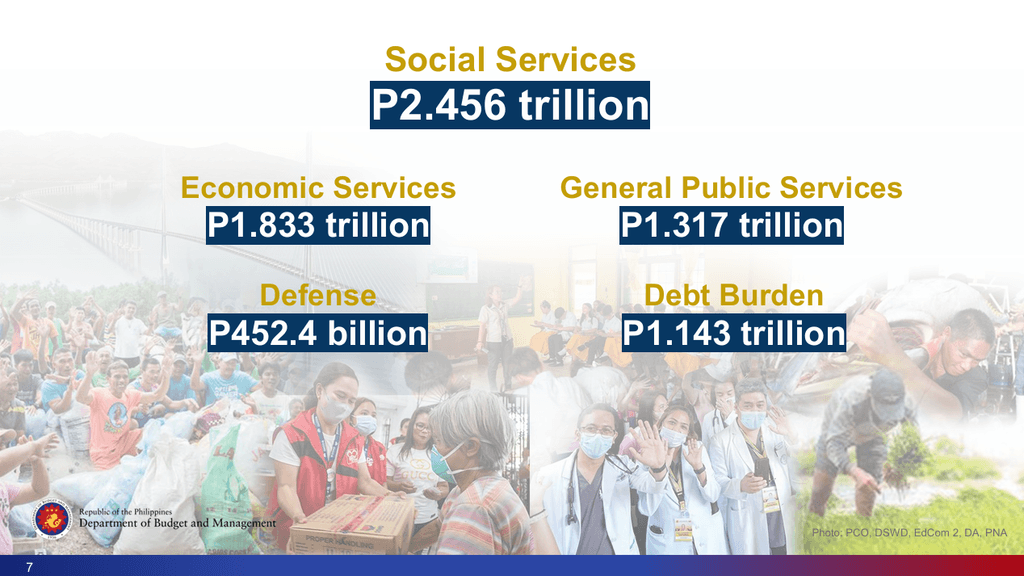
PROPOSED BUDGET. Breakdown of the proposed 2027 national budget, grouped into broad categories. Presentation from the DBM.

The budget department is also attempting to rein in unprogrammed appropriations (UA), another controversial part of government spending. The proposed P7.2-trillion national budget for 2027 contains P111.98 billion in unprogrammed appropriations, equivalent to just 1.6% of the expenditure program. De Leon said this was the lowest proposed UA in nominal terms since 2019 and the lowest share of the expenditure program since 1991.

Asked whether the government could eventually reduce unprogrammed appropriations even further, De Leon said “the lower the better.” 

He said the 2027 budget proposal limits UA largely to foreign-assisted projects still undergoing approval processes, as well as a handful of contingent items including risk-management provisions tied to public-private partnership and privatization commitments.

Underspending dragged growth

Department of Economy, Planning and Development Secretary Arsenio Balisacan was more explicit about how much weak public spending had hurt the economy.

Balisacan told the EJAP forum that the economy could have turned in “quite good growth” in recent quarters despite the Middle East conflict had government funds moved as intended. But they did not.

Instead, he said public spending contracted by more than 30% for two consecutive quarters.

“That’s not likely to be the case in the next two quarters,” Balisacan said.

Balisacan argued that the recent weakness should be viewed against a longer period in which the Philippine economy expanded by an average 5.1% over the past 15 years.

But even with the chief economist’s optimism for an improvement in the second quarter, the government’s economic team has already cut its expected full-year growth to only 3.5% to 4.5% in 2026.

Must Watch

The Philippines is now upper-middle income. Really?


The Philippines is now upper-middle income. Really?

Finding the money

The push to spend faster also comes as the government tries to narrow its fiscal deficit and keep debt manageable.

Of the proposed P7.2-trillion budget for 2027, P1.143 trillion or 15.9% is already allotted for the debt burden, covering interest payments and net lending to government corporations. That’s nearly three times as much as the Philippines is projected to spend on defense (P452.4 billion).

Keenly aware of the crushing burden, the government plans to gradually bring the deficit down from 5.4% of gross domestic product in 2026 to 3.5% by 2030, even as it continues to fund infrastructure and other programs aimed at lifting economic growth.
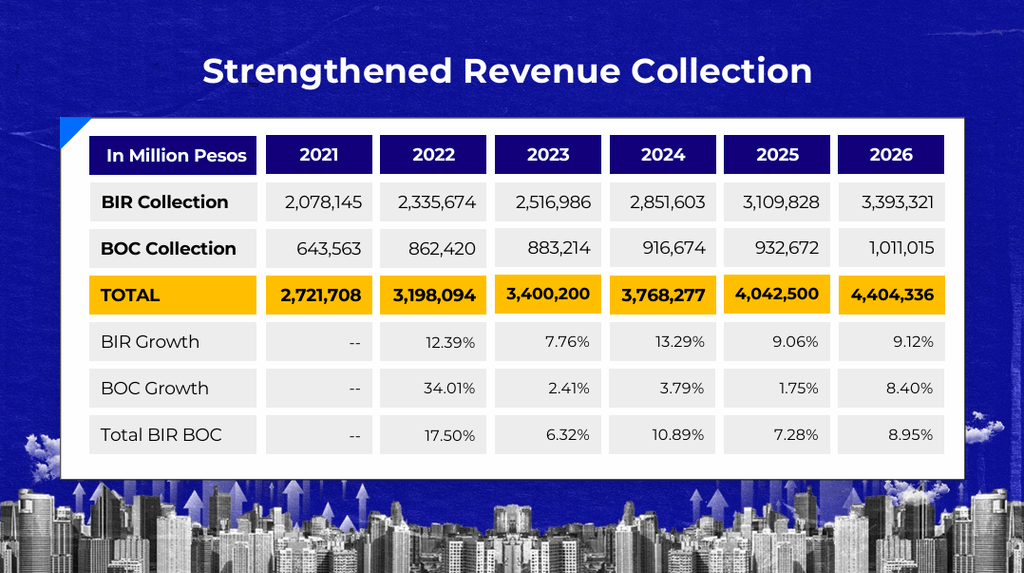
REVENUE. Year by year growth in BIR and BOC revenue collection. Presentation from the DOF.

Finance Secretary Frederick Go touted stronger tax collections and other government revenues, which help create more room for spending. Go said annual government collections increased by an average of 10% during the first four years of the Marcos administration. The Bureau of Internal Revenue surpassed P3 trillion in collections in 2025, while the government expects the Bureau of Customs to finally breach the P1-trillion mark this year.

Government-owned and -controlled corporations have also remitted P501 billion in dividends from 2022 to 2026, already 31% more than the P382 billion collected during the previous administration, Go said.

Privatization has provided another source of funds, including almost P49 billion raised from the sale of power assets in recent years. – Rappler.com

Must Read

Government earns P205 million from sale of 2024 smuggled ultraluxury Bugatti Chirons


Government earns P205 million from sale of 2024 smuggled ultraluxury Bugatti Chirons

Similar Posts

  • | |

    Shein turns to China as Hong Kong IPO nears

    Fast-fashion giant Shein is preparing to make its stock market debut in Hong Kong after years of efforts to list in the United States and Britain, marking a significant shift in how the company presents its relationship with China. The company is expected to raise around $1.7 billion through its Hong Kong initial public offering, with a valuation of about $26.5 billion. That figure is considerably below the company’s valuation in 2022. Shein had previously sought to establish itself as a global company. It moved its headquarters to Singapore in 2021 and promoted plans to expand manufacturing and operations in countries including Brazil, Türkiye and parts of Europe. However, its attempts to secure a Western listing faced regulatory and political obstacles. Chinese authorities were also reportedly involved in blocking earlier efforts to list in New York and London. After shifting its focus to Hong Kong in 2025, Shein founder Sky Xu increased his engagement with Chinese officials and became more involved in regulatory and capital-market discussions inside the country, according to people familiar with the matter. Xu also made a rare public appearance at a business forum in Guangdong earlier this year, where he announced plans for Shein to invest $1.5 billion in the province. He said the company would deepen its presence in Guangdong and develop its smart supply-chain system while contributing to the region’s fashion industry. Shein also opened a research and development centre in Nanjing, the eastern Chinese city where the company was founded in 2012. These moves helped reinforce the company’s economic links with China at a time when Beijing has been paying close attention to companies with major overseas operations. Officials in Guangdong also reportedly highlighted Shein’s contribution to employment and domestic economic activity when engaging with central authorities. The company has sought to emphasise that its main business is overseas rather than in China. Shein does not market its extremely low-priced products to Chinese consumers, allowing it to distance itself from the intense competition among domestic e-commerce platforms. Shein has instead argued that its international operations benefit China by generating foreign currency and supporting Chinese manufacturing and supply chains. The company’s Hong Kong prospectus describes China as the foundation of its global logistics and fulfilment network. Nearly 80 per cent of Shein’s workforce is based in mainland China. The shift comes after growing difficulties in Western markets. In the United States, lawmakers raised concerns over Shein’s supply chains and called for stronger assurances that its products were not linked to forced labour. The company has also faced scrutiny in Europe over competition, product safety and items offered through its online marketplace. At the same time, changes to low-value import rules in the US and Europe have created additional challenges for Shein’s business model, which relies heavily on inexpensive shipments directly to consumers. Analysts say the company’s experience demonstrates how geopolitical tensions are increasingly influencing corporate decisions and stock-market listings.

  • |

    Pakistan enlists top global banks for sovereign de…

    The federal government has appointed three consortiums of leading international banks to manage Pakistan’s future sovereign debt issuances under its Global Medium-Term Note (GMTN) and international Sukuk programmes. The move is part of the government’s broader strategy to regain access to international capital markets and strengthen external financing. The Ministry of Finance announced the appointments on Tuesday. Officials said the banks were selected through a competitive and transparent procurement process carried out under pre-defined financial and technical criteria. The selected consortiums will provide advisory and financial services for Pakistan’s future issuance of conventional Eurobonds, Islamic Sukuk and rupee-denominated bonds settled in US dollars. The Eurobond consortium includes Standard Chartered Bank, Citibank, Deutsche Bank AG, Emirates NBD Capital and MUFG Securities Asia Limited. The international Sukuk consortium consists of Standard Chartered Bank, Dubai Islamic Bank PJSC, Citibank, Emirates NBD Capital and Mashreq Bank PSC. The consortium for rupee-denominated, US dollar-settled bonds includes Standard Chartered Bank, Citibank and Deutsche Bank AG. The Finance Ministry said the appointments will remain valid for three years. During this period, the consortiums will support Pakistan’s sovereign borrowing programme through both conventional and Islamic financing instruments. Officials said any future debt issuance will take place after the completion of all required legal documentation, regulatory approvals and market-related formalities. Finance Minister Muhammad Aurangzeb, who is currently visiting Washington, DC, held a virtual meeting with senior executives of the selected banks. The meeting marked the beginning of the government’s strategic partnership with the international financial institutions. The ministry said the inclusion of MUFG Securities Asia Limited and Mashreq Bank has expanded Pakistan’s engagement with leading global financial institutions and is expected to attract a wider range of international investors. According to the ministry, recent improvements in Pakistan’s economic indicators have strengthened investor confidence. Officials pointed to fiscal consolidation, stronger external financial buffers, progress on structural reforms and narrowing sovereign credit spreads as key factors supporting the country’s planned return to international debt markets.

  • | |

    Google slapped with $1bn EU fine, holds talks to dodge further penalties

    The European Union has fined Google about €890 million, or $1 billion. The fine punishes Google for breaking EU rules meant to control the power of big tech companies. But regulators also hinted that no more fines are coming soon, because Google is making good progress toward following the rules. The fine has two parts. The first part, €460 million, is for Google favoring its own products. When people search for things like shopping, hotels, flights, or sports scores, Google often showed its own results first instead of treating competitors fairly. The second part, €430 million, is about the Google Play app store. Google had stopped app makers from telling users about cheaper deals outside the app store. This is the first time Google has been fined under this specific EU law, called the Digital Markets Act. But counting older cases, Google has now paid six fines for unfair business practices. In total, the company has paid more than €10 billion in EU fines over about twenty years. EU officials said they are just enforcing the law. “Our job is to make sure the rules are followed,” said Teresa Ribera, the EU’s top antitrust official. Another official, Henna Virkkunen, said the goal is fair competition. Google now has 60 days to fix its practices. Google is not happy. A company spokesperson said the changes will hurt features people like, such as quick pricing for hotels and flights. He said the ruling is not really about fair competition, it is making Google’s products worse to please a small number of complainers. Even so, there is good news for Google too. The EU said Google has already started testing new ways of showing search results more fairly. It called this real progress. The EU may also apply the same rules to Google’s AI tools, like AI Overviews. Talks about this are still ongoing. Google’s changes to its app store rules were also seen as a step in the right direction. This fight is happening while tensions rise between the US and EU. The Trump administration says Europe is unfairly targeting American companies and has threatened tariffs in response. Some US lawmakers agree. Google’s fine comes after the EU already fined Apple and Meta last year under the same law. It shows the EU is serious about controlling big tech, even as pressure grows from the US side.

  • | | |

    Aurangzeb, Baker discuss stronger Pak-US economic …

    Federal Minister for Finance Muhammad Aurangzeb met US Chargé d’Affaires Natalie Baker on Monday to discuss ways to strengthen Pakistan-US economic relations, trade and investment cooperation. According to the Finance Ministry, Aurangzeb briefed the US diplomat on his recent visit to Washington and meetings with senior American officials, including the US Treasury secretary. He also shared details of discussions with officials from the International Monetary Fund (IMF), US International Development Finance Corporation (DFC) and US Export-Import Bank. The meeting focused on increasing US investment and financing for commercially viable projects in Pakistan. Both sides also discussed improving Pakistan’s access to US markets and expanding Pakistani exports. The two sides agreed to advance a framework aimed at increasing bilateral trade and investment. They also discussed Pakistan’s participation in international capital markets and efforts to diversify the country’s sources of financing. According to the ministry, discussions also covered measures to strengthen foreign exchange reserves and improve Pakistan’s credit profile. Opportunities for greater investment by US financial institutions in Pakistan were reviewed. Cooperation in key sectors, including ports, logistics, energy and telecommunications, also came under discussion. The two sides explored potential collaboration in digital technology and artificial intelligence. Aurangzeb said significant progress had been made in negotiations on a bilateral trade framework between Pakistan and the United States. He said the government was working to create a more favourable environment for private-sector investment. The finance minister welcomed the interest of US companies and investors in Pakistan. He said the government was continuing reforms aimed at improving the business and investment climate. Aurangzeb also briefed the US chargé d’affaires on Pakistan’s new system for daily adjustments in petroleum product prices. He explained that the mechanism was designed to align domestic prices more closely with developments in the international market. He said the government’s priorities included maintaining fiscal discipline, strengthening foreign exchange reserves and increasing exports. He added that reforms were underway to improve economic stability and attract investment. Natalie Baker appreciated Pakistan’s efforts to manage its economic situation during a period of regional tensions. She also praised the country for maintaining economic and financial stability despite rising energy prices.

  • |

    KP cabinet approves tax exemptions for merged districts, Malakand

    PESHAWAR: The Khyber Pakhtunkhwa government has approved a package of measures aimed at providing tax relief to businesses and industries operating in the province’s merged tribal districts and Malakand Division, while also expanding welfare and education initiatives. According to Khyber Pakhtunkhwa Information Minister Shafiullah Jan, the provincial cabinet has endorsed exemptions from certain provincial taxes for service providers and industries operating in areas previously covered by the Federally Administered Tribal Areas (FATA), Provincially Administered Tribal Areas (PATA) and Malakand Division. Under the decision, service providers operating in the former FATA, PATA and Malakand areas will be exempted from provincial sales tax on services. Industries established in these regions will also receive relief from withholding sales tax. The government said the tax measures were intended to encourage investment, facilitate businesses and support economic activity in areas that have historically faced developmental and infrastructure challenges. Ehsaas Nawaz funding increased The cabinet also approved a significant increase in the financial allocation for the Ehsaas Nawaz programme. According to the information minister, the programme’s funding has been raised from Rs3 billion to Rs5 billion. The increase is expected to provide additional financial support under the government’s welfare initiatives and expand the programme’s reach among deserving segments of the population. Ashra Rahmat Lil-Aalameen programme approved The provincial cabinet also approved arrangements for observing Ashra Rahmat Lil-Aalameen (PBUH) across Khyber Pakhtunkhwa. The celebrations will formally begin from the first day of Rabi-ul-Awwal, with the cabinet approving a schedule for programmes to be organised across the province. The initiative is expected to include a range of activities aimed at highlighting the teachings, life and message of the Holy Prophet Muhammad (PBUH). Education sector measures Several decisions concerning education were also approved during the cabinet meeting. The provincial government sanctioned funds for schools and colleges in various districts to address educational requirements and improve facilities. The cabinet also approved a system for providing textbooks according to the semester system up to Grade 5. In another major education-related decision, the cabinet approved the provision of 100 percent free textbooks for students from Grade 9 to Grade 12. The measures are aimed at reducing the financial burden on students and their families while improving access to educational resources, particularly for students enrolled in government institutions. Public-private partnership legislation The cabinet further approved the Khyber Pakhtunkhwa Public Private Partnership Authority Bill 2026 for enactment. The proposed legislation is intended to establish a formal framework for public-private partnerships in the province and facilitate greater participation of the private sector in development projects. The government believes stronger public-private cooperation can help mobilise investment, improve service delivery and accelerate infrastructure development across Khyber Pakhtunkhwa.

Leave a Reply

Your email address will not be published. Required fields are marked *