gohar rejects reports
| |

Gohar rejects reports on Imran-Noreen meeting

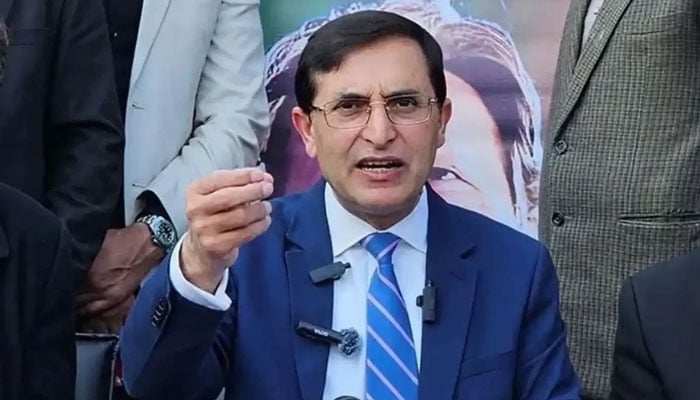
PTI Chairman Barrister Gohar Khan has rejected reports about the meeting between party founder Imran Khan and Noreen Niazi. He said several fabricated reports were being circulated about what was discussed during the meeting.

Speaking about the matter, Barrister Gohar said he contacted Noreen Niazi by phone after her meeting with Imran Khan. However, he said she did not share details of the conversation or explain what had taken place during the meeting.

According to Barrister Gohar, Noreen Niazi had made it clear that she would not discuss the meeting outside. She had also decided not to speak publicly about the details of her interaction with Imran Khan.

Barrister Gohar said there was no truth in reports claiming that Imran Khan had spoken against PTI leadership. He specifically clarified that the PTI founder had not made any remarks against Sohail Afridi or other members of the party leadership.

He said the reports being circulated about the meeting were misleading and should not be treated as factual. Barrister Gohar maintained that the details being attributed to the meeting did not reflect what had actually been discussed.

The PTI chairman also said Noreen Niazi appeared to be happy after meeting Imran Khan. However, he noted that there were certain matters discussed during the meeting that could not be shared publicly.

He said some information remained private because of the nature of the meeting. Barrister Gohar therefore urged people not to rely on unverified reports or speculation regarding the interaction between Imran Khan and Noreen Niazi.

Similar Posts

  • | |

    IHC reserves decision on Imaan Mazari, Hadi Chatth…

    The Islamabad High Court on Friday reserved its decision on whether petitions seeking the suspension of prison sentences awarded to lawyers and human rights activists Imaan Zainab Mazari-Hazir and Hadi Ali Chattha can proceed. The petitions relate to the couple’s convictions in a case involving alleged controversial social media posts under the Prevention of Electronic Crimes Act (PECA). The hearing was conducted by Justice Muhammad Azam Khan, who considered preliminary arguments from both the prosecution and the defence before reserving his ruling on the maintainability of the petitions. During the proceedings, lawyers representing the National Cyber Crime Investigation Agency (NCCIA) argued that the requests for suspension of sentence had been filed too early. They maintained that the court should first decide the prosecution’s objection challenging the admissibility of the petitions before considering any request for relief. The prosecution submitted that hearing the suspension petitions before deciding its objection would make its legal challenge ineffective. It therefore requested the court to first determine whether the petitions were legally maintainable. Counsel for Imaan Mazari and Hadi Chattha opposed the objection and said he was ready to argue the prosecution’s application immediately. He suggested that both the objection and the suspension requests should be heard together to avoid unnecessary delays in the proceedings. The judge advised the defence to fully prepare its arguments, observing that doing so would better protect the legal rights of the convicted lawyers. However, the defence maintained that it was prepared to proceed without delay and formally waived any request for additional preparation time. After hearing submissions from both sides, Justice Azam Khan stated that the court would first determine whether the petitions seeking suspension of sentence were legally maintainable. Only after resolving that issue would the court consider the merits of the requests for suspension of the sentences. At the end of the hearing, the Islamabad High Court reserved its decision on the prosecution’s objection. The ruling will determine whether the petitions can move forward for further consideration. Imaan Mazari and Hadi Ali Chattha were convicted by a sessions court earlier this year and received a combined sentence of 17 years’ imprisonment on multiple charges under PECA

  • |

    Diesel price rises as government increases petroleum levy

    ISLAMABAD: The federal government has increased the price of high-speed diesel after raising the Petroleum Development Levy (PDL) on the fuel by Rs1 per litre, adding further pressure on consumers and transport-related costs. Following the latest adjustment, the price of high-speed diesel has gone up by 54 paisas per litre, reaching Rs382.89 per litre. The increase comes despite a decline in the ex-refinery price of diesel, with the higher petroleum levy pushing up the final price paid by consumers. The government has raised the diesel levy by Rs1 per litre as part of the latest petroleum price adjustment. The PDL on high-speed diesel now stands at Rs76.28 per litre. The latest increase follows another adjustment made on August 12, when the government raised the petroleum levy on diesel by Rs2 per litre. The successive increases have resulted in a significant rise in the levy component of the retail price. Petrol price reduced In contrast to diesel, the government has reduced the price of petrol by 94 paisas per litre. The price of petrol has now been fixed at Rs324.98 per litre. The Petroleum Development Levy on petrol, however, has remained unchanged at Rs80 per litre. The differing price movements for petrol and diesel are largely linked to changes in their respective pricing components. While the ex-refinery price of diesel declined, the increase in the government levy more than offset the reduction, resulting in a higher retail price. The latest adjustment is expected to have an impact on transportation and logistics costs because diesel is widely used by commercial vehicles, buses, trucks, agricultural machinery and other heavy transport. Higher diesel prices can also influence the cost of goods and services by increasing transportation expenses across supply chains. Meanwhile, the reduction in petrol prices provides limited relief to motorists using petrol-powered vehicles. The government periodically reviews petroleum prices based on international oil prices, exchange-rate movements, taxation and other components of the domestic pricing mechanism. The latest changes reflect the impact of adjustments in the petroleum levy and ex-refinery prices on consumers.

  • |

    AI builds 16 brand-new viruses in world-first genome experiment

    Artificial intelligence has designed 16 entirely new viruses that have never existed in nature before. Researchers in the US are calling it a genuine scientific breakthrough. According to the team behind the project, these newly designed viruses are fully functional and can replicate successfully in lab conditions. Scientists are describing the achievement as a major turning point for the field. This marks the first time AI has managed to design a complete viral genome from scratch. The viruses were specifically built to target bacteria, particularly drug-resistant strains of E. coli, and pose no risk to humans. The work was led by Dr Brian Hie and his team at Stanford University. They relied on genome language models, including systems called Evo1 and Evo2, trained using data from roughly two million bacteriophages. To keep the research safe, the team deliberately excluded any genetic data linked to viruses capable of infecting humans, animals or plants. That precaution was built into the training process from the very start. Hie explained that this represents a new level of complexity for what generative AI can design. He noted that building a complete, functional genome capable of replicating inside cells was completely uncharted territory for his team. Out of thousands of AI-generated designs, researchers narrowed the list down to around 300 for lab synthesis. After testing, only 16 of those proved effective at killing antibiotic-resistant E. coli. Scientists have framed the achievement as a potential breakthrough with real medical applications ahead. Tom Ellis, a synthetic genome expert at Imperial College London, called the work impressive but pointed out its current limitations. He noted that this particular genome remains one of the simplest and smallest to design successfully. Ellis added that concerns around AI-designed pathogens are often overstated compared to more realistic risks. He explained that modifying existing pathogens through gain-of-function techniques remains a far easier and more likely biosecurity threat. Still, some researchers in the wider scientific community remain cautious about where this technology could eventually lead. Experts at the Johns Hopkins Center for Health Security warned that proper oversight for this kind of AI-driven genome design doesn’t fully exist yet. Dr Filippa Lentzos from King’s College London argued that regulation needs to focus on multiple layers, including lab safety and DNA synthesis screening, rather than restricting AI models alone.

  • | |

    PPP, PML-N hold unity talks over AJK polls

    Senior leaders of the Pakistan Peoples Party (PPP) and the Pakistan Muslim League-Nawaz (PML-N) held a high-level meeting in Muzaffarabad on Thursday to defuse growing political tensions over the ongoing Azad Jammu and Kashmir (AJK) elections. The meeting came after days of heated exchanges between the two coalition partners following the Mirpur election. The PPP had accused the electoral process of being marred by widespread irregularities and raised concerns over the credibility of the results. According to sources, the talks were aimed at preventing the election dispute from affecting the working relationship between the two parties in the federal coalition government. The meeting was reportedly arranged after consultations at the federal level. Some sources claimed that the initiative received support from both the Presidency and the Prime Minister’s Office. However, this could not be independently verified. The PPP delegation included Qamar Zaman Kaira, Nadeem Afzal Chan, AJK Prime Minister Faisal Rathore and Nayyar Bukhari. They met with senior PML-N leaders Rana Sanaullah and Amir Muqam. During the meeting, both sides openly discussed their concerns over statements made during the election campaign and after the announcement of the Mirpur results. PML-N leaders asked the PPP to present evidence supporting its allegations of organised election rigging. In response, PPP leaders said their objections were limited to four constituencies — LA-5, LA-9, LA-11 and LA-12 — where they believe serious irregularities took place. PML-N leaders argued that by restricting its objections to only four constituencies, the PPP had effectively accepted the results of the remaining nine seats. They noted that PML-N won five of those seats, while the PPP secured four. After detailed discussions, both parties agreed that political tensions should not be allowed to escalate further. They also agreed that the dispute should not affect the remaining phases of the AJK elections. The meeting also reviewed security arrangements for polling in the remaining constituencies, particularly in Muzaffarabad. Both parties agreed that no individual should be allowed to carry weapons inside or around polling stations. They stressed that strict security measures were necessary to ensure peaceful, transparent and orderly polling. Political observers view the meeting as the first major reconciliation effort by the two coalition partners to contain the election dispute

  • |

    Yungblud refuses to let injury stop his performances

    Yungblud is refusing to let a painful leg injury keep him away from the stage, even after suffering an accident just hours before one of his recent performances. The 29-year-old English musician revealed that he injured his leg in a dirt bike accident only two hours before taking the stage at the Sturgis Motorcycle Rally in South Dakota on August 9. Despite the injury, the singer decided to continue with the scheduled performance and appeared in front of thousands of fans. According to footage shared by a fan on TikTok, Yungblud addressed the crowd and admitted that his injury would affect the way he performed. He jokingly told concertgoers that he would not be able to move around or dance as energetically as he normally does because of the condition of his leg. However, the musician made it clear that the injury would not prevent him from doing what he loves. Rather than cancelling the show, he pushed through the pain and completed his performance for fans attending the motorcycle rally. Yungblud later gave an update to fans who were unable to attend the South Dakota concert. On August 17, the singer shared several photographs on Instagram showing his injured and bandaged leg, along with a crutch that he has been using while recovering. Alongside the pictures, he reassured fans that although his leg was in bad shape, he was still determined to continue performing. He also confirmed that he would be heading to Europe for upcoming shows in Portugal and Belgium, promising fans that the performances would still be full of energy. His update quickly attracted a wave of supportive messages from followers. Many fans praised the singer for refusing to let the injury stop him from appearing on stage, while others encouraged him to take some time to rest and properly recover. Some followers also used humor to lighten the situation. One fan praised him for continuing to show up despite the injury, while another jokingly referenced the phrase “break a leg,” suggesting that he had taken the expression a little too literally. Others were more concerned about his health and urged him to be careful and look after himself during his recovery. The Sturgis Motorcycle Rally performance marked the conclusion of the American leg of Yungblud’s Idols World Tour. Despite his unexpected injury, the singer appears determined to keep the tour moving forward, with European performances now on his schedule. Yungblud’s decision to perform just hours after the accident has further highlighted his commitment to his fans and his determination to remain on the road, even when faced with an unexpected setback.

  • | | | |

    S&P upgrades Pakistan’s rating to ‘B’ o…

    S&P Global Ratings has upgraded Pakistan’s long-term sovereign credit rating from ‘B-’ to ‘B’, citing improvements in economic stability, foreign exchange reserves and reform progress. The global rating agency maintained a stable outlook for Pakistan, indicating expectations that the country’s economic recovery will continue if current policies and reforms remain in place. S&P said the rating upgrade reflects stronger institutional capacity and Pakistan’s progress in implementing reforms under the International Monetary Fund’s (IMF) programme. The agency highlighted that the $7 billion IMF Extended Fund Facility (EFF) has played an important role in improving economic management, supporting fiscal reforms and rebuilding external financial buffers. According to S&P, Pakistan has achieved most of the IMF programme targets so far, which has helped maintain the flow of financial assistance and improve investor confidence. The rating agency also pointed to a major improvement in Pakistan’s foreign exchange reserves. It said reserves increased to around $25.3 billion, including gold holdings, by the end of last month. This is a significant rise compared with the low level of around $6.7 billion recorded in December 2022. S&P said the improved reserve position provides greater capacity to manage external payments and cover upcoming foreign debt obligations. The agency added that continued support from international partners, multilateral institutions and access to global financing markets would help Pakistan strengthen its external position. S&P projected further improvement in Pakistan’s fiscal performance, saying the government deficit could decline to around 4% of GDP by fiscal year 2027. This compares with nearly 8% during the economic difficulties faced in 2022 and 2023. The agency also noted that economic reforms, fiscal discipline and improved financial management could help Pakistan achieve sustainable growth in the coming years. However, S&P warned that a slowdown in reforms, increased fiscal pressures or worsening external conditions could create risks for the country’s future rating. The agency said Pakistan could receive another rating improvement if it continues reducing fiscal deficits, increasing revenues, lowering financing costs and strengthening external economic indicators.

Leave a Reply

Your email address will not be published. Required fields are marked *