govt increases petrol
|

Govt increases petrol by Rs1.09, HSD by Rs2.42

The government on Thursday increased the prices of petrol and high-speed diesel (HSD) by Rs1.09 and Rs2.42 per litre, respectively, passing on the impact of fluctuating global oil prices amid ongoing Middle East tensions.

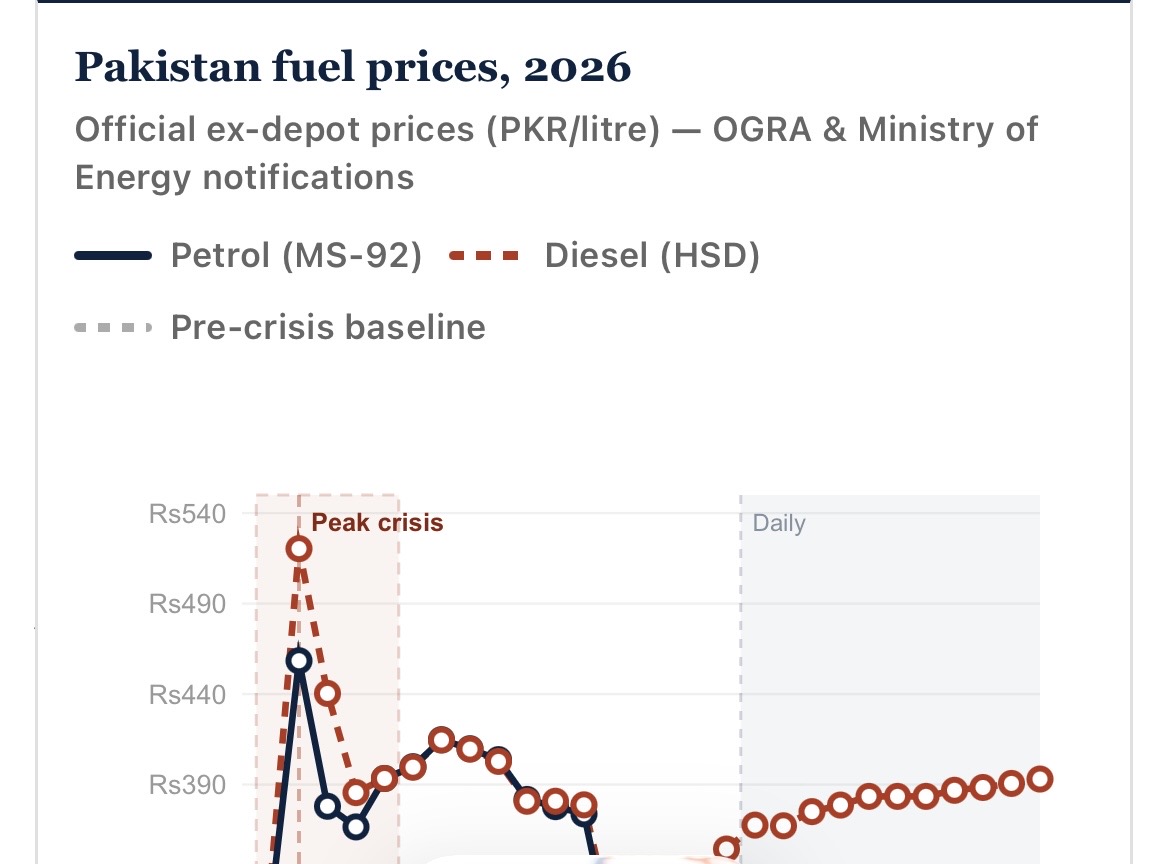
Following the revision, petrol will retail at Rs336.15 per litre, while HSD will cost Rs393.04 per litre. The government continues to levy Rs110 per litre in taxes and duties on petrol and Rs96 per litre on diesel. The Petroleum Division’s notification said the new prices would be applicable for July 31 (Friday).

The diesel price has come down from a peak of Rs520.35 recorded on April 3, after beginning its upward trajectory from Rs281 per litre when the US-Iran war broke out on February 28. Similarly, petrol had peaked at Rs458.41 on April 3 after rising from Rs266 in the first week of March.

Earlier, Petroleum Minister Ali Pervaiz Malik announced that fuel prices would now be fixed on a daily basis due to fluctuations in international market prices following renewed hostilities between Iran and the US. The government had been announcing weekly revisions since early March, alongside conservation measures amid possible oil supply disruptions due to the ongoing conflict in the Middle East. In April, the federal government also announced targeted relief measures to provide subsidised fuel.

The petroleum minister stated that the cabinet and the prime minister had decided to give the Oil and Gas Regulatory Authority (OGRA) the responsibility of deciding fuel prices on a daily basis based on international market trends. The daily pricing decision was rejected by the All Pakistan Dealers Association, which said it would consider a protest plan this week.

Petrol is mainly used in private transport, small vehicles, rickshaws and two-wheelers, and changes in its price affect the middle and lower-middle classes. Similarly, diesel price changes impact the public at large, as it is primarily used in the heavy transport sector, power plants and large generators. Petrol and HSD are the major revenue earners, with monthly sales of about 700,000 to 800,000 tonnes, compared to just 10,000 tonnes of monthly demand for kerosene.
Similar Posts

  • US and Israel Launch Massive Strikes Against Iran, Trump Vows to Destroy Missile Program

    TEHRAN — The United States and Israel launched a massive military attack against Iran in the early hours of Saturday, targeting regime objectives and military bases across the country, as President Donald Trump confirmed American involvement and vowed to ensure Iran never obtains a nuclear weapon. Exiled Iranian Crown Prince Declares Regime’s Collapse Imminent, Calls […]

  • | |

    Zardari, Shehbaz among officials depositing gifts …

    President Asif Ali Zardari, Prime Minister Shehbaz Sharif and other senior officials have deposited numerous gifts received from foreign dignitaries in the Toshakhana. The government has released details of gifts received by senior officeholders during the recent period. The Cabinet Division has also made records of gifts received by public officials since 2002 available on its official website. Information Minister Attaullah Tarar said details of deposited gifts are published periodically. He said the records cover gifts received by the president, prime minister, deputy prime minister, federal ministers and other government officials. However, the names of the foreign dignitaries who presented the gifts have not been made public. The Cabinet Division has stated that the valuation of some of the newly listed gifts is still being completed. It has also clarified that the published information is based on records and declarations submitted by individuals and departments. The records show that President Zardari received several valuable and ceremonial items. These included a tea set, sword, golden desert model, woollen overcoat and a Vacheron Constantin Geneve wristwatch. Other gifts listed for the president included a decorative piece, ceremonial sabre set, chessboard, serving bowl and an oil painting. First Lady Assefa Bhutto-Zardari and Bakhtawar Bhutto-Zardari also received jewellery. The records show that both received necklaces. Jewellery sets were also listed among their gifts. Assefa Bhutto-Zardari additionally received a Kumis set. Prime Minister Shehbaz Sharif also received a wide range of gifts. The items included shields, souvenirs, portraits, ties, frames and swords. Some jewellery items were also listed among the gifts received by the prime minister. The records further show several watches, including Rolex and Patek Philippe models. Other items included a coin, traditional dress, clock, sugar bowl and car model. Cups, pens and cufflinks were also among the listed gifts. Deputy Prime Minister Ishaq Dar received several items as well. His gifts included a decorative piece and a traditional Chinese stamp. The records also mention a Burmese string puppet, a Myanmar cultural frame, a Rolex watch, vase, medal and Chinese leather belt. Dar also received an Egyptian statue, pen and cufflink set. Several other federal officials were also listed in the records. Economic Affairs Minister Ahad Khan Cheema received a book about Uzbekistan and a T-shirt. Economic Affairs Secretary M. Humair Karim received a ballpoint pen. Information Minister Tarar was listed as having received a Rolex watch. Several members of the president’s staff also received watches. These included the military secretary, chief security officer, Air ADC, principal staff officer and presidential spokesperson. National Assembly Speaker Ayaz Sadiq received a large ceramic jar. Senator Saleem Mandviwalla received a Bvlgari watch. Former NAB chairman retired Lt Gen Nazir Ahmed received a wristwatch and an INTERPOL commemorative book. Deputy Chief of State Protocol Hafeezullah received a Tag Heuer watch. Special Assistant to the Prime Minister on Foreign Affairs Tariq Fatemi received a Rolex watch and a hand-chased tea set. Prime Minister’s spokesperson for foreign media Mosharraf Ali Zaidi received a Tag Heuer watch. Special Assistant to the Prime Minister for Industries and Production Haroon Akhter received a hand-chased tea set with 24-karat gold plating. The government has said the details of Toshakhana gifts will continue to be uploaded periodically. The Cabinet Division has also placed a disclaimer on the records. It said the information is based on available records and declarations made by officials and departments under the rules applicable at the time.

  • Police Officer Shoots His Wife Then Himself Over Debt and Jealousy

    PETCHABUN – A tragic event unfolded when a young Thai police officer shot his wife during a car ride. Police Sergeant Major Thanakhrit, aged twenty-nine, fired the weapon inside their white Honda passenger vehicle. The speeding vehicle immediately lost control and crashed directly into a nearby commercial brick building. His thirty-year-old wife, named Jeerapha, tragically […]

  • Suvarnabhumi Airport Steps Up Ebola Screening For Arrivals From Congo And Uganda

    BANGKOK, Thailand — The Department of Disease Control has established enhanced screening checkpoints at Suvarnabhumi Airport to monitor passengers arriving from the Democratic Republic of the Congo and Uganda, following the Ministry of Public Health’s classification of both nations as high-risk zones for Ebola transmission. Thailand Intensifies Hantavirus Screening For Travelers From South America Health […]

  • | |

    US military depletes long-range missile stockpile …

    The United States has burned through nearly all of its long-range precision missiles during five months of fighting in Iran, according to three people familiar with internal defense data, fueling concern inside Washington about military readiness for future crises. The weapons in question are primarily the Army’s ground launched systems, the Army Tactical Missile System and the newer Precision Strike Missile. Two of the sources said the military has expended virtually its entire supply of both. These munitions let forces strike targets accurately from a safe distance and have already proven vital in Ukraine, where American supplied versions allowed Ukrainian troops to hit targets deep inside Russian territory. The Precision Strike Missile represents a more advanced generation designed to eventually replace the shorter range ATACMS. Defense analysts note that such long-range munitions, each costing more than a million dollars, would also play a central role in any future confrontation with China. The sources declined to specify exact remaining quantities of either weapon. President Donald Trump launched the joint offensive against Iran alongside Israel in February, initially predicting a brief campaign. Instead, the conflict has stretched on for months, and the three sources said they worry that shrinking missile reserves could weaken the country’s ability to deter rivals such as Russia and China going forward. A fourth person familiar with the matter said Central Command, which oversees American forces across the Middle East, has nearly exhausted the land based missiles it held before the war started, though it has managed to replenish supplies by drawing from military stockpiles based elsewhere around the world. All four sources spoke on condition of anonymity. Asked to respond to the stockpile figures, the White House shared a statement from Trump asserting the country holds “far more munitions than anyone in the world” and more than it currently requires. He added that American defense manufacturers are producing at record volumes while also expanding factory capacity. Analysts largely agree that certain categories of weapons, including artillery shells and select missile types, are rolling off production lines at historic rates. Still, they caution that overall output may fall well short of what a prolonged conflict would demand. Lockheed Martin, which manufactures both the ATACMS and the Precision Strike Missile along with the THAAD missile defense system, did not respond to questions about the stockpile figures or the president’s remarks. Raytheon, maker of the Tomahawk cruise missile and the Patriot interceptor, also did not respond to inquiries. Chief Pentagon spokesperson Sean Parnell defended the state of American readiness, saying the military maintains a deep arsenal capable of protecting national interests and has carried out multiple successful operations across combatant commands. Internal debate over munitions The stockpile figures have circulated through federal government channels over the past week amid tense internal discussions about how much longer American forces can keep striking Iranian targets without depleting reserves needed to respond to crises elsewhere in the world. One source said the drawdown in ATACMS and Precision Strike Missile inventories reflects a deliberate choice by the administration to avoid riskier tactics, such as sending piloted aircraft to drop bombs directly over Iranian territory. Because these missiles allow strikes from a distance, analysts consider them especially valuable against an adversary with sophisticated air defenses, a category that includes China. A March assessment from the Center for Strategic and International Studies noted that these weapons have already been used against targets inside Iran. That same assessment found that Precision Strike Missile stocks started the conflict relatively low, since the weapon is still new to the arsenal, though the Army has placed large orders set for delivery in 2027. Military officials have said ATACMS production is winding down as manufacturing shifts toward the newer missile system. Military leaders have spent weeks warning the president that stocks of defensive weapons, including the Patriot interceptor system effective against ballistic missiles, are running low, according to two of the sources. Several news outlets reported last week that Trump opted against launching another large scale offensive inside Iran partly because military advisers raised concerns about dwindling supplies. A separate US official disputed that account, saying the president held off due to pressure from Gulf states rather than munitions concerns. The extended campaign has also reignited debate over the scope of presidential war powers, since no formal declaration of war or authorization for the use of military force has gone before Congress. Defensive systems also strained A separate assessment published last week by the Center for Strategic and International Studies estimated that the military used roughly 65 percent of its Patriot interceptor stock between February and July, while THAAD interceptor supplies fell by at least 38 percent compared with pre war levels. Two of the sources said those figures align with internal government data, though the underlying numbers could not be independently verified. The military has also used up close to half of its worldwide Tomahawk cruise missile inventory since fighting began, according to one source, a figure that likewise could not be independently confirmed. The Tomahawk, typically launched from Navy destroyers, cruisers and submarines, has long served as the primary tool for striking heavily defended targets without exposing pilots to risk. Raytheon, now part of RTX, has reached a preliminary multi year deal with the Pentagon to expand Tomahawk output alongside other munitions as officials work to rebuild depleted stockpiles amid the ongoing conflict.

  • |

    PERA’s proposed training academy puts 200 acres of fertile farmland, homes and wildlife breeding facilities at risk

    CHAKWAL: A proposed training academy of the Punjab Enforcement and Regulatory Authority (PERA) near Kallar Kahar has sparked concern among local residents, farmers and wildlife conservationists, as the site selected for the project comprises around 200 acres of fertile agricultural land, several homes, livestock farms and wildlife breeding facilities. The Punjab government has allocated Rs6.786 billion for the construction of the PERA training academy near Kallar Kahar, while Rs10 million has reportedly been released for the current financial year.     The proposed site, located along the Kallar Kahar-Talagang Road, was selected despite the availability of alternative locations, raising questions about the decision to choose an area that is not only inhabited but also serves as an important habitat for wildlife. The move has also left local PML-N MNA Sardar Ghulam Abbas and officials of the Punjab Wildlife Department apparently unable to prevent the proposed construction at the selected site. For 91-year-old Dost Muhammad, who has spent his life overcoming hardships, the latest development has become a source of deep anxiety. His family of around 40 members, along with their livestock, now faces the prospect of eviction from their ancestral land following a recent demarcation carried out for the proposed academy.   A few days ago, Dost Muhammad and his sons were constructing a cattle shed on their land. However, they have now abandoned the work after officials from the Punjab Revenue Department marked the boundaries of the proposed site. According to a letter available with Minute Mirror, PERA had requested the deputy commissioner of Chakwal on June 9 to initiate the process of acquiring land at a “suitable location in the pleasant hilly area of Kallar Kahar” for the construction of its training academy.   Following the request of the PERA director general, the district administration identified 1,568 kanals, or approximately 200 acres, along the Kallar Kahar-Talagang Road. Residents say the demarcation was carried out without adequately considering that the land is fertile agricultural property and is home to around 20 families. The area also serves as an important habitat for wildlife and contains two wildlife breeding farms and a private game reserve. Dost Muhammad is not the only resident facing uncertainty. At least 19 other families living in the area are also reportedly at risk of losing their homes. The demarcation has also raised concerns among wildlife conservationists, as two breeding farms for urial, chinkara and partridge have reportedly fallen within the proposed project area. “We are six brothers. We purchased 24 kanals of land in 2018 and constructed our houses after obtaining a loan of Rs3 million under a scheme launched by Chief Minister Maryam Nawaz Sharif. Now our houses are facing demolition,” said Raja Mohammad Farooq, who recently completed construction of his house. The issue is particularly serious for farmers in the hilly Kallar Kahar tehsil, where cultivable land is already limited. “I own only four acres of land, from which I produce wheat for my family and fodder for my livestock throughout the year. My entire four acres have been included in the demarcated area. If the proposed academy is built on my land, where will I get wheat for my family and fodder for my livestock?” asked 62-year-old Ghulam Shabbir, a resident of Ratta village. Imtiaz Ahmed, who operates a cement-block plant and also keeps a flock of sheep, is similarly worried about his livelihood. “I sold four rams this year, but now my farm and plant are at risk of demolition,” he said anxiously. Malik Mukhtar Haider, who has been running a community-based conservation (CBC) initiative and two wildlife breeding farms for several years, said he had devoted his life to protecting wildlife and the natural environment. “I have spent my entire life working for the protection of wildlife and the natural environment, but the proposed construction of the PERA training academy has put my decades-long efforts at risk,” he said. Officials of the Punjab Wildlife Department have also expressed surprise over the selection of the site, questioning how an area serving as a wildlife refuge could have been chosen for the construction of a training academy. “The demarcated area is not only an important habitat for various wildlife species, including the rare Punjab urial, but also contains two breeding farms and flora and fauna that have been nurtured through more than two decades of sustained efforts,” Assistant Chief Wildlife Ranger Abid Hussain told Dawn. He questioned the rationale behind selecting the area and said the development appeared to undermine the conservation efforts being carried out by Malik Mukhtar Haider through his CBC initiative and breeding farms. “If government institutions themselves are bent on destroying wildlife habitats, then who will protect them?” he asked. Meanwhile, the district administration and local parliamentarians appear to have been unable to halt the proposed construction at the selected site. When contacted, Deputy Commissioner Chakwal Sara Hayat said the district administration had proposed three possible locations, but PERA had selected the present site. “We have to comply with the directions issued by the higher authorities,” she said. The proposed project has thus triggered a debate over the selection of public land for government infrastructure, with residents questioning why fertile agricultural land, inhabited settlements and an established wildlife habitat were chosen despite the reported availability of alternative sites.

Leave a Reply

Your email address will not be published. Required fields are marked *