heavy rain floods
| |

Heavy rain floods twin cities

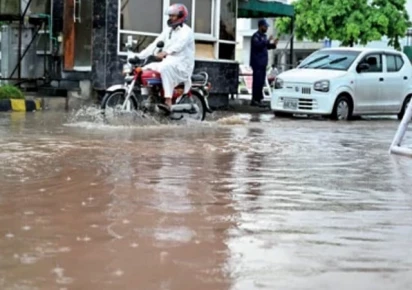
RAWALPINDI/ISLAMABAD: Heavy rain early Friday inundated low-lying areas of Rawalpindi and Islamabad, disrupting daily life and causing concern among residents.

Nullah Leh and all 15 major rainwater drains recorded medium-level flooding, while water up to three feet deep covered roads and streets in several low-lying neighbourhoods. Several underpasses across the twin cities also filled with rainwater, making roads difficult to navigate.

The downpour brought cooler weather but also forced water into homes and shops, affecting routine activities. Dense black clouds, thunder and lightning continued as rain lashed the cities.

The Meteorological Department recorded 65 millimetres of rain in Saidpur, 17mm in Golra, 8mm in Bokra, 19mm at PMD, 17mm in Shamsabad, 7mm in Kacheri, 11mm in Pirwadhai, 9mm in Gawalmandi and 13mm in New Katarian.

WASA Managing Director Azizullah Khan said heavy rain had continued since early morning and that the authority had placed the twin cities on high alert and declared a rain emergency.

WASA teams and heavy machinery moved into vulnerable areas to clear rainwater and keep roads open. Machinery was deployed at Liaquat Bagh, Committee Chowk underpass, Murree Road and low-lying parts of Sadiqabad.

Similar Posts

  • | |

    AJK orders re-polling at 23 stations in Bagh

    MUZAFFARABAD: The Azad Jammu and Kashmir Election Commission has ordered re-polling at 23 polling stations in two constituencies of Bagh district following disruptions during the third phase of the AJK elections. Re-polling will take place on August 15. It will cover nine polling stations in LA-15 Bagh Central and 14 polling stations in LA-16 Bagh East. The decision was taken after voting at several polling stations either failed to start on time or was disrupted and later cancelled. The four constituencies of Bagh and Haveli went to the polls on August 10. Elections in other parts of Poonch Division had earlier been delayed because of law and order concerns. In LA-15, PPP candidate Sardar Ziaul Qamar was leading according to unofficial results. He had secured 16,637 votes. PML-N candidate Mushtaq Ahmed Minhas was in second place with 15,015 votes. Jamaat-i-Islami candidate Brigadier (retd) Dr Mohammad Khan had received 12,259 votes. The nine polling stations scheduled for re-polling have more than 5,000 registered voters. Their votes could have a significant impact on the final result. Former AJK prime minister Sardar Tanveer Ilyas, who contested the constituency on the PTI ticket in the 2021 election, appeared to have fallen out of contention. A close contest was also reported in LA-16 Bagh East. PML-N candidate Sardar Mir Akbar was leading with 19,515 votes. PPP candidate Sardar Qamaruz Zaman had secured 16,290 votes. The 14 polling stations where re-polling has been ordered reportedly account for around 7,200 votes. Meanwhile, the Election Commission announced the preliminary result for LA-14 Dhirkot. Sajid Iqbal Abbasi of the Awami Dast-o-Bazu Party defeated Muslim Conference president Sardar Attique Ahmed Khan. Abbasi secured 40,522 votes, while Attique received 19,637 votes. The result marked a major setback for the Muslim Conference, which has historically been one of the region’s prominent political parties. The result of LA-17 Haveli also became controversial. PML-N candidate Chaudhry Mohsin Aziz demanded a recount and alleged irregularities in election documents. Aziz claimed that Form-24 documents from different polling stations had been altered. Election officials began examining the complaint. Ballot papers and other election material were also reportedly moved under security to Muzaffarabad for further counting and verification. Aziz called on PPP Chairman Bilawal Bhutto-Zardari to support a recount. He claimed that results signed by presiding officers showed him leading by around 8,600 votes. However, state broadcaster Radio Pakistan, citing the Election Commission, reported that PPP candidate and AJK Prime Minister Faisal Mumtaz Rathore had won the LA-17 seat. The AJK elections are being held in three phases. The polls have taken place amid political tensions and law and order concerns in several parts of the region. The Pakistan Muslim League-Nawaz has so far secured 24 seats, while the Pakistan Peoples Party has won 10 constituencies, according to the available results. The first two phases also witnessed allegations of electoral irregularities, clashes and political disputes. Both major parties have traded accusations over the conduct of the elections. The third phase was originally planned across all 11 constituencies of Poonch Division. However, voting was allowed only in Bagh and Haveli because of security concerns.

  • | |

    Six militants killed in Mastung security operation

    Six suspected militants were killed and several others, including male and female suicide bombers, were arrested during an intelligence-based operation carried out by security forces in the Khad Kocha area of Mastung district, Balochistan, on Thursday. The operation was conducted as part of the ongoing Operation Shaban, a joint counterterrorism campaign involving the Pakistan Army, Frontier Corps (FC) and Balochistan Police. The campaign was launched after the terrorist attack on the Mangi Dam Police Station and continues in different parts of the province to eliminate militant networks. According to official sources, security forces launched the raid after receiving credible intelligence about the presence of militants in the area. During the operation, troops surrounded the suspected hideouts and engaged the militants in an exchange of fire. Officials said six militants were killed during the operation, while several others were taken into custody. Those arrested included alleged facilitators as well as male and female suicide bombers who were reportedly planning future attacks. Security personnel also destroyed multiple militant hideouts and recovered a large cache of weapons, ammunition and explosives from the site. The military said security forces have intensified intelligence-based operations across Balochistan to dismantle terrorist networks and prevent attacks on civilians and security personnel. Officials maintained that such operations would continue until militant infrastructure is completely dismantled. Interior Minister Mohsin Naqvi praised the security forces for the successful operation and commended their professionalism and courage. He said the forces had once again foiled the plans of militants attempting to spread violence and instability in Balochistan. He added that the government’s resolve to eliminate terrorism remains unwavering and that the entire nation stands with the armed forces and law enforcement agencies in their efforts to restore peace and stability. The latest operation came only hours after unidentified gunmen attacked a vehicle carrying members of the judiciary on the National Highway in Mastung. A district and sessions judge and his security guard were killed in the attack, while an additional sessions judge and another person suffered serious injuries. Security forces later cordoned off the area, launched a search operation and established checkpoints to trace the attackers. The operation also follows another series of intelligence-based raids carried out a day earlier, during which security forces killed 10 suspected militants and arrested two female suicide bombers along with a facilitator in different areas of Balochistan.

  • | |

    Brad Pitt renews legal fight for Angelina Jolie’…

    Brad Pitt is continuing his years-long legal battle with ex-wife Angelina Jolie over the French winery, Château Miraval, with his legal team seeking access to years of Jolie’s financial records. According to court filings reported by PEOPLE, Pitt’s lawyers are asking for documents connected to Jolie’s income, including records from her Hollywood projects. His team argues that the information could be important because Jolie’s financial circumstances may help establish why she decided to sell her interest in the winery. (People.com⁠) The dispute centers on Jolie’s 2021 sale of her stake in Château Miraval to Tenute del Mondo, part of the Stoli Group. Pitt has argued that the sale violated an agreement between the couple that required his approval before either party could sell their interest. (People.com⁠) Jolie has rejected Pitt’s claims and pushed back against his requests for financial information. Her lawyers argue that Pitt has mischaracterized her position and that she was seeking to separate her finances from him when she sold her stake. (People.com⁠) Why Pitt wants the records Pitt’s legal team reportedly believes Jolie’s financial records could help challenge aspects of her account of the sale. His lawyers have sought information concerning her earnings between 2017 and 2021, including movie contracts and professional income. (People.com⁠) The request has become another point of disagreement despite the couple finalizing their divorce in 2024. Jolie’s side has described the demands as excessive. Her attorneys have argued that the records Pitt wants are not necessary to resolve the central questions surrounding the winery transaction. (People.com⁠) A legal dispute Pitt and Jolie purchased Château Miraval in 2008, when they were together, and developed the property into both a family retreat and a wine business. Their relationship later ended in a divorce, but disagreements involving the estate continued after their separation. (courthousenews.com⁠) The winery case has produced legal filings and disputes over documents, communications and testimony. Both sides have continued seeking information they believe supports their positions. Pitt’s renewed request for Jolie’s financial documents does not settle the dispute. Instead, it marks another stage in the discovery process as the legal battle moves forward. Neither side appears ready to abandon its position. Pitt continues to argue that the records could strengthen his case, while Jolie maintains that the requests go too far. The Château Miraval dispute remains an unresolved chapter in the couple’s legal saga.

  • | |

    ‘Patience has run out’: JI warns government

    Jamaat-e-Islami (JI) Emir Hafiz Naeemur Rehman has warned the government of expanding protests across the country if the petroleum levy is not withdrawn. Speaking at a press conference at the party’s ongoing protest camp outside the Punjab chief minister’s residence in Lahore on Tuesday, the JI chief said the demonstrations had entered their 10th day. He said public patience had reached its limit and demanded immediate relief from rising fuel prices and taxes. Rehman warned that the party could announce a nationwide strike, block roads and march towards Islamabad if the government failed to meet its demands. The JI leader said the date for a nationwide shutdown would be announced on 13th Rabi-ul-Awwal. He added that demonstrations would continue during Eid Milad-un-Nabi ﷺ. According to Rehman, the JI had mobilised supporters in all four provinces. He said the protest movement would be expanded if the government continued to ignore public concerns. He criticised the petroleum levy and other fuel-related taxes, saying ordinary citizens were struggling to cope with increasing living costs. He particularly highlighted the difficulties faced by commuters, students, workers and motorcyclists. Rehman also demanded that the price of roti be reduced to Rs10. The JI emir accused the government of placing the burden of economic difficulties on the public. He argued that fuel price increases had added to the financial pressure on households while the government had failed to provide sufficient relief. He also raised concerns about alleged irregularities in coal imported for independent power producers (IPPs). Rehman called for a forensic audit and an independent investigation into coal-related transactions. He claimed that consumers were being made to pay for expensive fuel, electricity that was not produced and costly arrangements involving IPPs. He said the public should not be forced to bear the financial consequences of alleged mismanagement. Rehman recalled the JI’s earlier campaign against IPPs and claimed that public pressure had helped reduce electricity prices by around Rs10 per unit. The JI chief said his party was prepared to intensify its campaign if the government failed to respond. He described a nationwide shutdown, road blockades and a march on Islamabad as possible next steps. “Do not test our resolve,” he warned. Rehman also criticised the political system and questioned the performance of the ruling coalition. He alleged that governments without genuine public support remained unable to address the problems faced by ordinary citizens. He criticised the PPP’s governance in Sindh and raised concerns about what he called political families dominating Punjab. He also questioned the continued delay in holding local government elections. Regarding the Punjab government, the JI leader said its major announcements could not hide failures in dealing with basic public problems. Rehman maintained that the JI’s campaign was aimed at securing relief for the people rather than serving any personal or political interest. He invited the government’s negotiating team to visit the protest camp and clearly explain when the petroleum levy would be abolished. He said the JI would not travel to Islamabad simply to attend another briefing without concrete assurances. The JI emir also commented on a recent incident involving a security official at Sarhad University of Science and Information Technology in Islamabad. He demanded a transparent, merit-based investigation and said legal action should be taken against anyone found responsible, regardless of their position.

  • |

    Solar boom needs battery storage, grid reforms to sustain momentum

    Islamabad: Pakistan’s rapid expansion of solar energy has already generated billions of dollars in savings, but experts and policymakers on Tuesday warned that battery storage, grid modernization and supportive policies are now essential to sustain the country’s clean energy transition. Speaking at the Solar, Storage and Flexibility 2026 Conference, Federal Minister for Power Awais Leghari said Pakistan’s energy mix is already 50% clean and is targeted to reach 90% by 2035. He stressed that local manufacturing of battery storage systems and the introduction of a daytime Time-of-Use (ToU) tariff would be key to integrating growing solar generation into the national grid. Addressing the conference, PPP Vice President Senator Sherry Rehman said solar energy has already saved Pakistan US$12 billion, with another US$6.3 billion in savings expected this year. She said the country now faces an energy management challenge rather than a generation shortfall, calling for major investments in battery storage, smart grids and modern transmission infrastructure. Rehman said one in every five Pakistani households now uses solar energy and urged international climate finance to prioritize distributed renewable energy, battery storage and affordable financing for households and small businesses instead of focusing mainly on large utility-scale projects. She also opposed the proposed 18% GST on solar equipment, saying it would have slowed Pakistan’s clean energy transition, and called for targeted subsidies, microfinance and supportive regulations to expand access to renewable energy, particularly in underserved and off-grid communities. Renewable energy experts noted that Pakistan has installed an estimated 38 gigawatts of distributed solar capacity, while imports of lithium-ion Battery Energy Storage Systems (BESS) surged 220% in 2025, signalling rapidly growing demand for energy storage. Global renewable energy leaders, including Global Solar Council CEO Sonia Dunlop and Renewable Energy Council Asia Pacific representative John Grimes, described Pakistan’s consumer-led solar revolution as a model for other countries but stressed that a comprehensive battery storage policy and modern electricity grid are now critical to maintaining the momentum.

  • | |

    SHC orders independent probe into HIV cases at Kar…

    KARACHI: The Sindh High Court has directed the provincial government to establish an independent committee to conduct a comprehensive investigation into the reported spread of HIV among children treated at Karachi’s Kulsum Bai Valika Hospital. A two-member bench, headed by Justice Adnanul Karim Memon and comprising Justice Muhammad Jaffer Raza, issued the directions while announcing its reserved judgment on a petition seeking an impartial investigation, medical treatment and compensation for affected children. The court noted that the departmental inquiries and reports submitted so far were not sufficient to establish the actual number of affected patients, determine how the virus was transmitted or assess whether proper infection-control procedures were followed. According to figures presented by the Sindh government, 78 children were identified as HIV-positive at the hospital, while screening in the surrounding area detected another 120 cases. However, the petitioner claimed that the number of infected children could be around 200. The court ordered the Sindh chief secretary to head the inquiry committee and include two senior government officers of at least BS-20 rank. The officers should preferably have no direct administrative connection with the hospital or the investigations already conducted. The committee has been directed to establish the exact number and identities of HIV-positive children and other patients who were treated at the hospital during the relevant period. It will also investigate the possible source and method of HIV transmission on the basis of medical and scientific evidence. The committee will examine whether disposable syringes or other medical equipment were reused, improperly discarded or inadequately sterilised in violation of medical standards and applicable laws. It will also review the hospital’s infection-prevention arrangements, including the procurement, storage and use of auto-lock, auto-destruct and auto-break syringes. The roles of doctors, nurses, technical staff, administrative officials and supervisors will also come under scrutiny. The committee will determine whether any official failed to fulfil a legal, administrative or supervisory responsibility. The inquiry will further assess ongoing departmental proceedings against 37 officials and determine whether those proceedings adequately address individual responsibility. Officials will also examine whether the Sindh Regulation and Control of Disposable Syringes Act, 2010, or any other relevant law was violated and identify those responsible if evidence establishes wrongdoing. The committee has been authorised to examine medical and laboratory reports, screening records, procurement and stock registers, syringe records, duty rosters, infection-control reports, inspection documents, departmental inquiry material and relevant CCTV footage. The inquiry must provide an opportunity for a fair hearing to anyone against whom adverse findings are proposed. The committee has been directed to submit its report to the competent authority and the high court within two months of its formation. The court also directed the Sindh chief secretary to ensure that all affected HIV-positive children and other identified patients receive uninterrupted medical care while the inquiry continues. The treatment must include medicines, diagnostic tests, counselling and follow-up care and must be provided completely free of cost. The government and SESSI will bear all expenses, and no costs are to be recovered from affected children or their families. Treatment should continue for as long as medically necessary. Given the vulnerability of the children, the court also ordered authorities to determine whether affected families are entitled to compensation, financial assistance or other relief under the relevant laws and government policies. The court stressed that no affected child or family should face discrimination, stigma or denial of lawful assistance because of HIV status. It further ordered authorities to protect the privacy and confidentiality of the children’s identities and medical records. The Sindh chief secretary and health department secretary were directed to take immediate corrective and preventive measures at the hospital to prevent further avoidable risks to patients. Authorities were also ordered to ensure strict compliance with infection-control procedures and the law governing disposable syringes. The court said the case involved fundamental rights, including the rights to life, health, dignity and fair treatment. It observed that the matter could not be treated merely as an administrative issue because the state has a constitutional responsibility to protect life and ensure proper public health and medical safety. At the same time, the court cautioned that allegations or departmental proceedings alone cannot establish the guilt of individual officials. Responsibility must be determined through evidence and after providing the concerned persons an opportunity to defend themselves. The court also took notice of an incident involving the petitioner, Advocate Tariq Mansoor, during proceedings. According to the order, Mansoor allegedly raised his voice and encouraged people accompanying him, while some individuals reportedly recorded videos inside the courtroom. The court said the incident disrupted proceedings and affected the dignity and decorum of the courtroom. It also noted that the situation was serious enough for the bench to retire to chambers before completing the order. The court issued a show-cause notice to Mansoor, asking why contempt and criminal proceedings should not be initiated against him. Court security officials were also directed to explain an alleged security lapse that allowed a group of people to enter the courtroom and disrupt proceedings. The Sindh High Court Bar Association and Sindh Bar Council were asked to intervene and take appropriate measures regarding the alleged misconduct.

Leave a Reply

Your email address will not be published. Required fields are marked *