ihc reserves verdict
| |

IHC reserves verdict on judges’ appointments ple…

The Islamabad High Court (IHC) on Thursday reserved its verdict on the maintainability of a petition challenging the delay in the approval of judicial appointments for high courts across the country.

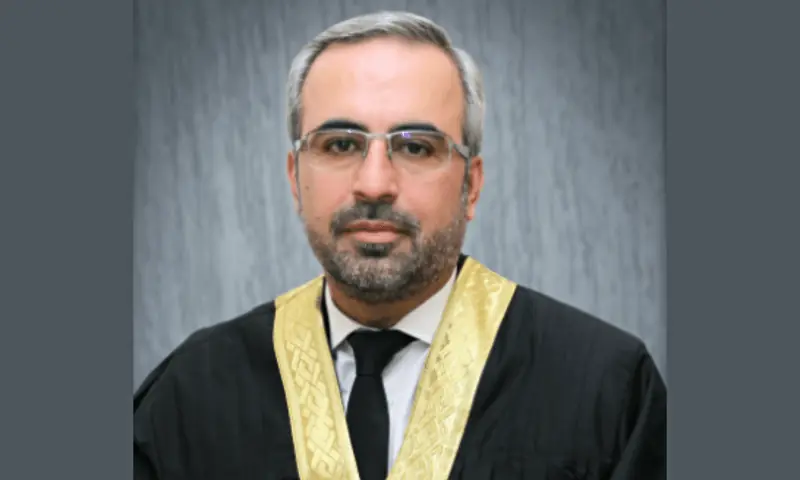
Justice Arbab Muhammad Tahir heard the petition filed by advocate Luqman Zafar Chaudhary through his counsel Zahid Asif Chaudhry. The petitioner requested the court to direct President Asif Ali Zardari to approve a summary forwarded by the prime minister for the appointment of 19 additional judges and the confirmation of five judges in the Islamabad, Lahore, Sindh, Balochistan and Peshawar high courts.

During the hearing, the petitioner’s lawyer argued that the Judicial Commission of Pakistan (JCP) had recommended the appointments during its meetings held on July 20 and 21. He said the summary was later sent to the president for approval, but no decision has been made despite the passage of more than two weeks.

The counsel maintained that the delay is affecting the functioning of the superior judiciary. He informed the court that the tenure of an additional judge of the Sindh High Court has already expired, while the terms of four additional judges of the Peshawar High Court are expected to end within the coming days.

The lawyer also told the court that reports suggest the government may issue notifications regarding the appointments within the next 48 hours.

Justice Tahir repeatedly questioned whether a constitutional petition could legally be maintained against the president. He asked the petitioner’s counsel to cite any previous court ruling in which a writ had been issued against the president regarding the exercise of constitutional powers.

The court observed that the judgments presented by the petitioner did not support the argument that courts could direct the president in matters governed by Article 48 of the Constitution. Justice Tahir asked whether any legal precedent existed requiring the president to act on such matters through a judicial order.

The petitioner’s counsel argued that Article 48 requires the president to act on the advice of the prime minister or the cabinet. He maintained that the president has no independent authority to indefinitely delay judicial appointments once the Judicial Commission has completed its recommendations.

The lawyer further argued that the Ministry of Law is the competent authority to issue appointment notifications after the completion of the constitutional process. He claimed that the president’s role in the appointment process is largely formal and that unnecessary delays should not hinder the functioning of the judiciary.

The petitioner requested the court to seek responses from the federal government, the Prime Minister’s Office and the Ministry of Law regarding the status of the pending summary. However, the court declined to issue notices at this stage.

Similar Posts

  • Four Thai Soldiers Killed, Three Wounded in Battle for Strategic Hill

    UBON RATCHATHANI – Four Thai soldiers were killed and three others wounded in intense fighting for control of Mount 677 in the Chong Anh Ma area of Ubon Ratchathani province today, according to Thai military sources. The Second Army Region confirmed that Thai forces have now successfully seized full control of the strategic hilltop. Thai […]

  • HRH Princess Sirivannavari Awarded France’s Prestigious Grand Officier De La Légion D’honneur

    PARIS, France — Her Royal Highness Princess Sirivannavari Nariratana Rajakanya has been awarded the Grand Officier de la Légion d’Honneur, one of France’s highest distinctions, in recognition of her contributions to promoting French culture, the French art de vivre, and the enduring friendship between France and Thailand, according to an official statement from the Thai […]

  • |

    Emilio Gay boosts England ahead of Pakistan Tests

    BECKENHAM: England have received a timely boost ahead of their Test series against Pakistan, with opener Emilio Gay included in the Professional County Club Select XI squad for a three-day warm-up match. Gay’s participation is encouraging news after the left-handed batter suffered a right shoulder injury while representing Durham against Middlesex in the One-Day Cup last week. He experienced discomfort early in his innings before aggravating the problem while playing a straight drive against Toby Roland-Jones. The 26-year-old was forced to leave the field after scoring nine runs from 17 deliveries, raising concerns over his availability for England’s upcoming Test assignment. However, medical scans reportedly showed no serious damage, allowing Gay to return to competitive action as England assess his fitness. The warm-up fixture at Beckenham was initially scheduled for four days but has been shortened to three following an agreement between the England and Wales Cricket Board and the Pakistan Cricket Board. Gay will feature alongside England Test squad members Shoaib Bashir and Matthew Fisher in the PCC Select XI. The match could provide England with an important opportunity to monitor Gay’s shoulder before the first Test. Gay earned his place in England’s Test plans after an impressive run of form and made his international debut earlier this summer. His availability is particularly significant as England reshape their batting line-up following Ben Stokes’ retirement. Bashir, meanwhile, remains highly regarded by England’s selectors despite limited recent county appearances. The young spinner may not feature in the Test XI, with England considering a four-seamer attack and relying on Dan Lawrence and Joe Root for occasional off-spin. The PCC Select XI will be coached by England Under-19 head coach Mike Yardy, with the England Lions head-coach position currently vacant. For England, Gay’s return offers a welcome sense of relief — but the warm-up match will reveal whether the opener is truly ready for the pressure of Test cricket against Pakistan. PCC Select XI squad Tom Haines (c), Shoaib Bashir, Luc Benkenstein, Caleb Falconer, Matt Fisher, Emilio Gay, Nathan Gilchrist, Josh Hull, Manny Lumsden, James Rew, James Sales, Charlie Tear, Noah Thain, Saif Zaib.

  • 28 mine workers killed, Parliament raises safety concerns

    Islamabad: A serious safety crisis in Pakistan’s mining sector came under the spotlight after the National Assembly Standing Committee on Overseas Pakistanis and Human Resource Development questioned why many mine workers remain unregistered even after losing their lives in dangerous mining accidents. The committee expressed concern that families of deceased workers may struggle to receive compensation and welfare support because authorities lack complete records of people working inside mines. Members demanded immediate steps to register all mine workers and ordered a review of mining safety arrangements across the country. The issue was discussed during the meeting of the Standing Committee on Overseas Pakistanis and Human Resource Development, chaired by Syed Rafiullah, following a deadly coal mine accident in Balochistan. Members offered prayers for the workers who lost their lives and said repeated mining accidents show serious weaknesses in monitoring and enforcement systems. During the discussion, committee members questioned officials about whether the workers who died in the accident were officially registered. Officials informed the committee that complete registration details were unavailable, raising concern among members about the protection available to mining workers and their families. The committee questioned how workers could spend their lives working in dangerous conditions while government departments lacked basic information about their employment status. Members rejected the argument that many mine workers are seasonal employees and therefore difficult to register. They said anyone working in a mine, whether permanent, temporary or seasonal, should be counted as a worker and provided protection. The committee stressed that registration should not depend on the type of employment. It said workers who risk their lives underground deserve safety measures, legal protection and welfare benefits. Officials informed the committee that worker registration involves different institutions, including provincial departments and labour related organisations. However, members questioned why coordination gaps continue despite years of discussions. The committee also raised concerns over mine inspections and safety checks. Members asked when mines were last inspected, whether safety rules were followed and how many workers were present at different mining sites. Officials stated that mining safety falls under provincial responsibility, but the federal government cannot ignore the issue and must collaborate with provinces to improve worker protection. The committee directed authorities to conduct a complete survey to identify how many mines are operating, how many workers are employed and how many workers are officially registered. The Federal Minister assured the committee that action would be taken and a long term strategy would be developed to ensure every mine worker is registered. Another major concern raised during the meeting was the lack of emergency facilities near mining areas. Members questioned whether proper trauma centres, ambulances and emergency services were available near mines to save workers after accidents. They pointed out that discussions about emergency facilities had taken place in previous years, but clear improvements were still needed. The committee said safety rules cannot remain only on official documents; they must be visible at mining sites through practical action. Members also suggested reviewing mining leases and ensuring that mine operators follow safety standards before continuing operations. The committee recommended that all provinces and Gilgit Baltistan review mining conditions, worker registration systems and compliance with safety procedures. Officials informed the committee that a survey would be carried out to assess the situation on the ground and identify gaps in the current system. The committee also discussed the Workers Welfare Fund and recommended taking up the issue of its management and distribution at the Council of Common Interests level. Members stressed that workers across Pakistan must receive their legal rights and no labourer should remain invisible in government records.

  • |

    Accused architect of Rohingya persecution Min Aung Hlaing arrives in Thailand for official state visit

    Myanmar’s military leader Min Aung Hlaing has arrived in Thailand for an official state visit, marking his first international trip to a neighbouring democracy since assuming the role of civilian president following highly contested national elections. The visit comes despite international condemnation surrounding Min Aung Hlaing’s role as the chief commander responsible for the 2017 campaign of mass violence and expulsion against Muslim Rohingyas in Rakhine State. Already subject to Western sanctions and target of an International Criminal Court arrest warrant application for crimes against humanity, the former general faces renewed calls for accountability. Human rights organisations, including the Burmese Rohingya Organisation UK, have petitioned international judiciaries to coordinate with Thai authorities to execute active arrest warrants regarding acts of genocide and persecution. Thai Prime Minister Anutin Charnvirakul received Min Aung Hlaing with full diplomatic honours at Government House in Bangkok, including an official guard of honour and a scheduled state dinner. The two leaders are set to preside over a bilateral business forum aimed at bolstering economic ties, cross-border security, and trade infrastructure between the nations. Thailand’s formal reception of Min Aung Hlaing highlights a policy of “calibrated re-engagement” with Naypyidaw, separating Bangkok from several Association of South East Asian Nations (ASEAN) members that continue to exclude Myanmar’s leadership over unfulfilled peace commitments. While Thai officials maintain that direct high-level dialogue is essential to address shared border concerns and transnational crime, rights campaigners argue that hosting the general grants undeserved diplomatic legitimacy to an administration accused of severe human rights violations.

  • | |

    US military depletes long-range missile stockpile …

    The United States has burned through nearly all of its long-range precision missiles during five months of fighting in Iran, according to three people familiar with internal defense data, fueling concern inside Washington about military readiness for future crises. The weapons in question are primarily the Army’s ground launched systems, the Army Tactical Missile System and the newer Precision Strike Missile. Two of the sources said the military has expended virtually its entire supply of both. These munitions let forces strike targets accurately from a safe distance and have already proven vital in Ukraine, where American supplied versions allowed Ukrainian troops to hit targets deep inside Russian territory. The Precision Strike Missile represents a more advanced generation designed to eventually replace the shorter range ATACMS. Defense analysts note that such long-range munitions, each costing more than a million dollars, would also play a central role in any future confrontation with China. The sources declined to specify exact remaining quantities of either weapon. President Donald Trump launched the joint offensive against Iran alongside Israel in February, initially predicting a brief campaign. Instead, the conflict has stretched on for months, and the three sources said they worry that shrinking missile reserves could weaken the country’s ability to deter rivals such as Russia and China going forward. A fourth person familiar with the matter said Central Command, which oversees American forces across the Middle East, has nearly exhausted the land based missiles it held before the war started, though it has managed to replenish supplies by drawing from military stockpiles based elsewhere around the world. All four sources spoke on condition of anonymity. Asked to respond to the stockpile figures, the White House shared a statement from Trump asserting the country holds “far more munitions than anyone in the world” and more than it currently requires. He added that American defense manufacturers are producing at record volumes while also expanding factory capacity. Analysts largely agree that certain categories of weapons, including artillery shells and select missile types, are rolling off production lines at historic rates. Still, they caution that overall output may fall well short of what a prolonged conflict would demand. Lockheed Martin, which manufactures both the ATACMS and the Precision Strike Missile along with the THAAD missile defense system, did not respond to questions about the stockpile figures or the president’s remarks. Raytheon, maker of the Tomahawk cruise missile and the Patriot interceptor, also did not respond to inquiries. Chief Pentagon spokesperson Sean Parnell defended the state of American readiness, saying the military maintains a deep arsenal capable of protecting national interests and has carried out multiple successful operations across combatant commands. Internal debate over munitions The stockpile figures have circulated through federal government channels over the past week amid tense internal discussions about how much longer American forces can keep striking Iranian targets without depleting reserves needed to respond to crises elsewhere in the world. One source said the drawdown in ATACMS and Precision Strike Missile inventories reflects a deliberate choice by the administration to avoid riskier tactics, such as sending piloted aircraft to drop bombs directly over Iranian territory. Because these missiles allow strikes from a distance, analysts consider them especially valuable against an adversary with sophisticated air defenses, a category that includes China. A March assessment from the Center for Strategic and International Studies noted that these weapons have already been used against targets inside Iran. That same assessment found that Precision Strike Missile stocks started the conflict relatively low, since the weapon is still new to the arsenal, though the Army has placed large orders set for delivery in 2027. Military officials have said ATACMS production is winding down as manufacturing shifts toward the newer missile system. Military leaders have spent weeks warning the president that stocks of defensive weapons, including the Patriot interceptor system effective against ballistic missiles, are running low, according to two of the sources. Several news outlets reported last week that Trump opted against launching another large scale offensive inside Iran partly because military advisers raised concerns about dwindling supplies. A separate US official disputed that account, saying the president held off due to pressure from Gulf states rather than munitions concerns. The extended campaign has also reignited debate over the scope of presidential war powers, since no formal declaration of war or authorization for the use of military force has gone before Congress. Defensive systems also strained A separate assessment published last week by the Center for Strategic and International Studies estimated that the military used roughly 65 percent of its Patriot interceptor stock between February and July, while THAAD interceptor supplies fell by at least 38 percent compared with pre war levels. Two of the sources said those figures align with internal government data, though the underlying numbers could not be independently verified. The military has also used up close to half of its worldwide Tomahawk cruise missile inventory since fighting began, according to one source, a figure that likewise could not be independently confirmed. The Tomahawk, typically launched from Navy destroyers, cruisers and submarines, has long served as the primary tool for striking heavily defended targets without exposing pilots to risk. Raytheon, now part of RTX, has reached a preliminary multi year deal with the Pentagon to expand Tomahawk output alongside other munitions as officials work to rebuild depleted stockpiles amid the ongoing conflict.

Leave a Reply

Your email address will not be published. Required fields are marked *