indian police use
|

Indian police use water cannons to disperse Bihar exam protesters

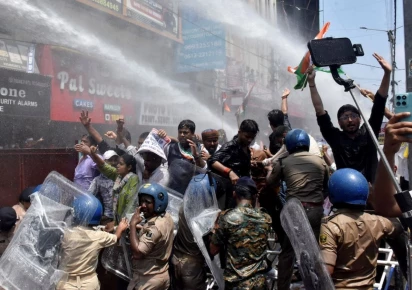
PATNA: Indian police used water cannons and detained several protesters in Bihar on Tuesday as students demonstrated against alleged irregularities in a civil services recruitment examination.

The protesters were demanding cancellation of the Bihar Public Service Commission (BPSC) examination over allegations that question papers had been leaked and that other irregularities had affected the recruitment process.

The protesters attempted to march towards the governor’s residence in the state capital, Patna. Police blocked their route and used water cannons after demonstrators pushed through barricades.

Several protesters were also taken into police custody and transported away from the demonstration site.

The BPSC examination is one of Bihar’s most competitive recruitment tests. It is conducted to select officials for various positions in the state administration.

The latest demonstrations are linked to an examination held in December 2024. More than 300,000 candidates reportedly competed for around 2,000 positions. The recruitment process was completed in June after multiple stages, including examinations and interviews.

Authorities have previously rejected claims of a widespread question paper leak. However, a re-examination was ordered at one examination centre following complaints at the time.

Police later said the protest had become peaceful. Senior police officer K.S. Anupam said most of the protesters’ demands had been addressed by the government.

Bihar Education Minister Mithilesh Tiwari also said the government had responded to the students’ concerns. He maintained that discussions with the protesters remained possible and that the government’s doors were open for further dialogue.

The dispute comes amid growing student protests in India over alleged irregularities in competitive examinations.

Similar demonstrations have taken place in other Indian states, with concerns ranging from alleged paper leaks to recruitment procedures and examination management.

In neighbouring Jharkhand, protests over similar allegations previously resulted in the cancellation of civil service examinations.

The latest unrest has also added to pressure on authorities to strengthen safeguards around competitive examinations, which attract hundreds of thousands of applicants seeking government jobs.

Similar Posts

  • |

    Snapchat cracks down on fully AI-made videos flooding Spotlight

    Snapchat is now drawing a clear line between videos made by humans and those made entirely by machines. The company is betting this move will make its Spotlight feed worth scrolling through again. On Friday, Snap confirmed a major change to its Spotlight recommendation system. Videos that are completely AI-generated will no longer be surfaced through recommendations. Creators can still post this type of content on the platform. However, it will only reach their existing followers going forward. This effectively cuts off the discovery boost that once made Spotlight appealing for fully automated content. Snap isn’t rejecting AI tools altogether, though. Videos edited or enhanced using Snapchat’s own built-in AI features will remain eligible for recommendations. These videos will also carry a visible label, letting viewers know AI played a role in the process. According to Snap, the real issue here comes down to authorship, not the technology itself. Content generated purely from a prompt, without any human involved in filming, performing, or editing, is what’s being pushed out of recommendations. This decision follows similar moves from other major platforms in recent months. YouTube recently revised its monetization policy to exclude videos built around generic, template-based content. That update came after reports last year revealed that several AI-driven creators had built massive followings and earned significant ad revenue through such content. LinkedIn has made changes of its own as well. The platform is now allowing users to report AI-generated posts. At the same time, it’s removing its built-in AI writing prompt that previously encouraged automated post creation. Substack has taken things a step further. The platform introduced a detection system designed to identify AI-generated articles. Speaking on the matter, CEO Chris Best warned that platforms which continue rewarding fake, synthetic content risk starting what he called a race to the bottom. As for Snap, some details remain unclear. The company has not explained exactly how it plans to distinguish fully AI-generated videos from AI-assisted ones at a larger scale. It also hasn’t confirmed whether this policy will eventually expand beyond just Spotlight recommendations into other parts of the app. For now, though, the move adds to a growing pattern across social media. Platforms increasingly appear to be prioritising authentic, human-made content over mass-produced material flooding user feeds every day.

  • | | |

    TTAP announces relief mission to AJK amid tensions

    ISLAMABAD: The opposition alliance Tehreek Tahaffuz-e-Ayeen Pakistan (TTAP) has announced that its senior leadership will travel to Azad Jammu and Kashmir (AJK) on Monday with relief supplies, while criticizing the government’s handling of the situation in the region and calling for dialogue to address ongoing political tensions. Speaking at a press conference in Islamabad, TTAP spokesperson Akhunzada Hussain Yousafzai said the delegation would carry humanitarian assistance for affected residents and express solidarity with people in Rawalakot, where a protest sit-in has continued in recent days. Yousafzai alleged that the government had responded to public dissent with force rather than engagement. He claimed that, according to what he described as verified information, dozens of people had lost their lives during the unrest. His claims have not been independently verified, and no official confirmation of the casualty figures was immediately available. The spokesperson also alleged that leaders associated with the Joint Awami Action Committee (JAAC) had either been killed or had bounties placed on them. Authorities have not publicly responded to these specific allegations. Political tensions in Azad Jammu and Kashmir have persisted since widespread demonstrations erupted last year over demands for constitutional, administrative and governance reforms. The JAAC-led protests called for a broad package of changes, including an end to privileges for the political elite, the abolition of 12 legislative assembly seats reserved for refugees and the removal of the existing quota system. The unrest resulted in deadly clashes before negotiations between the government and the JAAC produced an agreement covering several core demands. As part of that understanding, both sides agreed to establish a high-level committee to examine the issue of refugee seats in the AJK Legislative Assembly. However, the issue remains unresolved. The JAAC continues to demand the abolition of the reserved refugee seats, while the government maintains its opposition to the proposal. Yousafzai argued that attempts to suppress opposing voices had deepened political divisions and contributed to the emergence of public movements in the region. He maintained that all outstanding issues could be resolved through meaningful negotiations rather than confrontation. The opposition alliance said its planned visit is intended to provide humanitarian support while also urging all stakeholders to pursue peaceful dialogue. Political observers say the coming days could prove significant as discussions over governance reforms and representation continue to shape the political landscape in Azad Jammu and Kashmir.

  • | |

    Punjab Govt, PPP on collision course after Azma Bo…

      Azma accuses PPP of disrespecting elders as Bilawal faces sharp attack. PPP’s Lahore convention plans halted after govt denies approval. Punjab’s ruling PML-N and the Pakistan Peoples Party appeared to be on a collision course on Friday, as a sharp verbal attack by a senior provincial minister coincided with the sudden halting of PPP convention preparations in Lahore, leaving the two parties at odds on multiple fronts. Punjab Minister for Information and Culture Azma Bokhari strongly criticised PPP spokespersons, saying they should choose their words carefully and learn to respect their elders. She said it was ironic that people she described as coming from a “blackmailing mandate” were now taunting others.  Bokhari said PPP leaders repeatedly mock a person old enough to be their father by making faces and chanting “Raiwind, Raiwind.” She asked whether PPP leaders did not consider it disrespectful when their own leader ridicules someone of a father’s age. She said PPP leaders had turned Raiwind into a subject of mockery and routinely insult senior figures through their gestures and remarks.The minister warned that if such language continued, it would be met with an appropriate response. She said Bilawal Bhutto was not a figure beyond criticism. She further accused him of repeatedly naming Punjab’s cities in his speeches to spread what she called falsehoods and misleading propaganda, questioning whether his conduct was serious at all. The sharp exchange came on the same day that preparations for a PPP workers’ convention at Greater Iqbal Park were halted. The Lahore district administration said the party had not secured formal written permission for the event, even though a stage and other arrangements were already in place. The convention had been planned for July 25, ahead of celebrations marking President Asif Ali Zardari’s birthday on July 26.  District authorities questioned why preparations had begun without official approval and asked PPP leadership to explain. Lahore PPP President Faisal Mir said the party had moved ahead after receiving verbal assurances from the Punjab Chief Minister’s Office that there was no objection to the event. He said preparations were made in good faith, but officials later stepped in and stopped the work.Mir criticised the administration, saying access to the venue had been restricted and vehicles carrying chairs and other equipment had been blocked from reaching the site. He said the party remained committed to holding the convention peacefully and said he was ready to face arrest if needed.The Chief Minister’s Office did not comment on claims that approval had been given through the chief minister’s principal secretary. PPP leaders shared videos on social media showing workers, the stage and seating arrangements already prepared, signalling the party’s intent to proceed regardless.Party sources admitted that written permission had not been obtained but argued that verbal approval was enough to begin preparations. They said local police had been informed of the gathering in advance.The convention was expected to feature PPP Chairman Bilawal Bhutto Zardari addressing workers through video link, along with senior leaders including Raja Pervaiz Ashraf, Hassan Murtaza and Qamar Zaman Kaira. Officials said permission could still be granted if formalities were completed, but noted that approving the event without standard procedure could complicate similar requests from other parties, including the Pakistan Tehreek-e-Insaf, which is seeking permission for a Lahore gathering next month.Taken together, the harsh words from Bokhari and the administrative roadblock facing PPP’s convention point to a provincial government and opposition party growing increasingly hostile toward one another, with neither side showing signs of backing down.

  • | | |

    Kuwait’s foreign minister arrives in Pakistan on…

    Kuwait’s Foreign Minister, Sheikh Jarrah Jaber Al-Ahmad Al-Sabah, arrived in Islamabad on Tuesday for an official visit to Pakistan at the invitation of Deputy Prime Minister and Foreign Minister Ishaq Dar. The visit highlights the longstanding friendship and growing diplomatic cooperation between the two countries. According to Pakistan’s Ministry of Foreign Affairs, the Kuwaiti foreign minister received a warm welcome upon his arrival at Islamabad International Airport. Additional Secretary for the Middle East, Zahid Hussain, welcomed the distinguished guest on behalf of the Pakistani government. During the visit, senior officials from both countries are expected to hold high-level discussions on a wide range of bilateral, regional, and international issues of mutual interest. The talks will focus on strengthening political cooperation, expanding economic partnerships, enhancing trade and investment opportunities, and promoting collaboration in various sectors. The Foreign Office stated that the visit reflects the deep-rooted brotherly relations between Pakistan and Kuwait, built on a shared history, mutual trust, and close cooperation over the years. Both nations have maintained friendly diplomatic ties and regularly work together on regional and international platforms. Pakistan and Kuwait enjoy strong cooperation in labor, energy, investment, and defense, while a large Pakistani expatriate community continues to contribute significantly to Kuwait’s economy. The leadership of both countries has repeatedly expressed a commitment to further strengthening these ties through increased engagement and high-level exchanges. Officials believe the visit will provide an opportunity to review the progress made in bilateral relations and identify new areas for collaboration. Discussions are also expected to cover regional developments in the Middle East and South Asia, as well as other international issues of common concern. The official visit underscores the shared commitment of Pakistan and Kuwait to enhancing diplomatic relations, promoting economic cooperation, and expanding strategic partnerships. It also reaffirms both countries’ desire to deepen engagement through regular dialogue and continued collaboration for mutual benefit. The outcomes of the meetings are expected to contribute to stronger Pakistan-Kuwait relations and pave the way for future initiatives aimed at boosting trade, investment, and regional cooperation.

  • | |

    Naqvi vows full support for Balochistan security

    Interior Minister Mohsin Naqvi has assured Balochistan of continued federal support to improve security and restore lasting peace in the province. Naqvi visited Quetta on Saturday. He met Balochistan Chief Minister Mir Sarfraz Bugti. The two leaders jointly chaired a high-level meeting on the province’s law and order situation. The meeting reviewed the latest security situation in Balochistan. Officials also discussed ongoing security operations and future plans to deal with terrorism. Chief Minister Bugti briefed the meeting on the challenges facing the province. He also explained the measures being taken to improve security and maintain peace. The meeting decided to further strengthen the Counter-Terrorism Force (CTF) and Balochistan Police. The participants agreed that the professional capabilities of both forces must be improved. The authorities also agreed to speed up decisions aimed at strengthening the provincial police force. The federal government assured Balochistan that it would provide the required resources and support. Naqvi said the federal government would continue to provide every possible assistance to Balochistan. He said restoring peace required immediate and effective implementation of a comprehensive security plan. The interior minister also called for greater use of the experience of former Balochistan police chiefs. He said their expertise could help authorities develop a stronger and more effective security strategy. Naqvi stressed the importance of modern technology in counterterrorism operations. He also highlighted the need for better intelligence and stronger coordination between security institutions. He said the federal and provincial governments were working together to address the security challenges. According to Naqvi, coordinated efforts are essential for establishing lasting peace in the province. Chief Minister Bugti also reaffirmed his government’s determination to fight terrorism. He said the provincial government would remain prepared to respond to threats on every front. Bugti made it clear that the government would not surrender to pressure from terrorists. He said the writ of the state would be established across Balochistan. The chief minister said no space would be allowed for terrorists to operate. He also stressed that security agencies would continue taking steps to protect citizens and public institutions. Bugti said the government’s strategy would not focus only on security operations. He said improving opportunities for young people was equally important. According to the chief minister, education, skills development, employment and positive activities could help young people build better futures. He said promoting merit would help restore the confidence of the province’s youth. He added that young people should receive equal opportunities to succeed. Bugti also highlighted the strong connection between peace and development. He said security, progress and prosperity must move forward together. He said the provincial government would continue working with the federal government to improve law and order. Development projects would also be accelerated across the province. The meeting came as Balochistan continues to face serious security challenges. Several attacks have occurred in the province in recent months. Security forces and law enforcement agencies have increased operations against militant groups. The Pakistan Army, Frontier Corps and Balochistan Police have also continued joint efforts in affected areas. Officials believe stronger intelligence sharing and better coordination can help prevent future attacks. Modern equipment and improved training are also being considered important parts of the security strategy. The federal and provincial governments have therefore agreed to combine security measures with development initiatives. They say improving employment, education and skills opportunities for young people is essential for long-term stability.

Leave a Reply

Your email address will not be published. Required fields are marked *