indian soldier accused
|

Indian soldier accused of killing wife while on leave in Punjab


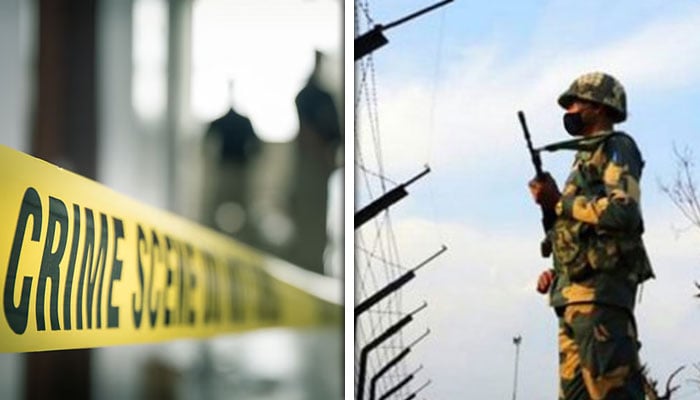
PUNJAB, INDIA: An Indian Border Security Force (BSF) personnel has allegedly killed his wife while he was home on leave in Punjab, with the incident taking place in Hoshiarpur district, according to Indian media reports.

The BSF personnel has been accused of murdering his wife and allegedly attempting to conceal the circumstances surrounding her death by claiming that she had accidentally fallen from the roof of their house.

According to reports, the couple had been married for around 12 years and had two children. Family members reportedly said that tensions between the husband and wife had been frequent because of the man’s alleged behaviour. The victim’s family has accused him of repeatedly subjecting her to physical abuse during their marriage.

In an application submitted to the police, the victim’s family alleged that the accused reached home on August 13 and severely assaulted his wife shortly after arriving. The family claimed that the incident resulted in serious injuries to the woman.

According to the complaint, the victim’s parents were informed the following morning that their daughter was in critical condition and had been taken to a hospital. They immediately went to the hospital, where they were reportedly informed that she had succumbed to her injuries.

The victim’s family said they observed multiple severe marks of physical assault on her body. Based on the condition of the body and the family’s previous concerns about the couple’s relationship, they raised suspicions about the explanation that she had fallen from the roof.

The victim’s father accused his son-in-law of having an extremely aggressive and violent temperament. He alleged that the accused had physically abused his daughter repeatedly since their marriage and had subjected her to violence on several occasions.

The father further alleged that the accused beat his wife to death and then attempted to avoid arrest and legal consequences by portraying the incident as an accidental fall from the roof.

Following the complaint, police registered a case against the accused husband as well as his uncle and aunt. The BSF personnel has been arrested in connection with the case, while the other two named suspects are reportedly absconding. Police teams are conducting searches to locate and arrest them.

The authorities are investigating the circumstances surrounding the woman’s death and are expected to examine evidence collected from the scene, statements from family members and other relevant material. The allegations made by the victim’s family will also be subject to investigation and legal proceedings.

The case has drawn attention to concerns surrounding domestic violence and the difficulties victims and their families can face when allegations of repeated abuse are involved. The victim’s family has maintained that the woman’s death was not an accident and has demanded legal action against those responsible.

The investigation will determine whether the injuries were caused by an assault and whether the accused deliberately attempted to misrepresent the circumstances of his wife’s death.

Police have not yet announced the final findings of the investigation. The arrested BSF personnel will face further legal proceedings as authorities continue investigating the case, while efforts remain underway to locate the two other suspects named in the complaint.

Similar Posts

  • |

    Saudi Arabia says It seeks strong ties with Iraq

      Riyadh:A senior Saudi government official has reaffirmed the Kingdom’s commitment to maintaining strong and friendly relations with Iraq, stressing that recent airstrikes carried out in Iraqi territory were directed solely at armed militia groups and not at the Iraqi government or its people. According to Arab media reports, the official said Saudi Arabia values its relationship with Iraq and remains committed to strengthening cooperation between the two neighboring countries. He emphasized that the military operation was not intended to undermine Iraq’s sovereignty or harm its citizens, but was instead a response to growing security threats posed by armed militias operating inside the country. The Saudi official stated that the airstrikes specifically targeted the military capabilities of armed militia groups that the Kingdom believes have threatened Saudi national security. He alleged that these militias had launched attacks against key Saudi civilian infrastructure and important economic facilities, including petroleum installations that are vital to the country’s economy. According to the statement, the military operation was carefully planned and limited to militia weapons depots and military storage facilities. Saudi Arabia maintained that these locations were being used to store weapons and launch attacks against strategic sites inside the Kingdom. The official added that the response came only after several months of restraint and patience, during which Saudi authorities had sought to avoid military escalation. The official further accused the militia groups of harming not only Saudi Arabia’s security but also Iraq’s own national interests. He argued that these organizations have damaged Iraq’s relationships with neighboring Arab and Islamic countries by using Iraqi territory and resources as a base for hostile activities against other states. He also claimed that the militias have attempted to weaken Iraq’s diplomatic standing by drawing the country into regional conflicts. According to the Saudi government, the actions of these armed groups threaten regional stability and undermine efforts to promote peace, security, and economic cooperation across the Middle East. Saudi Arabia reiterated that its objective is to protect its national security while preserving positive relations with the Iraqi government. The official emphasized that Riyadh supports Iraq’s sovereignty, stability, and development, and hopes to continue working with Baghdad to address common security challenges through cooperation and dialogue. The statement comes after military strikes carried out on July 29, when United States and Saudi forces reportedly targeted sites linked to alleged Iranian-backed militias in Iraq. According to available reports, the attacks resulted in the deaths of 20 people and left 32 others injured. The strikes have intensified regional tensions and drawn widespread international attention, with concerns growing over the possibility of further escalation in the region. The incident has once again highlighted the complex security situation in Iraq, where various armed groups continue to operate alongside government forces. Regional analysts warn that continued military confrontations could further destabilize the country and increase tensions between regional powers. While Saudi Arabia insists that the operation was a defensive measure aimed solely at preventing future attacks, the developments underscore the fragile security environment in the Middle East. The Kingdom has expressed hope that cooperation with Iraq and other regional partners will help address shared security concerns while preventing further violence and preserving stability throughout the region.

  • | |

    Trump hosts Netanyahu, Zelensky for high level tal…

    WASHINGTON: US President Donald Trump is set to meet Israeli Prime Minister Benjamin Netanyahu and Ukrainian President Volodymyr Zelensky at the White House on Tuesday, as the wars involving Iran and Ukraine enter what officials describe as a decisive and highly sensitive phase. The two leaders are in Washington to attend a memorial service for Senator Lindsey Graham, a prominent Republican ally of Trump and a strong advocate of military support for Ukraine. However, the diplomatic spotlight has shifted to their separate meetings with the US president, which are expected to focus on two of the world’s most volatile conflicts. Trump’s relationship with Zelensky has improved significantly in recent months as Ukrainian forces have slowed Russian advances and intensified strikes on Russian energy infrastructure. Ahead of his meeting, Zelensky said strengthening anti-ballistic missile defence and expanding strategic cooperation with the United States were his top priorities, stressing that efforts to bring peace closer must continue. Despite renewed diplomatic contacts, there is little indication that either the Ukraine war or the widening confrontation involving Iran is nearing an end. Following the collapse of a ceasefire linked to the Iran conflict, Trump has said he paused US airstrikes to allow diplomacy another opportunity, while continuing consultations with regional allies. Netanyahu arrives in Washington amid signs of growing frustration within theWhite House over the lack of progress toward a broader settlement related to Iran. Tensions between Trump and the Israeli leader have become more visible in recent weeks, including reports of a heated phone conversation in June that was later publicly acknowledged by Trump. According to sources familiar with the discussions, Netanyahu is also seeking to reinforce his political standing ahead of Israel’s October 27 election. A public display of close coordination with Trump could help him domestically, where he has faced pressure in opinion polls. Before departing for Washington, Netanyahu said the talks would focus primarily on Iran, while also addressing regional security and efforts to expand peace agreements with Arab states. A White House official said Trump plans to discuss the Iran conflict, tensions between Israel and Lebanon, and the future of the Abraham Accords. The administration is reportedly continuing efforts to encourage Saudi Arabia to join the accords, although Riyadh has maintained that any normalisation with Israel would require a credible pathway toward Palestinian statehood. Trump struck a notably warmer tone when speaking to reporters aboard Air Force One, describing Netanyahu as a strong wartime leader and saying the two had worked well together.Zelensky is expected to hold a brief private meeting with Trump, likely without media present. Ukrainian officials say securing additional Patriot missile interceptors is their most urgent request, as Russian missile and drone attacks continue almost daily. The Ukrainian president is also expected to push for expanded air-defence cooperation, progress on a drone agreement with the United States, and discussions on Trump’s proposal to allow Ukraine to produce Patriot interceptors under licence. White House officials said the meeting with Zelensky would focus on the ongoing peace process between Russia and Ukraine and reiterated that the administration believes the time has come to seek an end to the war. After the White House talks, Zelensky is expected to visit Capitol Hill for meetings with all 100 US senators, underscoring the continuing bipartisan interest in Ukraine’s defence despite growing debate over the pace and delivery of American military assistance.

  • |

    Netanyahu accuses New York Mayor Mamdani of ‘fomenting hate’ and rejects ICC war crimes charges

    Israeli Prime Minister Benjamin Netanyahu has strongly criticised New York City Mayor Zohran Mamdani, accusing him of “fomenting hate” and attempting to divide the city’s population. The sharp exchange follows comments by Mamdani asserting that Netanyahu is unwelcome in New York City due to ongoing International Criminal Court (ICC) war crimes charges linked to the war in Gaza, and urging federal authorities to execute the court’s arrest warrant when the prime minister attends the United Nations General Assembly in September. Appearing on Fox News Channel, Netanyahu dismissed the ICC charges as “bogus” and claimed the allegations were designed to divert attention from internal misconduct within the prosecutor’s office. He expressed concern over eroding bipartisan support for Israel within the United States, warning that political rhetoric from progressive Democrats risks fueling rising anti-Semitism in major American cities. Despite the mayor’s stance, US President Donald Trump has publicly assured Netanyahu that he will face no risk of arrest during his visits to the United States.

  • |

    Zelensky accuses Iran of direct role in Russia’s war against Ukraine

    Ukrainian President Volodymyr Zelensky has accused Iran of directly participating in the war against Ukraine through its continuous military support for Russia. Speaking on potential threats following a recent incident involving an Iranian vessel, Zelensky urged caution to prevent the opening of another front while stressing that Ukraine must remain prepared for all scenarios. He stated that Tehran became a direct participant by supplying Moscow with thousands of attack drones from the outset of the full-scale invasion and subsequently granting licences for local production. He added that both Iran and North Korea have effectively attacked Ukraine by supplying Russia with weaponry, including missiles, drones, and artillery ammunition. In response, Iranian Foreign Ministry spokesperson Ismail Baghaei rejected assertions that Tehran had sought negotiations with the United States to end hostilities, asserting that Iran will independently determine matters of war and peace. Baghaei added that Washington had initially expected an Iranian surrender within days of commencing attacks, yet months later, the United States continues to face severe challenges in the region.

  • | |

    Rising heat pushes even Africa’s resilient c…

    Camel herders and scientists across Africa say that rising temperatures are now overwhelming animals long regarded as uniquely suited to desert extremes, with herds facing rising death tolls, illness, and shrinking grazing lands. In the Afar region of northeastern Ethiopia, among the hottest and driest places on the planet, nomadic herders traditionally lead camel caravans loaded with salt across the desert. Ali Umer, a 40 year old herder from Semera who owns around 500 camels, said he watches his animals struggle under conditions he has never seen before. He described blistered feet, watery eyes, and burned skin among his herd, and said the sand itself now scorches the animals as they rest. Umer said he lost eight camel calves in a single month due to extreme heat, and added that even the wind no longer brings relief. He said the changes have become noticeably worse in recent years. Umer’s account matches what researchers and veterinarians are documenting across the continent. Scientists and animal welfare specialists point to stress, fatigue, dehydration, and rising disease rates as direct consequences of extreme heat, while indirect effects such as water shortages, vegetation loss, and disappearing shade compound the damage. North Africa and the Horn of Africa are home to roughly 80 percent of the world’s dromedary camel population, the single humped variety that farmers across the region have increasingly relied on because of its reputation for withstanding drought and heat. A 2025 study examining herder perceptions in southern Ethiopia found that climate variability had measurably harmed camel health, productivity, and reproduction. The crisis appears especially acute in Somalia. Research published in June found that drought linked camel deaths have affected nearly 46 percent of camel owning households, based on a survey of almost 6,000 pastoral families. The mortality was heavily concentrated in northern areas, with the Sool region recording a death rate of nearly 73 percent. Experts say extreme heat is the central driver behind the region’s drought conditions, though poor veterinary access and weak herd management make outcomes worse. Atmospheric scientists have linked the severe 2021 to 2022 drought to sustained high temperatures, which accelerate evaporation from soil and water sources and increase the rate at which plants release moisture into the air. Veterinarians on the ground report a growing caseload tied to heat. Hassan Nuya Guyo, a veterinary officer in Marsabit county in northeastern Kenya near the Ethiopian border, said his clinic is seeing a sharp rise in hyperthermia cases that leave camels vulnerable to secondary infections. He said camel deaths in the county have risen more than 15 percent over the past two years due to heat and drought. Separate research from the Horn of Africa links heat stress to higher disease rates and falling milk yields among camel herds. A similar pattern is emerging in North Africa. A study conducted in Algeria and published this year documented a marked rise in camel deaths during summer heatwaves, with researchers noting clear seasonal mortality spikes that they say call for targeted responses such as emergency water supplies, supplemental feeding, and closer disease monitoring during peak summer months. The World Meteorological Organization says extreme heat events have become routine across North Africa, with heatwaves trending upward since 1981. Several countries in the region and the wider Middle East recorded temperatures above 50 degrees Celsius in 2024. The organization’s most recent State of the Climate in Africa report found that North Africa warmed faster than any other subregion on the continent between 1991 and 2025, at a rate of 0.43 degrees Celsius per decade. Camels are naturally equipped to handle heat up to about 40 degrees Celsius. Their bodies allow internal temperature to fluctuate throughout the day, reducing the need to sweat, while concentrated urine, dry waste, and a thick protective coat help limit water loss and block solar radiation. But researchers say those adaptations are no longer enough. Mohammed Bengoumi, a camel health specialist with the United Nations Food and Agriculture Organization who works across North Africa, said summer temperatures in large parts of the Sahara now regularly exceed 50 degrees Celsius, raising the risk of severe heat stress, especially where vegetation, water, and shade are already scarce. Abdelmadjid Chehma, a professor at the University of Ghardaia in Algeria who has conducted experimental research on desert camels, said sustained heat above 41 to 45 degrees Celsius damages the animals at a cellular level, weakening their immune systems and preventing white blood cells from repairing themselves. He said the resulting stress slows the animals’ metabolism as their bodies try to limit internal heat production, which in turn reduces appetite and causes lethargy, lower milk output, and reproductive problems. Mohammed el Khasmi, an animal hydrobiology expert at the University of Casablanca in Morocco, said his team has documented a wide range of heat related harm in camels, including weight loss, inflammation, muscle and bone damage, kidney related chemical imbalances, and parasite driven infections. The combined pressures are forcing some herding communities to abandon land they have used for generations. Daniel Gelan, a pastoralist development researcher at Vision University in Ethiopia, said herders in the country’s north are relocating permanently to southern areas with more reliable water and vegetation, rather than following the seasonal migration patterns of the past, because the northern region can no longer sustain camel herding. The Horn of Africa is still recovering from a severe drought that lasted from 2020 to 2023 and is now facing another period of harsh conditions, according to the charity Oxfam, which reported that water prices in parts of Somalia have jumped by more than 2,000 percent. Back in Afar, Umer said he fears disease could soon begin killing his adult camels as well. Chehma said that concern reflects a broader shift underway across the region, where an animal once seen as the ultimate survivor of desert life is now being pushed toward its own breaking point by the pace and severity of current heatwaves.

Leave a Reply

Your email address will not be published. Required fields are marked *