|

Iran appoints former IRGC commander Mohsen Rezaei as national security chief

Iran has appointed former Islamic Revolutionary Guard Corps (IRGC) commander Mohsen Rezaei as secretary of the Supreme National Security Council (SNSC), placing a prominent hardliner at the center of the country’s defense and foreign policy establishment.

Rezaei replaces Mohammad Baqer Zolqadr, who held the post briefly following the death of previous secretary Ali Larijani during an air strike in the ongoing conflict with the US and Israel.

Supreme Leader Mojtaba Khamenei issued a decree appointing Rezaei as his direct representative on the council alongside Saeed Jalili, citing Rezaei’s extensive military experience during the Iran-Iraq War.

The leadership shuffle comes as Iran negotiates conditional proposals to reopen shipping lanes through the Strait of Hormuz amid ongoing military and diplomatic friction.

Rezaei, 71, commanded the IRGC from 1981 to 1997 and later served as secretary of the Expediency Discernment Council and vice president for economic affairs under President Ebrahim Raisi.

Zolqadr, whom officials shifted to a political advisory role under the Supreme Leader, had previously outlined strict preconditions for diplomatic progress, including an immediate end to US military threats and an easing of economic sanctions.

Similar Posts

  • | |

    Homenet Pakistan urges protection of democratic ma…

      Lahore, July 2026: HomeNet Pakistan, in partnership with AwazCDS/PDA, organized a high-level policy dialogue with Members of the Provincial Assembly (MPAs), including members of the Standing Committee on Local Government, to discuss legislative reforms aimed at promoting a stronger, more inclusive, and constitutionally compliant local government system in Punjab. The dialogue brought together parliamentarians, civil society representatives, and governance experts to exchange views on the future of local governance and explore ways to strengthen democratic institutions at the grassroots level. The session focused on ensuring political continuity, enhancing public participation, and improving the effectiveness of elected local governments.   Opening the event, Mr. Zia ur Rehman, Chief Executive of AwazCDS-Pakistan, highlighted the constitutional importance of Article 140A, which requires the devolution of political, administrative, and financial authority to elected local governments. He stressed that an effective local government system is essential for democratic governance and improved public service delivery. He urged the Punjab Assembly to introduce legal and institutional reforms that would safeguard democratic continuity, ensure the timely conduct of local government elections, and strengthen the autonomy of elected local bodies.   During the session, Ms. Ume Laila Azhar, Executive Director of HomeNet Pakistan, presented a set of policy recommendations designed to reinforce democratic governance at the local level. She emphasized the need for a stable and party-based electoral framework for local governments, noting that frequent legislative changes have weakened institutional continuity. She referred to the replacement of the Punjab Local Government Act 2022 with the Punjab Local Government Act 2025 as an example of policy shifts that have contributed to delays in restoring elected local governments across the province. She called for legal safeguards to prevent repeated delimitations and unnecessary postponements of local government elections. HomeNet Pakistan also recommended a transparent and representative mechanism for filling reserved seats allocated to women, youth, minorities, workers, persons with disabilities, and other marginalized groups. According to the organization, such measures would promote broader democratic participation and ensure that local governments better reflect the diversity of society.   In addition, the organization emphasized the importance of returning key municipal responsibilities—including water supply, sanitation, solid waste management, and local infrastructure development—to elected local governments. It proposed that provincial and district administrations should primarily provide technical guidance and institutional support rather than directly managing these essential services. The dialogue was attended by Ms. Sumbal Malik Hussain, Ms. Fizzah Maimona Rao, Ms. Somia Atta, Ms. Rukhsana Kausar, Ms. Farzana Abbas, Ms. Nasreen Riaz, and Ms. Attia Hanif, alongside representatives from civil society organizations and governance experts. Responding to the recommendations, the participating MPAs appreciated the constructive engagement and acknowledged the importance of strengthening democratic local governance. They reaffirmed the Punjab Government’s commitment to transparency, institutional reforms, and democratic accountability, expressing confidence that these principles would continue to guide the ongoing local government reform process. The parliamentarians informed participants that the delimitation process had made substantial progress, with geographical boundaries largely finalized. They stated that the remaining objections were expected to be addressed by the end of July 2026. Following the completion of the statutory process, they expressed optimism that the election schedule would be announced, paving the way for timely local government elections. The MPAs also committed to sharing the recommendations emerging from the dialogue with the Honorable Speaker of the Punjab Assembly and pledged to advocate for legislative reforms that promote constitutional compliance, political continuity, and an empowered local government system capable of responding effectively to citizens’ needs. Concluding the event, HomeNet Pakistan reaffirmed its commitment to working closely with parliamentarians, government institutions, and civil society partners to advance democratic governance, strengthen inclusive representation, and support the timely restoration of empowered elected local governments across Punjab.

  • | |

    Pakistani climbers open historic new route on broa…

      Pakistani mountaineers have achieved a landmark feat by opening a brand-new climbing route on Broad Peak, one of the world’s highest mountains. The accomplishment is being hailed as a major milestone for Pakistan’s mountaineering community, showcasing the country’s growing expertise in high-altitude climbing and technical expedition planning. Broad Peak, standing at 8,051 metres (26,414 feet), is located in the Karakoram mountain range of Gilgit-Baltistan, approximately five miles from K2. Ranked as the world’s 12th-highest mountain, Broad Peak has long attracted climbers from around the globe because of its challenging terrain and unpredictable weather conditions. The newly established route, officially named the Mirza Ali Legacy Route, begins above Camp 3 and offers a fresh approach to the summit. The route was created after an intensive three-day effort that required climbers to navigate deep snow, steep rock faces, and mixed sections of snow and rock under extremely demanding conditions. The expedition was led by renowned Pakistani mountaineer Mirza Ali, founder of Karakorum Expeditions. Along with his team, he spent days fixing ropes and securing the mountain to make the route accessible for future expeditions. Their summit push began at 2:00 a.m. local time on July 19. Battling continuous snowfall, freezing temperatures, and severe weather, the climbers finally reached the summit at 9:55 p.m. after more than 24 hours of nonstop climbing. To establish the route, the team installed over 1,600 metres of fixed rope and placed permanent rock pitons at critical points to improve safety and stability. According to expedition organisers, the new line is shorter, more direct, and significantly safer than the traditional path, which passes through Broad Peak’s hazardous “V Section.” The redesigned route is expected to reduce climbers’ exposure to avalanches and falling rocks, two of the mountain’s most serious risks. Organisers estimate that under normal weather conditions, climbers using the new route should be able to reach the summit from Camp 3 within seven to eight hours and descend in approximately two to three hours, making the ascent both faster and more efficient. The route was unanimously named in honour of Mirza Ali to recognise his 16 years of dedication to Pakistan’s mountaineering sector. Throughout his career, he has trained aspiring climbers, organised national and international expeditions, and promoted Pakistan as a premier destination for adventure tourism. Reflecting on the achievement, Mirza Ali said the successful opening of the route demonstrates the technical capability, determination, and resilience of Pakistani climbers. He also stressed the importance of investing in mountaineering education, safety training, and adventure tourism, highlighting Gilgit-Baltistan’s enormous untapped potential within the mountain economy. International members of the expedition also praised the accomplishment. Argentine climber Juan Toro described the project as a historic milestone for Pakistani mountaineering, while Hungarian climber David Klein called the newly opened path an innovative and technically brilliant route that reflected the team’s exceptional skill and perseverance. The summit team included Mirza Ali, Ahmed Baig, Rizwan Dad, Waqar Ali, Nawaz Ali Khan, Zaman Karim, Juan Toro, and David Klein. To support future expeditions and improve emergency response, the team also recorded all major anchor locations using Garmin inReach GPS technology, ensuring the new route can be safely managed for climbers in the years ahead.

  • |

    Time-restricted eating may boost brain health

      A recent study suggests that limiting daily meals to an eight- to nine-hour eating window may help support brain health, particularly in older women. The findings were presented at NUTRITION 2026, the annual meeting of the American Society for Nutrition, and are currently considered preliminary because the research has not yet been peer-reviewed. Scientists from Rutgers University found that women aged 50 to 79 who followed time-restricted eating while maintaining a calorie deficit performed better on certain cognitive tests than those who spread their meals over a typical 12-hour period. The six-month study included 47 overweight or obese women, all of whom reduced their daily calorie intake by about 500 calories. Of the participants, 26 consumed all of their meals within an average 8.2-hour window, while the remaining women ate over an average 12.3-hour period. Both groups lost nearly 15 pounds on average by the end of the study. However, the women who followed the shorter eating window performed better in spatial planning and problem-solving tasks. They also made fewer errors on learning and memory tests, although those improvements were not statistically significant. Researchers found no noticeable differences in reaction time or multitasking abilities. Lead researcher Dr. Sue Shapses, a professor at Rutgers University and Rutgers Robert Wood Johnson Medical School, said the findings suggest that meal timing may provide additional cognitive benefits beyond weight loss alone. She explained that finishing meals about four hours before bedtime and limiting eating to an eight- or nine-hour daily window may help reduce age-related cognitive decline. Researchers believe these benefits could be linked to the body’s circadian rhythm, metabolism, inflammation, and nutrient-sensing pathways, although more research is needed to confirm these effects. Experts cautioned that the findings should be interpreted carefully because the study involved a relatively small number of participants and has not yet undergone peer review. The researchers emphasized that larger and longer-term studies are needed to determine whether time-restricted eating can significantly improve long-term brain health and cognitive function. Until further evidence becomes available, the results provide encouraging but preliminary insights into how meal timing may influence healthy brain aging.

  • | | | |

    Trump warns Oman over Strait of Hormuz

    US President Donald Trump has warned Oman that Washington could launch an attack if Muscat interferes with US efforts in the Strait of Hormuz, according to comments he made in an interview with US media. Trump said the United States would take military action if Oman obstructed American operations in the strategically important waterway. His remarks mark another escalation in Washington’s warnings toward Oman, following a similar threat he reportedly made in May. The US president also said his administration had established a direct, behind-the-scenes communication channel with Iran’s Islamic Revolutionary Guard Corps (IRGC). He did not provide further details about the nature or purpose of those contacts. Trump also sought to underline the scale of America’s military capabilities, saying the United States still has extensive weapons stockpiles. He claimed that the amount of weaponry the US has used so far represents only a small fraction of its available reserves. “We have a lot of weapons left,” Trump said, while indicating that Washington still possesses large quantities of medium-range weapons. The Strait of Hormuz remains a critical global energy route, making any potential military confrontation in the area a major concern for international markets and regional security. Any disruption to shipping through the strait could affect global oil supplies and trigger wider economic and geopolitical repercussions.

  • | | |

    Karachi oil spill: NRL pipeline bursts in DHA phas…

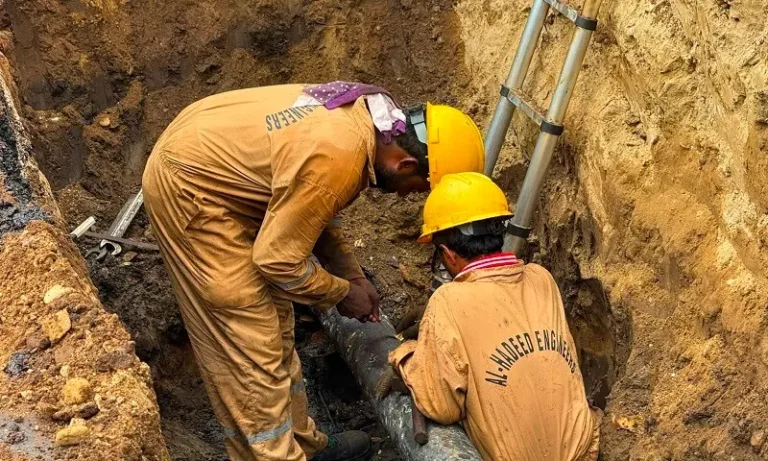
    A crude oil pipeline operated by National Refinery Limited (NRL) burst in Karachi’s DHA Phase VI, triggering an emergency containment and repair operation, authorities said. The leak occurred around 10:30pm on Saturday on Khayaban-e-Sehar, Street 13. The pipeline carries crude oil from Keamari to Korangi and reportedly runs through a road median. The incident caused crude oil to spill onto the road, prompting authorities to restrict access to the affected area. NRL’s response team arrived around midnight and began containment and cleanup operations using specialised spill kits. More than 20 drums of leaked oil had been collected, while excavation work was launched to identify the exact point of the damaged pipeline and stop the leak completely. The Sindh Environmental Protection Agency (Sepa) directed authorities to safely remove contaminated soil, sand and sludge and dispose of the material according to environmental regulations. Fresh sand will reportedly be placed after remedial work is completed. Officials urged residents to stay away from the affected location and avoid smoking or using open flames near the spilled oil. They also warned residents against attempting cleanup themselves or washing oil into nearby drains. Authorities continue to monitor the situation closely.

  • | |

    Supreme Court orders early hearing of Imran’s me…

    ISLAMABAD: The Supreme Court on Friday accepted a chamber appeal filed by former prime minister and Pakistan Tehreek-e-Insaf (PTI) founder Imran Khan. The court directed that his petition be fixed for hearing before a Supreme Court bench at the earliest. Imran Khan has requested the court to order his transfer from Adiala Jail to Islamabad’s Shifa International Hospital for medical treatment. He has also sought permission for regular meetings with his family members, personal physicians and legal counsel. In addition, he wants his medical reports to be shared with his family. The appeal challenged an earlier decision by the Supreme Court Registrar, who had returned the petitions after raising objections. The Registrar’s Office said the petitions were incomplete because they did not include a signed power of attorney. During Friday’s proceedings, Advocate Uzair Karamat Bhandari appeared before Chief Justice Yahya Afridi in chambers on behalf of Imran Khan. After hearing the arguments, the chief justice declared the Registrar’s objections ineffective and directed the legal team to submit a signed power of attorney. The Registrar’s Office was also instructed to assign a regular case number to the petition so it could be listed for hearing without unnecessary delay. The Supreme Court further ordered that a separate petition filed by Imran Khan’s sister, Dr Uzma Khan, should be heard together with his own case. In the appeal, Imran Khan argued that the Registrar had exceeded his administrative powers by deciding the maintainability of the petition. His legal team maintained that such questions should be decided by judges because they involve constitutional and legal interpretation rather than administrative scrutiny. The petition also requested that Imran Khan be examined by doctors of his own choice. The names included Dr Khurram Mirza, Dr Asim Yusuf, Dr Faisal Sultan and Dr Samina Niazi. It further asked the court to order his immediate transfer to Shifa International Hospital for a detailed medical examination and treatment. The petition also sought uninterrupted access to his personal doctors, family members and lawyers during his imprisonment and treatment. Dr Uzma Khan has also challenged an Islamabad High Court ruling that refused to order Imran Khan’s transfer to Shifa International Hospital. She also questioned the decision denying his family access to his medical information and visits by his personal physicians. In her petition, Dr Uzma said Imran Khan and his wife are currently imprisoned in Adiala Jail, while his two sons live abroad. She said she is his closest immediate family member in Pakistan and, as a medical doctor, is deeply concerned about his health. She argued that she has the legal standing to pursue the case on his behalf. Imran Khan has remained in custody since August 2023. He is serving a 14-year prison sentence in the £190 million Al-Qadir Trust corruption case. He is also receiving treatment for right central retinal vein occlusion (CRVO), an eye condition that was diagnosed earlier this year. His medical treatment has become a major political issue in recent months. Opposition leaders have repeatedly accused the government of failing to ensure proper medical care and denying him access to his personal doctors. They have also demanded his transfer to Shifa International Hospital

Leave a Reply

Your email address will not be published. Required fields are marked *