iran shoots down
|

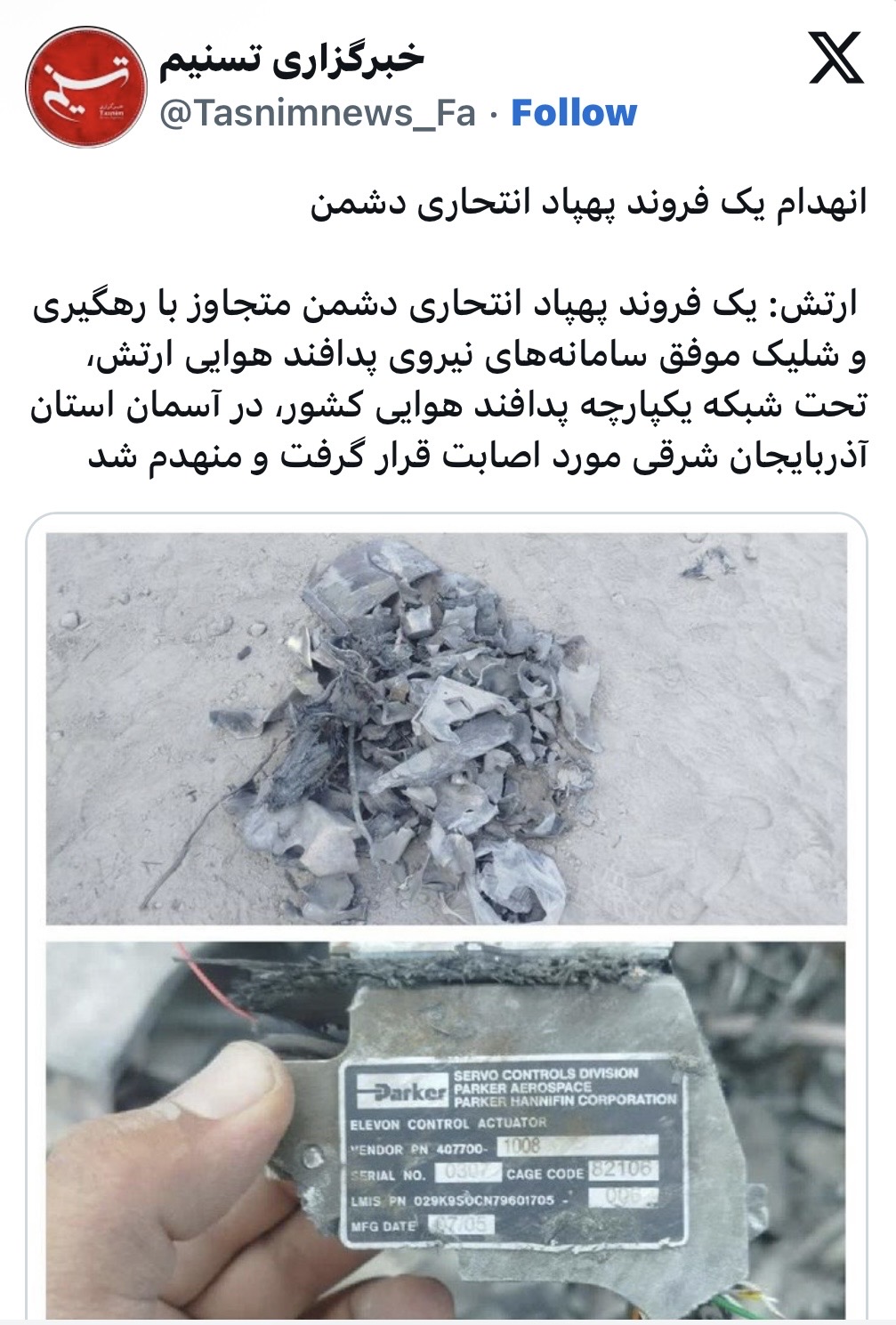
Iran shoots down enemy Kamikaze drone over East Azerbaijan Province

Iran’s integrated air defence network has shot down an enemy one-way attack drone over the country’s East Azerbaijan province, according to the Tasnim news agency. The report, citing the Iranian army, stated that the drone was intercepted and destroyed by air defence systems operating under the country’s unified air defence network.

The announcement comes amid escalating tensions in the region, with the US and Iran locked in a dangerous standoff following the collapse of the ceasefire. Both sides have traded military strikes in recent weeks, with Iran launching attacks on US allies in the Gulf region and the US conducting strikes on Iranian targets. The downing of the drone is the latest in a series of incidents that have heightened fears of a wider conflict.

The Iranian army did not specify the origin of the drone, but the use of kamikaze drones has been a hallmark of recent attacks in the region. Iran has previously accused the US and Israel of using such drones to target its infrastructure and military sites. The downing of the drone demonstrates Iran’s air defence capabilities and its readiness to protect its territory against what it perceives as aggression.

The incident also highlights the growing threat of drone warfare in the region, with both state and non-state actors increasingly using unmanned aerial vehicles for reconnaissance and attack purposes. Iran has developed a robust drone programme and has supplied such systems to its allies, including the Houthis in Yemen and Hezbollah in Lebanon.

The international community has urged restraint, but the situation remains volatile. The US has enforced a naval blockade in the Strait of Hormuz, while Iran has targeted vessels that violate its rules on navigating the vital waterway. The downing of the drone is likely to further inflame tensions, with Iran warning that it will respond forcefully to any aggression.

As the conflict continues, the risk of further escalations and unintended consequences remains high. The downing of the kamikaze drone serves as a reminder of the volatile security environment in the Middle East and the potential for miscalculation to spark a wider war. The coming days will be critical in determining whether diplomacy can prevail or whether the region will slide further into chaos.

Similar Posts

  • |

    Americans mark 25 years since September 11 attacks amid enduring grief, reflection

    For many whom the attacks directly affected — the victims’ families and friends, first responders and rescue workers — the anniversary is a tribute to the lives lost on a clear blue day a quarter century ago and the heartbreak that followed

  • |

    Taliban mark five years in power

    KABUL: The Taliban on Saturday marked five years since returning to power in Afghanistan, staging a military parade in Kabul and presenting their rule as a period of stability despite mounting humanitarian and human rights concerns. Armoured Taliban vehicles moved past the former US embassy in Kabul as officials raised flags and banners for what the government called “victory day” over Western domination. Interior Minister Sirajuddin Haqqani said in a video message that the Taliban’s return resulted from “morale, courage” and “divine assistance.” He also acknowledged that the country still faces unresolved issues and problems. The United Nations and international aid organisations have warned that Afghanistan continues to struggle with severe humanitarian and natural crises. They have also criticised the Taliban’s restrictions on women and girls. According to UNESCO, the Taliban have kept around 2.5 million girls and women out of secondary schools and universities since 2021 and imposed restrictions on their movement. UN Women reported this week that half of Afghan women now leave their homes only once or twice a month. The Taliban maintain that they uphold women’s rights under Islamic Sharia law. The group has also faced security challenges, including a series of attacks on officials in northeastern Afghanistan. Islamic State claimed responsibility for the killing of the Taliban’s information director in Badakhshan in late July. The mayor of the provincial capital was also killed in an attack on Thursday, according to local media. The Taliban seized power in August 2021 as US and allied forces withdrew from Afghanistan. The group initially promised a more moderate form of government than during its previous rule in the late 1990s and early 2000s. However, rights groups say its policies have instead imposed sweeping restrictions on women and girls. Five years after returning to power, the Taliban government still lacks broad international recognition. Russia remains the only country to have formally recognised it. Meanwhile, relations with Pakistan have deteriorated. Islamabad accuses Kabul of allowing Pakistani militants to operate from Afghan territory, adding further pressure to an already strained relationship.

  • |

    ICC member states decide Karim Khan’s future

    The International Criminal Court (ICC) member states met on Friday to decide the future of suspended Chief Prosecutor Karim Khan, who is facing allegations of sexual misconduct made by a former staff member. Khan has firmly denied all accusations and insists he has done nothing wrong. Representatives from the court’s 125 member countries gathered at the United Nations headquarters in New York to vote on whether Khan should continue in office or be removed permanently. The decision is being made through a secret ballot, and an absolute majority is required for a final outcome. Karim Khan stepped aside from his duties in May 2025 after the allegations emerged and an internal investigation was launched. Last month, the ICC’s governing bureau suspended him from office, stressing that the suspension was a temporary administrative measure and did not represent a final judgment on the case. During the meeting, Assembly of States Parties President Päivi Kaukoranta described the issue as a complex and sensitive disciplinary matter. She urged member states to conduct the proceedings fairly while respecting the rights, privacy and dignity of everyone involved and protecting the credibility of the court. The allegations gained wider international attention after the complainant, identified only as Sarah, publicly shared her account in a recent media interview. She alleged that repeated inappropriate behaviour by Khan eventually led to physical assault. She also said the significant difference in authority between them meant there could be no genuine consent. Khan has repeatedly denied the allegations. His legal team recently urged ICC member states not to remove him, arguing that he had not been given a fair opportunity to defend himself during the disciplinary process. His lawyers also warned that dismissing the prosecutor without proper legal safeguards could weaken the independence of future ICC prosecutors. Supporters of Khan argue that the investigation did not conclusively establish misconduct and say the case could create a dangerous precedent for future office holders. Others believe the seriousness of the allegations requires decisive action to maintain public trust in the court. Since becoming the ICC’s chief prosecutor in 2021, Khan has overseen several major international investigations. He gained global attention after seeking arrest warrants for Israeli Prime Minister Benjamin Netanyahu and former Defence Minister Yoav Gallant over the Gaza conflict. The court also issued arrest warrants for several Hamas leaders during his tenure. Those decisions led to strong criticism from Israel and sanctions imposed by the United States on Khan and several ICC judges, increasing political pressure on the court. Legal experts remain divided over the case. Some argue that removing Khan is necessary to protect the ICC’s credibility and public confidence. Others maintain that any decision must be based strictly on due process and the rule of law rather than political considerations.

  • | |

    Rubio and Bessent stayed aboard decoy jet as Trump…

    Two members of President Donald Trump’s cabinet remained aboard a decoy aircraft after Trump quietly departed the plane and boarded a different flight while in Turkey last month, according to a US television network report. Secretary of State Marco Rubio and Treasury Secretary Scott Bessent stayed on what was widely believed to be Air Force One and did not join the alternate flight arranged for Trump due to security concerns tied to Iran. Trump boarded Air Force One on July 8 alongside both officials as well as members of the traveling press before slipping away via a catering truck, which transported him discreetly to a separate military aircraft. Because the designation “Air Force One” applies to whichever plane the president occupies, the original aircraft retained the call sign even after Trump had already left it, effectively turning it into the decoy. According to the report, Rubio and Bessent remained on the first aircraft in order to preserve the presidential line of succession in case anything happened to Trump during the flight. Under that line of succession, Vice President JD Vance would assume power if the president died or became incapacitated, followed by the Speaker of the House and the President Pro Tempore of the Senate. The Secretary of State ranks next in the order, followed by the Treasury Secretary. Others who stayed aboard the original aircraft designated as Air Force One included White House Deputy Chief of Staff Stephen Miller and White House communications director Steven Cheung. The second aircraft that carried Trump out of Ankara also included Defense Secretary Pete Hegseth, according to separate US media reports. Speaking to reporters Monday night, Trump said the decision to carry out the plane switch came from the US military and the Secret Service, who he said wanted him to travel on a different aircraft. He did not provide specifics about the nature of the security threat, saying only that he regularly receives numerous threats and that any consequential president faces the same. A request for comment sent to the White House had not been answered as of publication.

  • | | | |

    Iran warns of Strait of Hormuz closure as regional tensions escalate

    TEHRAN: Iran has warned that continued US pressure in regional waters could force the closure of the Strait of Hormuz and other strategic maritime routes, as military and diplomatic tensions across the Middle East continue to intensify. Mohammad Bagher Zolghadr, Secretary of Iran’s Supreme National Security Council, said continued US actions in the region could have serious consequences for global shipping and energy supplies. According to Iranian state media, he warned that any further escalation could affect not only the Strait of Hormuz but also other key maritime chokepoints. He said such developments would have a significant impact on the global economy, international energy markets and trade, while also increasing political pressure within the United States. Meanwhile, Kuwait announced that its air defence systems intercepted drones launched from Iran early Saturday. The Kuwaiti military said the drones were successfully engaged before causing damage and confirmed that no casualties or destruction had been reported. Residents were advised to follow official safety instructions as authorities monitored the situation. In Yemen, the Houthi movement denied reports that it planned to charge commercial vessels for passing through the Bab al-Mandab Strait. The group’s Humanitarian Operations Coordination Center said no decision had been taken to impose transit fees and stressed that safe passage through the waterway remained free. The Houthis also urged shipping companies not to make payments to unauthorised individuals claiming to represent Yemeni authorities. The clarification came after reports suggested the group was considering introducing charges following its declaration of a maritime blockade targeting Saudi Arabia. Separately, the Houthis claimed that eight Saudi oil tankers had been forced to reroute around the Cape of Good Hope instead of using the Bab al-Mandab Strait. The group said the diversions were a result of its maritime blockade, although the claim has not been independently verified. Maritime security concerns also increased after a commercial tanker was struck by an unidentified projectile near the coast of Oman. The UK Maritime Trade Operations (UKMTO) said the projectile damaged the vessel’s engine room, leaving it unable to manoeuvre. No casualties or environmental damage were reported, while an investigation into the incident is underway. Iranian Foreign Minister Abbas Araghchi said Tehran is working with Oman to establish practical mechanisms for managing navigation through the Strait of Hormuz. During a telephone conversation with British Foreign Secretary Ed Miliband, Araghchi said outside interference would only worsen the regional situation and complicate efforts to maintain maritime stability. The British foreign secretary reiterated London’s support for diplomacy and said the United Kingdom was not involved in any war with Iran. He stressed that dialogue remained the best path to reducing tensions in the region. Meanwhile, reports from US media suggested that Washington and Israel are considering possible strikes on Iran’s energy infrastructure. According to the reports, discussions have focused on targeting energy facilities if diplomatic efforts fail. However, no final decision has been officially announced. Iranian officials responded by warning that the country has prepared plans to retaliate against any future military action targeting its territory. They said any attack would receive a strong response against strategic interests in the region.

  • |

    Lebanese PM vows efforts to secure full Israeli withdrawal

    Lebanese Prime Minister Nawaf Salam has said the government will continue working through diplomatic and political channels to secure a complete Israeli withdrawal from southern Lebanon. His remarks came during a visit to the village of Zawtar al Gharbiyah where the Lebanese army has recently expanded its deployment following a new security agreement aimed at reducing tensions along the border. Speaking to residents and military personnel, Salam said Lebanon remains committed to restoring full control over all its territory. He stressed that the government would continue its efforts to ensure Israeli forces leave the remaining occupied areas in the south while supporting the Lebanese army as it strengthens its presence in the region. The prime minister’s visit followed talks between Lebanese President Joseph Aoun and US President Donald Trump at the White House. During the meeting, Aoun urged the United States to support Lebanon’s demand for a complete Israeli withdrawal from its territory as part of ongoing efforts to stabilise the border. Last month, Lebanon and Israel agreed to a US backed framework under which the Lebanese army would gradually deploy in designated areas while Israeli troops would withdraw from selected locations. The agreement also calls for the Lebanese military to take responsibility for disarming Hezbollah in those zones. Hezbollah has rejected the deal and insists it will not surrender its weapons. Tensions remain high despite the agreement. Lebanon’s army said Israeli forces opened fire near soldiers who were deploying in Zawtar al Gharbiyah on Tuesday. The Israeli military responded by saying its troops fired warning shots after Lebanese soldiers entered an area outside the agreed deployment zone. The border region has remained unstable since Hezbollah entered the regional conflict by launching attacks against Israel in support of Iran earlier this year. Israel responded with large scale airstrikes and a ground offensive that caused widespread destruction across southern Lebanon. Although violence has eased following recent diplomatic agreements, occasional military exchanges continue. During his visit, Salam raised the Lebanese flag in the village and promised that the government would focus on rebuilding damaged communities. He said authorities would work alongside the army to reopen roads, clear rubble, restore essential public services, and create conditions that allow displaced residents to return home safely. Many local residents gathered near the village hoping to receive permission to inspect their homes after months of conflict. Some expressed relief over the arrival of the Lebanese army, saying its presence gave them confidence that life could gradually return to normal. However, military officials advised civilians to wait until security operations in the area are completed before returning. The army is currently conducting security sweeps in villages close to Israeli controlled positions to ensure the areas are safe for returning residents. Officials say these operations are necessary because of the continued risk of military activity near the border. Meanwhile, Lebanon’s state news agency reported additional Israeli drone strikes and artillery shelling in nearby areas on Wednesday. It also said Israeli troops entered the Dubieh area near the border town of Shaqra and raised an Israeli flag over the historic Dubieh Castle. Lebanese Culture Minister Ghassan Salame strongly criticised the move, describing it as a provocative action that violates Lebanon’s sovereignty. He said the government remains committed to regaining control over all historic sites and national territory in the south. The latest incident follows Israel’s seizure of the historic Beaufort Castle in May. International attention has also turned to the condition of several historic castles in southern Lebanon. The United Nations is expected to consider adding five of these sites, including Beaufort Castle and Dubieh Castle, to its list of cultural landmarks at risk due to ongoing conflict. Lebanese officials hope international support will help protect these important heritage sites while diplomatic efforts continue to prevent further escalation along the border.

Leave a Reply

Your email address will not be published. Required fields are marked *