macron calls crisis
|

Macron calls crisis meeting as wildfires threaten bordeaux

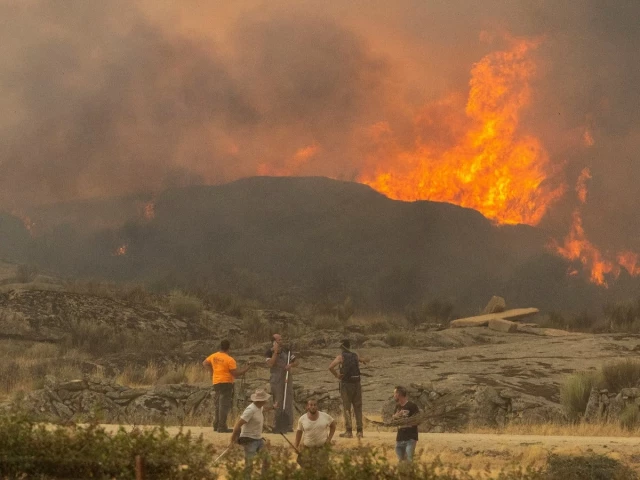
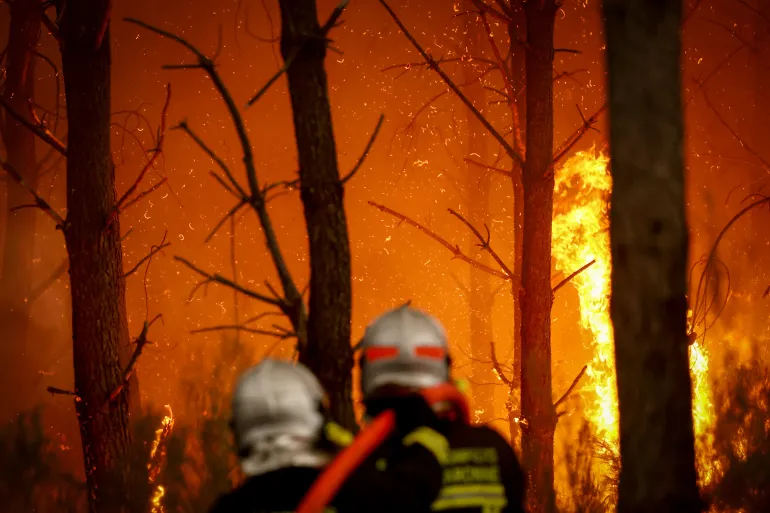
French President Emmanuel Macron has called an emergency cabinet meeting to coordinate the response to massive wildfires sweeping through southwestern France, as firefighters work to stop the flames from reaching Bordeaux.

The meeting comes amid forecasts of another heatwave later this week, raising concerns that high temperatures could further worsen the situation.

Firefighters battled the blaze overnight, while authorities in Gironde, the wine-producing region that includes Bordeaux, described the situation as “broadly stable.”

Bordeaux Mayor Thomas Cazenave said Sunday that the fire remained “at the gates of the metropolitan area.” At its closest point, the blaze was around 15 kilometres (9 miles) from the Bordeaux metropolitan area, which is home to roughly 850,000 people.

Wildfires across France and Spain have caused widespread disruption and forced more than 300,000 people to evacuate their homes. The fires have intensified as Europe faces record-breaking temperatures, with scientists warning that extreme heat is leaving the continent increasingly dry and vulnerable to wildfires.

Europe has already endured three heatwaves this summer, fuelling fires across several countries and contributing to new temperature records.

Similar Posts

  • Trump imposes 50% tariffs on Canada as Carney vows to consider ‘All Options’ in response

    US President Donald Trump has imposed a 50% tariff on a wide range of goods imported from Canada, retaliating against what he called “unequal treatment” of US cars, dairy, and alcohol. Everyday consumer items like wine and hockey sticks, as well as industrial goods such as cement, are on the target list, though several key exports including energy, potash, critical minerals, and fish will be spared. Prime Minister Mark Carney said he had spoken to Trump and both leaders agreed to “intensify” trade talks in a bid to calm growing tensions between the North American neighbours. However, Carney warned that “all options” were on the table in terms of how Canada could respond to the fresh tariff threat. Since the tariff war broke out more than 18 months ago, Carney said Canadians have “stood together” by buying home-produced goods and agreeing new trade routes with other countries. “[The] country is stronger, stronger because we are united, and we will remain united,” he told reporters. Tensions between the major trading partners have been simmering since Trump returned to office in January last year and unleashed a wide-ranging global programme of tariffs. Asked about the latest tariffs, which the White House says will take effect in 30 days, Trump said Canada had been “very, very tough on us over the years” and “no other presidents done anything about it.” He added: “I love Canada, I love the people of Canada, many friends that live in Canada. Without us, there’s no way they can survive.” The latest move comes after the US Supreme Court ruled earlier this year that many of the tariffs imposed globally under emergency powers were illegally enacted. Trump has since sought other legal avenues to push through his flagship trade policy. Trump has said the levies will boost American manufacturing and jobs, but some economists have warned that higher charges on imported goods risk pushing up prices for consumers. This new round of duties on Canadian goods has also fuelled speculation about a potential wider tariff announcement by the US on countries across the world. US Trade Representative Jamieson Greer said on Tuesday that he expected to “see some action soon” when asked about the possibility of forthcoming levies. Canada, which is one of the US’s closest trading partners, was one of the few countries to retaliate last year against Trump’s tariffs, placing a 25% levy of its own on about C$30 billion worth of US goods. Carney later dropped some of them. As the trade war escalates, the implications for both economies remain significant. Canada’s reliance on US markets for exports and the interconnected nature of North American supply chains mean that any prolonged tariff dispute could have far-reaching consequences. Carney’s warning that “all options” are on the table suggests that Canada is prepared to respond forcefully if necessary, potentially escalating the conflict further. The coming weeks will be critical in determining whether diplomatic efforts can de-escalate the tensions or whether the trade war will intensify, impacting businesses and consumers on both sides of the border. The international community will be watching closely as two of the world’s largest trading partners navigate this dangerous standoff.

  • |

    Amber heat-health alert issued across England

    An Amber Heat-Health Alert has been issued across affected parts of England as hot weather continues, with the alert remaining in place until 9am on Friday, August 14. Health authorities are urging people to take precautions during the heat, particularly those who may be more vulnerable to high temperatures. People are advised to drink plenty of water, avoid the hottest part of the day where possible and take steps to keep cool. Authorities have also urged the public to check on family members, friends and neighbours who may struggle to cope with the heat. Those considered particularly vulnerable include older people, young children and babies, as well as people living with existing health conditions. The alert is intended to raise awareness of the potential health impacts of sustained high temperatures and encourage people to take preventative measures. People are advised to keep indoor spaces as cool as possible, stay out of direct sunlight during the hottest periods and seek medical advice if they become seriously unwell because of the heat. The Amber Heat-Health Alert will remain in force until 9am on Friday, August 14, unless conditions change earlier. Authorities are continuing to monitor the weather situation and are urging the public to take the heat seriously, particularly as temperatures remain elevated across parts of the country.

  • |

    Zelensky accuses Iran of direct role in Russia’s war against Ukraine

    Ukrainian President Volodymyr Zelensky has accused Iran of directly participating in the war against Ukraine through its continuous military support for Russia. Speaking on potential threats following a recent incident involving an Iranian vessel, Zelensky urged caution to prevent the opening of another front while stressing that Ukraine must remain prepared for all scenarios. He stated that Tehran became a direct participant by supplying Moscow with thousands of attack drones from the outset of the full-scale invasion and subsequently granting licences for local production. He added that both Iran and North Korea have effectively attacked Ukraine by supplying Russia with weaponry, including missiles, drones, and artillery ammunition. In response, Iranian Foreign Ministry spokesperson Ismail Baghaei rejected assertions that Tehran had sought negotiations with the United States to end hostilities, asserting that Iran will independently determine matters of war and peace. Baghaei added that Washington had initially expected an Iranian surrender within days of commencing attacks, yet months later, the United States continues to face severe challenges in the region.

  • | |

    British Columbia declares emergency as fast-moving…

    British Columbia declared a provincial state of emergency on Saturday after a rapidly spreading wildfire forced thousands of residents in the western Canadian province to flee their homes overnight, with the blaze nearly doubling in size within hours. The Bald Range wildfire burned out of control and expanded rapidly to roughly 9,500 hectares, prompting evacuation orders across Summerland, Peachland and other districts west of Okanagan Lake in the province’s southern interior. The region produces the majority of British Columbia’s wine and ranks as Canada’s second largest wine producing area, adding an economic dimension to the disaster beyond the immediate threat to homes and lives. Officials describe explosive fire behaviour Premier David Eby told a news conference on Saturday that one fire official had compared the blaze to an explosion going off. Eby said the official described flames reaching 100 feet up trees, with additional flames shooting a further 200 feet above that, and the fire generating its own weather system that produced lightning, which in turn fed further fire growth in a self-sustaining cycle. “Homes have been lost, and properties have been destroyed,” Eby said, adding that some residents became trapped as conditions shifted rapidly and required rescue. The premier described the situation as highly dynamic and continuing to pose a serious threat to the region. Summerland had a population of about 12,000 residents according to the 2021 census, while neighbouring Peachland is home to roughly 6,500 people. Province activates emergency powers The declaration of a state of emergency grants provincial authorities immediate access to special powers, including the ability to impose travel restrictions, protect essential supplies from price gouging and deploy specific tools to coordinate rescue operations across affected areas. Officials said the Bald Range wildfire has triggered the largest evacuation event of the summer so far, with more than 20,000 people across British Columbia forced from their homes since the fire began its rapid expansion. Summerland Mayor Doug Holmes, speaking by phone from nearby Penticton, said a large number of farms in the area have been affected and that officials do not yet know the full extent of structural losses. “They’re still busy fighting the fire,” Holmes said, adding that the community needed to prepare for the worst possible outcome as firefighting efforts continued. Residents flee as highways begin closing Many residents left their homes overnight, driving south toward Penticton or north toward Kelowna before several highways in the region began closing due to the advancing fire. Terry Fries, a Summerland resident, said he was watching a football game on Friday night when a neighbour warned him to prepare an emergency bag as the fire continued to grow nearby. Fries said the fire remained visible behind nearby hills earlier in the evening before conditions worsened. When British Columbia authorities issued the formal evacuation order around midnight, Fries and his family drove approximately 45 kilometres north to the city of Kelowna to reach safety. Residents captured video footage showing fires burning along the highway and structures engulfed in flames as they fled the area. By Saturday afternoon, ash had begun settling on cars and houses in nearby communities as smoke from the fire cast an orange glow across the sky. Power and water systems disrupted Summerland lost electricity on Saturday and issued a boil water notice for residents after untreated water entered the municipal system when it bypassed the standard water treatment plant due to disruptions caused by the wildfire. Wildfires strain resources nationwide Several Canadian provinces, including Ontario and Quebec, have battled significant wildfires this year as hot and dry weather conditions fuelled blazes across dense forest regions. International firefighting crews from Mexico, Australia, France and New Zealand have travelled to Canada to assist local personnel in combating the fires. In British Columbia specifically, where continued hot and dry conditions have heightened the risk of further fire spread, approximately 1,500 firefighting personnel are currently battling more than 100 active fires across the province. Authorities have issued 40 formal evacuation orders and an additional 49 evacuation alerts as the fire season continues to intensify. Wildfires have burned through approximately 4 million hectares of land across Canada so far this year, according to figures from the Canadian Interagency Forest Fire Centre, underscoring the scale of a fire season that has placed sustained pressure on emergency services and firefighting resources nationwide.

  • |

    Gaza students overcome adversity for top results

    Thousands of students across the Gaza Strip achieved success in this year’s Tawjihi high school examinations despite months of conflict, displacement and severe disruptions to daily life, demonstrating remarkable determination to continue their education under extraordinary circumstances. The annual Tawjihi examinations, which play a decisive role in determining admission to universities and future careers, were completed by thousands of Palestinian students who prepared for the tests while living through prolonged instability, damaged infrastructure and limited access to educational resources. Among the success stories were three siblings from Khan Younis who earned outstanding grades after months of dedicated study. Despite facing repeated challenges during the academic year, the family celebrated their achievements, describing education as a source of hope and resilience. The students said the difficult conditions often made it emotionally exhausting to continue studying. However, they remained focused on their academic goals and credited their family for providing encouragement throughout the year. They said their success represented not only personal achievement but also a reward for months of perseverance. The family’s journey was particularly challenging because two of the siblings have physical disabilities, making regular attendance at private tuition difficult. Their parents arranged for teachers to conduct lessons at home, ensuring they could continue their studies despite mobility challenges and the difficult security situation. Their mother said years of continuous support, confidence and determination helped her children overcome obstacles. She expressed pride in their achievements, saying their success proved that dedication and family support can help students overcome even the most difficult circumstances. Education officials said nearly 89,000 students from the occupied Palestinian territories took the Tawjihi examinations this year, while thousands of Palestinian students living abroad also participated. Authorities added that more than 36,000 students from Gaza alone sat for the examinations despite the ongoing humanitarian crisis. Officials also noted the heavy impact of the conflict on the education sector. Hundreds of schools have reportedly been damaged, while many educational institutions remain unusable because of destruction. In many areas, students attended lessons inside temporary shelters, tents or partially damaged buildings where classrooms lacked desks, chairs and basic learning facilities. Teachers continued providing instruction despite the challenging conditions. Many educators said they had to support students emotionally as well as academically because many had lost family members or been forced to leave their homes during the conflict. One mathematics teacher said students often arrived carrying emotional trauma, making psychological support just as important as classroom instruction. She explained that teachers tried to encourage students, helping them remain focused on their studies despite the hardships surrounding them. Several students also shared deeply personal stories of loss. One student who lost multiple close family members during the conflict said completing her examinations became both an emotional struggle and a tribute to her loved ones. Although she celebrated passing the exams, she said the moment was bittersweet because many family members were no longer alive to witness her achievement.

  • |

    Xi backs Brazil against foreign interference in call with Lula

    Chinese President Xi Jinping expressed support for Brazil’s efforts to protect its sovereignty and resist foreign interference during a phone conversation with Brazilian President Luiz Inacio Lula da Silva, according to Chinese state media. The discussion took place just months before Brazil’s closely watched presidential election and against the backdrop of growing trade and diplomatic tensions with the United States. According to China’s Xinhua news agency, Xi praised Brazil’s role on the international stage and said Beijing values the country’s influence in global affairs. He stated that China supports Brazil in defending its independence, rejecting outside interference, and contributing to regional and international peace and stability. The phone call comes less than three months before Brazilians head to the polls in an election expected to be highly competitive. President Lula is seeking another term and faces a challenge from right wing candidate Flavio Bolsonaro, the son of former president Jair Bolsonaro. The Brazilian presidency said the two leaders also discussed strengthening economic cooperation. Both sides agreed on the importance of accelerating negotiations for a trade agreement between China and Mercosur, the South American trade bloc that includes Brazil, Argentina, Paraguay, and Uruguay. Such an agreement could expand trade opportunities between the region and the world’s second largest economy. During the conversation, which lasted more than an hour, Lula reaffirmed his commitment to expanding Brazil’s international trade network. He said his government is working to diversify export markets and reduce dependence on a limited number of trading partners, particularly as Brazil faces increased tariff pressure from the United States. Relations between Brasilia and Washington have become more strained in recent months. The United States introduced two additional rounds of tariffs on a range of Brazilian products this month, following a significant tariff increase imposed last year. The measures were linked to political tensions surrounding the legal case that resulted in former president Jair Bolsonaro being sentenced to prison over an alleged coup plot. Lula has strongly criticized the tariffs, arguing that they amount to political pressure during an election year. He has accused Washington of attempting to influence Brazil’s domestic affairs through economic measures, an allegation the United States has rejected. Diplomatic tensions have also surfaced over election related issues. According to diplomatic sources, Brazil recently refused entry visas for two American officials who planned to visit the country’s election authorities ahead of the October vote. The move reflected growing sensitivity within the Brazilian government over foreign involvement in electoral matters. Meanwhile, Flavio Bolsonaro has continued to question the reliability of Brazil’s electronic voting system despite repeated assurances from election officials that it is secure. His claims have echoed similar allegations made by US President Donald Trump regarding American elections, although no credible evidence has supported those accusations. While the Chinese government highlighted Xi’s support for Brazil in resisting external interference, the official statement released by the Brazilian presidency did not specifically mention that part of the discussion. Instead, it focused on economic cooperation and the importance of strengthening trade ties between Brazil, China, and the Mercosur bloc. The conversation underscores the increasingly close relationship between Beijing and Brasilia at a time when Brazil is balancing political challenges at home with shifting economic and diplomatic dynamics on the global stage.

Leave a Reply

Your email address will not be published. Required fields are marked *