meloni demands probe
|

Meloni demands probe into Bologna death after violent clashes

Italian Prime Minister Giorgia Meloni has called for a thorough investigation into the death of a man during a police operation in Bologna, while strongly condemning violent protests that left dozens of police officers injured.

The incident occurred in the Pilastro area of Bologna, where police were called to respond to reports of an aggressive man damaging a vehicle. The man, identified as Moroccan-born Abderrahim Fakir, died following the confrontation with police.

Meloni said all facts surrounding the incident must be established through a transparent investigation. She stressed that the truth should be determined without bias and that responsibility should be identified based on evidence.

The situation later escalated when protesters gathered in Bologna and clashes broke out with police. Demonstrators threw firecrackers, bottles and chairs at law enforcement personnel, prompting police to use tear gas and water cannons to control the crowd.

Police officials said 56 officers were injured during the violent demonstrations. Meloni condemned the attacks on security personnel, saying violence could not be justified under any circumstances.

Authorities have launched an investigation into the man’s death. Bologna police said body-camera footage from the officers involved would be handed over to investigators as part of the inquiry.

According to initial reports, officers attempted to calm Fakir before using pepper spray and restraining him while trying to place him under arrest after he allegedly became aggressive.

The incident has triggered political debate across Italy, with opposition parties demanding accountability and government supporters defending the actions of police officers.

Meloni accused some protesters of using the incident as an excuse to create unrest rather than seeking justice. She said those responsible for attacking police and damaging public property were pursuing confrontation instead of the truth.

Similar Posts

  • | |

    Pakistan rejects Imran Khan’s sons’ allegation…

    The Government of Pakistan has categorically rejected allegations by the sons of former Prime Minister Imran Khan that he has been kept under a seven-month communications blackout and denied access to his family, lawyers and doctors, terming the claims “unsubstantiated” and contrary to official prison records. In a detailed response, the government said documented records showed that Imran Khan had continued to receive visitors, legal access and medical care during his imprisonment, rejecting what it described as an attempt to create an international controversy without evidence. According to the government, since the beginning of his conviction, prison records show 198 meetings involving more than 900 visitors, including family members, legal representatives and political associates. It said Khan was also allowed a weekly meeting with his wife, with the latest meeting taking place on 4 August 2026, the same day his sons made allegations of a communications blackout during an appearance on CNN. The government said prison authorities maintain records of approved visits and communications, including WhatsApp and landline calls with family members in Pakistan and abroad. It added that Khan’s last call with his son was recorded on 21 March 2026. The statement said any temporary restrictions were imposed under Pakistan Prison Rules, court orders and security requirements applicable to high-profile prisoners, particularly due to political activities outside the prison. “There is no prohibition on access; it is regulated under the law,” the government said, adding that prison meetings cannot be used as unrestricted political communication channels. Rejecting claims regarding medical treatment, the government said Imran Khan had received regular medical examinations by specialist teams and medical boards from institutions including the Pakistan Institute of Medical Sciences (PIMS), Shifa International Hospital, Shaukat Khanum Memorial Hospital and Al-Shifa Trust Eye Hospital. The government said Khan underwent treatment for a retinal condition, including five intravitreal anti-VEGF injections, specialist examinations and retinal imaging. It added that his latest specialist assessment was carried out in July 2026, with further medication and follow-up care prescribed. According to the official statement, medical records describe Khan as “oriented and stable”, with no reported acute or unmanaged deterioration. The government said disclosure of medical reports remained subject to legal procedures, patient confidentiality and ongoing proceedings before the Supreme Court of Pakistan. Addressing the issue of Khan’s sons’ travel to Pakistan, the government said the matter involved separate processes relating to NICOP and visa requirements. It stated that overseas Pakistanis holding a valid NICOP are eligible for visa-free entry and rejected what it called an attempt to present an administrative matter as political victimisation. The statement also detailed the facilities provided to Imran Khan in prison, saying he was being kept in a separate compound with accommodation and amenities exceeding minimum requirements for prisoners in the same category. The government maintained that Imran Khan was being treated according to constitutional guarantees, prison laws and court directives, while insisting that no individual was entitled to a separate legal framework or exemption from security regulations.

  • |

    Anger boils over as residents jeer French PM in Gironde

    French Prime Minister Sebastien Lecornu faced a hostile reception in the Gironde region on Monday. Residents booed him during a visit to Le Porge, amid growing anger over the government’s handling of recent wildfires. Lecornu had travelled to the area to meet local officials and discuss reconstruction efforts following a devastating wildfire last month. The visit, however, quickly turned tense. Footage published by BFMTV showed residents jeering as the prime minister arrived. Several locals also criticised him for leaving without engaging freely with the community. Speaking to AFP, 65-year-old resident Tony Veiga said the least Lecornu could have done was actually meet with residents directly. He said the government’s approach made people feel as though they simply didn’t matter. Lecornu’s office responded by saying he had spoken with affected residents and farmers during the visit. Speaking separately with officials in nearby Merignac, the prime minister insisted there was nothing to hide regarding how fire protection efforts had been carried out in recent weeks. According to AFP, much of the anger stems from allegations that authorities prioritised protecting the affluent Cap-Ferret peninsula over ordinary local homes during the firefighting response. Lecornu firmly rejected those claims, denying any preferential treatment had taken place. The backlash adds to broader frustration across parts of Europe currently grappling with wildfire emergencies. Meanwhile, the European Commission has ramped up support elsewhere on the continent, deploying additional firefighting resources to both Belgium and Spain through its civil protection mechanism. Swedish aircraft and helicopters from several European countries have been sent to Belgium to assist with ongoing fire response efforts there. Separately, 104 French firefighters and 36 vehicles have joined operations in Spain to help combat blazes spreading through the region. With wildfires continuing to strain resources across multiple European countries, pressure on national governments to respond effectively is likely to remain high in the coming weeks. For Lecornu, Monday’s frosty reception in Gironde signals that public patience with the government’s crisis response is wearing thin.

  • | |

    Mir Raza’s mysterious death exposes crores d…

    Investigators have uncovered new evidence in the mysterious death of Karachi resident Mir Raza Ali, whose body was found in Gulistan-e-Jauhar, as police continue to investigate whether he was murdered or died by suicide. According to investigation sources, CCTV footage obtained by police shows Mir Raza leaving his shop near Bahadurabad at around 3:30am on July 29 after taking a security guard’s pistol from a drawer. He then drove to his home, where he left behind his car, smartwatch, house keys, and Rs39,000 before booking an online taxi. Police said Mir Raza departed his home at 4:08am and headed toward Gulistan-e-Jauhar alone. CCTV footage also captured him walking by himself in the area. His mobile phone was switched off at around 4:22am near Johar Mor Hilltop, and he was dropped off in Block 2 of Gulistan-e-Jauhar at approximately 4:28am. Authorities are still trying to determine whether Mir Raza was killed or took his own life. Investigation sources said Mir Raza was involved in the digital currency business in addition to his other commercial ventures. He had reportedly managed investments for several people and regularly paid profits to investors. However, officials said his digital currency business began suffering losses in December 2025, with financial difficulties worsening significantly in April 2026. To cover the losses, he allegedly started borrowing money and eventually accumulated debts estimated between Rs50 million and Rs80 million. Sources further claimed that an overseas friend invested Rs7.5 million in his business but did not receive the promised returns. Police have also recorded the statement of Mir Raza’s fiancée. According to investigators, the two remained in contact until around 11:30pm on July 28. She attempted to contact him again at around 3:00am, making more than 40 calls and sending numerous messages within 20 minutes, but received no response. Investigators also revealed that Mir Raza had deleted all of his social media accounts before leaving home. He reportedly transferred Rs250,000 to his father’s bank account and carried the shop security guard’s .30-bore pistol with him. While police recovered the pistol holster from the scene, the firearm itself has not yet been found. Another CCTV recording from the area where Mir Raza’s body was discovered has provided a new lead. The footage shows a motorcycle arriving at the deserted location at 3:36am on July 29 and remaining there for approximately 22 seconds before leaving. Based on preliminary evidence, investigators suspect the body may have been dumped at the site during the early hours of July 29. They believe those involved may also have discarded the pistol holster at the scene, which could become a crucial piece of evidence. Police have expanded their investigation, using CCTV footage and other forensic evidence to identify and arrest those responsible while examining every possible angle of the case. Investigation sources also disclosed that Mir Raza had thrown away his mobile phone along University Road. The device was later found by three labourers working in the area. Police tracked down the workers and recovered the phone as part of the ongoing investigation.

  • | |

    Pakistani climbers open historic new route on broa…

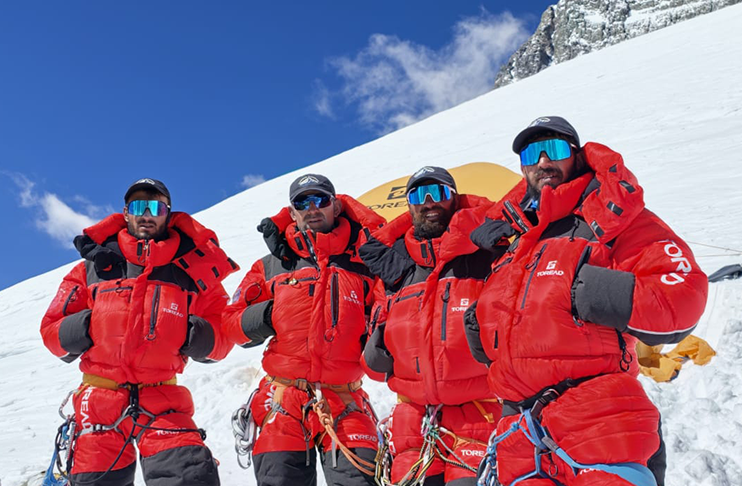
      Pakistani mountaineers have achieved a landmark feat by opening a brand-new climbing route on Broad Peak, one of the world’s highest mountains. The accomplishment is being hailed as a major milestone for Pakistan’s mountaineering community, showcasing the country’s growing expertise in high-altitude climbing and technical expedition planning. Broad Peak, standing at 8,051 metres (26,414 feet), is located in the Karakoram mountain range of Gilgit-Baltistan, approximately five miles from K2. Ranked as the world’s 12th-highest mountain, Broad Peak has long attracted climbers from around the globe because of its challenging terrain and unpredictable weather conditions. The newly established route, officially named the Mirza Ali Legacy Route, begins above Camp 3 and offers a fresh approach to the summit. The route was created after an intensive three-day effort that required climbers to navigate deep snow, steep rock faces, and mixed sections of snow and rock under extremely demanding conditions. The expedition was led by renowned Pakistani mountaineer Mirza Ali, founder of Karakorum Expeditions. Along with his team, he spent days fixing ropes and securing the mountain to make the route accessible for future expeditions. Their summit push began at 2:00 a.m. local time on July 19. Battling continuous snowfall, freezing temperatures, and severe weather, the climbers finally reached the summit at 9:55 p.m. after more than 24 hours of nonstop climbing. To establish the route, the team installed over 1,600 metres of fixed rope and placed permanent rock pitons at critical points to improve safety and stability. According to expedition organisers, the new line is shorter, more direct, and significantly safer than the traditional path, which passes through Broad Peak’s hazardous “V Section.” The redesigned route is expected to reduce climbers’ exposure to avalanches and falling rocks, two of the mountain’s most serious risks. Organisers estimate that under normal weather conditions, climbers using the new route should be able to reach the summit from Camp 3 within seven to eight hours and descend in approximately two to three hours, making the ascent both faster and more efficient. The route was unanimously named in honour of Mirza Ali to recognise his 16 years of dedication to Pakistan’s mountaineering sector. Throughout his career, he has trained aspiring climbers, organised national and international expeditions, and promoted Pakistan as a premier destination for adventure tourism. Reflecting on the achievement, Mirza Ali said the successful opening of the route demonstrates the technical capability, determination, and resilience of Pakistani climbers. He also stressed the importance of investing in mountaineering education, safety training, and adventure tourism, highlighting Gilgit-Baltistan’s enormous untapped potential within the mountain economy. International members of the expedition also praised the accomplishment. Argentine climber Juan Toro described the project as a historic milestone for Pakistani mountaineering, while Hungarian climber David Klein called the newly opened path an innovative and technically brilliant route that reflected the team’s exceptional skill and perseverance. The summit team included Mirza Ali, Ahmed Baig, Rizwan Dad, Waqar Ali, Nawaz Ali Khan, Zaman Karim, Juan Toro, and David Klein. To support future expeditions and improve emergency response, the team also recorded all major anchor locations using Garmin inReach GPS technology, ensuring the new route can be safely managed for climbers in the years ahead.

  • |

    Goods transport strike threatens Pakistan’s industry

    KARACHI: A nationwide strike by goods transporters has triggered growing concern among industrialists, who fear that a prolonged disruption in cargo movement could disrupt factory operations, delay export shipments and add further pressure to Pakistan’s already fragile economy. Business leaders have warned that the continued suspension of freight services could create serious bottlenecks in the supply chain, particularly for industries that rely on the regular movement of raw materials and intermediate goods. Any prolonged shortage of essential inputs could force factories to slow down production or temporarily shut operations. The industrial sector is also facing the risk of delays in the delivery of finished products to domestic markets and international buyers. Export-oriented industries, in particular, could suffer if consignments fail to reach ports or overseas customers within agreed timelines. President of the SITE Association of Industry (SAI) Abdul Rehman Fudda said the transporters’ strike had created a critical situation for the manufacturing sector, as industries could not maintain uninterrupted production without a reliable logistics network. He said factories depended on the timely arrival of raw materials and the smooth transportation of finished goods. Any disruption in freight movement, he added, could interrupt production schedules and increase costs for manufacturers. Fudda warned that the impact of the strike could extend beyond factories, affecting workers, suppliers, exporters, retailers and other businesses linked to the industrial supply chain. He pointed out that Pakistan’s export sector was already operating under significant pressure because of high production costs and other economic challenges. A disruption in transportation, he said, would further increase the difficulties faced by exporters. The SAI president cautioned that delays in export shipments could have financial as well as reputational consequences. International buyers may impose penalties, demand price reductions or seek compensation when shipments fail to arrive within agreed deadlines. According to him, exporters operate under strict delivery schedules, and even a temporary disruption in logistics can affect production planning, container bookings and shipment arrangements. Fudda stressed that the consequences of the strike should be assessed from a broader economic perspective rather than being viewed solely as a dispute between transporters and other stakeholders. He said an interruption in the movement of goods could affect the entire supply chain, from the procurement of raw materials to the manufacturing process and eventual delivery of products to customers. The industrialist further warned that repeated delays in fulfilling export orders could undermine the confidence of foreign buyers and make it more difficult for Pakistani businesses to retain existing international contracts or secure new orders. Industrialists have therefore urged the relevant authorities and representatives of goods transporters to resolve their differences at the earliest and restore the movement of cargo across the country. They maintained that an uninterrupted logistics system was essential for keeping factories operational, protecting jobs, meeting export commitments and supporting economic activity. Business leaders also called for a sustainable resolution to the issues behind the transporters’ strike so that similar disruptions could be avoided in the future. They said uncertainty in the movement of goods not only affects individual industries but can also have wider implications for investment, exports, government revenue and overall economic growth. With industries already facing a challenging business environment, manufacturers fear that a prolonged transport shutdown could further increase operational costs and compound supply-chain problems. They urged the authorities to prioritise negotiations and ensure the resumption of freight services without further delay.

Leave a Reply

Your email address will not be published. Required fields are marked *