mamdani8217s multilingual memefriendly
|

Mamdani’s multilingual, meme-friendly style wins over young voters

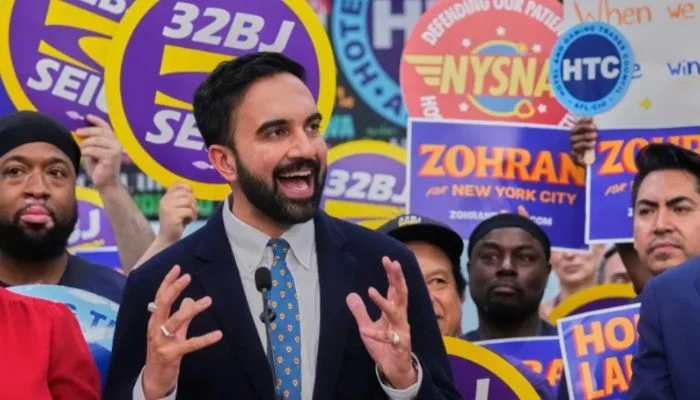
Zohran Mamdani has built a notably different kind of political connection with New York’s diverse communities. His approach centers on delivering campaign outreach in multiple languages, including Mandarin, Bengali and Spanish.

Rather than relying solely on English, Mamdani’s team has woven the city’s varied linguistic makeup directly into its outreach strategy. That approach has helped him connect more directly with working-class neighbourhoods and immigrant populations in their native languages.

The New York City mayor’s approach to engaging constituents has repeatedly drawn attention. His localised messaging and public appearances, often delivered fluently across several languages, have become a defining feature of his public image.

The style has also sparked plenty of reaction online, with social media users reacting with a mix of praise and humour. One widely shared comment joked that he seems to be collecting languages the way people collect Pokémon cards.

Online audiences have picked up on his frequent switching between languages across different platforms, fuelling ongoing viral commentary and internet humour surrounding his public appearances.

Mamdani’s rise has been driven largely by viral moments, genuine community engagement, and his multilingual outreach. Together, these elements have made him a particularly influential figure among Gen Z and millennial voters.

Exit polling data shows just how central younger voters have been to his political base. Roughly 75% to 78% of voters aged 18 to 29 backed him, contributing to a notable rise in youth turnout during recent municipal elections.

Unlike many politicians who stick closely to rehearsed talking points, Mamdani’s communication style leans heavily on relatable humour, short-form video content and an active social media presence.

Whether he is sharing lighthearted Gen Z-style clips, interacting casually with a neighbourhood cat, or switching fluidly between Mandarin, Bengali and Spanish, his approach reflects both the language and culture of a diverse, younger audience.

Beyond his online popularity, younger voters also point to his focus on core issues like housing affordability, economic inequality and broader representation. By treating everyday culture and multilingual communication as central to his political identity rather than an afterthought, Mamdani has reshaped how candidates in the city are attempting to reach younger, more diverse voters.

Similar Posts

  • |

    Spokane wildfires destroy 700 homes, force 64,000 to flee

    SPOKANE: Devastating wildfires sweeping across the outskirts of Spokane, Washington, have destroyed more than 700 buildings, displaced 64,000 residents, and prompted fears that fatalities may be discovered as emergency crews struggle to contain the fast-moving infernos. The cluster of three major wildfires, which erupted over the weekend, has become the highest firefighting priority in the United States, with more than 1,100 firefighters deployed to battle the flames. Despite their efforts, officials confirmed that none of the fires had been contained by Monday. The blazes have scorched over 8,000 acres (3,200 hectares) on the northern edge of Spokane, Washington’s second-largest city, located near the Idaho border. Thick smoke has blanketed the region, reducing visibility and worsening air quality across large parts of the Pacific Northwest. Dramatic aerial footage showed firefighting aircraft repeatedly dropping fire retardant over forests as towering flames raced toward residential neighborhoods. Entire communities have been reduced to ashes, with officials warning that another 400 structures may also have been damaged or destroyed. For many families, the evacuation came with little warning. Among them was Kami Fehlig, who fled her home with her husband, two daughters and family dog after watching flames leap across the Spokane River and race toward their neighborhood. “We knew we had to leave immediately,” she recalled. “We grabbed our wedding album, baby books, pet supplies and whatever we could carry before the power went out.” Hours later, the family learned that their home and surrounding neighborhood had been completely destroyed. Authorities said thousands more residents remain under mandatory evacuation orders as shifting winds continue to threaten additional communities. Emergency officials also warned that the full scale of the disaster may not yet be known. Several people have been reported missing, while search teams have been unable to access some of the hardest-hit areas because of intense fire activity. “There is a high probability that fatalities will be found once crews can safely enter devastated neighborhoods,” incident command spokesperson Benjamin Cossel said. The cause of the fires remains under investigation. The Spokane fires are part of an exceptionally severe wildfire season gripping the Pacific Northwest. Washington alone is battling 15 major wildfires, with more than 250,000 acres already burned. Across the United States, officials have recorded over 44,700 wildfires so far this year, consuming nearly 5.2 million acres, making it one of the worst fire seasons in recent years. Neighboring British Columbia, Canada, is also experiencing intense wildfire activity fueled by record drought conditions and extreme heat. Fire managers hope a brief period of cooler temperatures and lighter winds will help firefighters make progress before another round of scorching weather arrives later this week. Scientists say increasingly frequent and intense wildfire seasons across North America and Europe are being driven by prolonged drought, rising temperatures and other effects linked to human-caused climate change, leaving communities facing ever-growing environmental and economic challenges.

  • |

    Harshad Chopda becomes first finalist as Shivangi Joshi exits

    Harshad Chopda has secured the first finalist position in Lock Upp 2, while Shivangi Joshi’s journey on the reality show came to an unexpected end after a dramatic elimination that left contestants and viewers stunned. The latest episode featured an emotional task to determine the season’s first finalist. Several contestants, including Varun Yadav, Shilpa Shinde, Ram Kapoor and Akanksha Chamola, stepped aside, leaving Harshad Chopda and Shivangi Joshi as the final two contenders for the coveted spot. As part of the challenge, the two actors were locked inside the final cell and asked to decide between themselves who deserved to move directly into the finale. However, the decision proved difficult as both contestants hesitated to choose themselves over the other, resulting in an emotional conversation that revealed the strong bond they had formed during the competition. During the discussion, Chopda surprised Joshi by admitting that he had intentionally lost one of the earlier tasks to help her. The revelation caught the actress off guard, especially after he had previously denied making such a sacrifice. “I did lose the game,” Chopda confessed, leaving Joshi visibly confused and emotional. Questioning his decision, Joshi asked why he had given up an opportunity that could have benefited him. Chopda explained that throughout the season he had often put others before himself. This time, however, he felt it was important to focus on his own journey and fight for a place in the finale. Despite his explanation, neither contestant was willing to make the final decision. Their reluctance prompted hosts Farah Khan and Riteish Deshmukh to intervene and encourage them to settle the matter. Chopda remained firm, saying that for the first time in the competition he wanted to prioritise himself. Realising his determination, Joshi eventually stepped out of the final cell, allowing Chopda to claim the title of the season’s first finalist. The emotional moment was followed by another dramatic twist that changed the course of the game. Earlier in the episode, Shreya Kalra had earned a special advantage after winning a crucial task. The reward gave her the authority to eliminate one contestant from the competition. Most contestants believed Kalra would use her power against either Yogesh Rawat or Akanksha Chamola, making her eventual decision all the more surprising. Instead, Kalra chose to evict Shivangi Joshi, bringing the actress’s journey on Lock Upp 2 to an abrupt end. The unexpected elimination shocked fellow contestants, many of whom had not anticipated Joshi’s exit at this stage of the competition. Viewers also reacted with surprise, as the actress had been widely considered one of the strongest contenders for the title. With Chopda becoming the first confirmed finalist and Joshi leaving the show in a dramatic fashion, the race for the Lock Upp 2 trophy has become even more intense. As the finale draws closer, the remaining contestants will continue battling for the remaining spots in the final, promising more emotional moments, strategic gameplay and unexpected twists before the winner is crowned.

  • |

    Colombia requests US joint military operations against cartels under new president

    US Defense Secretary Pete Hegseth announced that the newly inaugurated government of Colombian President Abelardo de la Espriella has formally requested US collaboration in joint military operations within Colombia to combat drug trafficking organizations. Speaking in Panama City during a meeting of the Americas Counter-Cartel Coalition, Hegseth confirmed that Colombia will join the US-led “Shield of the Americas” regional counter-narcotics initiative as its 19th member nation. De la Espriella, a conservative leader sworn into office last week, has taken a hardline stance against armed groups, reversing the policy direction of his predecessor, Gustavo Petro. Hegseth also urged participating Latin American nations to reject the jurisdiction of the International Criminal Court (ICC). Addressing legal scrutiny surrounding recent US military strikes against suspected regional drug networks, Hegseth maintained that US counter-cartel actions fully comply with international humanitarian law.

  • |

    Abeer Asad, Suleiman Hussain face photoshoot backlash

    Abeer Asad Khan and Suleiman Hussain are among the Pakistani fashion models who have built recognition through stylish campaigns, editorial shoots, and collaborations with some of the country’s prominent designers. Both have remained visible in the fashion industry through lawn, bridal, and high-fashion projects, while Abeer Asad Khan has also gained attention through major magazine features and industry recognition. The two models recently became the center of an online debate after appearing together in a new photoshoot for designer Malik Yasir. Inspired by the visual style of the Bollywood classic Raam Leela, the shoot features Abeer Asad and Suleiman Hussain in an intimate and dramatic setting. The project was styled and directed by Nabia Saqib and Abdullah Siddiqui and has attracted considerable attention across social media. While fashion enthusiasts appreciated the styling, photography, and cinematic presentation, the shoot also received strong criticism from a section of social media users. Several commenters objected to what they considered the intimate nature of the shoot and argued that such fashion campaigns do not reflect the cultural and religious values they expect from Pakistani celebrities. One social media user criticized the shoot by claiming that obscenity was becoming increasingly common in Pakistan and questioned why people were not speaking against it. Another commenter made a personal remark about Abeer Asad Khan’s past, while someone else pointed out that she had recently performed Umrah and questioned her choice of participating in such a photoshoot afterward. The Bollywood-inspired theme also became a major point of discussion. One user said the visuals appeared heavily influenced by Indian cinema and questioned why Pakistani fashion creatives could not develop concepts that were more closely connected to Islamic and local cultural traditions. Others used humor and sarcasm to compare the models with Bollywood stars Ranveer Singh and Deepika Padukone, describing them as the “poor man’s Ranveer and Deepika.” The criticism did not stop at the models themselves. Some social media users argued that provocative fashion campaigns were becoming increasingly common in Pakistan and claimed that the industry was gradually moving away from traditional cultural boundaries. A few commenters also questioned why fashion models were not criticized as heavily as family vloggers when controversial content appeared online. There were also accusations that celebrities and models sometimes participate in such shoots primarily for financial gain and publicity. However, supporters of the fashion industry may view such projects as artistic expressions that experiment with international cinema, contemporary styling, and visual storytelling. The photoshoot has therefore sparked a wider discussion about the balance between artistic freedom, fashion trends, cultural identity, and social expectations in Pakistan. As the images continue circulating online, Abeer Asad Khan and Suleiman Hussain remain at the center of the debate, with social media users expressing sharply divided opinions about the controversial campaign.

  • |

    India’s young protesters turn memes into a tool of resistance

    NEW DELHI: A massive youth-led protest in India’s capital has taken an unusual turn after thousands of demonstrators responded to a police crackdown not only with slogans but also with memes, short videos and social media posts. The online campaign has become a powerful extension of the street movement, with young protesters using humour to document their experiences and keep public attention focused on their demands. The demonstrations were organised by supporters of the Cockroach Janta Party (CJP), a youth movement that first emerged over allegations of examination paper leaks and irregularities in government recruitment. Over time, the campaign expanded into a broader call for transparency, accountability and reforms in India’s education and recruitment systems. Tens of thousands of protesters marched towards Parliament in New Delhi, demanding the resignation of Education Minister Dharmendra Pradhan. Demonstrators accused the government of failing to stop repeated examination leaks that they say have damaged the future of millions of students. The minister has rejected the allegations and insisted that opposition parties are using students for political purposes. Police blocked the march before protesters could reach Parliament. Security personnel used tear gas and baton charges to disperse the crowd after demonstrators attempted to cross security barriers. Authorities also suspended mobile internet services around the protest area, saying the measure was necessary to maintain law and order. Both protesters and police reported injuries during the clashes. Demonstrators claimed that many participants were beaten during the operation, while police said several officers were also injured. Once internet services were restored, social media platforms were flooded with videos recorded during the protest. Instead of sharing only images of violence, many young protesters posted humorous clips showing themselves preparing for the march, running from tear gas and joking about the day’s events. Several participants uploaded “fit check” videos before joining the protest. The popular social media trend, usually used to show clothing and fashion, was transformed into political content. Some joked that they were dressed for a protest where they expected to face police action. Hours later, many of those same individuals were posting videos from the streets after the clashes. Other protesters shared short clips reviewing the effects of tear gas in a humorous style or laughing about the long distances they ran while escaping baton charges. The humour quickly attracted millions of views and became one of the defining features of the protest movement online. Participants said the jokes were never meant to make light of the violence. Instead, they described humour as a way to deal with fear and emotional stress. Many said laughing together helped them remain calm during an extremely tense situation. Young demonstrators also explained that recording videos had become a natural part of participating in modern protests. Smartphones allowed them to document events from their own perspective and preserve evidence of what happened on the streets. Researchers who study digital culture say the protests highlight how political activism is changing among younger generations. Unlike traditional demonstrations that relied mainly on speeches, banners and newspapers, today’s movements increasingly use short videos, memes and online storytelling to spread their message. Experts believe internet humour has become an effective political tool because it reaches audiences who may not normally follow current affairs. A single viral video or meme can introduce complex political issues to millions of young people in a simple and engaging way. Observers also note that humour has always played an important role in protest movements around the world. Songs, cartoons, street theatre and satire have historically helped protesters build unity, reduce fear and maintain morale during difficult campaigns. Social media has simply given those traditions a new digital form.

  • | |

    Lil Wayne reveals he recorded music over the phone…

    Lil Wayne has opened up about one of the most challenging periods of his life, revealing that he continued making music even while serving an eight-month sentence at New York City’s Rikers Island in 2010. During a recent appearance on the Keep Secrets podcast, the Grammy-winning rapper shared how his passion for music never faded, even behind bars. The 43-year-old artist explained that he found a creative way to keep recording despite the restrictions of prison life. According to Lil Wayne, he would use the prison phone system to record verses, calling producers and collaborators who would capture his vocals on the other end of the line. Although the audio quality was far from perfect, he said it allowed him to continue writing and creating music during one of the most difficult chapters of his career. Lil Wayne, whose real name is Dwayne Michael Carter Jr., was sentenced to eight months at Rikers Island after pleading guilty to attempted criminal possession of a weapon stemming from a 2007 incident. He entered the correctional facility in March 2010 and was released in November of the same year after serving approximately eight months. Reflecting on that time, the rapper said music became a source of motivation and helped him stay mentally focused. Rather than letting prison halt his creativity, he used every opportunity he could find to keep working on new material. His determination to remain productive, even under difficult circumstances, demonstrated the dedication that has defined much of his career. Lil Wayne has long been regarded as one of hip-hop’s most influential artists, with a catalog that includes hit albums such as Tha Carter III, Tha Carter IV, and Tha Carter V. Throughout his career, he has earned multiple Grammy Awards and inspired a new generation of rappers with his distinctive style and lyrical creativity. During the podcast conversation, Wayne also reflected on the importance of resilience. He suggested that difficult experiences can shape an artist’s perspective and fuel creativity rather than stop it. His willingness to adapt, even while incarcerated, highlights the relentless work ethic that has kept him relevant in the music industry for decades. Fans have responded with admiration to the revelation, praising Wayne’s determination to continue making music despite the limitations he faced. Many said the story offers a new appreciation for the effort that went into his work during that period. More than 15 years after his release, Lil Wayne’s latest comments provide a rare behind-the-scenes look at how he stayed connected to his craft while incarcerated. His story serves as a reminder that, for some artists, creativity can endure even in the most challenging environments, proving that passion often finds a way to overcome obstacles.

Leave a Reply

Your email address will not be published. Required fields are marked *