married woman found
| |

Married woman found dead in Rawalpindi apartment

A 45-year-old woman was found dead inside an apartment in Rawalpindi’s Lalkurti area, with her hands tied behind her back and a wire around her neck.

The woman, identified as Hina Javed, was discovered in the bathroom of a second-floor apartment at Askari Apartments on Thursday morning.

According to the police complaint, the incident came to light after Hina’s father-in-law contacted her brother, Fahad Javed Malik, and informed him that an emergency had occurred at the residence. Malik and other family members then reached the apartment and found Hina dead.

The family told police that Hina’s hands had been tied with cloth and that her mouth was gagged. A wire was also found around her neck and connected to the bathroom shower. Police collected evidence from the scene as part of the investigation.

Hina’s relatives have accused her husband, Faisal Asghar Imam, his domestic worker Zeeshan Arshad and his father, Asghar Ali Fayyaz, of being involved in the alleged killing. Police have not yet established the responsibility of any suspect, and the allegations remain part of the ongoing investigation.

Hina had married Faisal in November 2025. Her brother told police that she had previously complained about domestic violence and alleged that she had faced repeated physical and psychological abuse after her marriage.

The family also alleged that Hina’s husband had previously subjected another wife to abuse, which they believe may be relevant to the case.

Hina was employed by a semi-government organisation, while her husband had reportedly faced periods of unemployment, according to her family.

Police registered a murder case under Sections 302 and 34 of the Pakistan Penal Code. Section 302 deals with murder, while Section 34 concerns acts carried out by multiple people with a common intention.

The woman’s body was shifted to Benazir Bhutto Hospital for a post-mortem examination. Police said evidence from the apartment was being examined and efforts were underway to locate the suspects.

Civil Lines police said the investigation was continuing and that no arrests had been made at the time of reporting. Authorities said further action would depend on the findings of the investigation and forensic examination.

The complainant also alleged that Hina had faced severe physical violence and torture during her marriage. He further claimed that her husband had allegedly abused his previous wife, who later obtained a divorce.

Police registered the case at Civil Lines police station under Sections 302 and 34 of the Pakistan Penal Code. The provisions relate to murder and acts allegedly committed by several people with a common intention.

Authorities are investigating the circumstances surrounding Hina’s death. Police are expected to rely on forensic evidence, the post-mortem examination and statements from family members and other witnesses to determine the actual cause of death and establish responsibility.

The case has once again highlighted concerns over violence against women and domestic abuse in Pakistan. Rights advocates have repeatedly called for stronger protection mechanisms and timely action when women report threats or violence within their homes.

Similar Posts

  • | |

    Iran vows to withstand sweeping new US sanctions

    TEHRAN: Iran has said it is fully prepared to deal with the latest expansion of US economic sanctions, as Washington launches what it describes as a major campaign to cut Tehran off from international financial and trade networks. Iranian Economy Minister Ali Madanizadeh said the government had anticipated the new measures and prepared a long-term strategy to limit their impact. He said Tehran had its own economic tools and expected to continue commercial relations with countries willing to trade with Iran. The remarks came after US Treasury Secretary Scott Bessent announced a broad package of sanctions targeting Iran’s financial connections and revenue sources. Washington said the measures were designed to put further pressure on Tehran and force it to choose between greater international isolation and a return to normal economic relations. Bessent described the campaign as an unprecedented financial offensive against Iran. He said the United States would target networks and channels allegedly used by Tehran to generate revenue and bypass existing sanctions. The new measures cover several sectors, including digital assets, technology, gold, aviation and shipping. The US Treasury also announced sanctions against dozens of entities, individuals and vessels allegedly connected to Iran’s economic activities. Washington warned governments, banks and businesses that continue dealing with Iran that they could also face consequences. Bessent said the administration would move quickly against entities that continued to support Tehran’s financial networks. Iran, however, rejected the pressure campaign and said it expected to maintain economic relations with key trading partners. China has also criticised the latest US measures, describing unilateral sanctions as illegitimate. Beijing said economic pressure would not resolve disputes and stressed that it would protect its own economic interests. China is particularly important to Iran because it remains a major buyer of Iranian oil. Analysts say the effectiveness of the latest sanctions will depend heavily on whether countries such as China enforce Washington’s restrictions. Experts have also questioned how much additional pressure the new measures can place on Iran’s energy sector. Some analysts argue that existing restrictions and disruptions to oil exports have already significantly affected Tehran’s energy revenues. The confrontation is also affecting global energy markets. Oil prices have risen sharply since the conflict began, raising concerns about inflation and fuel costs in several countries. Iran has warned that it could take further action against regional oil exports if the conflict continues. Tehran has also issued warnings to vessels seeking to pass through the Strait of Hormuz, a strategically important waterway through which a significant share of global oil and gas shipments normally travels. The latest sanctions come after months of escalating pressure between Washington and Tehran. The United States has repeatedly sought to use economic measures to force Iran to change its policies, while Tehran has continued to reject what it calls unilateral American pressure. The economic consequences are also being felt in the United States. Higher oil prices have pushed gasoline costs above $4 per gallon in parts of the country, adding to concerns over household expenses ahead of the November midterm elections. For Iran, the latest US campaign presents another major economic challenge. However, Tehran’s response indicates that it intends to rely on existing trade relationships, particularly with countries that oppose unilateral US sanctions, to keep its economy functioning.

  • | | |

    Pakistan faces critical shortage of warehouse faci…

    Pakistan’s healthcare system is facing a significant logistical challenge, as the country lacks a dedicated warehouse to store emergency medicines and medical kits supplied for disease outbreaks and public health emergencies, according to sources within the Ministry of National Health Services. The revelation has raised concerns about the country’s preparedness to manage essential medical supplies, particularly those intended for large-scale disease prevention and treatment programs. Health Ministry sources disclosed that Pakistan does not even have a designated warehouse for storing medicines purchased under the country’s Hepatitis C elimination initiative. The absence of proper storage facilities has forced health authorities to rely on temporary arrangements that fall short of standard warehousing requirements. According to officials, the District Health Office (DHO) in Islamabad has converted parking areas into makeshift storage rooms to accommodate the growing stockpile of medicines and medical supplies. Temporary structures and storage racks have been installed to protect the supplies until a permanent solution becomes available. While the emergency arrangement has helped address immediate storage needs, officials acknowledge that it is not a long-term replacement for a purpose-built medical warehouse designed to safely store pharmaceutical products and emergency health equipment. The shortage of storage space has become even more pressing following the arrival of hundreds of medical kits donated by the United Nations Population Fund (UNFPA). Ministry sources said the UN agency recently supplied 742 Emergency Obstetric and Newborn Care (EmONC) and Family Planning kits to support Pakistan’s maternal and reproductive healthcare services. However, authorities are struggling to find adequate space to safely store the newly received supplies, creating additional logistical challenges for the health sector. Officials also revealed that medicines for approximately 1.6 million patients have already been procured under the Prime Minister’s Hepatitis C Elimination Programme. The large-scale procurement is intended to strengthen Pakistan’s campaign against one of the country’s most widespread infectious diseases, but the lack of dedicated storage infrastructure threatens to complicate distribution and inventory management. Health Ministry sources explained that temporary storage rooms were established in 2023, when additional racks and shelving units were installed to accommodate the increasing volume of medicines. These facilities were developed as an interim solution until permanent warehouse infrastructure could be built. Despite these efforts, experts believe that the growing number of medical supplies and emergency response materials requires modern storage facilities equipped with appropriate environmental controls, inventory management systems, and security measures to ensure the quality and effectiveness of medicines. Responding to concerns, Islamabad District Health Officer Dr. Rashida said that the medicines currently being stored in the temporary facilities are not deteriorating or losing their effectiveness. She maintained that health officials are taking the necessary precautions to preserve the supplies under existing conditions. At the same time, Dr. Rashida acknowledged the urgent need for a dedicated warehouse and confirmed that letters have been sent to development partners requesting support for the establishment of proper storage infrastructure. The shortage highlights broader challenges within Pakistan’s public healthcare system, where expanding disease-control programmes and increasing international assistance have outpaced the development of essential logistics and storage capacity. Health officials hope that with support from development partners and international organizations, permanent warehouse facilities can be established to strengthen the country’s ability to respond to public health emergencies and ensure the safe storage and timely distribution of life-saving medicines and medical supplies.

  • Mobile phone packages become expensive across Paki…

    Islamabad: Mobile phone users across Pakistan will now have to pay higher charges for various call and internet packages as telecom companies have increased their tariffs after approval from the Pakistan Telecommunication Authority (PTA). The PTA has released updated details of the top 15 hybrid and data only mobile bundles offered by major telecom operators, including Jazz, Zong, Telenor and Ufone. The revised tariff sheets show price increases in several monthly, weekly and short term packages, with some bundles witnessing an increase of up to 33 percent. According to the PTA data, monthly call and data packages have seen increases of up to Rs500, while 15 day packages have become costlier by up to Rs300. Weekly hybrid bundles have recorded increases of up to Rs130, whereas three day, two day and one day packages have also witnessed price hikes. The updated tariff details show that Jazz, Zong, Telenor and Ufone have revised prices of several popular packages. Jazz’s Monthly Supreme Plus package has increased by Rs300, reaching Rs1,900, while its Monthly Social Max package has increased by Rs50. Zong users will also face higher charges as the company has increased prices of several packages. The Monthly Supreme Plus bundle has gone up by Rs300, while Weekly Premium has increased by Rs100. Some other weekly and monthly packages have also recorded price adjustments. Telenor has also revised multiple package prices. Its 90 Day Power Pack has increased by Rs700, reaching Rs3,700, while Monthly Extreme Plus has increased by Rs300. Several weekly packages have also witnessed price increases ranging from Rs50 to Rs100. Ufone has increased prices of several popular bundles, including Super Card Max, Social Extreme and Monthly WhatsApp packages. The company’s Monthly WhatsApp package has increased by Rs60, while some other monthly bundles have gone up by Rs100 or more. The PTA said that it has updated its consumer awareness section to provide customers with complete information about mobile tariffs. The authority has published new tariff sheets containing existing package prices, revised charges, validity periods and available facilities. According to PTA, the purpose of releasing the updated information is to help consumers compare different mobile operators and select packages according to their needs. The telecom regulator further stated that transparency in the telecom sector and protection of consumer interests remain among its top priorities. The increase in mobile package prices comes at a time when millions of Pakistanis depend on mobile internet services for education, business, online payments and daily communication, making the revised tariffs a major concern for regular users.

  • | |

    Pakistan paid Rs6,405 billion to IPPs in capacity …

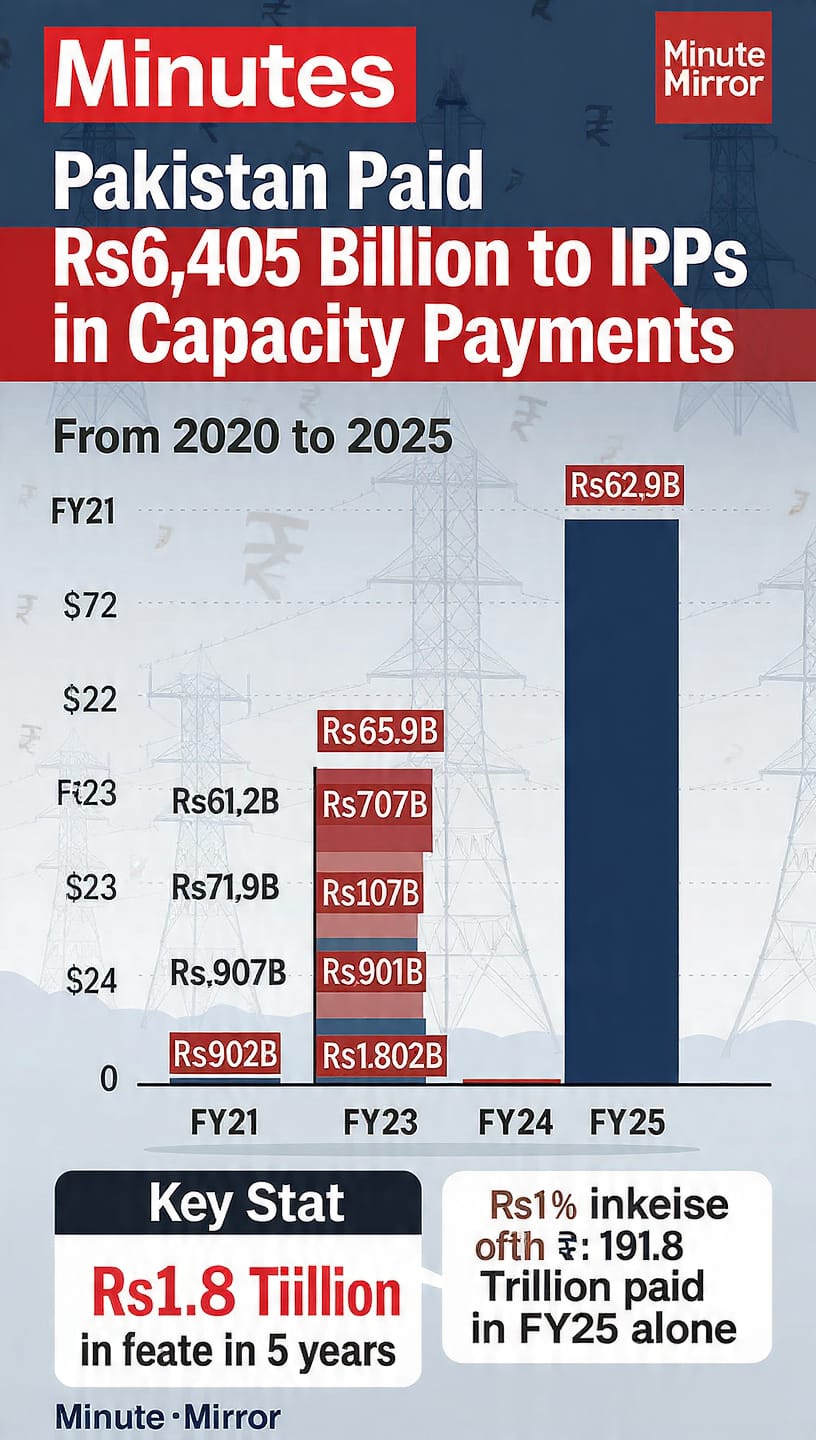
      ISLAMABAD: Pakistan’s federal government paid a total of Rs6,405 billion to Independent Power Producers (IPPs) in capacity payments between 2020 and 2025, the National Assembly has been informed, highlighting the growing financial burden associated with the country’s power sector. According to a written response submitted by Federal Minister for Energy Awais Ahmad Leghari, capacity payments increased significantly during the five-year period despite government efforts to renegotiate power purchase agreements and reduce electricity costs. The figures presented to the National Assembly show that capacity payments rose from Rs613.9 billion in FY2020-21 to Rs1,807 billion in FY2024-25. This represents an increase of approximately 194% over the period. The government paid Rs613.9 billion in capacity charges during FY2020-21. The amount increased to Rs775.9 billion in FY2021-22 before rising sharply to Rs1,307 billion in FY2022-23. Capacity payments reached their highest level during FY2023-24, when the government paid around Rs1.902 trillion to IPPs. Although the amount declined slightly in FY2024-25 to Rs1.807 trillion it remained almost three times higher than the amount paid in FY2020-21. Capacity payments are charges made to power producers for keeping their generating plants available to supply electricity, regardless of whether the full generation capacity is actually utilised. These payments are part of the contractual arrangements between the government and IPPs and have frequently been identified as one of the factors contributing to Pakistan’s expensive electricity system and growing circular debt. Responding to questions in the National Assembly, Energy Minister Awais Ahmad Leghari said the government has taken several measures to reduce the financial pressure created by existing power agreements. According to the minister, a government task force has terminated power purchase agreements with six IPPs, while agreements with several other producers have also been revised. The objective of these measures is to reduce electricity costs and limit the financial burden on the national power sector. The Ministry of Energy estimates that the changes made to the agreements could result in savings of approximately Rs4.3 trillion over the remaining life of the contracts. Leghari also clarified that payments made to power producers are based on tariffs determined by the National Electric Power Regulatory Authority (Nepra) and the terms agreed under the relevant power purchase agreements. He rejected the impression that generators were receiving payments outside the approved contractual and regulatory framework, stating that there were no additional payments beyond the applicable arrangements. Despite the government’s renegotiation efforts, the figures show that capacity payments continue to represent a major financial obligation for Pakistan. The Rs1.807 trillion paid in FY2024-25 alone demonstrates the scale of the challenge facing the country’s power sector. The government’s efforts to terminate and revise agreements are expected to provide substantial savings in the coming years. However, reducing capacity payments and addressing the broader issues of electricity pricing, power utilisation and circular debt remain critical challenges for Pakistan’s energy sector.

  • |

    Meloni faces growing youth backlash ahead of Italy election

    ROME: Italian Prime Minister Giorgia Meloni is facing growing dissatisfaction among young voters as the country moves closer to a national election expected next year. Recent opinion polls indicate that voters aged 18 to 34 are increasingly moving away from Meloni’s right-wing coalition and towards opposition parties. Analysts say the shift could become significant if young Italians turn out in large numbers at the 2027 election. Lorenzo Pregliasco, head of polling agency Youtrend, said younger voters were clearly showing greater support for the centre-left. Meloni’s coalition, which includes her Brothers of Italy party, Matteo Salvini’s League and Antonio Tajani’s Forza Italia, now has less than 30% support among voters under 35. The opposition bloc, led by the Democratic Party, the 5-Star Movement and the Left-Green Alliance, commands close to half of the support among the same age group. The situation marks a major change from 2023, when Meloni’s party alone enjoyed support among young voters comparable to the combined backing now received by her coalition. Analysts attribute much of the discontent to Italy’s economic difficulties and limited opportunities for younger people. Critics argue that the government has failed to introduce major economic reforms capable of improving employment prospects and reversing the country’s long-standing youth unemployment problem. Eurostat data shows that Italy has the lowest employment rate among people aged 15 to 24 in the 21-member eurozone. The country also spends less on education than most of its European partners. The economic challenges have encouraged many young Italians to seek opportunities abroad. According to Bank of Italy data cited in the analysis, young graduates in Germany earn substantially more than their Italian counterparts. Meloni’s approval rating among voters under 35 stands at around 25%, compared with approximately 35% among the wider population. Political scientist Lorenzo De Sio of Rome’s Luiss University said the lack of movement on economic policy was a major source of frustration among young voters. Meloni is also facing competition from the far right. National Future, a party formed earlier this year by former army general Roberto Vannacci, has already gained around 7% support in some polls. The party has attracted middle-aged men but is also gaining attention among some young urban voters opposed to immigration. The government’s law-and-order policies have further contributed to tensions with sections of the younger population. Measures targeting rave parties, cannabis production, street protests, squatters and juvenile crime have drawn criticism from youth groups. A nationwide student protest known as “No Meloni Day” brought thousands of demonstrators onto the streets last year. Protesters criticised security measures, education spending and Meloni’s position on the Gaza conflict. The government has also proposed changes to rules governing criminal responsibility for minors. Under the proposed legislation, people aged 14 to 17 who commit crimes could be treated as fully responsible unless it is established that they did not understand the consequences of their actions. Youth dissatisfaction has previously been difficult to measure because turnout among younger Italians is traditionally low. Many young voters have tended to stay away from elections rather than support opposition parties. That pattern changed during a March referendum on a judicial reform backed by Meloni. Around 67% of voters under 35 participated, and 60% of them rejected the proposed reform. The result demonstrated the potential influence of young voters when they participate in large numbers.

  • | |

    US expands import blacklist over Chinese forced la…

    The United States has banned imports from 43 additional Chinese companies over alleged human rights abuses and forced labour involving Uyghurs and other minority groups in the Xinjiang region. The decision marks the largest single expansion of the Uyghur Forced Labor Prevention Act Entity List since its enactment in December 2021, bringing the total number of restricted entities from 144 to 187. Newly blacklisted firms span electronics, lithium, metals, pharmaceuticals, and food sectors, including major capacitor manufacturer Hunan Aihua Group and exporter Chacha Food Co, which US officials accuse of sourcing materials or recruiting personnel through state-backed forced labour programmes. While US Customs and Border Protection has intercepted more than 24,300 shipments valued at nearly $1 billion under the law, the Chinese embassy in Washington has rejected the allegations, maintaining that workers of all ethnic groups in Xinjiang freely choose their employment and receive equal remuneration.

Leave a Reply

Your email address will not be published. Required fields are marked *