messi misses penalty
|

Messi misses penalty as Nashville crush Inter Miami 4-1

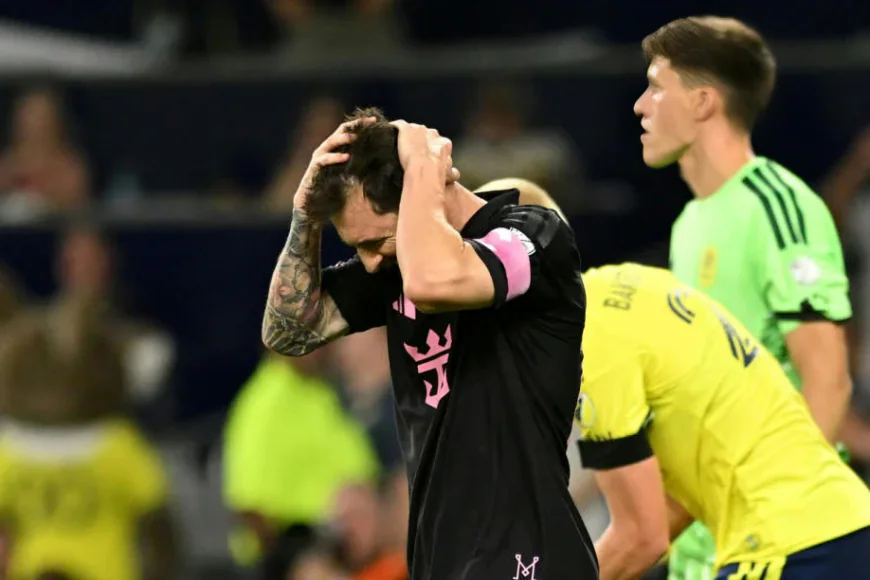
Lionel Messi endured a frustrating night as Inter Miami suffered a heavy 4-1 defeat against Nashville SC in a top-of-the-table Major League Soccer clash on Saturday.

The Argentina and Inter Miami captain missed a first-half penalty, received a yellow card and saw his team’s seven-match unbeaten MLS run come to an end. Despite the disappointment, Messi still produced a moment of quality by assisting Inter Miami’s only goal.

Nashville made the perfect start when Honduran defender Andy Najar rose to head the hosts into a 1-0 lead in the 17th minute.

Miami were handed an opportunity to respond six minutes later when Messi stepped up from the penalty spot. However, his effort lacked power and Nashville goalkeeper Brian Schwake made a comfortable save.

Messi’s struggles from penalties have become an unusual feature of his otherwise remarkable career. The latest miss added further frustration for the superstar forward, who has also failed to convert from the spot on major international occasions.

Inter Miami eventually found an equaliser in first-half stoppage time. Venezuelan midfielder Telasco Segovia fired a right-footed effort into the net after receiving an assist from Messi.

The momentum, however, quickly shifted back to Nashville after the break. Hany Mukhtar restored the home side’s advantage in the 49th minute before England striker Sam Surridge extended the lead.

Mukhtar then struck again in the 63rd minute to complete a memorable individual performance and put Nashville firmly in control at 4-1.

Messi was booked in the 59th minute, adding to an increasingly difficult evening for the veteran forward. In stoppage time, he came agonisingly close to finding the net when his effort struck both posts.

The victory strengthened Nashville’s position at the top of the MLS standings with 43 points from 19 matches. Inter Miami remained second on 38 points.

The defeat also ended Miami’s impressive away record and seven-game unbeaten league streak, while Nashville maintained its unbeaten home record in MLS.

The result adds another chapter to the growing rivalry between the two sides, with Nashville having also eliminated Inter Miami from the 2026 CONCACAF Champions Cup earlier this year.

Similar Posts

  • |

    CDA launches Rs5.07bn Six-Lane Road project from Faizabad to Koral Chowk

    The Capital Development Authority (CDA) has accelerated plans to construct a new six-lane carriageway along Service Road East, approving a project worth Rs5.072 billion aimed at easing chronic traffic congestion on the Islamabad Expressway and improving connectivity between Faizabad and Koral Chowk. The 9.25-kilometre road will run parallel to the Islamabad Expressway, extending from Faizabad to Koral Chowk near Gulberg Housing Society. Once completed, the new corridor is expected to provide motorists with an alternative route, reducing travel time on one of the capital’s busiest transport arteries while facilitating smoother traffic movement for commuters travelling to Islamabad and Rawalpindi. Officials said the project forms part of the CDA’s broader strategy to upgrade the capital’s road infrastructure in response to increasing traffic volumes and rapid urban expansion in surrounding residential and commercial areas. According to official sources, the new carriageway is expected to improve access to several housing societies and neighbourhoods located along the eastern side of the Islamabad Expressway. Authorities believe the project will not only ease traffic bottlenecks but also stimulate commercial development by increasing the value of properties and attracting new businesses along the corridor. To facilitate construction, the CDA has earmarked approximately Rs500 million for the relocation of critical utility infrastructure. This includes fibre-optic networks operated by the Islamabad Police Safe City Project, the Strategic Plans Division (SPD), Sui Northern Gas Pipelines Limited (SNGPL), and the Islamabad Electric Supply Company (IESCO). Sources said extensive utility shifting will be required before the main construction work can proceed at full pace. The project involves relocating 11kV electricity distribution lines, shifting 242 electricity poles, and relocating 248 graves that fall within the road alignment. Earthwork activities have already begun at selected locations. The road project also incorporates environmental protection measures. Officials said engineers have planned the preservation of 22 underground water channels, natural streams, and stormwater drains located along the proposed route to minimise environmental disruption and maintain the area’s natural drainage system. A breakdown of utility relocation costs shows that around Rs406 million has been allocated for IESCO infrastructure, Rs87.3 million for shifting Safe City fibre-optic networks, and approximately Rs6 million for relocating SPD facilities. Work on these utility relocation components is expected to commence after the completion of technical and administrative formalities. A senior CDA official said the authority has revised the project’s completion timeline, reducing the original target of 12 months to between six and eight months. However, the official acknowledged that the timely relocation of utilities remains the biggest hurdle and will largely determine whether the revised deadline can be achieved.

  • | |

    Pakistan’s military tightens grip on Islamis…

    Munir’s family background feeds into this shift as well. He is the son of an imam and considers himself a devout, conservative Muslim, and religious identity remains deeply woven into Pakistan’s state institutions. Even so, he has pushed the country toward international engagement through cryptocurrency partnerships, foreign investment deals, a mediating role in the conflict between the United States and Iran, and a mutual defence pact with Saudi Arabia. Data shared with a foreign news agency by the Armed Conflict Location and Event Data Project, a group that tracks conflict incidents worldwide, shows the scale of the shift. Pakistan averaged more than seven blasphemy related riots or attacks annually between 2021 and 2024, but recorded only one such incident over the past twelve months. Economic pressure appears to have played a significant role in prompting the crackdown. Two Pakistani government sources said officials grew alarmed during the summer of 2025 that rising hostility from fundamentalist groups toward France and other European countries threatened to jeopardize a European Union duty waiver covering Pakistani exports. Nearly a third of Pakistan’s total exports go to the EU, and losing that preferential access could have dealt a severe blow to the national economy. Neither the European Commission nor Pakistan’s commerce ministry responded to requests for comment on the matter. Washington has added its own pressure over religious freedom concerns. The US Commission on International Religious Freedom, a government watchdog, recommended last year that Pakistan be placed back on a list of countries of particular concern due to its blasphemy laws, a designation Islamabad has firmly rejected. Analyst Abdul Basit of Singapore’s S. Rajaratnam School of International Studies said worsening insurgent violence in Balochistan and Khyber Pakhtunkhwa, Pakistan’s two most mineral rich provinces, likely added urgency to Munir’s campaign, particularly since he has pitched foreign investment in the country’s mining sector to American officials over the past year. Basit noted that religious groups have lost favor within the state’s priorities, though he cautioned that the militias driving these regional insurgencies are not formally tied to the newly banned Islamist organizations, even if both draw recruits from the same pool of young, radicalized men. Elizabeth Threlkeld, who directs the Stimson Center’s South Asia program, said the open question going forward is whether Pakistan can sustain this level of focus over time. Crackdown targets country’s largest fundamentalist movement The largest of the groups swept up in the crackdown, Tehreek e Labbaik Pakistan, built its identity around the slogan “Death to blasphemers” before authorities banned it late last year. Many of its leaders now sit in jail, its mosques have been sealed shut and its financial accounts frozen. A previously undisclosed government document that laid the groundwork for the ban argued the organization had become a serious threat to Pakistan by damaging both domestic stability and the country’s standing internationally. A spokesperson for the group pointed to a statement it issued last year describing the ban as illegal and unconstitutional. The move against Tehreek e Labbaik follows earlier crackdowns on groups such as Lashkar e Taiba and Jaish e Muhammad, which Pakistan pursued under pressure from the Financial Action Task Force, the international body that monitors terrorism financing. Basit linked the newest crackdown to a period of internal reflection within Pakistan over its historical backing of the Afghan Taliban, whom Islamabad now blames for stoking Islamist insurgencies against the Pakistani state from across the border. The Taliban government in Kabul has dismissed that accusation as baseless, and a spokesperson for its foreign ministry declined to comment further, describing Pakistan’s crackdown as an internal matter. For Pakistan’s Christian, Shia and Ahmadi communities, the change in atmosphere has been dramatic. In the past, suspects in blasphemy related killings, including police officers, were sometimes greeted with rose petals or celebratory receptions, and individuals accused of burning churches or minority mosques often received public praise. Blasphemy remains a capital offense under Pakistani law, and even a rumor of an accusation has historically been enough to spark riots or lynchings. Human rights organizations say victims’ families have rarely obtained justice, since judges and lawyers have often been too frightened to take on such cases. Officer Malik said everyone who confronted the crowd during last month’s incident in Karachi felt genuine fear. The Christian family targeted that day was eventually moved to safety, and an initial investigation has since found the accusations against them to be false. Group’s military links trace back a decade Tehreek e Labbaik formed in 2015 while its founder was imprisoned for shooting and killing a Pakistani provincial governor in 2011 over his support for a Christian woman accused of blasphemy. That gunman, a former police bodyguard, was later convicted and executed months after the group’s founding. Analysts have long suspected the group’s creation received at least tacit support from Pakistan’s military establishment, including its intelligence services, as a tool to keep civilian governments and mainstream political parties in check. Following violent riots led by the group in 2017, then army chief General Qamar Javed Bajwa referred to its protesters as the country’s own people. Pakistan’s Supreme Court later ordered the military and intelligence agencies to stay out of politics but stopped short of directly tying them to the organization. Analysts and former officials say the effects of years of tolerance for the group will not disappear simply because of a ban, and that the shock felt by its supporters could still trigger backlash. Ihsan Ghani, who served as Pakistan’s counter terrorism chief during the 2017 riots, said he worries the group could resurface at full strength if its usefulness to the state changes again. He compared decades of state backed nurturing of the movement to something that cannot simply be switched on and off at will. Within Pakistan’s minority communities, the sudden shift still feels fragile. One of the Christian women rescued during last month’s incident in Karachi said she and her family are now physically safe, but admitted the fear has not fully faded.

  • |

    US delegation walks out of UN Security Council after dispute with France

    The United States walked out of a United Nations Security Council meeting on Monday during remarks by France’s ambassador, escalating a diplomatic dispute between the two allies over human rights and the leadership of the UN’s top human rights office. The disagreement began after a recent vote on extending the term of Volker Turk as the United Nations High Commissioner for Human Rights. The United States joined Russia and North Korea in opposing his reappointment, placing Washington on the same side as two countries it has frequently criticized over human rights issues. Following the vote, France’s mission to the United Nations strongly criticized the US position on social media, saying Washington had once been a global symbol of human rights but no longer deserved that reputation. The statement drew a sharp response from American officials and set the stage for the diplomatic confrontation that followed. The latest tension unfolded during an emergency Security Council meeting on Russia’s war in Ukraine. As France’s UN Ambassador Jerome Bonnafont began speaking, members of the US delegation left the chamber in protest. US Ambassador Dan Negrea later said the walkout was a direct response to what he described as France’s disrespectful and condescending language toward the United States. He warned that similar protests would continue unless France changed its approach and withdrew its criticism. Earlier, US Ambassador Mike Waltz defended Washington’s opposition to Turk’s second term. He argued that the human rights chief had unfairly criticized democratic countries while failing to take a strong enough stance against governments with poor human rights records. Waltz did not identify specific examples to support his criticism. During his time in office, Turk has repeatedly condemned Russia’s invasion of Ukraine and has also raised concerns about Israel’s military operations in Gaza. Despite US objections, his second term was approved by a large majority of UN member states, with 144 countries voting in favor, 10 voting against and 13 abstaining. The dispute reflects broader tensions between the United States and the United Nations under President Donald Trump’s administration. In recent years, Washington has reduced financial support for several UN agencies and withdrawn from a number of UN bodies as part of a wider review of its international commitments. After the vote on Turk’s reappointment, US Ambassador Jeff Bartos warned that the United States would reconsider its participation, engagement and funding for UN institutions. He accused the organization of allowing procedural abuses and political deals to influence key appointments. France, however, strongly defended Turk’s leadership. Ambassador Bonnafont described him as a principled and impartial official who had carried out his responsibilities with integrity during his first term. France argued that his reappointment reflected the confidence of the overwhelming majority of UN member states. A spokesperson for the United Nations declined to comment directly on the American walkout but said the organization expects all member countries to respect decisions made through its established voting process. The incident has added to growing friction between Washington and the UN at a time when international cooperation is already under pressure from several global conflicts.

  • | | | |

    Upper Dir battles massive cholera outbreak as case…

    PESHAWAR: A major cholera outbreak has struck several areas of Upper Dir in Pakistan’s Khyber Pakhtunkhwa province, infecting more than 3,000 people and placing severe pressure on local healthcare facilities, officials said on Saturday. The outbreak has affected multiple localities, including Ashirai Dara, Sharingal, Barawal and Dir Khas, where a large number of residents have reported symptoms associated with the waterborne disease. According to Dr. Sahibzada Imtiaz, Medical Superintendent of the District Headquarters Hospital in Upper Dir, the number of cholera patients has risen rapidly over the past few days. He said more than 3,000 people, including women and children, have been infected since the outbreak began. Hospital authorities revealed that 600 patients were admitted in a single day, highlighting the alarming pace at which the disease is spreading. The influx of patients has overwhelmed the District Headquarters Hospital, leaving medical staff under immense pressure. Doctors said several patients remain in critical condition and are being shifted to other healthcare facilities for specialized treatment because the main hospital has reached full capacity. In response to the health emergency, teams from the Khyber Pakhtunkhwa Health Department have been dispatched to the affected districts. Public health officials are conducting field inspections, monitoring the spread of the disease and working to improve access to safe drinking water. Authorities are also testing local water sources to identify possible contamination, as cholera is commonly spread through polluted water and poor sanitation. Health experts have urged residents to drink only boiled or purified water, maintain proper hygiene and seek immediate medical attention if they experience severe diarrhea, vomiting or dehydration. They stressed that early treatment can significantly reduce the risk of serious complications. The outbreak has raised concerns about public health infrastructure in remote areas, where limited access to clean water and medical services can accelerate the spread of infectious diseases. Officials say emergency response efforts will continue until the situation is brought under control and further infections are prevented.

  • |

    Hong Kong democracy activist allowed to remain in UK after deportation scare

    Former Hong Kong opposition leader Wu Chi-wai has been granted permission to stay in the United Kingdom for six months after initially facing the possibility of deportation upon arriving at Heathrow Airport. The decision ends several days of uncertainty and allows the veteran pro-democracy activist to reunite with his family after years of separation. Wu arrived in London last Wednesday but was detained by UK Border Force officers for nearly 10 hours. Speaking to BBC Chinese, he said officials initially refused him entry and later informed him that he would only be allowed to remain in the country for one week before reporting back to the airport for deportation. However, the situation changed on Monday when UK authorities approved his entry under standard visitor rules, allowing him to stay in the country for up to six months. The 63-year-old is one of Hong Kong’s best known pro-democracy figures and formerly led the now dissolved Democratic Party. He was also among the group widely known as the Hong Kong 47, prominent activists and politicians prosecuted under Hong Kong’s national security law. Wu was released from prison in June after serving more than five years on convictions related to subversion and other charges. Wu said the trip was mainly intended to reunite with his wife and son, who moved to the United Kingdom in 2022 and 2023. During his imprisonment, he said their contact was limited to monthly phone calls and letters, making the visit especially meaningful after years apart. Before leaving Hong Kong, Wu said he sought advice from staff at the British Consulate General regarding his travel plans. According to him, officials assured him there should be no problems entering the UK and said they would inform the UK Border Force about his criminal record and travel itinerary in advance. Wu said border officials questioned whether he was a genuine visitor travelling only to see his family. He also rejected media reports claiming that he intended to seek political asylum in Britain, insisting that he had no such plans. The rights group Hong Kong Watch welcomed the UK’s decision to allow Wu to remain in the country. Policy Director Megan Khoo said the outcome was the correct one and argued that Wu should never have faced the threat of being sent back to the city where he had been imprisoned. Wu entered Britain using a British National Overseas passport, a travel document available to many Hong Kong permanent residents born before the territory’s transfer from British to Chinese rule in 1997. Holders of the passport are generally allowed to visit the UK without a visa for up to six months. The UK introduced a special visa route for British National Overseas passport holders in 2021 following the crackdown on Hong Kong’s pro-democracy movement. The programme allows eligible applicants to live, work and study in Britain and eventually apply for citizenship after meeting residency requirements. Since the scheme began, more than 230,000 Hong Kong residents have received BNO visas, while nearly 170,000 have relocated to the United Kingdom, according to government figures. The UK Home Office declined to comment on Wu’s individual case but reaffirmed its support for the Hong Kong community living in Britain. Meanwhile, the Hong Kong government said it had not received any request for assistance from Wu or other Hong Kong residents regarding the matter.

  • | |

    Makkah Pact Seen as key to regional stability

      LAHORE, Aug 12 (APP): Senior journalists, defence analysts and experts have described the Makkah Joint Defence Pact between Pakistan, Saudi Arabia and Türkiye as a significant step towards regional peace, collective security and stronger defence cooperation. The views emerged during a panel discussion titled “Makkah Pact: Peace, Security and Stability”, organised by the Press Information Department (PID) Lahore. PID Lahore Director General Shafqat Abbas said the agreement aimed to strengthen peace, stability and mutual trust rather than target any country. He stressed the importance of diplomacy, dialogue and cooperation in resolving regional disputes. He said Pakistan, Saudi Arabia and Türkiye brought different strengths and experiences to the partnership, creating opportunities for cooperation in defence, diplomacy, trade and investment. Abbas also said Pakistan’s national strength should extend beyond defence and include education, science, technology, skilled human resources and a strong economy. He urged the country to turn its defence capabilities into broader economic gains through research, skills development and increased exports. Senior journalist and analyst Mujeebur Rehman Shami highlighted Pakistan’s achievements in defence and diplomacy but called for greater investment in education, science, technology and skills. He also stressed the need to increase exports and improve economic productivity. Journalist Salman Ghani said the three countries offered complementary strengths, with Pakistan contributing its defence capabilities, Saudi Arabia its economic influence and Türkiye its advanced defence industry and technology. He said the pact could also encourage investment and economic cooperation. Defence analyst Col (retd) Abid said Pakistan’s leadership and military diplomacy played an important role in developing the agreement. He noted that its impact could extend beyond defence to economic, diplomatic and strategic affairs. Other speakers, including Dr Faleha Afzal, Malik Salman, Dr Farzana Riaz and journalist Noorullah, called for greater unity among Muslim countries and urged Pakistan to pursue economic development alongside defence preparedness. The participants agreed that stronger cooperation between Pakistan, Saudi Arabia and Türkiye could contribute to regional peace and stability. They also emphasised dialogue, common interests and coordinated efforts to address shared challenges. At the end of the session, Shafqat Abbas thanked the participants and said such discussions helped promote informed public debate on important national and international issues.

Leave a Reply

Your email address will not be published. Required fields are marked *