mobile phone packages

Mobile phone packages become expensive across Paki…

Islamabad: Mobile phone users across Pakistan will now have to pay higher charges for various call and internet packages as telecom companies have increased their tariffs after approval from the Pakistan Telecommunication Authority (PTA).

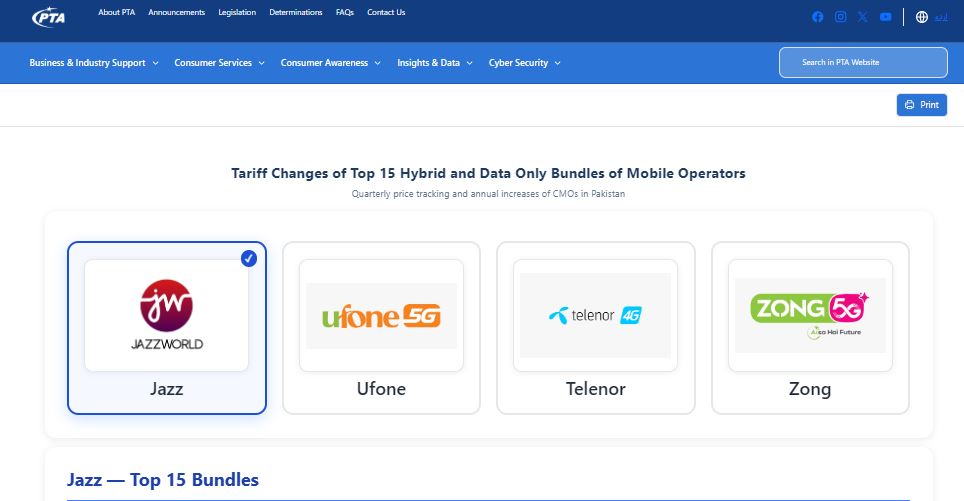
The PTA has released updated details of the top 15 hybrid and data only mobile bundles offered by major telecom operators, including Jazz, Zong, Telenor and Ufone. The revised tariff sheets show price increases in several monthly, weekly and short term packages, with some bundles witnessing an increase of up to 33 percent.

According to the PTA data, monthly call and data packages have seen increases of up to Rs500, while 15 day packages have become costlier by up to Rs300. Weekly hybrid bundles have recorded increases of up to Rs130, whereas three day, two day and one day packages have also witnessed price hikes.

The updated tariff details show that Jazz, Zong, Telenor and Ufone have revised prices of several popular packages. Jazz’s Monthly Supreme Plus package has increased by Rs300, reaching Rs1,900, while its Monthly Social Max package has increased by Rs50.

Zong users will also face higher charges as the company has increased prices of several packages. The Monthly Supreme Plus bundle has gone up by Rs300, while Weekly Premium has increased by Rs100. Some other weekly and monthly packages have also recorded price adjustments.

Telenor has also revised multiple package prices. Its 90 Day Power Pack has increased by Rs700, reaching Rs3,700, while Monthly Extreme Plus has increased by Rs300. Several weekly packages have also witnessed price increases ranging from Rs50 to Rs100.

Ufone has increased prices of several popular bundles, including Super Card Max, Social Extreme and Monthly WhatsApp packages. The company’s Monthly WhatsApp package has increased by Rs60, while some other monthly bundles have gone up by Rs100 or more.

The PTA said that it has updated its consumer awareness section to provide customers with complete information about mobile tariffs. The authority has published new tariff sheets containing existing package prices, revised charges, validity periods and available facilities.

According to PTA, the purpose of releasing the updated information is to help consumers compare different mobile operators and select packages according to their needs.

The telecom regulator further stated that transparency in the telecom sector and protection of consumer interests remain among its top priorities.

The increase in mobile package prices comes at a time when millions of Pakistanis depend on mobile internet services for education, business, online payments and daily communication, making the revised tariffs a major concern for regular users.

Similar Posts

  • | |

    FBR collects record Rs44bn income tax from salarie…

    ISLAMABAD: The Federal Board of Revenue (FBR) collected Rs44 billion in income tax from the salaried class during July, the first month of the current financial year. The collection was higher than the amount collected from salaried individuals during the same month in the previous two years. FBR had collected Rs42 billion from the salaried class in July 2025 and Rs30 billion in July 2024. According to sources, the higher collection from salaried individuals came despite an overall decline in income tax collection in some sectors. The figures indicate that the salaried class continued to contribute a significant share of income tax revenue at the beginning of the new financial year. Sources said property buying and selling transactions increased during July this year. However, tax collection from property transactions remained lower compared with the corresponding period last year. The development comes after the government introduced changes to income tax rates for several salaried income brackets in the federal budget for the current financial year. The government reduced tax rates on annual incomes above Rs2.2 million as part of its budget measures. Under the revised tax structure, the income tax rate for individuals earning between Rs2.2 million and Rs3.2 million annually was reduced from 23 per cent to 20 per cent. Similarly, the tax rate for the annual income bracket of Rs3.2 million to Rs4.1 million was reduced from 30 per cent to 25 per cent. For individuals earning between Rs4.1 million and Rs5.6 million annually, the income tax rate was reduced from 35 per cent to 29 per cent. The tax rate for people earning between Rs5.6 million and Rs7 million annually was also reduced from 35 per cent to 32 per cent. Despite these reductions in tax rates, FBR’s collection from salaried individuals increased in July compared with the previous two years. The figures show that the tax contribution from the salaried class remained strong despite changes in the tax slabs.

  • | |

    SMEDA partners with PAAPAM for auto show 2026

    LAHORE: The Small and Medium Enterprises Development Authority (SMEDA) has partnered with the Pakistan Association of Automotive Parts & Accessories Manufacturers (PAAPAM) as a strategic partner for the 21st Pakistan Auto Parts Show (PAPS) 2026. The three-day exhibition will take place from September 18 to 20 at the Expo Centre Lahore, bringing together stakeholders from Pakistan’s automotive and engineering sectors as well as potential international business partners. The partnership reflects SMEDA’s continued efforts to strengthen micro, small and medium enterprises (MSMEs) in line with the policy direction of the Ministry of Industries and Production and the SMEDA Board of Directors. The initiative aims to help local businesses expand their market reach, develop new partnerships and become part of regional and global industrial supply chains. Special Assistant to the Prime Minister for Industries and Production Haroon Akhtar Khan chaired a meeting on SMEDA’s collaboration with PAAPAM. Secretary of Industries and Production Saif Anjum, SMEDA Board members, CEO Nadia Jahangir Seth, Pak Suzuki head Hiroshi Kawamura and representatives of PAAPAM attended the meeting. Haroon Akhtar Khan said the government wanted to transform Pakistan into a competitive manufacturing hub by empowering MSMEs and strengthening domestic industrial value chains. He highlighted the resilience and growth potential of Pakistan’s automotive sector, saying events such as the Pakistan Auto Show could help promote local manufacturing, encourage innovation and attract investment. The SAPM called for the 2026 exhibition to become a major international platform with a strong focus on business-to-business engagement, memorandums of understanding and joint ventures. He also ordered the formation of a private-sector-led committee to prepare a comprehensive plan for making the event a landmark occasion. Khan further directed SMEDA to provide full support to PAAPAM and engage with foreign embassies and local MSMEs to facilitate effective business matchmaking during the exhibition. He said the government wanted to give MSMEs better access to markets, stronger commercial connections and greater opportunities to join regional and international value chains. Secretary MoI&P Saif Anjum said the event should help local auto parts manufacturers gain greater exposure and establish business links with international competitors. He called for SMEDA, PAAPAM, the Trade Development Authority of Pakistan (TDAP) and the Engineering Development Board (EDB) to work together to achieve the exhibition’s objectives. SMEDA CEO Nadia Jahangir Seth described the automotive sector as one of Pakistan’s most dynamic industries, with significant potential for SME-driven growth. She said numerous MSMEs play a key role in the country’s auto parts and engineering ecosystem. Through its partnership with PAAPAM, SMEDA aims to help these businesses present their capabilities, establish strategic alliances, adopt modern technologies and explore new opportunities in domestic and international markets. PAPS 2026 Convener Salman Saleem welcomed SMEDA’s participation, saying the partnership would strengthen efforts to present Pakistan’s automotive industry to the global market. He said SMEDA’s support would increase SME participation and reinforce efforts to promote local manufacturing under the “Make in Pakistan” vision. A symposium will also take place on September 19 alongside the exhibition. Organisers expect the session to contribute to discussions on the future of Pakistan’s automotive industry and help develop a roadmap for further growth and collaboration.

  • | | |

    PML-N takes early lead in AJK Polls

    Polling in the first phase of the Azad Jammu and Kashmir Legislative Assembly elections ended on Monday after a day marked by political tensions, allegations of rigging and several security-related incidents across Mirpur Division. Voting began at 8am and continued until 6pm after authorities extended polling hours by one hour. The first phase covered 13 constituencies in Mirpur, Kotli and Bhimber districts. The election saw a close contest between the Pakistan Muslim League-Nawaz and Pakistan Peoples Party. The Istehkam-e-Pakistan Party also remained in the race in several constituencies. The most serious incident was reported in LA-9 Kotli-II, where PPP worker Mukhtar Younus was killed and two people, including his father, were injured in a firing incident. PPP Chairman Bilawal Bhutto Zardari blamed PML-N candidate Sardar Umair Naeem for the incident. He alleged that Younus was killed in firing linked to the PML-N candidate and questioned why authorities had not acted earlier against alleged threats. Bilawal said a video had reportedly surfaced two days before the incident showing Naeem and his associates allegedly firing weapons in public. He argued that timely action could have prevented the loss of life. PPP AJK Election Cell in-charge Sardar Abdul Shakoor demanded immediate arrests and called for stronger measures to protect voters and political workers. The PML-N rejected the PPP’s version of events. The party claimed that Younus had also been involved in its election campaign activities. The incident came against the backdrop of earlier violence in Kotli. A PML-N activist was killed and two others were injured in a firing incident on July 10 while they were returning from an election campaign. Polling disrupted at several stations Voting was also suspended for the remainder of the day at three polling stations in Kotli and two in Bhimber following election-related incidents. Officials said the possibility of re-polling would depend on whether the number of votes affected could change the final result. In Bhimber’s Samahni tehsil, supporters of IPP candidate Ali Shan Soni allegedly took ballot boxes away from a polling station. Videos showing the alleged incident also circulated online. Mirpur Commissioner Raja Tahir Mumtaz said a ballot box was later set on fire at another polling station. Police detained around 30 people in connection with the incident. The PPP and PML-N exchanged allegations of electoral interference in several constituencies. The PPP accused PML-N supporters of attempting to influence polling in LA-12 Kotli-V. It alleged that PML-N candidate Raja Riasat Khan entered polling stations with armed men. The party also raised objections over alleged interference at polling stations in LA-8 Kotli-I and called on the Election Commission to investigate. The PPP further complained that slow mobile phone services were affecting communication for voters, journalists and emergency responders. PML-N, PPP trade rigging allegations The PML-N also raised allegations of pre-poll and polling-day irregularities. PML-N leader Rana Sanaullah alleged interference in LA-10 Kotli-III and claimed that PPP AJK President Chaudhry Muhammad Yasin was involved in alleged manipulation of the electoral process. He demanded an investigation and said his party would not accept the constituency’s results until the allegations were examined. The Election Commission separately confirmed that two presiding officers in Kotli had been arrested and suspended after reportedly failing to reach their assigned polling stations. According to officials, the presiding officers had collected election material but went to a private residence instead of reporting to their designated polling stations. An FIR was registered in connection with the matter, while replacement presiding officers were appointed and the election material was taken into official custody. PPP leader Nadeem Afzal Chan rejected the PML-N’s allegations and instead accused the federal government of influencing the elections. He claimed that government resources and development announcements were being used during the election period. He called for the federal administration to stay away from the electoral process and urged all parties to allow voters to make their choice freely. Security tightened across Mirpur Division Authorities deployed a large security force to maintain order during polling. A total of 288 candidates contested the 13 constituencies. The Election Commission established 2,316 polling stations, including 1,241 classified as highly sensitive and 724 as sensitive. More than 18,500 police and other law-enforcement personnel were deployed under a three-tier security arrangement. Police formed the first security layer, while Rangers and the Federal Constabulary formed the second. The Pakistan Army provided the third layer and remained prepared to respond to emergencies. Around 2,100 army personnel were also deployed, while Quick Response Force teams remained on standby. AJK Inspector General of Police retired Captain Liaquat Ali Malik said the election remained largely peaceful despite a few incidents. He described minor arguments and scuffles as common during closely contested elections but warned that anyone attempting to disrupt polling would face legal action regardless of political affiliation. The AJK chief election commissioner had also warned before polling that strict action would be taken against anyone attempting to interfere with the electoral process. Preliminary results show close race Unofficial results indicated a competitive contest between the PML-N and PPP. The PML-N was leading in LA-1 Dadyal with 8,271 votes and was also ahead in LA-7 Bhimber with 14,560 votes. The party was also leading in LA-5 Bhimber with 2,545 votes in the preliminary figures available at the time. The PPP was leading in LA-2 Mirpur with 3,103 votes. The results remained preliminary and unofficial, with counting and compilation continuing after polling ended. The first phase is part of a three-stage election schedule adopted due to security concerns. The second phase is scheduled for August 2 and will cover nine constituencies of Muzaffarabad Division and 12 refugee constituencies. The third phase will be held on August 10 in 11 constituencies of Poonch Division. Bilawal and Nawaz clash over election campaign The AJK election has also become a political contest between senior leaders of the PPP and PML-N. Bilawal Bhutto Zardari and former prime minister Nawaz Sharif both participated in election campaigning before polling. Nawaz criticised the PPP’s political record in Sindh during a campaign rally

  • Cabin Crew Heroin Bust Escalates as Transnational Syndicate Unravels in Thailand

    BANGKOK, Thailand — Thailand is preparing to elevate a cross-border heroin trafficking investigation involving a Thai cabin crew member detained in Australia to special case status, as a wider syndicate and overseas recipient network come into focus. The Office of the Narcotics Control Board (ONCB) confirmed that the case is being proposed for transfer to […]

  • | | | |

    Pakistan repays $1.4bn China loan

    Pakistan has repaid a $1.4 billion commercial loan to China, with refinancing expected within the next few weeks, State Bank of Pakistan (SBP) Governor Jameel Ahmad said on Wednesday. Speaking to reporters after attending a meeting of the Senate Standing Committee on Finance at Parliament House, the SBP governor said the country had made external debt repayments worth $2.2 billion during July 2026. The repayments included the $1.4 billion commercial loan to Chinese banks, while the remaining $800 million was used to settle other external liabilities. Ahmad said the refinancing from Chinese banks had not yet been received but was expected shortly, adding that the funds would be made available to Pakistan after a brief delay. The central bank governor also revealed that the SBP had purchased $28 billion over the past three years to strengthen the country’s foreign exchange reserves. He said Pakistan’s external debt repayment requirement had declined from $26.5 billion to $21.5 billion, easing pressure on the country’s finances during the current fiscal year. According to Ahmad, around $3.5 billion of the remaining repayments will be used to service interest obligations. He said the government would continue its strategy of increasing foreign exchange reserves while maintaining external financial stability. The SBP governor further noted that Pakistan would require the rollover of nearly $12 billion in deposits from Saudi Arabia and China to support its external financing position. He expressed confidence that the country’s debt repayment burden would remain lower this year compared with previous years, helping improve Pakistan’s overall economic outlook.

  • | |

    ECC approves hike in petrol, diesel dealers’ mar…

    ISLAMABAD: The Economic Coordination Committee (ECC) has approved an increase in the dealers’ margin on petrol and diesel by Rs1.34 per litre. According to sources, the dealers’ margin on both petrol and diesel has been raised from Rs8.64 to Rs9.98 per litre. Vice Chairman of the All Pakistan Petrol Pumps Owners Association Nauman Butt thanked the prime minister and petroleum minister for approving the increase. The association said the government had fulfilled its long-standing demand by increasing the dealers’ margin by Rs1.34 per litre. Meanwhile, the government collected more petroleum levy revenue than both its target and the International Monetary Fund’s (IMF) estimate during the last fiscal year. According to Finance Ministry sources, petroleum levy collections exceeded Rs1.56 trillion during the previous fiscal year. More than Rs50 billion was also collected under the Climate Support Levy. Petroleum levy collections were around Rs100 billion higher than the government’s target and Rs21 billion above the IMF’s estimate. At present, a petroleum levy of Rs80 per litre is being charged on petrol. High-Speed Diesel carries a levy of Rs77.28 per litre. In addition, a separate Climate Support Levy of Rs5 per litre is being imposed on both petrol and diesel.

Leave a Reply

Your email address will not be published. Required fields are marked *