naqvi defends officials
| |

Naqvi defends officials over viral carriage video

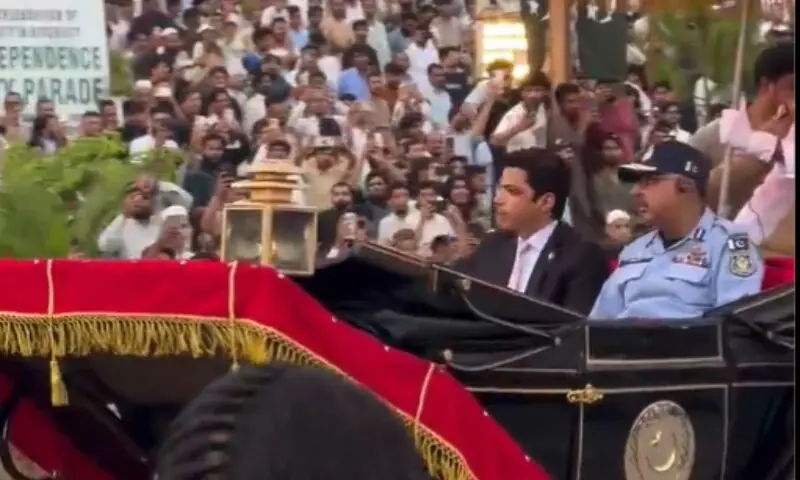
Interior Minister Mohsin Naqvi has defended the Capital Development Authority (CDA) chairman and Islamabad Inspector General of Police (IGP) after a video of the two officials arriving at an Independence Day event in a horse-drawn carriage triggered criticism on social media.

CDA Chairman retired Lt Sohail Ashraf and Islamabad IGP Syed Ali Nasir Rizvi were seen arriving at the parade in the carriage. The video showed event organisers asking the audience to applaud as the officials arrived, but little response could be heard from the crowd.

The footage quickly spread online, with several social media users describing the scene as outdated and comparing it with practices associated with the colonial era.

Naqvi later issued a clarification, saying the officials should not be blamed for using the carriage. According to the interior minister, the chief guest and he were delayed because of a meeting between the president and prime minister.

He said people had been waiting at the venue since 5pm. When it became clear that the senior officials would arrive late, instructions were given to start the programme so that citizens would not have to wait any longer.

Naqvi explained that the horse carriage had originally been arranged for the chief guest. However, due to the delay, it was used by the CDA chairman and Islamabad police chief to proceed with the programme.

The minister also said both officers had initially been reluctant to begin the event in the absence of the chief guest and himself. He maintained that they proceeded only after receiving specific instructions.

Despite the explanation, criticism continued online. Former federal minister Shireen Mazari shared the video and questioned the decision, while digital rights activist Usama Khilji criticised what he described as behaviour inappropriate for senior government officials.

Several journalists and public figures also reacted strongly to the footage. Journalist Farzana Ali questioned the appropriateness of such a display at a time when ordinary citizens are facing economic difficulties.

Journalist Zarrar Khuhro described the scene as embarrassing, while researcher Ammar Rashid criticised what he viewed as the growing distance between government officials and the public.

Former Pemra chairman Absar Alam also condemned the incident, calling it an example of an outdated bureaucratic mindset.

Former Sindh governor Mohammad Zubair drew a comparison with the recent visit of Norway’s foreign minister to Islamabad. He highlighted footage showing the foreign minister handling his own luggage at the airport and contrasted it with the behaviour shown in the Islamabad parade video
Similar Posts

  • | |

    ‘Fear and censorship cannot silence the public?…

    Lawyer and social activist Jibran Nasir has criticised the country’s political and economic situation, alleging that pressure, censorship and coercive measures have failed to change public opinion about PTI founder Imran Khan. Speaking to anchorperson Ameer Abbas, Nasir said authorities had been unable to alter public sentiment toward Imran Khan despite what he described as years of pressure and attempts to control political discourse. He argued that if public opinion had genuinely changed, millions of people would not have voted for Imran Khan and his political movement in the February 8 general elections. Nasir questioned how the authorities could claim to change broader public thinking about the economy, Constitution and rule of law when they had not been able to change people’s views about a single political leader. He also criticised what he described as restrictions on political expression and media freedom. Nasir alleged that force, state pressure, censorship and arrests were being used to control political developments. According to Nasir, suppressing criticism does not resolve underlying public grievances. He said people who speak about alleged injustices are sometimes portrayed as creating unrest rather than being allowed to raise their concerns. He warned that continued reliance on pressure could increase frustration among citizens instead of resolving political differences. Nasir further claimed that people were now more aware of political developments and could not easily be persuaded through fear or restrictions. He said arrests, cases and harsh measures had not succeeded in changing the position of a significant section of the public. The lawyer maintained that political issues could not be permanently controlled through force. He called for greater space for political expression and a process through which public grievances could be addressed. His comments come amid continued political tensions between the government and PTI. The party has repeatedly raised concerns over the treatment of its leadership, legal cases against its members and restrictions on political activities.

  • | |

    Security forces intensify K-P anti-terror operatio…

    Security forces have stepped up intelligence-based operations (IBOs) across Khyber Pakhtunkhwa under the Azm-e-Istehkam campaign, targeting militant hideouts and disrupting terrorist networks in several areas over the past two months, according to security sources. Officials said one of the major operations was carried out in the Khatti Killi area of North Waziristan, where security forces raided suspected militant hideouts following intelligence reports. During the operation, several terrorists were killed after an exchange of fire, while others sustained injuries and managed to flee. Security sources said troops recovered a large cache of weapons, ammunition and communication equipment from the militants’ hideouts. The recovered material is expected to assist investigators in tracing the activities and support networks of militant groups operating in the region. According to officials, the operations specifically targeted members of Fitna al-Khawarij, the term used by the state for the banned Tehreek-e-Taliban Pakistan (TTP). Authorities said the campaign was conducted with great care to protect civilians and prevent damage to local communities. Security officials emphasised that the ongoing operations are aimed at eliminating terrorist threats, restoring law and order, and ensuring lasting peace across Khyber Pakhtunkhwa. They reaffirmed that intelligence-led operations would continue until militant networks are dismantled and terrorism is eradicated. The latest operations are part of the broader Azm-e-Istehkam strategy launched to strengthen counterterrorism efforts nationwide. The campaign focuses on targeted intelligence operations against militant groups while enhancing the security of vulnerable areas. Last week, Director General of Inter-Services Public Relations (ISPR) Lieutenant General Ahmed Sharif Chaudhry said security forces had carried out more than 40,000 intelligence-based operations across Pakistan so far this year, with a significant number conducted in Balochistan and Khyber Pakhtunkhwa. He said nearly 194 intelligence-based operations are being conducted daily across the country. According to the military spokesperson, security forces have eliminated more than 2,000 terrorists during 2026, reflecting the intensified pace of counterterrorism operations.

  • |

    Karan Johar throws shade at rival reality shows during ‘Traitors 2’ launch

    The launch event for The Traitors India Season 2 was held in Mumbai. It was meant to introduce the new batch of contestants. But it was host Karan Johar’s remarks that ended up grabbing all the attention. Karan spoke about his role as host for this season. He hinted that his reputation would follow him into the show once again. He promised to be tougher on contestants than before. At the same time, he made it clear that entertainment would still remain the top priority. The Kuch Kuch Hota Hai director also explained the format of the show. According to him, the season is built around strategy, trust, and unexpected moves between contestants. These elements, he said, are what make the game so unpredictable. It was during this discussion that Karan made a subtle jab at other reality shows. He did not name any specific programme. However, he suggested that the eventual winner of this season would genuinely earn the win. This was seen as a contrast to how other competitions typically play out. Viewers quickly picked up on the comment. Many assumed it was aimed at rival reality formats currently on air. Karan did not stop there. He later made a lighter remark about Prime Video, the platform streaming the show. He spoke warmly about the partnership. He joked that being associated with the platform naturally comes with its own version of an alliance. The comment seemed to reference terms used by other popular reality shows. This only added more fuel to the online buzz. This season of The Traitors India brings together 21 new contestants. The show is scheduled to premiere on Prime Video starting August 13. That gives fans just under two weeks to prepare for its return. Beyond the contestant reveal, the event sparked plenty of conversation online. Between Karan’s sharper hosting style and his subtle digs at other shows, the launch managed to build strong buzz ahead of the premiere. With the countdown now on, attention shifts to how the new season will actually play out. Fans are curious to see whether Karan’s promise of a tougher, more strategic season holds up once the contestants settle in and the real alliances begin to form.

  • |

    IMF-backed move to End EPZ local sales Quota sparks concerns over textile recycling, jobs

    KARACHI: A proposed move to withdraw the permission allowing factories operating in Pakistan’s Export Processing Zones (EPZs) to sell up to 20% of their output in the domestic market has triggered concerns among exporters, investors and international textile-recycling organisations, who fear the policy could disrupt investment, employment and a wider global circular-economy supply chain. The controversy has emerged after Pakistan committed to the International Monetary Fund (IMF) that it would amend the existing rules governing EPZs and prohibit sales from these zones into the domestic tariff area. According to the IMF’s latest programme review, Pakistan has committed to introduce amendments aimed at ending domestic sales by EPZ-based manufacturers. The report states that the amendments were to be placed before the federal cabinet for approval by September 2026. However, exporters and industry representatives have challenged the move, arguing that the existing 80:20 arrangement was part of the investment and regulatory framework under which many businesses established operations in the zones. Under the existing system, EPZ manufacturers can export 80% of their production while selling up to 20% in Pakistan after payment of applicable duties and taxes. Industry stakeholders say the domestic-sale provision is particularly important for products that have limited commercial demand in overseas markets. The proposed abolition has also attracted attention in the United States because American companies supply raw materials and used textiles to Pakistani businesses operating in the EPZs. The US-based Secondary Materials and Recycled Textiles Association (SMART) has approached IMF Mission Chief to Pakistan Iva Petrova, warning that eliminating the domestic-sales provision could have consequences extending beyond Pakistan’s industrial sector. The association has argued that Pakistan occupies an important position in the global textile circular economy, particularly in the sorting, grading, reuse and recycling of used textiles collected in North America and Europe. According to SMART, used clothing and textile materials collected in the United States, Canada and European countries are sent to Pakistan, where they are sorted and graded before being channelled into reuse, recycling, manufacturing and affordable consumer markets. The association has warned that ending the 80:20 mechanism could reduce demand for recovered textiles and place downward pressure on their prices. Such a development, it said, could weaken textile-collection programmes in North America and reduce the income generated by charitable organisations from donated clothing. Organisations including Goodwill, the Salvation Army and St Vincent de Paul depend partly on revenues generated from donated goods to finance a range of social programmes, including workforce training, employment assistance, food support, recovery services, youth programmes and housing assistance. SMART has therefore cautioned that a major disruption in Pakistan’s used-textile market could have financial consequences for charitable organisations in North America, with potential losses running into tens of millions of dollars. The association also warned that reduced demand for used textiles could ultimately result in a greater volume of reusable material being sent to landfills or incinerators rather than being recycled or reused. US exporters raise objections US exporters have also expressed concern over the proposed withdrawal of the 20% domestic-sale allowance. Their concerns are significant because American suppliers form part of the upstream supply chain that feeds Pakistani recycling and manufacturing units located in EPZs. Abid Iqbal, representing Nashmia Industries, said during Express News programme The Review that US exporters had communicated their concerns to Pakistani counterparts. According to Iqbal, US exporters had also been told informally that the IMF itself had not initiated the proposal to remove the 20% quota. The development has consequently raised questions within the industry about how the condition was incorporated into Pakistan’s commitments under the IMF programme and whether sufficient consultation took place with affected stakeholders. Industry representatives have also warned of possible legal and contractual disputes, maintaining that the 20% domestic-sales provision was part of the regulatory and investment framework under which businesses made their investment decisions. They argue that companies entered the zones with an understanding that they would be able to export the bulk of their production while disposing of a limited portion in the domestic market after meeting applicable tax and customs obligations. EPZ rules and proposed amendment The Export Processing Zones Authority (EPZA) operates under the legal framework established through the EPZ Act of 1980. The law enables the establishment of export processing zones with approval from the federal government. Under Rule 228(5) of the Customs Rules, EPZ-based factories have historically been allowed to sell up to 20% of their production in the domestic tariff area, subject to applicable duties and taxes. A higher limit of 30% had been applicable to the Resalpur area. EPZA has reportedly forwarded a proposal to the Federal Board of Revenue (FBR) to eliminate the 20% quota from October 1 in line with the IMF-related commitment. The proposal, however, has exposed differences within the government over the scope and interpretation of the IMF condition. Proceedings of the Senate Standing Committee on Industries held last month indicate that the Ministry of Industries and Production maintained that abolition of the 20% domestic-sales quota was not included in the original IMF agreement. According to the ministry’s position, the initial IMF requirement was restricted to preventing the introduction of new fiscal incentives, including tax concessions and subsidies, rather than immediately eliminating the existing domestic-sales mechanism. The ministry has reportedly argued that the later addition of the quota-related condition requires further clarification. Assessment of EPZs The issue is also linked to an assessment of Special Economic Zones (SEZs) and EPZs that Pakistan was required to undertake under the IMF programme. The government engaged consultancy firm AT Kearney to assess the zones and determine whether their operations were creating distortions in the domestic market. According to records presented before the Senate Standing Committee on Industries, the assessment completed last year concluded that EPZs were not creating significant market distortions. The report, according to the parliamentary proceedings, did not recommend withdrawing existing fiscal incentives. The issue has therefore become a point of discussion between government officials and the IMF as authorities seek to reconcile the lender’s programme requirements with

  • | | | |

    Four Palestinians killed in Israeli raid on West B…

    JERUSALEM: At least four Palestinians were killed and four others wounded after Israeli forces, accompanied by Israeli settlers, launched a raid on a town in the occupied West Bank on Friday, according to Palestinian health officials and local sources. The latest violence took place in the town of Tell, located southwest of Nablus in the northern occupied West Bank, where tensions have continued to escalate amid repeated military operations and attacks by Israeli settlers. The Palestinian Ministry of Health confirmed in a statement that the death toll from the incident had risen to four. It added that four more Palestinians were injured during the assault, with three of the wounded reported to be in critical condition and receiving emergency medical treatment. According to local residents and security sources, Israeli settlers entered the town before Israeli troops moved in, triggering panic among residents. Witnesses said the attackers targeted several residential neighborhoods and opened direct fire at two Palestinian homes. Residents described scenes of chaos as families rushed to take shelter while ambulances struggled to reach the wounded. Emergency crews and local volunteers evacuated the injured under difficult conditions as sporadic gunfire continued in parts of the town. The incident marks another deadly episode in the occupied West Bank, where confrontations between Israeli forces, settlers and Palestinians have intensified in recent months. Rights groups and humanitarian organizations have repeatedly expressed concern over the growing number of civilian casualties and attacks on residential areas. The Palestinian Ministry of Health condemned the killings and called on the international community to take immediate steps to protect civilians in the occupied territories. Palestinian officials have also urged international organizations to investigate the latest incident and hold those responsible accountable. Israeli authorities had not immediately issued a detailed statement regarding the operation or responded to the allegations made by Palestinian officials at the time of reporting. The occupied West Bank has witnessed a sharp rise in violence alongside the ongoing conflict in Gaza, with frequent Israeli military raids, armed confrontations and settler attacks contributing to worsening security conditions across the territory. Friday’s deadly raid in Tell adds to growing international concern over the deteriorating humanitarian situation in the Palestinian territories, as calls for restraint and renewed diplomatic efforts continue to mount. With casualties increasing and tensions showing little sign of easing, fears remain that violence could spread further across the region in the coming days.

  • | |

    Naqvi to visit KP, Balochistan over business secur…

    Interior Minister Mohsin Naqvi has announced plans to visit Peshawar and Quetta to engage directly with business leaders and provincial authorities as the government steps up efforts to address security challenges affecting trade and investment in Khyber Pakhtunkhwa and Balochistan. The announcement came during a meeting with a delegation of traders, industrialists, and representatives of chambers of commerce from both provinces. The delegation briefed the minister on the law and order situation and highlighted the security issues that continue to disrupt commercial and industrial activities. Naqvi said the government recognizes the difficulties faced by the business community and is committed to creating a safer environment for investment and economic growth. He assured participants that all available resources would be utilized to improve security and resolve issues affecting businesses. The interior minister said his upcoming visits to Peshawar and Quetta would include meetings with senior provincial officials, law enforcement agencies, and business representatives to develop practical and long-term solutions to security concerns. He emphasized that a secure business environment is essential for economic stability, adding that the success of traders and industrialists is closely linked to the country’s overall development. “The progress of the business community is the progress of Pakistan,” Naqvi said, reaffirming the government’s commitment to supporting entrepreneurs and protecting commercial activities. The meeting followed a high-level discussion held a day earlier between Naqvi and President Asif Ali Zardari, during which they reviewed the country’s overall security situation, with particular focus on Khyber Pakhtunkhwa and Balochistan. Pakistan has witnessed a rise in militant violence in recent months, particularly in the two provinces. Security forces have intensified intelligence-based operations to counter militant groups responsible for attacks on civilians, security personnel, and public infrastructure. The deteriorating security environment has also affected workers and businesses. Earlier this week, six labourers who had been abducted in Balochistan’s Kech district were found dead, while several other attacks in recent weeks targeted police officers, judges, transport routes, and public facilities. The government believes improving security is essential not only for protecting citizens but also for restoring investor confidence and advancing major regional connectivity and infrastructure projects that have been affected by instability.

Leave a Reply

Your email address will not be published. Required fields are marked *