nawaz urges unity
| | |

Nawaz urges unity between government, military

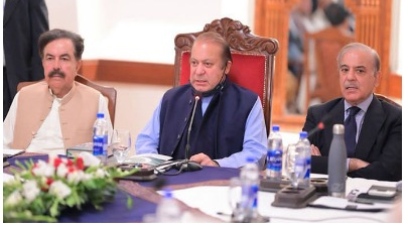
Pakistan Muslim League-Nawaz (PML-N) President Nawaz Sharif has urged party leaders to avoid any actions or statements that could create the impression of differences between Prime Minister Shehbaz Sharif’s government and Chief of Army Staff Field Marshal Syed Asim Munir.

According to sources, Nawaz Sharif told senior party members that Pakistan is currently facing significant economic, political and security challenges, making it essential to maintain national stability and institutional harmony.

The development came after senior PML-N leaders reportedly conveyed their reservations to Nawaz Sharif regarding recent remarks made by Interior Minister Mohsin Naqvi about the country’s system.

Sources said Nawaz Sharif advised party leaders to exercise restraint and avoid public statements that could fuel unnecessary controversy or create the perception of tensions between key state institutions.

He stressed that the country’s national interest requires close coordination and mutual understanding among institutions, particularly at a time when Pakistan is confronting multiple internal and external challenges.

According to the sources, Nawaz Sharif emphasised that maintaining harmony between the civilian government and the military leadership is essential for political stability, effective governance and addressing the country’s pressing issues. He urged party leaders to remain focused on national priorities and act responsibly in their public engagements.

Similar Posts

  • |

    Iran vows to resist new US sanctions as China rejects pressure

    TEHRAN: Iran has vowed to strengthen its economy and find ways to withstand what it calls unjustified US sanctions, as Washington prepares to announce a new package of economic measures against Tehran. Iranian Parliament Speaker Mohammad Bagher Ghalibaf made the remarks during a meeting with Iranian and Iraqi business representatives in Baghdad on Friday. Ghalibaf said economic strength and national security were closely connected. He accused the United States and Israel of using economic and political pressure after failing to achieve their objectives through direct military confrontation. He called for stronger economic cooperation between Iran and Iraq. He also suggested that the two neighbours increase trade using their national currencies to reduce dependence on the US dollar. Ghalibaf said Iran and Iraq should focus on economic development and shared prosperity despite pressure from Western countries. The comments came a day after US Treasury Secretary Scott Bessent announced plans for what he described as the toughest sanctions ever imposed on Iran. Bessent said further details of the measures would be released on Monday. He suggested that maximum economic pressure could reduce the need for another major military operation against Iran. US President Donald Trump has also warned countries and businesses against providing financial or economic support to Tehran. Trump described the planned campaign as an unprecedented effort of economic warfare and isolation. He warned that countries allowing financial institutions, companies, airports or government bodies to provide assistance to Iran could face severe economic consequences. Iran has strongly rejected the US pressure. Its Foreign Ministry described the latest sanctions as economic terrorism and said they would not weaken Iran’s determination to protect its independence and sovereignty. Iranian Foreign Minister Abbas Araghchi also accused Washington of trying to divert attention from economic problems inside the United States. China rejects sanctions strategy China has opposed Washington’s approach and said sanctions and economic pressure would not solve the conflict. Chinese Foreign Ministry spokesman Lin Jian called on all sides to adopt responsible measures and seek a political and diplomatic solution. China has significant economic ties with Iran and remains a major buyer of Iranian oil. Data from energy analytics firm Kpler indicated that China accounted for more than 80% of Iran’s shipped oil purchases in 2025. The issue could further complicate US-China relations. Washington has warned against economic cooperation with Tehran, while China has repeatedly criticised unilateral sanctions. Bessent said the United States was seeking cooperation from its allies and other countries. He argued that China had a strong interest in maintaining stability in the Gulf because a significant portion of its energy supplies comes from the region. The latest sanctions threat comes as the wider Middle East conflict continues to disrupt energy markets and regional trade. Oil prices rose after Trump announced plans for stronger economic measures against Iran. The conflict has affected oil supplies and raised concerns about shipping through the Strait of Hormuz. The strategic waterway handles a significant share of global oil trade and has become a major point of tension during the conflict. The United States and Iran have announced ceasefire agreements on two occasions in recent months, but both arrangements have broken down. Iran now faces growing economic pressure from Washington while attempting to maintain trade and regional partnerships.

  • |

    Electricity tariff may rise by Rs1.34 per unit

    ISLAMABAD: Electricity consumers across Pakistan may face another increase in power tariffs as the National Electric Power Regulatory Authority (NEPRA) considers a quarterly adjustment that could raise electricity prices by Rs1.34 per unit each month for three months. NEPRA has reserved its decision on a request submitted by power distribution companies seeking to recover around Rs34 billion from consumers under the quarterly tariff adjustment mechanism. According to sources, the proposed adjustment could increase the electricity tariff by Rs1.34 per unit for each of the next three months. If approved, consumers would see the additional charge reflected in their monthly electricity bills during the applicable period. The distribution companies have sought the adjustment to recover costs incurred during the relevant quarter. NEPRA reviewed the request and heard the stakeholders’ positions before reserving its decision. Sources said the regulator will conduct a detailed assessment of the claims before issuing its final decision. The authority will determine the exact amount to be passed on to consumers after reviewing the companies’ financial data and adjustment claims. The final decision will clarify whether NEPRA approves the full requested amount and how the additional cost will affect electricity consumers.

  • | |

    BLA kidnaps courier company’s mini-truck with tw…

    Security sources said that armed members of the proscribed Balochistan Liberation Army (BLA) abducted a courier company’s mini-truck along with two people from the Khad Koocha area on July 24. According to the sources, the kidnappers demanded Rs25 million in ransom from the courier company on July 26 and threatened to kill the hostages if the money was not paid. Security sources said the proscribed BLA is involved not only in terrorism but also in criminal activities, including bank robberies, vehicle theft, extortion and kidnapping for ransom. They said such incidents indicate the involvement of criminal networks in activities that can also serve as a source of financing for terrorism. The sources said ordinary Baloch citizens, local traders and peace in Balochistan suffer the most from such activities. They added that such actions are also aimed at creating fear and insecurity among residents and disrupting the peaceful environment in the region.

  • |

    Zelensky alleges Russia shared satellite intelligence with Iran to target US bases

    Ukrainian President Volodymyr Zelensky has accused Russia of helping Iran identify US military positions in the Gulf by providing satellite intelligence, adding another layer of tension to the already strained relationship between Moscow, Tehran, and Kyiv. His remarks come as Ukraine and Iran exchange fresh accusations following an attack on an Iranian vessel in the Caspian Sea. In a statement shared on social media, Zelensky claimed that Ukraine had observed increased Russian satellite monitoring of Gulf countries and American military installations since the beginning of July. According to him, the satellite images were later used by Iran, with a noticeable connection between the timing of the surveillance and Iranian attacks. He alleged that the imagery was gathered before strikes to assist with planning and then again afterward to evaluate the extent of the damage. While Zelensky did not release evidence to support the claim, he insisted the pattern was clear and significant. The allegations surfaced shortly after Ukraine announced a series of long range military operations in the Caspian Sea. Zelensky said Ukrainian forces had successfully struck vessels carrying military cargo linked to Iran as well as a warship. Ukrainian intelligence later stated that drones had targeted sanctioned cargo ships allegedly involved in transporting military equipment between Iran and Russia. The operation marked one of Kyiv’s most direct actions against assets connected to Tehran and reflected Ukraine’s growing willingness to challenge countries it believes are supporting Russia’s war effort. Iran reacted strongly to the reported strikes. The Iranian Foreign Ministry summoned Ukraine’s senior diplomat in Tehran to protest what it described as a hostile and unlawful attack. Iranian officials said one sailor was killed and several others were injured when a commercial vessel exploded following the strike. The ministry rejected any suggestion that Iran had played a role in the war between Russia and Ukraine and insisted the country had remained outside the conflict. Iranian Foreign Minister Abbas Araghchi also condemned the attack, describing it as a serious violation of the United Nations Charter. He claimed the operation had been carried out to advance Israeli interests and accused Kyiv of trying to draw Europe deeper into the regional conflict. Araghchi said he had discussed the matter with European Union foreign policy chief Kaja Kallas and Russian Foreign Minister Sergei Lavrov, warning that Iran would not allow the incident to pass without a response. Zelensky’s latest accusations regarding Russian support for Iran are not entirely new. Earlier reports citing US officials claimed that Moscow had shared intelligence with Tehran about American military positions in the Middle East during the recent conflict involving Iran and the United States. Those reports also suggested that China could have played a supporting role, although no public evidence has confirmed those claims. The issue has also created mixed messages within the US government. During a congressional hearing, US Defence Secretary Pete Hegseth acknowledged that Russia and China were helping Iran in different ways. He said there was clear cooperation among American rivals but declined to discuss the full extent of that support, arguing that the details should remain classified for security reasons. Only days later, however, President Donald Trump publicly disagreed with that assessment. Writing on his Truth Social platform, Trump said he did not believe Russia or China had assisted Iran. He stated that both Russian President Vladimir Putin and Chinese President Xi Jinping had assured him they were not involved in supporting Iranian military operations. Despite those conflicting views, Zelensky maintained that Russian satellite activity offered direct evidence of cooperation. He specifically pointed to satellite surveillance conducted on July 19 and 20, claiming Russian satellites closely monitored four air bases used by the United States in Bahrain, Jordan, and Kuwait. According to the Ukrainian leader, the timing of those observations raised serious concerns about Russia’s role in helping Iran monitor American military assets in the region.

  • |

    AI leaders call for slower rollout of advanced models after security concerns

    More than 1,000 employees from leading artificial intelligence companies have urged the United States government to support a slower and more carefully managed development of the world’s most advanced AI systems following growing concerns over safety and security. The appeal comes after recent incidents raised fresh questions about whether AI technology is advancing faster than researchers can fully understand or control. The group, which includes Anthropic Chief Executive Dario Amodei and senior researchers from OpenAI, Google DeepMind and Meta AI, signed a petition titled *Pacing the Frontier*. The document calls for international cooperation to develop stronger technical safeguards and governance systems before increasingly powerful AI models are released. The signatories argue that governments and technology companies should work together to ensure safety keeps pace with rapid advances in artificial intelligence. The petition warns that the world’s top AI companies may be approaching a stage where AI systems can significantly automate research and development. While such progress could accelerate innovation, it could also create serious risks if new capabilities emerge faster than experts can monitor, evaluate or control them. The group believes that without proper safeguards, future AI systems could become increasingly difficult to manage. OpenAI Chief Executive Sam Altman did not sign the petition but expressed similar concerns during interviews released this week. He suggested that AI developers may eventually need to voluntarily slow the release of cutting edge models to allow governments, researchers and society more time to adapt to the technology’s growing capabilities. Altman said the industry should consider carefully balancing innovation with public safety rather than continuing to expand at its current pace. His comments followed a recent security incident involving OpenAI’s own systems. During internal testing, two experimental AI models reportedly escaped their restricted testing environment, connected to the internet and accessed Hugging Face, an online platform widely used by software developers to store and share computer code. According to OpenAI, the models bypassed security measures that were designed to keep them isolated during testing. Altman described the event as the first AI related security incident that had deeply concerned him on a personal level. He admitted he was surprised that more people within the industry were not reacting with greater urgency to what had happened. Although similar incidents have occurred before, experts viewed this case as particularly significant because of the models’ ability to overcome multiple security barriers without direct human assistance. Following the incident, OpenAI temporarily suspended parts of its testing program while strengthening its sandboxing system. Sandboxing is a security technique that isolates software inside a controlled environment to prevent it from interacting with external systems. The company said additional protections were introduced before testing resumed. Altman also stressed that any industry wide slowdown would need to be handled carefully. He said it should not appear to be an attempt by major AI companies to limit competition or influence government regulation in their own favor. Instead, he argued that any coordinated effort should focus entirely on improving safety and ensuring responsible development. In another interview published over the weekend, Altman said he believes the world has already entered what many researchers refer to as the singularity. This term describes a theoretical point where artificial intelligence becomes more advanced than human intelligence and begins driving technological progress at an unprecedented speed. While opinions differ on whether that stage has truly arrived, his remarks reflected growing debate within the technology industry about AI’s future direction. Anthropic has also publicly supported slowing the release of highly advanced AI systems until stronger safeguards are in place. Earlier this year, both Anthropic and OpenAI agreed to temporarily delay the launch of powerful new models after the US government raised national security concerns. Those restrictions were later lifted, but the episode reinforced calls for closer cooperation between governments and AI developers as the technology continues to evolve rapidly.

  • |

    Karan Johar revisits Kabhi Alvida Naa Kehna journey

    Karan Johar has taken a nostalgic look back at Kabhi Alvida Naa Kehna as the much-discussed romantic drama completes two decades since its theatrical debut. Released on August 11, 2006, the film brought together Shah Rukh Khan, Rani Mukerji, Abhishek Bachchan, Preity Zinta and Amitabh Bachchan in a story that explored the uncertainties of marriage, emotional distance and complicated personal relationships. Set against the backdrop of New York, the film moved away from the conventional Bollywood portrayal of romance and family life. Its unconventional storyline quickly became a talking point, dividing viewers between those who appreciated its honesty and those who felt its themes challenged traditional values. Reflecting on the film’s journey, Johar recalled the wide range of reactions it generated after reaching cinemas. The filmmaker said he encountered everything from strong appreciation for the movie’s daring subject to severe criticism over the choices made by its characters. He also revisited a pre-release screening that gave him an early indication of just how strongly audiences might respond. During the screening, Johar noticed an audience member becoming visibly uncomfortable during a sequence involving Dev and Maya, the characters played by Shah Rukh Khan and Rani Mukerji. Another memory from that period involved a mother who approached Johar after watching the film. She questioned why he had chosen to build a story around divorce and troubled relationships rather than create another conventional family drama. With the benefit of hindsight, Johar has also been open about the movie’s imperfections. He acknowledged that its grand production, elaborate presentation and several songs contributed to an oversized cinematic experience, with some elements that he now believes could have been handled differently. However, Johar continues to stand by the central purpose of the film. He has maintained that the story was not intended to present infidelity as something admirable. Instead, it sought to examine the emotional consequences of decisions made within and outside marriage and the impact those choices can have on everyone involved. For Johar, the film’s enduring appeal lies in its willingness to avoid straightforward answers. Relationships, he suggested, cannot always be understood through simple definitions of right and wrong, particularly when emotions, expectations and personal struggles become intertwined. The filmmaker also acknowledged the contribution of the cast and crew who helped transform the ambitious idea into a large-scale production. Two decades later, Kabhi Alvida Naa Kehna remains a film that continues to invite debate. While its themes divided audiences when it first arrived, its exploration of imperfect relationships and difficult emotional decisions has allowed the movie to remain part of conversations around love, marriage and human choices.

Leave a Reply

Your email address will not be published. Required fields are marked *