walking through time
|

Walking through time: A personal journey inside Na…

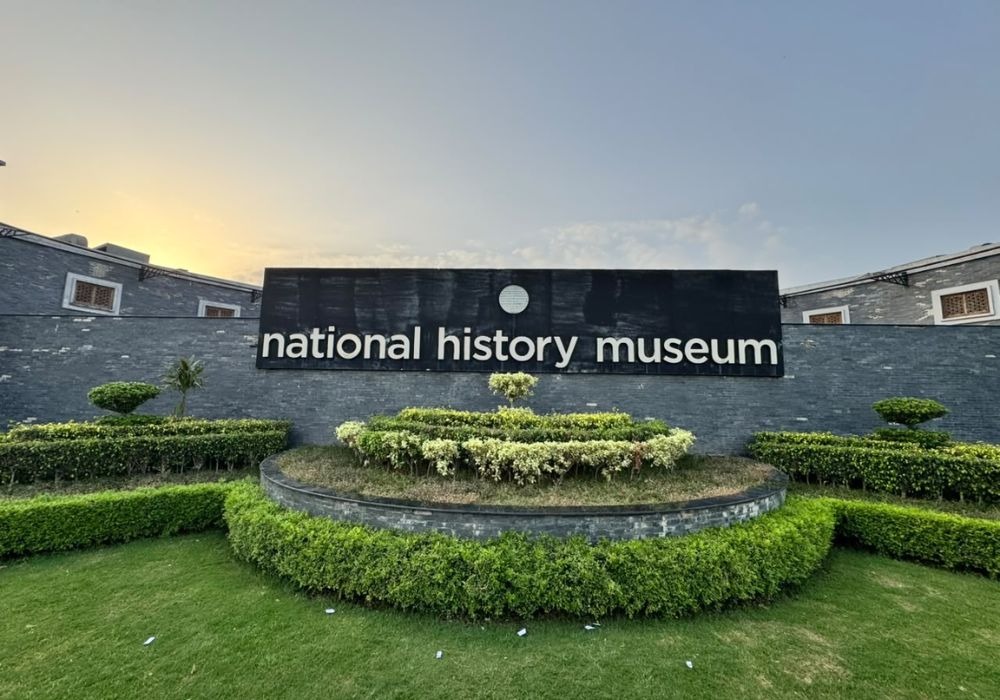
The rain had just stopped when I reached Lahore’s National History Museum. The roads were quieter than usual, the air felt fresh and, for the first time in weeks, I wasn’t in a hurry. I had postponed this visit for years, ever since a brief stop during my internship at the Lahore Museum left me wishing for more time. This Sunday, I finally had it.

I have also realised something over the past few weeks. Waiting for friends before exploring new places often means never going at all. So I decided to spend the afternoon on my own, following nothing except curiosity.

As I entered the museum, Floor Supervisor Tabish welcomed me and arranged a guided tour with Muhammad Shamsher, a PhD scholar in History who also serves as one of NHM’s guides.

His explanations never sounded like a lecture. Instead, he connected historical events with the people behind them, making every gallery feel like part of one continuing story.

Growing up, I believed museums were places where objects sat behind glass while visitors quietly read information panels. That idea came from childhood visits to museums in Islamabad, Taxila and Harappa, and later from my internship at Lahore Museum.

The National History Museum challenged that idea completely.

Through digital displays, sound, projection and interactive exhibits, history became something to experience rather than simply observe. Every gallery encouraged visitors to slow down and become part of the story unfolding around them.

One exhibit that caught my attention focused on the making of Minar-e-Pakistan. Like many Pakistanis, I had always admired the monument without knowing much about the person who designed it.

The museum introduced architect Nasreddin Murat-Khan and displayed photographs that offered a glimpse into the creative process behind one of Pakistan’s most recognisable landmarks. It reminded me how often we celebrate monuments while forgetting the people who imagined them.

The journey then moved towards Partition, where history became deeply personal.

The restored railway carriage, once part of the North Western Railway, stood quietly inside the gallery. Visitors could step inside and experience a virtual reality presentation recreating the migration of 1947. I had watched countless documentaries and films about Partition, but sitting inside that carriage created an entirely different feeling. The sounds, voices and uncertainty surrounding the experience made history feel much closer than any textbook ever could.

The museum then shifted from the birth of Pakistan to the challenge of building a new country. One gallery recreated the early government offices established after independence. I found myself studying old files, furniture and official records, imagining the enormous responsibility carried by those tasked with running a newly created nation.

Nearby, early Pakistani passports were displayed inside glass cases. Different in design from today’s passports, they represented the same hope of a country beginning to define its identity.

Another section I found especially engaging was Camera from the Past. Visitors could stand before a vintage-style camera and have their photograph taken, creating a small connection between the present and the past.

The gallery also highlighted photographer Aziz Ahmed Azmi, whose images documented Pakistan’s early years. Looking at his work, I realised that photographs often become history long after the moment they capture has passed.

Perhaps the gallery where I spent the most time was Popular Culture.

Having studied Mass Communication with a specialisation in Theatre, Film and Television and continuing to work in journalism, I naturally found myself drawn towards the colourful Lollywood posters and displays celebrating Pakistan’s cinematic heritage.

Reading about Azra, the country’s first colour film, and Zinda Laash, Pakistan’s first horror film, reminded me how rich our film history is, even if many younger audiences know little about it today.

Before leaving, I also explored Husn-e-Hunar, an exhibition celebrating Pakistan’s traditional craftsmanship. Alongside literature, music and cultural displays, it served as a reminder that a nation’s identity is shaped not only by political events but also by its artists, craftsmen and storytellers.

When I stepped back outside, I realised I had spent far longer inside the museum than I had planned.

I didn’t leave with pages of notes or dozens of photographs. Instead, I left with a greater appreciation for how history can be presented when museums invite visitors to participate rather than simply observe.

The National History Museum doesn’t just preserve Pakistan’s past. It encourages visitors to pause, ask questions and discover the stories that continue to shape the country today.

Similar Posts

  • Lettuce linked to U.S. parasite outbreak

    A recent outbreak of cyclosporiasis, a parasitic illness has spread to more parts of the United States. Health officials say the number of affected states has now increased to nine making it the largest known outbreak of its kind in the country. According to the latest update from U.S. health authorities the outbreak was first reported in Indiana Kentucky, Michigan Ohio and West Virginia. It has now also been confirmed in Illinois Kansas, Oklahoma and Pennsylvania. Investigators believe most of the cases are linked to contaminated iceberg lettuce imported from central Mexico. The lettuce is believed to have been contaminated with the Cyclospora parasite. Although cyclosporiasis is usually not life threatening experts say it can cause severe symptoms.  These include frequent watery diarrhea vomiting stomach cramps nausea and extreme tiredness. Officials say people in the newly affected states became sick around the same time as earlier patients suggesting they may have been exposed to the same shipment of contaminated lettuce. Health authorities are urging anyone who develops these symptoms after eating contaminated food to seek medical care as soon as possible. The investigation into the source of the outbreak is still ongoing.

  • Unbearable heat in Turbat

    Hani Rasheed Through the columns of your esteemed newspaper, I wish to highlight the unbearable heat in Turbat. Every summer, temperatures rise to dangerous levels, making life extremely difficult for residents. Students, labourers, elderly people, and patients suffer the most. Long hours of load shedding and water shortages make the situation even more unbearable. The authorities should take urgent measures to ensure an uninterrupted electricity supply, improve water availability, and plant more trees to reduce the effects of extreme heat. Public awareness about staying safe during heatwaves should also be promoted. The people of Turbat deserve timely action before this severe weather causes more health problems. I hope the concerned authorities will address this issue without delay

  • Journalism Education in AI Era: Harmonizing Traditional Skills and Emerging Technologies

    By Muhammad Aaraiz Altutmish  Two weeks ago, I attended a workshop under the project titled “Digital Trust and Free Expression in the AI Era” at the Department of Media and Development Communication, University of the Punjab, supported by the U.S. Mission to Pakistan in partnership with the Pakistan-U.S. Alumni Network (PUAN). The Workshop fetched together students, media persons, and experts to address one of the most significant topics framing advanced communication: the impression of AI on Media & Journalism.  Across the set of captivating sessions, presenters highlighted how Artificial Intelligence revolutionizing newsrooms, altering the way journalists collect information, inspect the facts and generate content. The fast development of technology specifically Artificial Intelligence (AI) has reshaped the advance digital world. AI is no longer a far-off concept; it has already integrated into the newsrooms and become a part of modern media networking. Therefore, media professionals and journalists can’t neglect this technology anymore. Instead they are continuously expected to develop their expertise and to modernize their skillset according to the changing media environment. This circumstance raises a significant question for journalism students who aim to foster their careers in the media industry. Should they first concentrate on learning the traditional basics or foundations of journalism, or should they prefer AI and developing technologies? While AI is transforming the means of working in media industry, journalism students are still needed to practice and learn the conventional principles and standards of journalism that have long been instructed in academic institutions. The AI development has brought prominent changes to writing, editing, publishing and content creation. Most of the operations can now be done in more quick and efficient way. Research functions have become effortless and many of newsroom tasks have been managed via technological tools. These advancements have transformed the media organizations operate and have affected many aspects of journalistic practices. Regardless of these changes, journalism education proceeds to emphasize the conventional methods of reporting, news values, interviewing techniques, fact- verification, and other foundational skills. Students are expected to master these standard practices while they also have to upskill themselves understanding and adapting to AI driven technologies and tools. As a result, journalism students often face the challenge of learning both traditional techniques and mastering themselves to developing technological skills within the same academic timeframe. This challenge becomes even more substantial for upcoming generations of media education and profession. They will have the same timeframe of study as former generations, still they may need to master a wide range of subjects and practical skills. Alongside traditional training of journalism, they will also require to develop their skillset related to AI, Digital media technologies, data driven networking and developing newsroom techniques. Consequently, media instructors, academic institutions, field professionals, and experts are set upon with a significant problem. They must reflect upon that how journalism education can accommodate both traditional practices of journalism and developing technological requirements. The hurdle stems in empowering students to master a wider spectrum of knowledge and practical experience within the existing timeframes and educational structures. The development of AI in journalism has therefore produced a new educational reality. While conventional journalism stands a central component of media education, technological developments continues to transform professional expectations. This continuing transformation spotlight the growing requirement to confront how future journalists can productively learn both the traditional practices of journalism and developing skills needed in an AI-driven media environment. The views, thoughts, and opinions expressed in this blog are solely those of the author and do not necessarily reflect the official policy or position of the U.S. Mission to Pakistan or USEFP/PUAN.

  • | |

    Deadly heatwave sweeps South Korea, claims 16 live…

    SEOUL: South Korea is grappling with one of the most intense heatwaves in its recorded history, with at least 16 people losing their lives and more than 2,000 others suffering from heat-related illnesses as extreme temperatures continue to grip the country. According to South Korean authorities, the nation recently recorded its highest temperature in 122 years of weather observations, with the southern city of Yangsan reaching a scorching 42.5°C. For the first time, officials have issued an extreme heat warning for the capital, Seoul, highlighting the severity of the ongoing weather conditions. President Lee Jae Myung has instructed government agencies to step up emergency measures to protect vulnerable groups, including the elderly, outdoor workers, and people with underlying health conditions. He also directed officials to closely monitor the country’s electricity supply as soaring demand for cooling systems places added pressure on the power grid. Climate experts say the unprecedented heat is being driven by a combination of persistent high-pressure weather systems and the growing impact of climate change, which has intensified extreme weather events across the region. Authorities continue to urge residents to limit outdoor activities, stay hydrated, and take precautions as the record-breaking heatwave shows little sign of easing.

  • | |

    PPP leader Nadeem Afzal Chan criticizes Punjab gov…

    Pakistan Peoples Party (PPP) Central Secretary for Information Nadeem Afzal Chan has strongly responded to a speech delivered by Punjab Chief Minister Maryam Nawaz during a public gathering in Muzaffarabad. In his statement, Chan accused the Punjab chief minister of making false allegations against the Pakistan Peoples Party and rejected the claims made during her address. Responding to Maryam Nawaz’s remarks, Nadeem Afzal Chan said that the Pakistan Muslim League-Nawaz (PML-N) should focus on addressing its own governance challenges instead of criticizing political opponents. He alleged that the party’s poor governance and corruption had negatively affected Punjab and claimed that the current condition of the province reflected years of administrative failure. Chan argued that the slogan of “Clean Punjab” had remained only a political promise and had not translated into meaningful improvements on the ground. According to him, the situation across the province demonstrates that many of the commitments made by the Punjab government have not been fulfilled.   Referring to the recent heavy rainfall in different parts of Punjab, the PPP leader claimed that a single spell of rain exposed weaknesses in the province’s infrastructure and urban management. He said that roads in several cities were submerged under water, creating serious difficulties for residents and disrupting normal daily life. Many people, he alleged, were forced to remain inside their homes because flooded streets made travel difficult and unsafe.   Nadeem Afzal Chan specifically mentioned the cities of Gujranwala and Layyah, describing their condition after the rainfall as particularly concerning. According to him, streets, markets, and residential areas in these cities resembled rivers and streams due to inadequate drainage systems. He argued that the flooding highlighted shortcomings in planning and municipal services despite repeated claims of development by the provincial government.   The PPP leader further criticized what he described as excessive government spending on publicity campaigns. He said billions of rupees had allegedly been spent on advertisements promoting the Punjab government’s performance, but the actual situation experienced by citizens painted a very different picture. In his view, the condition of roads and public infrastructure after the rainfall contradicted the government’s claims of effective governance and development.   Chan also accused the Punjab government of setting new records for corruption, alleging that financial irregularities had become a growing concern under the current administration. He claimed that additional controversies could emerge in the near future, including what he described as a potential wheat-related scandal. According to him, the details of the matter would soon become public, though he did not provide specific evidence to support the allegation. The remarks by Nadeem Afzal Chan reflect the continuing political rivalry between the Pakistan Peoples Party and the Pakistan Muslim League-Nawaz, with both parties frequently criticizing each other’s governance and policy decisions. Political exchanges between government and opposition leaders have intensified in recent months, particularly over issues related to public services, infrastructure, and economic management. The Punjab government has not immediately responded to Chan’s latest allegations. As political debate continues, issues such as urban infrastructure, flood management, public spending, and governance remain central topics in Pakistan’s political discourse, with both government and opposition parties presenting differing views on the province’s performance and future priorities.

  • NASA shares breathtaking full moon photo

    People on Earth see a full Moon almost every month but have you ever wondered what it looks like from space? A NASA astronaut living aboard the International Space Station (ISS) has shared a breathtaking photo showing the full Moon from orbit. The image was released on July 29, when July’s full Moon appeared in the night sky. It was shared on social media by NASA astronaut Anil Menon. While people on Earth watched the full Moon rise above the horizon and shine brightly in the sky astronauts on the ISS enjoyed a completely different view. From space the Moon appears to glow brilliantly against the deep black background of the universe. NASA also shared a message encouraging people to take a moment to look up at the night sky. The space agency said that the full Moon remains one of nature’s most beautiful and timeless sights continuing to inspire people around the world with its beauty.

Leave a Reply

Your email address will not be published. Required fields are marked *