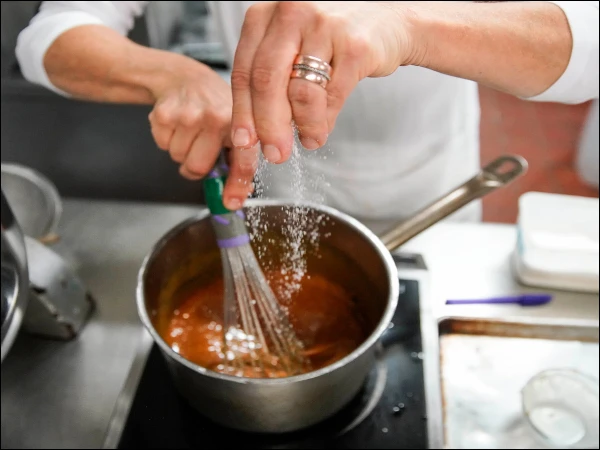
too much salt

Too much salt? Try these simple tricks

Salt is one of the most important ingredients in cooking because it brings out the flavor of food.  A small change in spices may not make much difference but too little salt can make a dish taste bland while too much can ruin its flavor.

Adding salt to food is easy when it is needed. But if you accidentally add too much salt you may think the whole dish is ruined.  Fortunately there are several simple kitchen tricks that can help reduce the strong salty taste and save your food.

Add a Potato

If your curry or another dish has too much salt take a raw potato cut it into two pieces and add it to the food. Let it cook for about 10 minutes and then remove it.  A boiled potato can also be used. If you prefer you can leave the potato in the curry and serve it with the dish.

Use fresh cream

Fresh cream can help make a salty dish taste milder. Add a small amount of cream to the curry or other suitable dishes and mix well.  It can reduce the strong salty taste while also making the food smoother and richer.

Try a dough ball

A small ball of flour dough is another traditional home method. Make a small dough ball and place it in the curry.  Leave it for around 15 minutes and then take it out. This may help reduce the salty taste of the dish.

Add water or milk

For dishes that can handle extra liquid adding a little water can reduce the salty taste.  Milk or cream can also work well in some recipes. Milk can make the flavor softer and more balanced.

Use yogurt and fried onion

Yogurt and fried onions can also help balance the taste especially in dishes such as meat curry karahi, or mixed vegetables. Grind some browned onions with yogurt and mix them into the dish. This can make the strong salty flavor less noticeable while adding extra taste.

Add salt slowly

The best way to avoid overly salty food is to add salt little by little while cooking. Taste the food before adding more.  This simple habit can help you control the amount of salt and keep your dishes flavorful.

Using less salt overall is also better for general health. So instead of adding a large amount at once add small amounts gradually and adjust the taste as needed.

Similar Posts

  • Keep lizards away with bird feathers

    Seeing a lizard inside the house is quite common. Most house lizards are not poisonous or dangerous but many people feel uncomfortable or scared when they see them. This is why people often try simple home methods to keep lizards away. Lizards can actually help control insects because they eat small bugs. However most people still do not want them inside their homes. If lizards often appear on walls in the kitchen or in other parts of the house a few simple steps may help reduce their presence. Use bird feathers Some people use bird feathers as a traditional way to keep lizards away.  Lizards are natural prey for birds so the sight of feathers may make them feel that a bird could be nearby. Peacock feathers are sometimes placed in areas where lizards are often seen.  Besides being used as a traditional method they can also work as a decorative item. Try eggshells Eggshells are another popular home remedy. After using eggs the shells can be cleaned and placed in areas where lizards are commonly seen. Some people believe that the smell of eggshells may discourage lizards from staying in the area. However this method may not work equally well for everyone. Use garlic Garlic is also commonly used to keep lizards away because of its strong smell.  You can place a few garlic cloves near corners windows or other possible entry points. The strong smell may help discourage lizards from coming into these areas. Keep the House clean Home remedies alone may not be enough.  Keeping your house clean is one of the best ways to reduce lizard visits. Avoid leaving food uncovered and clean crumbs or leftover food quickly. It is also important to control insects because mosquitoes flies and other small bugs are a major food source for lizards. By keeping the home clean reducing insects and blocking possible entry points you can make your home less attractive to lizards.

  • |

    Walking through time: A personal journey inside Na…

    The rain had just stopped when I reached Lahore’s National History Museum. The roads were quieter than usual, the air felt fresh and, for the first time in weeks, I wasn’t in a hurry. I had postponed this visit for years, ever since a brief stop during my internship at the Lahore Museum left me wishing for more time. This Sunday, I finally had it. I have also realised something over the past few weeks. Waiting for friends before exploring new places often means never going at all. So I decided to spend the afternoon on my own, following nothing except curiosity. As I entered the museum, Floor Supervisor Tabish welcomed me and arranged a guided tour with Muhammad Shamsher, a PhD scholar in History who also serves as one of NHM’s guides. His explanations never sounded like a lecture. Instead, he connected historical events with the people behind them, making every gallery feel like part of one continuing story. Growing up, I believed museums were places where objects sat behind glass while visitors quietly read information panels. That idea came from childhood visits to museums in Islamabad, Taxila and Harappa, and later from my internship at Lahore Museum. The National History Museum challenged that idea completely. Through digital displays, sound, projection and interactive exhibits, history became something to experience rather than simply observe. Every gallery encouraged visitors to slow down and become part of the story unfolding around them. One exhibit that caught my attention focused on the making of Minar-e-Pakistan. Like many Pakistanis, I had always admired the monument without knowing much about the person who designed it. The museum introduced architect Nasreddin Murat-Khan and displayed photographs that offered a glimpse into the creative process behind one of Pakistan’s most recognisable landmarks. It reminded me how often we celebrate monuments while forgetting the people who imagined them. The journey then moved towards Partition, where history became deeply personal. The restored railway carriage, once part of the North Western Railway, stood quietly inside the gallery. Visitors could step inside and experience a virtual reality presentation recreating the migration of 1947. I had watched countless documentaries and films about Partition, but sitting inside that carriage created an entirely different feeling. The sounds, voices and uncertainty surrounding the experience made history feel much closer than any textbook ever could. The museum then shifted from the birth of Pakistan to the challenge of building a new country. One gallery recreated the early government offices established after independence. I found myself studying old files, furniture and official records, imagining the enormous responsibility carried by those tasked with running a newly created nation. Nearby, early Pakistani passports were displayed inside glass cases. Different in design from today’s passports, they represented the same hope of a country beginning to define its identity. Another section I found especially engaging was Camera from the Past. Visitors could stand before a vintage-style camera and have their photograph taken, creating a small connection between the present and the past. The gallery also highlighted photographer Aziz Ahmed Azmi, whose images documented Pakistan’s early years. Looking at his work, I realised that photographs often become history long after the moment they capture has passed. Perhaps the gallery where I spent the most time was Popular Culture. Having studied Mass Communication with a specialisation in Theatre, Film and Television and continuing to work in journalism, I naturally found myself drawn towards the colourful Lollywood posters and displays celebrating Pakistan’s cinematic heritage. Reading about Azra, the country’s first colour film, and Zinda Laash, Pakistan’s first horror film, reminded me how rich our film history is, even if many younger audiences know little about it today. Before leaving, I also explored Husn-e-Hunar, an exhibition celebrating Pakistan’s traditional craftsmanship. Alongside literature, music and cultural displays, it served as a reminder that a nation’s identity is shaped not only by political events but also by its artists, craftsmen and storytellers. When I stepped back outside, I realised I had spent far longer inside the museum than I had planned. I didn’t leave with pages of notes or dozens of photographs. Instead, I left with a greater appreciation for how history can be presented when museums invite visitors to participate rather than simply observe. The National History Museum doesn’t just preserve Pakistan’s past. It encourages visitors to pause, ask questions and discover the stories that continue to shape the country today.

  • “A Glimpse After Twenty-One Days”

    By Amar Qawi If, someday, the entire sky were covered in darkness—without a moon, without stars, without even the faintest sparkle—would a lover whose heart glows like moonlight still be able to live beneath such a sky? That day, I sat on the rooftop of my house searching for the moon. But fate had something else in store. Instead of appearing in the heavens, the moon descended into the street below to grant me a glimpse after twenty-one long days. I did not dwell much on that radiance because something similar had happened to me earlier, on the fifteenth of July. Therefore, I took it as nothing more than an unfulfilled dream rather than believing that the moon belonged to me. In truth, even considering someone as one’s possession is itself a form of poverty. Since childhood, society has taught us that air, fire, and water are the necessities of life. Yet I feel sorry for those teachers who remain unaware of a deeper truth: human beings do not survive by air, fire, and water alone. Love, inspiration, and moonlight are equally essential for the soul to remain alive. A person may survive in this highly technical age amidst bombs and weapons, but without the sight of the beloved, the soul can never truly live. Just as air, fire, and water are essential to human existence, so too is the vision of the beloved. The truth is, I was not sitting on the rooftop in search of the moon in the sky. I was waiting for that moon from whom my moonbird-like heart had been separated for what felt like centuries. And yet, even when I found that moon, it was only within my dreams. Twenty-one days after the fifteenth of July, as I walked through that familiar street, she passed by me just as a shadow silently slips along a wall in the darkness. She is my shadow, and I am her reflection. She is my reflection, and I am her moonbird. She is the full moon to me. Whenever she shines like the full moon, my heart, like a restless chakor bird, longs to fly toward her and kiss her beauty. But alas, those delicate butterfly-like wings eventually grow weary from endless flights inspired by love. When I saw her in that street after twenty-one days, the fallen Taj Mahal of my imagination began to rebuild itself. The shy poet hidden within me blossomed with the spirit of Sheikh Ayaz’s immortal lines: “O moon! Who has stolen your sleep? Surely the chakor birds have enchanted you.” Just as Sheikh Ayaz expressed, something similar happened to me. When I first met her, I had no intention of falling in love. Yet I vividly remember that when we parted, dryness had settled upon our lips while tears embraced our eyes. It was as though the Urdu poet had written about our separation: “When we parted, my poem remained within her eyes— A poem that had never yet been recited to anyone.” When she passed beside me after twenty-one days, my eyes swore by the little golden nose ornament she wore and silently recalled the beautiful verse of Shah Abdul Latif: “Who says, my beloved, that you should walk gently? Place your feet upon my eyelashes without hesitation. Leave behind all fear of causing pain, For your passage itself is my greatest joy.” When even her tongue could not gather the courage to speak to me, my own eyes, too, denied themselves the permission of truly beholding her after those twenty-one days. Love is not dependent upon union; it longs for the meeting of souls. Therefore, for a lover like me, a glimpse after twenty-one days carries no real meaning if the beloved merely passes by like a silent shadow in the darkness. In the end, I wish to encourage the young people of our society who lose their dreams and their future while chasing someone who does not value their love. As an Urdu poet beautifully said: “If you have changed, then so be it. If not you, then someone else. And if not someone else, then another.” Thus, that glimpse after twenty-one days holds no value for me if it is wrapped in deception, falsehood, and unfaithfulness. To me, that meeting means nothing if pride and arrogance overshadow love. She merely appeared in the street and passed by like a shadow. Yet even today, I continue to wait for her, because my heart still loves that moon-like beloved with the devotion of a chakor bird. Even after twenty-one days, she remains steadfast in her pride. Still, the beloved’s pride is a matter of honor for the lover, for the beloved herself is both the lover’s pride and the most precious treasure he possesses. He can be reached at alikareemshaikh123@gmail.com

  • |

     Why collectors pay millions for fractured porcelain

    There is a low-frequency hum inside an antique shop, an acoustic hush from dust and centuries of quiet survival. It is often the wounded object that commands the most reverence amidst the polished mahogany and gleaming silver. A spiderweb hairline fractured across the belly of a Qing dynasty jar; a cobalt Blue Willow plate stitched together with iron staples; a tea bowl held in delicate cohesion by golden veins of lacquer. In a modern economy obsessed with pristine surfaces and factory precision, these fractured ceramics defy logic. They do retain value despite their damage. Often, they derive their singular majesty precisely because they broke. The art market regularly bears witness to this quiet paradox. At major auction houses in London and New York, porcelain pieces bearing dramatic structural fractures, historic restorations or visible fractures routinely sell for astronomical sums. When a cracked 18th-century Chinese brush washer or a chipped Song Dynasty bowl is launched, purists do not turn away. Instead, connoisseurs see a vessel that has successfully negotiated with time. A pristine artifact can feel like an untouched relic in a glass museum case. A cracked ceramic, however, carries the irreplaceable friction of human history. This romantic obsession with fracture finds its deepest philosophical roots in the Japanese tradition of Kintsugi: literally, golden joinery. In 15th-century Japan, legend holds that the shogun Ashikaga Yoshimasa sent a damaged Chinese tea bowl back to China for repair. It returned bound by heavy and unsightly metal staples. Japanese craftsmen was displeased and sought a more poetic solution. He bonded the porcelain shards with Japanese lacquer dusting it with powdered gold. Rather than disguising the trauma, Kintsugi illuminated the break. This technique transformed a domestic accident into a radiant architecture of resilience. When collectors haunt dim antique parlors today for cracked celadon or worn earthenware, they are participating in a quiet rebellion against the disposable. We live in an era of engineered obsolescence where a small fracture on a smartphone screen renders the entire device wasted. Antique ceramics represent the opposite: fired earth that withstands centuries, absorbing the touch of generations, bearing scars as badges of longevity. A crack proves that the vessel was used, held, washed, dropped, mourned and salvaged. It shifts the object from a passive decoration to an active survivor. Even the historical methods of repair have become prized antiques in their own right. Before gold lacquer was widely available, 18th and 19th-century itinerant tinkerers repaired heirloom china using metal staples. They were drilling tiny holes on either side of a split and hammering in delicate bronze or iron rivets. To a contemporary eye, these industrial-looking stitches might seem like visual vandalism. Yet, to collectors of stapled china, those iron rivets are exquisite evidence of human ingenuity and resourcefulness from an era when nothing precious was ever casually thrown away.   Ultimately, the enduring value of cracked porcelain in antique shops lies in what it reflects about our own human condition. Perfection is intimidating, fragile and ultimately unfeeling. Rupture, on the other hand, is universal. When a buyer pays for a cracked jar, they are purchasing a physical manifestation of survival. They acquire a tangible reminder that broken things can be mended, that wounds can be highlighted with beauty and that time does not diminish value, but rather confers it.

  • Easy dandruff care tips for healthy hair

    Easy dandruff care tips for healthy hair. Along with proper hair care some simple home remedies may help manage dandruff. Neem Neem has been used for many years for skin and hair care. You can make a simple hair mask by mixing crushed neem leaves with yogurt.  Apply it to the scalp for about 20 minutes and then wash it off. Neem is known for its antifungal properties which is why neem oil and other neem based hair products are often used for scalp care. Amla Amla is another popular ingredient in traditional hair care. Mix amla powder with water to make a paste.  You can also add a few basil leaves. Apply the paste to your scalp for around 30 minutes and then wash your hair with a mild shampoo. Fenugreek seeds Fenugreek seeds are also commonly used for hair and scalp care. Soak the seeds in water overnight. Grind them the next morning to make a paste and apply it to your scalp. Leave it on for about 30 minutes before washing your hair properly. Choose the right shampoo If dandruff keeps coming back using an anti-dandruff shampoo may be more helpful than relying only on home remedies.  Regular hair washing can help remove excess oil dead skin and flakes from the scalp. Eat a balanced diet A healthy diet is also important for healthy hair and skin. Try to include enough protein, vitamins minerals and healthy fats in your daily meals. When should you see a Doctor? If dandruff becomes severe or causes intense itching redness sores or does not improve with anti dandruff shampoo it is better to consult a dermatologist. In some cases symptoms that look like ordinary dandruff may actually be caused by conditions such as seborrheic dermatitis eczema or another skin problem.

  • Easy tips for dark circles

    Dark circles under the eyes are common and can appear for many reasons including lack of sleep and tiredness. They can make the face look dull but they are not always caused by poor sleep. Lifestyle habits aging allergies and genetics can also play a role. Getting enough sleep every night is one of the most important steps.  Resting well may help reduce the appearance of dark circles especially if they are caused by fatigue. If dark circles remain even after getting enough sleep you can try a few simple home remedies. Cucumber slices Place chilled cucumber slices over your closed eyes for a few minutes.  The cool feeling may help soothe tired eyes and reduce puffiness for a short time. Some people also use potato slices for dark circles. While they are a popular home remedy there is limited scientific evidence that they provide long term results. Eat healthy fruits A balanced diet is important for healthy skin.  Fruits such as bananas papaya and guava provide vitamins and nutrients that support overall skin health. However eating these fruits alone cannot guarantee that dark circles will disappear. Lemon juice and Oil Some home remedies suggest mixing lemon juice with jasmine oil and applying it around the eyes. However you should be very careful because lemon juice can irritate the delicate skin around the eyes and should never get into the eyes. Dark circles can have different causes in different people including genetics aging allergies skin tone and lack of sleep. If they continue for a long time or are accompanied by swelling or other unusual symptoms it is best to consult a dermatologist.

Leave a Reply

Your email address will not be published. Required fields are marked *