pak boxing team
|

Pak boxing team ready for Commonwealth Games

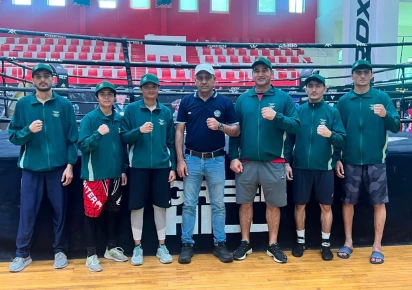
A five-member Pakistan boxing squad has arrived in Glasgow to participate in the Commonwealth Games, with national sports officials expressing confidence in the athletes’ preparation following months of intense training.
​The national contingent, accompanied by team officials and Pakistan Olympic Association (POA) Secretary General Haji Khalid Mahmood Chaudhry, will represent the country across five distinct weight divisions. The squad features three male and two female boxers who have earned their selection through top domestic performances.
​In the men’s categories, Samama Rehman will enter the ring in the 55kg division, Qudrat Ullah will compete in the 60kg event, and Afzal Khan Pathan will feature in the 65kg division. The women’s squad features Malaika Zahid in the 54kg category and Fatima Zahra representing the nation in the 60kg division.
​Maj. Irfan Younis has been appointed as team manager, while Muhammad Nisar Khan of the Pakistan Army will serve as head coach for the tournament. Pakistan Boxing Federation (PBF) President Col. (R) Nasir Ijaz Tung highlighted the extensive preparation undergone by the athletes, voicing optimistic expectations for the squad:
​”Our boxers have undergone comprehensive training and preparation leading up to this major competition. We are confident that they possess the skill and determination to deliver strong performances and make the nation proud on the international stage.”
​The boxing events are scheduled to run from July 23 to August 2, drawing top talent from across participating Commonwealth nations. Pakistan holds a proud competitive tradition in international boxing, and team officials believe the mix of emerging talent and dedicated coaching will yield positive results despite stiff international competition.

Similar Posts

  • Missing 57 Million Litres of Fuel Off-Loaded at Sea, Justice Minister Says

    BANGKOK — The amount of fuel oil that has gone missing at sea could be more than 57 million litres, and it was off-loaded from oil tankers onto smaller vessels over 96 trips, Justice Minister Rutthapon Naowarat said today. Authorities Probe Mystery Loss of 57 Million Litres of Fuel in Surat Thani The minister did […]

  • | |

    ECC approves hike in petrol, diesel dealers’ mar…

    ISLAMABAD: The Economic Coordination Committee (ECC) has approved an increase in the dealers’ margin on petrol and diesel by Rs1.34 per litre. According to sources, the dealers’ margin on both petrol and diesel has been raised from Rs8.64 to Rs9.98 per litre. Vice Chairman of the All Pakistan Petrol Pumps Owners Association Nauman Butt thanked the prime minister and petroleum minister for approving the increase. The association said the government had fulfilled its long-standing demand by increasing the dealers’ margin by Rs1.34 per litre. Meanwhile, the government collected more petroleum levy revenue than both its target and the International Monetary Fund’s (IMF) estimate during the last fiscal year. According to Finance Ministry sources, petroleum levy collections exceeded Rs1.56 trillion during the previous fiscal year. More than Rs50 billion was also collected under the Climate Support Levy. Petroleum levy collections were around Rs100 billion higher than the government’s target and Rs21 billion above the IMF’s estimate. At present, a petroleum levy of Rs80 per litre is being charged on petrol. High-Speed Diesel carries a levy of Rs77.28 per litre. In addition, a separate Climate Support Levy of Rs5 per litre is being imposed on both petrol and diesel.

  • Sam Rainsy Calls for Overthrow of Cambodian Leadership

    BANGKOK – In a forceful statement issued today, exiled Cambodian opposition leader Sam Rainsy has urged the nation’s military and citizens to rise up and topple the government led by former Prime Minister Hun Sen and his son, current Prime Minister Hun Manet. The appeal was made in the name of the ‘Independent Cambodian Government […]

  • | | |

    Salman Ali Agha backs Babar Azam’s return to rev…

      Pakistan’s stand-in captain Salman Ali Agha has backed the return of Babar Azam, expressing confidence that the experienced batter can provide a much-needed boost to the team’s struggling batting lineup. His comments came after Pakistan suffered a heavy defeat against England in the opening Test at Headingley on Friday. England completely dominated the match and secured an innings-and-103-run victory, taking control of the Test series. Pakistan struggled throughout the game, particularly with the bat, as they were dismissed for just 171 runs in their first innings before being bowled out for 135 in the second. In contrast, England produced a strong batting performance, posting 409 runs in their first innings. Pakistan’s bowlers were unable to take full advantage of the helpful conditions, while England’s players maintained pressure throughout the match. Ollie Robinson was named Player of the Match after an impressive bowling display in which he claimed eight wickets. Speaking after the match, Salman Ali Agha acknowledged that England had been the superior team and admitted that Pakistan had made several costly mistakes. “England have outplayed us,” Salman said, emphasizing that the team’s inexperienced batting unit needed to become more consistent, especially when playing in challenging overseas conditions. The Pakistan captain also defended his fast bowlers despite their failure to capitalize on the moisture and overcast conditions at Headingley. He pointed out that the pace attack had performed well during Pakistan’s previous tour of the West Indies and believed the conditions in England should have suited them. According to Salman, Pakistan have bowlers capable of reaching speeds of around 140 kilometers per hour, but they were unable to produce their best performances in the first Test. He insisted that he continued to have faith in the bowling unit and said the team would work on correcting its mistakes before the next match. Despite the disappointing result, Salman praised the individual efforts of Ali Usman and Abdullah Shafique. He was particularly pleased with Usman’s bowling performance in difficult conditions and also highlighted Shafique’s determination with the bat. Looking ahead to the next Test, Salman believes the potential return of Babar Azam could significantly improve Pakistan’s batting. Babar’s experience and ability to perform under pressure could provide stability to a lineup that struggled against England’s bowling attack. “Hopefully Babar will come back in the next match and his presence will give a boost to our batting,” Salman said. Pakistan will now look to learn from their mistakes and make a strong comeback in the next Test. With Babar Azam potentially returning to the playing XI, the team will hope that his experience can help strengthen the batting order and give Pakistan a better chance of challenging England in the remainder of the series.

  • | |

    FGEHA warned in 2019, yet Rs5.4 billion released f…

    Islamabad: A major land controversy surrounding Sky Gardens, formerly known as Green Enclave II, has come under scrutiny after the Senate Standing Committee on Housing and Works was told that Rs5.4 billion had been released for development despite earlier warnings that disputed land could not be used for a housing project. The committee was further informed that around 2,600 kanals of land had now been physically retrieved from the private developer, with the administration marking the land and placing pillars at the site. The revelations have raised serious questions about how the project was approved, why a joint venture was signed despite official warnings, why development funds were released and why the withdrawal of a National Accountability Bureau no objection certificate in December 2023 was allegedly not brought before the committee earlier. The Senate committee, chaired by Senator Nasir Mehmood, took up the Green Enclave II and Sky Gardens matter during its meeting at Parliament House and decided to summon senior officials to explain how the disputed transactions and agreements took place. According to the briefing by NAB Director General Rizwan Khan, an inquiry into Green Enclave II, also known as Commerce Sky Gardens, was initiated on the basis of a Supreme Court judgment dated May 4, 2018. The central issue was the alleged conversion of Shamlaat land, which is common village land, into private land. NAB told the committee that the Supreme Court had placed a legal bar on the partition, construction and transfer of Shamlaat land and had declared such transactions illegal from the beginning. Despite this, more than 3,000 kanals in Moza Mengal were transferred to a private developer through two mutations in April 2018. The timing of these mutations became particularly controversial. NAB told the committee that the Supreme Court judgment came around 10 days after the mutations. The Naib Tehsildar Murree subsequently cancelled the mutations. However, after an appeal by the developer, the mutations were restored without following the required legal process, according to the NAB briefing. The issue did not end there. In April 2019, the Deputy Commissioner Murree wrote to the Federal Government Employees Housing Authority (FGEHA) and warned that the land was ineligible for a housing project because of the Supreme Court judgment. Despite this warning, the FGEHA Executive Board signed a joint venture agreement with the developer on October 11, 2019. The committee was told that 4,086 kanals were subsequently transferred to FGEHA and that by 2023, Rs5.4 billion had been released to the private contractor for development. Another issue raised before the committee was that the same party that supplied the land was also given the development contract without bidding. This raised further questions about the way the project was structured and approved. The controversy deepened over the role of NAB and two separate addenda. NAB officials told the committee that FGEHA had assured NAB in 2022 that it would not develop the disputed Moza Mengal land and would instead shift the project to Moza Kathar, which was described as clear private land. Based on that understanding, NAB closed its inquiry concerning Moza Mengal in May 2022. But according to the NAB briefing, after receiving the closure letter, FGEHA signed another addendum and brought Moza Mengal back into the project. The situation became even more serious when development funds were released. NAB said that after it learned in October 2023 that Rs5.4 billion was being released for development, it withdrew its no objection certificate and reopened the inquiry on December 12, 2023. The committee chairman questioned why FGEHA had entered into an agreement for land that had already been declared problematic. He said that if a project’s foundation was flawed, the entire project would face problems. The committee also questioned why FGEHA did not issue a warning to the developer after NAB withdrew its no objection certificate in December 2023. The Housing Secretary told the committee that FGEHA had called its joint venture partner and warned that the agreement could be cancelled if the partner failed to provide land free from legal complications. But the chairman was not satisfied. He pointed out that the committee had previously been told the NAB matter was complete, while the latest briefing showed that NAB had withdrawn its letter in December 2023 and reopened the inquiry. The chairman said this was a major issue and indicated that the committee would not leave the matter without further investigation. The committee then turned to recovering the disputed land. Revenue Officer Umer Owais told the committee that approximately 2,600 kanals had been retrieved so far. He said the entire Shamlaat land in the area had been marked in the official record with a red entry, making it non transferable. The district’s land record had also been digitised, with Shamlaat holdings digitally blocked to prevent further transactions. The administration also claimed that the recovery was not limited to paperwork. A show cause notice was issued to the Sky Gardens management on January 27, 2026. The management submitted its response on February 9, but officials said the response was unlawful and lacked supporting proof. An order was issued on March 17, 2026, after which officials went to the site. The administration found earthwork taking place and physically took back the relevant land. Officials demarcated the area and installed pillars and markings to identify the recovered land. The recovery report was also submitted to police, according to the briefing. The Secretary Housing questioned why he had not been informed about the physical recovery when he had visited the Commissioner’s office around two weeks earlier. The revenue officer replied that the matter had been discussed informally and that officials had planned to brief FGEHA and the Housing Ministry together. The chairman said the central question was simple: if the land had never been transferred, the controversy would not have developed. He questioned the role of the revenue officials who allowed the transfer and placed responsibility on FGEHA for accepting the land despite the Supreme Court judgment and the Deputy Commissioner’s

  • | |

    DI Khan church still guards colonial memories

    There are some places we pass every day without realising how much history they hold. They remain untapped until some visitors put their eyes on them. During summer vacations, I travelled to Dera Ismail Khan, a district situated in southern Khyber Pakhtunkhwa. It takes six hours from Lahore to arrive in this historic city. During my stay there, I came across one such place that immediately captured my attention, and I thought to write about it. It was St Thomas Church, sacred place of worship for Christian community. A large cross standing at the entrance, old rusty walls, and an ambience of spiritualism. But the Church showcased more than that. Its walls contain historical accounts of colonial past, the military campaigns led by British soldiers in this area and a grave of one Lieutenant Governor of Punjab.   St Thomas Church was built in 1856 during British rule in the Indian subcontinent. It is one of the oldest churches in present-day Pakistan. It has survived political changes, the Partition of 1947, and the passing of time. Even today it stands as a symbol of the rich and diverse heritage of Dera Ismail Khan. The church is not only a place of worship but also a reminder that different faiths and communities have long been part of the history of this region. As we walked inside, we met the old priest and caretaker of the church named Chand. He welcomed us warmly and narrated the remarkable history of this place. There are memorials of British soldiers who lost their lives in this region during military campaigns. The priest stood in front of each tablet inscribed on the church wall and briefed about it. One memorial narrates the names, ranks and units of one hundred and 69 British military officers and other ranks who were killed or died due to injuries or disease in Waziristan military campaigns launched between 1919 to 1921.     Another memorial lists details of sixty-eight officers and other ranks who met a similar fate during the 1936-1938 Waziristan military campaigns. Similarly, one tablet erected by friends and fellow officers mourns the death of Herbert Walter Gee, ICS, deputy commissioner of Dera Ismail Khan, who died in 1901. There are other memorials as well, erected by colleagues in memory of the fallen officers. I thought that these names contain historical accounts year by year about what happened in this part of the world at that time. Every sentence of the Priest carried a new story, such as how the church has witnessed a lot of happenings through generations and that it still serves the small Christian community living in Dera Ismail Khan. As we stepped outside, believing our visit had come to an end, the priest said, “Wait. I have to show you one more thing.” He took me to the back of the building, where I saw a large white grave standing quietly among the dusty bushes. Here rests Lieutenant General Sir Henry Marion Durand (1812-1871). Durdand – a quite familiar name for the people of Pakistan and Afghanistan. Sir Durand was a career British military officer, diplomat, and administrator. He served in the East India Company Army, took part in several military campaigns, and later became the Lieutenant Governor of Punjab from 1870 to 1871. His son Sir Mortimer Durand is the one who drew the contours of the border between British India and Afghanistan in 1893. A man who once held such an important position now lies in silence behind an old church, while many people living nearby are unaware that his grave even exists. Henry Marion Durand died in 1871 at the age of 58 from a tragic accident. He was visiting Nawab of Tank Shahnawaz Khan along with his daughter when he fell from an elephant. The elephant was passing through the gateway by the town of Tank with the Nawab on the same elephant and an official (Chaprassy). The gate was too low to cross an elephant with howdah. The howdah struck the walls of crossing and the elephant got frightened resulting in the fall of Durand. He remained unconscious for a few days and never recovered. He was buried beside St. Thomas’ Church in Dera Ismail Khan. The British suspected some conspiracy into this incident. One of descendent of Nawab Shahnawaz Khan says that The British launched an enquiry into it. But the daughter of Durand gave testimony in favour of the Nawab that it was just an accident and there was no fault on his part. However, as a punishment, the British authorities stripped the powers of Nawab Shahnawaz Khan in 1875 and sent him to Lahore under strict watch. He passed away in 1881 while under surveillance. Standing beside the grave of Sir Henry Durand, I felt as if I had stepped into a forgotten chapter of history. The name engraved on the stone reminded me that many important events and personalities of the past remain connected to places that we often overlook. How easily history can fade from people’s memories, even when it is standing right in front of us. As I left St Thomas Church, I felt that I had walked through a chapter of history that few people ever get to read. Sir Henry Durand ruled Punjab from this soil, and his son later sat across a table in Kabul and drew the line that still separates Afghanistan and Pakistan today. That line appears in newspapers and political debates all the time. Yet the grave of the man whose name it carries lies quietly behind a church in Dera Ismail Khan.

Leave a Reply

Your email address will not be published. Required fields are marked *