pakistan pushes stronger
| | |

Pakistan pushes stronger ties with Belarus, Centra…

Pakistan has renewed its commitment to strengthening relations with Belarus and Central Asian countries.

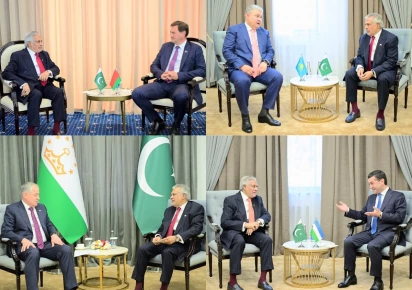
Deputy Prime Minister and Foreign Minister Ishaq Dar held separate meetings with the foreign ministers of Belarus, Kazakhstan, Tajikistan and Uzbekistan in Cholpon-Ata, Kyrgyzstan.

The meetings were held on the sidelines of the Shanghai Cooperation Organisation (SCO) Council of Foreign Ministers meeting.The discussions focused on bilateral relations, trade, investment, regional connectivity and security.

Dar met Belarusian Foreign Minister Maxim Ryzhenkov and reviewed the progress of relations between the two countries.The two sides agreed to expand cooperation in several important areas.

These include trade, investment, defence, agriculture, technology and workforce exchanges.They also discussed ways to strengthen economic ties and increase bilateral business activity.

Pakistan and Belarus are also preparing for the next session of their Joint Ministerial Commission.The ninth session is scheduled to take place in Islamabad on August 11 and 12, 2026.

The two countries are expected to use the meeting to explore new areas of cooperation.Dar and Ryzhenkov also discussed regional developments.

The Belarusian foreign minister appreciated Pakistan’s diplomatic efforts to support dialogue and promote peace and stability in the region.

Dar also met Kazakhstan’s Foreign Minister Yermek Kosherbayev.The two ministers reviewed the positive progress in relations between Pakistan and Kazakhstan.

They agreed to accelerate the implementation of agreements reached during recent high-level exchanges.A key focus was the implementation of 37 memorandums of understanding signed during a high-level visit.

The two countries also agreed to increase cooperation in trade, investment, transport, energy and regional connectivity.

People-to-people contacts and cooperation at international forums were also discussed.Kosherbayev appreciated Pakistan’s efforts to support regional peace and diplomacy.

He also invited Dar to visit Kazakhstan.The Pakistani foreign minister accepted the invitation and said the visit would take place at a mutually convenient time.

In another meeting, Dar held talks with Tajik Foreign Minister Sirojiddin Muhriddin.Both sides described Pakistan-Tajikistan relations as close and longstanding.

They agreed to further expand cooperation in several sectors.These include trade, investment, energy, connectivity and culture.

The two ministers also highlighted the importance of stronger people-to-people contacts.They agreed that regular high-level exchanges could help deepen bilateral relations.

The two sides also discussed regional and global developments.They stressed the importance of cooperation through international and multilateral platforms.

Tajikistan also expressed support for Pakistan’s efforts to promote peace and the peaceful resolution of regional issues.Dar also met Uzbek Foreign Minister Bakhtiyor Saidov.

The two ministers reaffirmed the importance of the Pakistan-Uzbekistan strategic partnership.

They reviewed progress in bilateral cooperation.Trade, investment, connectivity, energy, culture and people-to-people relations were among the key areas discussed.

Dar and Saidov also stressed the importance of stronger links between the business communities of both countries.

They said closer business engagement could help increase trade and investment.The two ministers also discussed the implementation of understandings reached during Uzbek President Shavkat Mirziyoyev’s recent visit to Pakistan.

They agreed that existing agreements should be converted into practical projects through timely implementation.

Regional and global developments were also discussed.Saidov appreciated Pakistan’s diplomatic efforts to promote regional peace and stability.

Both sides expressed hope that dialogue and diplomacy would continue to support lasting peace in the region.

Dar’s meetings took place during his visit to Kyrgyzstan for the SCO Council of Foreign Ministers meeting.

Pakistan used the diplomatic engagement to highlight its longstanding relations with SCO member states.

Islamabad also reaffirmed its readiness to assume the SCO chairmanship for 2026–27.Pakistan has expressed its intention to promote greater cooperation among member states.

The focus will include socioeconomic development, regional connectivity and mutual economic benefits.

Dar also attended an informal dinner hosted by Kyrgyz Foreign Minister Zheenbek Kulubaev for visiting dignitaries.

During the visit, Dar met Kyrgyz President Sadyr Zhaparov and conveyed greetings from Pakistan’s leadership.He expressed Islamabad’s desire to strengthen cooperation with Kyrgyzstan across different sectors.

Dar later led Pakistan’s delegation at the SCO ministerial meeting.

In his national statement, he reaffirmed Pakistan’s commitment to the SCO Charter and the principles of the Shanghai Spirit.These principles include mutual trust, mutual respect, shared prosperity and development.

Pakistan has also invited SCO member states to attend the SCO Council of Heads of State summit in Pakistan next year.The government says Islamabad’s upcoming SCO leadership will provide an opportunity to strengthen regional cooperation and deepen economic and diplomatic ties with member states.


Similar Posts

  • | |

    JUI-F cleric shot dead in Waziristan

    A religious scholar affiliated with Jamiat Ulema-i-Islam-Fazl (JUI-F) was shot dead by unidentified attackers in the Azam Warsak area of Birmal tehsil in Lower South Waziristan, police said on Saturday. The deceased was identified as Maulana Muhammad Ismail. According to police, the attack took place shortly after Friday prayers when unidentified gunmen riding a motorcycle opened fire on the cleric. He sustained multiple gunshot wounds and died at the scene before he could receive medical assistance. The attackers fled immediately after carrying out the shooting. Police launched a search operation in the area, but no arrests have been made so far. District Police Officer (DPO) Muhammad Tahir confirmed the incident and said an initial case has been registered. He added that investigators are examining all possible motives behind the attack and collecting evidence to identify those responsible. According to local officials and tribal elders, Maulana Muhammad Ismail was a resident of Kazha Panga and served as a teacher at a religious seminary in the area. He was known for his religious services and educational work in the community. Following the incident, law enforcement personnel reached the crime scene and shifted the body for legal formalities. Security was also tightened in nearby areas as authorities began efforts to trace the attackers. Police said no group has claimed responsibility for the killing. Investigators are questioning witnesses and reviewing available information to determine whether the attack was linked to personal enmity, militancy or any other motive. The killing has once again highlighted security concerns in parts of Khyber Pakhtunkhwa, where religious and political figures have occasionally been targeted in violent attacks. Earlier this year, former JUI-F provincial lawmaker Maulana Muhammad Idrees was shot dead by unidentified gunmen in Charsadda. In a separate incident in January, JUI-F leader Maulana Sultan Muhammad Wazir succumbed to injuries after being critically wounded in a bomb blast near a religious seminary in Wana Bazaar, South Waziristan.

  • |

    South Korea to enshrine nuclear pledge in law

    SEOUL: South Korea is preparing legislation that would legally reaffirm its commitment to nuclear non-proliferation while it moves ahead with plans to develop nuclear-powered submarines. The proposed bill is expected to be released for public consultation by the Defence Ministry. It will set out five key principles governing the country’s nuclear-powered submarine programme. If approved, the legislation would formally establish in domestic law Seoul’s pledge not to develop, produce, possess or use nuclear weapons. The proposed law would also prevent the government from using nuclear materials specifically for weapons-related purposes. It would prohibit activities that could weaken the international nuclear non-proliferation system. The move is aimed at addressing concerns that South Korea’s submarine programme could eventually lead to a domestic nuclear weapons capability. The legislation would reaffirm Seoul’s commitments under the Nuclear Non-Proliferation Treaty. It would also require cooperation with international organisations during the development of the submarines. The proposed framework would include safeguards for public safety and environmental protection against radioactive materials. The government also wants to speed up the submarine programme. The proposed law would reportedly allow the project to bypass a preliminary feasibility study. South Korea’s nuclear-powered submarine project, known as Jang Bogo N, involves plans for attack submarines powered by low-enriched uranium. The programme is being developed with US approval. The two countries reached an agreement on the project during a leaders’ summit last October. Seoul plans to launch its first nuclear-powered submarine in the mid-2030s. The vessel is expected to enter operational service later in the decade. Defence authorities are reportedly considering three submarines weighing about 8,000 tonnes each. However, official technical details have not yet been released. South Korean Defence Minister Ahn Gyu-back has previously stressed that the country will continue to follow its international non-proliferation commitments. Seoul also plans to work closely with the International Atomic Energy Agency throughout the programme.

  • | |

    NASA’s roman space telescope to explore dark ene…

    NASA is preparing to launch the Nancy Grace Roman Space Telescope a new observatory designed to explore some of the universe’s biggest mysteries. The nearly $4 billion telescope is scheduled to launch aboard a SpaceX Falcon Heavy rocket from NASA’s Kennedy Space Center in Florida. The Roman Space Telescope is expected to expand scientists’ understanding of dark matter, dark energy, gravity and planets beyond our solar system. It will complement the work already carried out by the Hubble and James Webb space telescopes. Unlike telescopes that focus closely on individual objects Roman will be able to survey enormous sections of the sky quickly. During its main mission, scientists expect it to observe billions of galaxies. These observations could reveal how galaxies formed, how cosmic structures changed over time and how the universe has expanded. A major objective of the mission is to investigate dark energy the mysterious phenomenon believed to be responsible for the accelerating expansion of the universe. Researchers also want to learn more about dark matter which cannot be seen directly but affects stars and galaxies through gravity. Scientists will use Roman to study gravitational lensing a phenomenon in which massive objects bend light traveling through space. These measurements could provide new tests of Albert Einstein’s theory of general relativity and help researchers determine whether our current understanding of gravity works across enormous distances. The telescope will also search for exoplanets which are worlds orbiting stars outside our solar system. Researchers expect the mission to identify thousands of new planets and gather information about how planetary systems are formed. Roman will also test technology that could eventually allow scientists to directly image some nearby exoplanets. After launch the telescope will travel to Lagrange Point 2, approximately 1.6 million kilometers from Earth. The James Webb Space Telescope operates in the same region while Hubble orbits much closer to Earth. NASA has planned an initial five-year mission for Roman. However, the telescope could potentially continue operating for several more years if it has enough fuel. Named after Nancy Grace Roman, NASA’s first chief astronomer the telescope represents another major step in humanity’s effort to understand the universe. Its discoveries could reshape scientists’ knowledge of cosmic evolution, gravity, dark matter, dark energy and distant planetary systems.

  • |

    US President Donald Trump backtracks on promise allowing Ukraine to produce Patriot missiles

    US President Donald Trump has walked back his previous offer to grant Ukraine a license to domestically produce Patriot interceptor missiles, stating during a Cabinet meeting at Camp David that the United States has “not agreed” to share the technology. Trump expressed caution over transferring sensitive defense hardware, warning that “they can someday turn on you” and emphasising the need to safeguard advanced military systems. The reversal comes just three weeks after Trump publicly promised Ukrainian President Volodymyr Zelensky at a NATO summit in Ankara that Washington would grant Kyiv the manufacturing rights to build the air defense interceptors. Although Zelensky recently stated after a White House visit that the production licensing had been approved, Trump clarified that no final commitment has been made. The decision arrives as Kyiv faces intensified Russian drone and ballistic missile strikes, with Ukrainian military officials warning that critical shortages of Patriot interceptors are severely compromising their air defense capabilities.

Leave a Reply

Your email address will not be published. Required fields are marked *