
pakistani climbers reopen
|

Pakistani climbers reopen historic Hindu Kush pass after 27 years

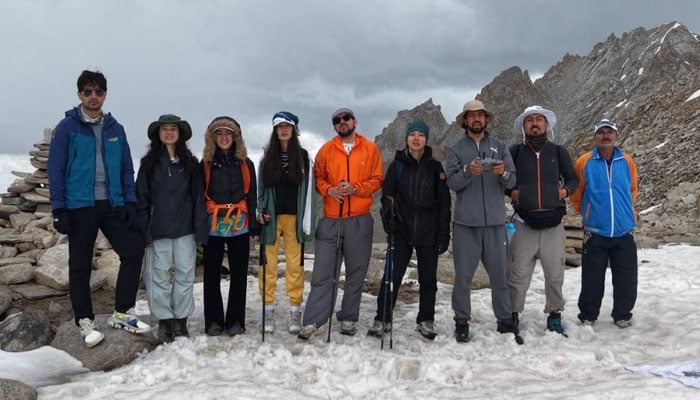
CHITRAL: A team of Pakistani mountaineers has successfully crossed the historic Phargam An Pass in the Hindu Kush mountain range for the first time in 27 years, marking a major achievement for the country’s mountaineering community.

The expedition successfully reached the 5,100-metre-high Phargam An Pass, completing a challenging journey through one of the most remote and difficult mountain routes in northern Pakistan.

The expedition also made history as female climbers reached the summit for the first time, highlighting the growing participation of women in Pakistan’s adventure and mountaineering sector.

The mission was organised in Upper Chitral with the support of the Khyber Pakhtunkhwa Culture and Tourism Authority. During the expedition, the team also discovered the memorial of Austrian mountaineer George Kronberger, who lost his life in the area in 1975.

Despite facing dangerous glaciers, steep snow-covered slopes, rocky terrain and the constant threat of avalanches, the team completed the expedition safely.

Expedition guide Zamrud Khan said the route to Phargam An Pass has changed significantly over the years due to the effects of climate change, making the journey more challenging than in the past.

Three sisters from Chitral—Mehrosh Akhtar, Ismail Roz and Madhu Shala Akhtar—took part in the historic expedition, setting a new milestone for women in Pakistani mountaineering.

Other members of the expedition included Kamran Khan, Samar Khan, Nauman Khan, Noorul Rahman, Zohaib Khan, Umar Khattab Sherani, Sohniya Babar, Amina Shabbir and Madiha Syed.

The successful expedition is being seen as an important milestone for adventure tourism and mountaineering in Pakistan, while showcasing the country’s growing potential as a destination for high-altitude exploration.

Similar Posts

  • | | |

    PM orders fast-track strategy for Discos privatisa…

    Prime Minister Shehbaz Sharif has directed the relevant authorities to adopt a comprehensive strategy to attract local and international investors for the privatisation of state-owned electricity distribution companies (Discos). He also ordered the restructuring of the Privatisation Commission within one month to strengthen its role in the reform process. Chairing a high-level meeting in Islamabad, the prime minister said the privatisation programme must move forward according to the approved timelines. He stressed that every stage should be completed transparently and in line with international standards and legal requirements. He added that the process should deliver positive financial results while protecting the interests of electricity consumers. The prime minister instructed officials to ensure that reputable investors participate in the bidding process. He said investor confidence should be increased through effective planning, transparency and a clear policy framework. At the same time, he emphasised that consumer rights should remain a top priority during the transfer of power distribution companies to the private sector. Officials informed the meeting that investor roadshows for the first phase of the privatisation programme had been completed successfully. These campaigns focused on Gujranwala Electric Power Company (Gepco), Faisalabad Electric Supply Company (Fesco) and Islamabad Electric Supply Company (Iesco). Similar investment outreach activities held in Türkiye, Saudi Arabia and China also received encouraging responses from potential investors. The meeting reviewed progress on institutional reforms within the Privatisation Commission. The prime minister directed the commission to recruit experienced professionals in finance, law and information technology. He said hiring qualified experts would improve the commission’s capacity to manage large-scale transactions and strengthen investor confidence. He also instructed officials to incorporate recommendations from professional consultants into the privatisation process. All legal, financial and regulatory requirements should be completed without delay to ensure smooth implementation, he added. The prime minister further ordered the establishment of an effective grievance redress mechanism to address complaints from consumers after the companies are privatised. He said public confidence would depend on uninterrupted services, transparency and accountability. The government is offering investors the opportunity to acquire majority or full ownership of Fesco, Gepco and Iesco, along with management control. These companies are considered among the strongest electricity distribution companies in the country and together provide power to more than 14 million consumers across Punjab, the Islamabad region and parts of Azad Jammu and Kashmir. The privatisation plan is part of the government’s broader economic reform programme. The initiative aims to improve operational efficiency, reduce financial losses, attract domestic and foreign investment, strengthen service delivery and modernise Pakistan’s power sector through greater private-sector participation.

  • |

    Pakistani celebrities demand justice after toddler’s tragic death

    A tragic incident in Karachi has sparked nationwide outrage after a 1.5-year-old girl died following an alleged sexual assault. According to police, the suspect is a 17-year-old boy who is reportedly the child’s cousin. Investigators said he took the toddler outside under the pretext of taking her for a walk before allegedly assaulting her. The child was later returned home in critical condition and was rushed to the hospital, where she succumbed to her injuries during treatment. A medical examination reportedly indicated signs of sexual assault, while police arrested the suspect from his residence. Authorities have launched a detailed investigation to determine all aspects of the case. The heartbreaking incident has left people across Pakistan in shock and grief. Social media platforms have been flooded with messages demanding justice for the innocent victim, while public figures and celebrities have also spoken out against the horrific crime. Actor Ahsan Khan shared his reaction on social media by posting about the incident and tagging the Sindh government, urging authorities to ensure justice is served. Actress Aiman Khan also expressed her anger through her Instagram Stories, writing that the country must begin imposing strict punishments on rapists to prevent such crimes from happening again. Television personality Mishi Khan strongly condemned the incident and called for tougher action against those involved in sexual crimes against children. She questioned how such horrific acts continue to occur and argued that criminals feel emboldened because punishments are not severe enough. Mishi demanded exemplary public punishment for offenders and stressed that stricter measures should be introduced to discourage such crimes. She also urged the Sindh government to take immediate action and address factors that may contribute to such incidents. Actress Mariyam Nafees also reacted to the tragedy, emphasizing the importance of child safety. She urged parents and guardians to remain vigilant and avoid leaving young children unattended, stressing that constant supervision is essential to protect them from potential harm. The incident has reignited conversations about child protection, public safety, and the need for stronger laws against sexual violence. Many people believe that stricter enforcement of existing laws, quicker trials, and harsher punishments are necessary to deter offenders and ensure justice for victims. The case has also prompted widespread discussion among social media users, many of whom urged parents to be extra cautious regardless of whether children are with relatives, neighbors, or acquaintances. Several users stressed that children should never be left alone without trusted supervision and that parents should educate their children about personal safety from an early age. Others highlighted the importance of teaching teenage boys and young men about respecting personal boundaries and treating younger children with care and responsibility. Some users also reflected on the challenges that can exist within extended family systems, saying that children are sometimes vulnerable to abuse even from people they know and trust. They argued that families should prioritize open communication, remain alert to warning signs, and create safe environments where children are protected and heard. As the investigation continues, the tragic death of the toddler has become a painful reminder of the urgent need for stronger child protection measures, swift justice, and greater public awareness to prevent such devastating crimes from happening again.

  • |

    93% admissions at top colleges go to private-schoo…

    Concern has been raised over the quality of education in Karachi’s government schools and the ability of their students to gain admission to the city’s leading government colleges. According to admission data, the overwhelming majority of students admitted to Karachi’s top 10 government colleges completed their matriculation from private schools. Despite these institutions being government colleges, around 93 out of every 100 students admitted to them are graduates of private schools, while only about seven come from government schools. Data obtained from the colleges shows that a total of 13,211 students were admitted to these institutions. Of them, 12,264 had completed their matriculation from private schools, while only 947 were graduates of government schools. This means that 92.8% of admissions were secured by students from private schools, while government school students accounted for just 7.2%. In other words, for every 100 students admitted to these government colleges, approximately 93 come from private schools and only seven from government schools. At Adamjee Government Science College, 613 students were admitted. Among them, 585 had completed matriculation from private schools, while only 28 came from government schools. Similarly, Government D.J. Sindh Science College admitted a total of 1,258 students. Of these, 1,214 were graduates of private schools and only 44 had studied at government schools. At Delhi Government Science College, 801 students were admitted. The figures show that 773 came from private schools, while only 28 were graduates of government schools. Government Boys College for Men, Nazimabad, admitted a total of 1,317 students. Of these, 1,257 had completed their matriculation from private schools, while only 60 came from government schools. The same trend is even more visible among government girls’ colleges. Government Sir Syed Girls College admitted 2,507 students. Among them, 2,266 had completed matriculation from private schools, while only 241 were graduates of government schools. At St Lawrence Government Girls College, 691 students were admitted. Of these, 631 came from private schools and only 60 from government schools. Similarly, at PECHS Government College for Women, 1,517 students were admitted. A total of 1,420 had studied at private schools, while only 97 had completed matriculation from government schools. At Khatoon-e-Pakistan Government College for Women, 2,107 students were admitted. Of these, 1,876 were graduates of private schools, while only 231 came from government schools. The figures for boys and girls at Government Degree College Malir Cantonment were also included. According to the data provided, 402 students were counted in the combined figures, while the reported breakdown listed 1,316 students from private schools and 86 from government schools. Meanwhile, Government Degree Boys and Girls College Stadium Road admitted a total of 998 students. Of these, 926 had completed matriculation from private schools, while only 72 were graduates of government schools. The situation at government girls’ colleges is similarly concerning. At Sir Syed Girls College, 2,266 students from private schools secured admission compared with only 241 from government schools. At PECHS Government College for Women, the ratio was 1,420 private-school graduates against 97 government-school graduates. At Khatoon-e-Pakistan Government College for Women, 1,876 private-school graduates were admitted compared with just 231 from government schools.

  • |

    PSX extends rally as KSE-100 jumps nearly 1,500 points

    The Pakistan Stock Exchange (PSX) maintained its strong upward momentum on Thursday, with investors continuing aggressive buying across major sectors, pushing the benchmark KSE-100 Index higher by nearly 1,500 points during intraday trading. By 2:40pm, the KSE-100 Index was trading at 181,488.61 points, reflecting an increase of 1,473.68 points, or 0.82%, compared with the previous session’s close. The latest gain extended the market’s recovery after Wednesday’s sharp rally, indicating renewed investor confidence amid improving domestic and international market conditions. Market participants said buying activity remained broad-based, with investors accumulating shares in several heavyweight sectors. Strong demand was witnessed in automobile assemblers, cement manufacturers, chemical companies, commercial banks, fertiliser producers, oil and gas exploration firms, oil marketing companies (OMCs), and power generation stocks. Among the index-heavy companies contributing to the rally were Attock Refinery Limited (ARL), Hub Power Company (HUBCO), Mari Energies (MARI), Oil and Gas Development Company (OGDC), Pakistan Petroleum Limited (PPL), Pakistan Oilfields Limited (POL), MCB Bank, Meezan Bank (MEBL), and National Bank of Pakistan (NBP), all of which traded in positive territory during the session. The bullish sentiment follows Wednesday’s impressive recovery, when the benchmark KSE-100 Index climbed 2,931.71 points, or 1.66%, to settle at 180,014.93 points. The surge enabled the index to reclaim the important 180,000-point milestone for the first time in 16 trading sessions, signaling renewed optimism among investors. Analysts attributed the recent gains to easing geopolitical concerns in the Middle East, which have reduced fears of supply disruptions in global energy markets. The decline in international crude oil prices has also helped improve investor sentiment by easing inflationary concerns and strengthening expectations for economic stability. The recovery has encouraged investors to return to the equity market, particularly in sectors expected to benefit from lower energy costs and improving macroeconomic indicators. Banking and energy stocks remained among the biggest contributors to the benchmark index’s advance. Meanwhile, global financial markets presented a mixed picture on Thursday. Asian stock markets paused after a technology-led rally in the previous session, while crude oil prices traded within a narrow range as investors monitored developments surrounding potential diplomatic progress between Iran and the United States. MSCI’s broad index of Asia-Pacific shares excluding Japan declined by 0.69%, weighed down primarily by losses in technology stocks. South Korea’s benchmark index fell 3.64%, while Japan’s Nikkei 225 dropped 1.57%. Major technology companies also came under pressure. In South Korea, Samsung Electronics slipped 2.44%, while semiconductor manufacturer SK Hynix fell 6.95%. In Japan, memory chip producer Kioxia plunged 9.61%, and Tokyo Electron declined 4.61%. The cautious mood in Asia followed a weaker overnight performance on Wall Street, where the Nasdaq Composite ended its recent winning streak. Investors reacted to quarterly earnings from major technology companies, including SpaceX and Advanced Micro Devices (AMD). Although companies continued to highlight strong demand for artificial intelligence-related investments, market participants remained cautious about the sustainability of heavy spending on AI infrastructure. Investors also questioned whether profitable businesses such as satellite internet services could continue financing expensive data centre expansion over the long term.

  • | |

    Transgender protest turns violent in Karachi

    Police have arrested three transgender persons after registering a case over an alleged attack on the Boat Basin police station in Karachi. The case was lodged by the state following an incident that took place a few days ago. According to police officials, a large group of transgender persons allegedly entered the police station in an agitated state and created unrest inside the premises. They are accused of pelting stones, damaging government property and disrupting official work. Police said the protesters allegedly smashed the windows of vehicles parked at the police station. They also damaged the glass panels of a police mobile and vandalized equipment linked to the Safe City surveillance system. Authorities said the doors of the Safe City monitoring room were also broken during the incident. Officials stated that police personnel tried to calm the protesters and asked them to remain peaceful. However, they claimed that the group continued its protest and refused to leave the premises. According to the First Information Report (FIR), the protesters also allegedly assaulted members of the public who were present at the police station despite repeated warnings from police officers. Eight transgender persons have been nominated in the case, while investigations are continuing to identify and arrest the remaining suspects. Police said the protest erupted after officials detained several beggars under the Beggary Act on the instructions of the assistant commissioner. During the operation, one transgender person reportedly suffered a nosebleed while being taken into custody. According to police, the injury occurred during the detention process. They alleged that the protesters later presented the incident as a case of police torture, which triggered the protest outside and inside the police station. Authorities said an investigation is underway to determine the exact sequence of events. Police are also reviewing available evidence, including surveillance footage, to identify everyone involved in the alleged vandalism and attacks on government property.

  • | |

    Three injured as rival MQM-P groups clash at party…

    KARACHI: Internal differences within Muttahida Qaumi Movement-Pakistan (MQM-P) intensified on Sunday after supporters of two rival factions allegedly clashed outside the party’s Bahadurabad headquarters in Karachi, leaving at least three people injured. According to reports, tensions between supporters of the groups associated with MQM-P Chairman Khalid Maqbool Siddiqui and senior leader Mustafa Kamal escalated following a party meeting. The confrontation turned violent as workers allegedly exchanged slogans, engaged in physical fighting, and pelted stones at each other. Witnesses also reported aerial firing near the Bahadurabad headquarters during the unrest, creating panic in the area. Three people sustained injuries during the clashes. Senior MQM-P leader Dr Farooq Sattar said the dispute erupted after a meeting of party leaders at the Bahadurabad office. Speaking to the media, he alleged that supporters of one faction assaulted MPA Ejaz-ul-Haq and party leader Zakir. He further claimed that party leaders Mangla Sharma and Sabeen Ghori were also mistreated during the incident. MQM-P leader Amin Ul Haque alleged that one party worker was injured in the firing, while several others suffered injuries due to stone-pelting. He also claimed that extensive vandalism took place inside the party office and that the office’s DVR recording system was taken away. Amin Ul Haque said the matter had reached a point where it could no longer be ignored and called the incident deeply concerning for the party. Meanwhile, Dr Farooq Sattar later arrived at the Bahadurabad headquarters following the clashes as senior party leaders attempted to assess the situation and address the growing internal crisis.

Leave a Reply

Your email address will not be published. Required fields are marked *