peso lingers recordlow
| | | | |

As peso lingers at record-low P62, what does it mean for Filipinos?

The Philippine peso has pushed deeper into territory it had never entered before.

For the first time in history, the currency sank past P62 to the US dollar on August 28, closing at a then-record low of P62.265. The peso then touched an unprecedented P62.775 intraday on Monday, September 7, before closing slightly stronger at P62.586.

On Tuesday, September 8, it weakened again to a fresh record-low closing rate of P62.625 to $1.

The peso’s slide began in March 2026, when it sank to an all-time low of P60 to the dollar. A month later, it sank to an all-time low again, breaking past P61. Now, it has sunk to an all-time low yet again, this time beyond P62.

So what does a peso sinking deeper into record-low territory actually mean for the economy?

A weaker peso can make its way to fuel pump prices and grocery checkouts, raise costs for businesses, complicate the central bank’s fight against inflation, and weigh on the Philippines’ economic growth. 

For OFW families, a weaker peso might provide some relief since they get more pesos for every dollar sent home. But that gain is partly eroded if the same currency weakness pushes up the cost of fuel, food, transport, and other everyday expenses anyway.

Currency depreciation hits the Philippines particularly hard because it is a country of imports – bringing in large amounts of fuel, food, machinery, raw materials, and other goods all priced and paid for in dollars. 

As the peso weakens, Philippine importers have to spend more pesos to pay for exactly the same dollar-priced shipment. Companies can absorb some of that increase through lower profit margins, but they’re more likely to pass the cost on to consumers. 
Must Read

MAP: Where Filipino families earn the most and least


MAP: Where Filipino families earn the most and least

More expensive fuel

Fuel is one of the clearest examples of how quickly the exchange rate can ripple through the economy.

At the Department of Energy’s September 7 briefing, Energy Secretary Sharon Garin said the peso’s depreciation was adding pressure to domestic pump prices because petroleum products are bought in dollars.

DOE officials said the peso weakened by around 68 centavos during the latest pricing period, compounding an increase of roughly $9 to $10 per barrel in petroleum import costs caused by renewed Middle East tensions.

In other words, Filipinos are being hit twice because global oil prices are rising at the same time as the peso is falling. The fuel itself becomes more expensive in dollars, while each dollar needed to buy it also costs more pesos.

The impact goes beyond just motorists having to pay more for their trips. Diesel powers trucks moving food and merchandise around the country too, while businesses depend on imported machinery, fertilizers, ingredients, and other inputs. As those costs rise, companies may eventually pass on at least some of them through higher prices.

Must Read

[In This Economy] The Philippine economy is stuck in a rut


[In This Economy] The Philippine economy is stuck in a rut

Inflation, and the BSP’s reserves

BPI lead economist Emilio Neri Jr. warned that the recent peso depreciation could fuel further inflation through higher import costs, with headline inflation in August already at a worrying 6.1%. That’s why peso weakness is also becoming a headache for the Bangko Sentral ng Pilipinas (BSP) as it tries to bring inflation back within its 2% to 4% target range.

The BSP will not, however, defend the currency at a particular level. At an August 27 Senate budget hearing, BSP Governor Eli Remolona Jr. said the central bank can smooth out sharp movements in, but trying to fix the peso at a particular rate would burn through the country’s dollar reserves.

Nevertheless, BSP data show that ammunition remains substantial.
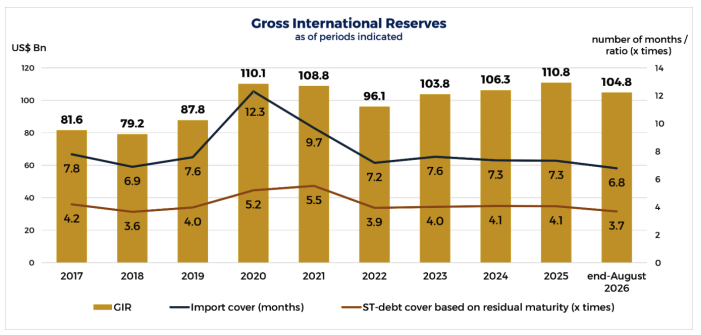
Photo from the BSP.

The country’s gross international reserves rose to $104.8 billion at end-August, from $103.3 billion in July, largely because higher gold prices boosted the value of the BSP’s holdings and because of income from its overseas investments. The increase was partly offset by government withdrawals of foreign currency to service external debt.

Still, the buffer has thinned from $110.8 billion at the end of 2025. At its August level, reserves could cover about 6.8 months of imports and around 3.7 times the country’s short-term external debt.

“These provide sufficient foreign currency to meet the country’s import needs, service its external debt obligations, and serve as a buffer against external economic shocks,” the BSP said in a statement on Monday.

If depreciation keeps inflation elevated, the BSP may instead have to keep interest rates high for longer or tighten further. Higher borrowing costs can then weigh on household spending, business expansion, housing, and investment, creating another drag on an economy already struggling with slower growth. – Rappler.com

Similar Posts

  • | | | | | |

    [OPINION] Will Pax Silica be another proverbial fish that got away for the Philippines?

    Pax Silica cannot be treated as a leisurely long-term development masterplan. It must lock in binding corporate commitments, sign multilateral joint ventures, and physically break ground while it possesses maximum geopolitical value to its Western allies.

  • |

    CPEC 2.0: Pakistan, China shift focus to B2B investment

    ISLAMABAD: Pakistan and China are moving toward a more business-driven model of cooperation under the second phase of the China-Pakistan Economic Corridor (CPEC), with greater emphasis on Business-to-Business (B2B) partnerships, industrial development, exports and productivity rather than large-scale Government-to-Government (G2G) financing. The development emerged during a high-level Chinese delegation’s visit to the CPEC Secretariat, where discussions focused on strengthening industrial and commercial ties between the two countries. According to an official statement issued by the Ministry of Planning on Tuesday, the Chinese delegation was headed by Sun Dongsheng, Senior Advisor, Economic Affairs Press. The delegation met Federal Minister for Planning, Development and Special Initiatives Ahsan Iqbal, along with senior policymakers and development experts. The talks centred on ways to advance B2B and industrial cooperation under CPEC 2.0, reflecting a broader shift in the corridor’s priorities from infrastructure-led development toward industrialisation, exports, technology and private-sector participation. From infrastructure to industrialisation During the meeting, Ahsan Iqbal briefed the Chinese delegation on the government’s Uraan Pakistan economic transformation programme and outlined Islamabad’s priorities for the next phase of CPEC. The minister proposed closer cooperation with Chinese institutions, including counterparts of the National Centre of New Manufacturing, to benefit from China’s experience in advanced manufacturing, innovation, automation and robotics. He said Pakistan needed to strengthen its productive capacity and adopt modern technologies to remain competitive in the era of Industrial Revolution 4.0 and prepare for the emerging Industrial Revolution 5.0. Ahsan Iqbal identified Pakistan’s limited export base as one of the country’s major economic challenges. According to the minister, repeated attempts to accelerate economic growth have struggled to generate sustainable momentum because productive sectors have not been sufficiently integrated with export markets. He stressed that the government’s priority was therefore to turn agriculture, manufacturing and other productive sectors into stronger sources of exports and foreign exchange. Pakistan seeks greater access to Chinese market The minister also called for greater facilitation of Pakistani exports to China, highlighting the considerable gap between the two countries’ trade potential. He noted that China imports goods worth around $2.6 trillion annually, whereas Pakistan’s exports to the Chinese market remain close to $3 billion. Ahsan said Pakistan needed to increase its presence in the Chinese market by improving production standards, competitiveness and the ability of domestic businesses to meet international demand. He expressed the expectation that CPEC 2.0 could help Pakistan address what he described as its “export deficit”, just as the first phase of the corridor contributed to addressing the country’s energy shortfall. CPEC enters a new phase Under CPEC’s first phase, China committed substantial financing to infrastructure, energy and other development projects in Pakistan. Nearly $30 billion was invested in infrastructure and power-sector projects, including independent power producers. However, the focus is now increasingly shifting toward private-sector-led cooperation. Islamabad continues to pursue financing for selected road and motorway projects, but China has yet to demonstrate readiness to finance the long-delayed Main Line-1 (ML-1) railway upgrade, which had previously been regarded as one of CPEC’s flagship projects. The latest consultations indicate that CPEC 2.0 is expected to rely more heavily on commercial partnerships between Pakistani and Chinese companies. The government has already been encouraging enterprises from both countries to explore joint ventures and investment opportunities in sectors including manufacturing, agriculture and mining. Ahsan Iqbal said recent agreements between Pakistani and Chinese companies showed that B2B cooperation was beginning to gain momentum. He expressed confidence that stronger business-to-business engagement would support the modernisation of Pakistan’s industrial and agricultural sectors while creating opportunities for investment, employment and exports. China stresses productive capacity Sun Dongsheng reaffirmed the importance China attaches to its longstanding relationship with Pakistan and highlighted the achievements of CPEC’s first phase. He called for further cooperation in industrial and agricultural development, particularly in strengthening Pakistan’s productive capacity. The Chinese delegation also stressed the importance of involving small and medium-sized manufacturing enterprises in bilateral economic cooperation. Greater enterprise-to-enterprise engagement, according to the delegation, could help create commercially sustainable partnerships and expand opportunities for businesses in both countries. The discussions also focused on technology transfer, innovation, skills development and the creation of stronger industrial linkages. Five Corridors aligned with Uraan Pakistan Officials also discussed the strategic relationship between the Five Corridors of CPEC 2.0 and Pakistan’s 5Es framework under Uraan Pakistan. The government’s 5Es framework focuses on exports, e-Pakistan, environment and climate change, energy and infrastructure, and equity and empowerment. The participants stressed that alignment between the two initiatives needed to translate into concrete economic outcomes, including new enterprises, technology adoption, innovation, employment opportunities, skills development, increased exports and higher investment. The delegation was also briefed on the progress achieved during CPEC Phase I and Pakistan’s priorities for the second phase. The consultations suggest that the next stage of CPEC will increasingly be measured not only by the volume of infrastructure investment but also by its ability to improve Pakistan’s industrial competitiveness, expand exports, attract private investment and create sustainable employment.

Leave a Reply

Your email address will not be published. Required fields are marked *