
rebukes islamabad chief
| | |

PM rebukes Islamabad chief commissioner, IG over i…

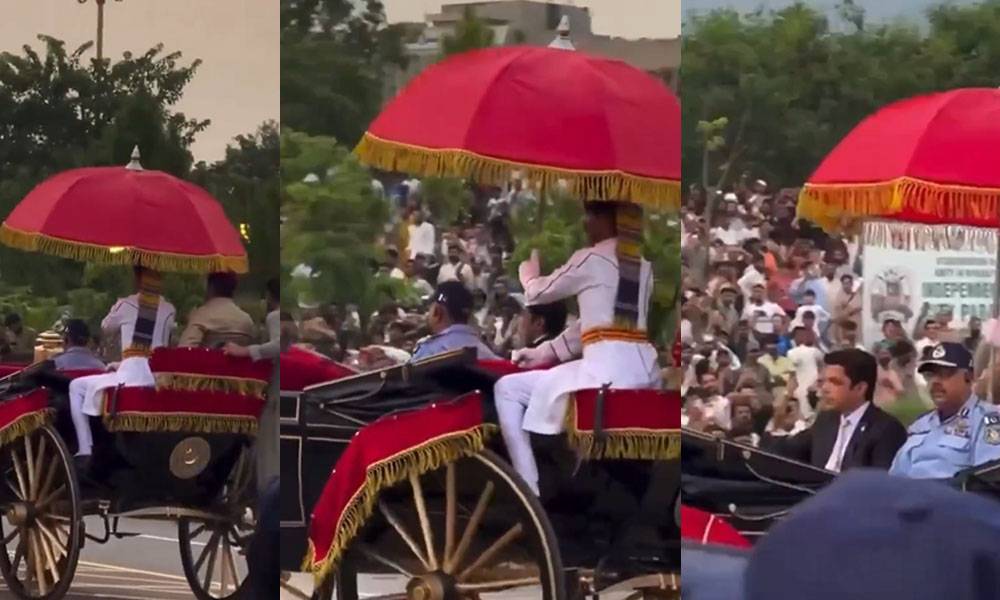
ISLAMABAD: Prime Minister of Pakistan has reprimanded Islamabad’s Chief Commissioner and Inspector General of Police (IGP) over their use of a ceremonial buggy during the Independence Day celebrations, describing the display as inconsistent with the principles and values expected from senior public servants.

According to official advisories issued by the Prime Minister’s Office on August 17, the incident took place on August 14 during the Independence Day celebrations. Chief Commissioner Islamabad Lt. (Retd.) Sohail Ashraf and IG Islamabad Syed Ali Nasir Rizvi reportedly used a ceremonial carriage belonging to the Prime Minister’s House to attend and observe the parade.The Prime Minister himself was not present at the event.

The use of the ceremonial buggy attracted public criticism, with concerns raised over what was perceived as an unnecessary display of protocol and privilege by senior government officials.

In its advisory, the Prime Minister’s Office expressed serious displeasure over the incident and said the conduct created an inappropriate impression about the role of public servants. The office maintained that government officials are expected to uphold simplicity, humility and dignity rather than engage in displays of grandeur or personal prominence.

The Prime Minister stated that the use of such protocol projected an image of privilege, ostentation and personal aggrandisement that was contrary to the basic ethos of public service. He stressed that government officers serve the public and should therefore avoid conduct that could undermine public confidence in state institutions.

The advisory further warned that displays of excessive protocol and personal privilege by senior officials could damage the credibility of public institutions. It emphasized that officers occupying important administrative and law-enforcement positions are expected to demonstrate the highest standards of professionalism and propriety.

Following the Prime Minister’s directions, the Establishment Division issued a formal warning to the two officers through Joint Secretary (Discipline) Syeda Shafaq Hashmi.

The directive called for an immediate end to practices involving unnecessary protocol, exhibitionism and self-promotion at official events. It instructed the officers to ensure that such conduct does not happen again and emphasized the importance of maintaining simplicity and dignity while performing official duties.

The Establishment Division also directed that the advisory be followed strictly, both in letter and spirit. The warning serves as a reminder to senior civil servants that official positions come with significant responsibilities and require them to maintain appropriate standards of conduct in public.

The Prime Minister’s Office highlighted the special responsibilities of the Chief Commissioner and IG Islamabad, who serve as the administrative and police heads of the federal capital. Given their positions, the public and government expect them to set an example through responsible governance, discipline and appropriate behavior.

The episode has once again brought attention to the government’s emphasis on reducing unnecessary official protocol and promoting a culture of simplicity among public officials. The Prime Minister’s message was clear that public office should be associated with service, responsibility and accountability rather than privilege and ceremonial extravagance.

The two officials have now been directed to ensure that similar displays do not recur at future official functions and to uphold the standards expected from senior government officers.

Similar Posts

  • | |

    Iran’s parliament backs bill criminalizing c…

    Iran’s parliament approved the general framework of a bill Sunday that would make it a crime to give interviews or engage in other communication with media outlets considered hostile to the Islamic Republic, including American or Israeli outlets and any media funded by either country, according to Iran’s Shargh newspaper. Osman Salari, a member of parliament’s judicial and legal commission, said individual provisions within the bill, which aims to counter what officials describe as foreign intelligence influence, still require separate debate and approval. He told the Mizan news agency that details reported so far about the bill should not be treated as final. Under the proposed legislation, interviews or participation in discussions with media deemed hostile would be banned outright, with violations carrying prison terms ranging from six months to two years. Interviews with other foreign media outlets would require advance notification to the intelligence ministry, while any contact with foreign embassies, offices of foreign organizations or other non Iranian institutions, conducted without notification and written permission from the foreign ministry, would draw fines and the loss of certain social rights. The bill would also increase penalties for economic crimes carried out under the direction or supervision of foreign actors, prohibit sharing information with foreigners without intelligence ministry approval, and limit scientific cooperation with foreign institutions to those on an approved list. It would further criminalize policy or legislative proposals made under the direction of foreign intelligence services if such proposals are found to harm Iran’s security or independence, with penalties reaching up to 30 years in prison. Cases brought under this provision would fall under the jurisdiction of Iran’s Revolutionary Courts. Parliament will now review the bill article by article. Once lawmakers approve a final text, the legislation must still pass review by the Guardian Council before it can take effect as law. This is not the first time Iran has moved to criminalize cooperation with foreign entities. A law passed in 2025, following a 12 day war with Israel, introduced harsher penalties for alleged cooperation with hostile states. Earlier this month, Iranian photojournalist Yalda Moaiery was sentenced to 15 years in prison under that law over accusations that included giving interviews to media considered hostile and supplying photographs to organizations linked to the United States and Israel.

  • | |

    China’s hypersonic arsenal expands with long-ran…

    BEIJING: China has developed a new generation of hypersonic weapons that could potentially threaten high-value military aircraft thousands of kilometres away, according to a Bloomberg report, highlighting the rapidly changing nature of long-range warfare and the growing strategic competition between Beijing and Washington. The reported development involves hypersonic glide vehicles (HGVs) capable of carrying air-to-air weapons. Such systems could potentially target aircraft that normally operate far behind the frontline, including aerial tankers, airborne command-and-control platforms and other support aircraft that provide fuel, communications and battlefield information to fighter jets. The report, citing a person with direct knowledge of the matter, said China has also added air-to-air capabilities to some hypersonic cruise missiles and anti-ship capabilities to several other missile systems. The reported changes reflect Beijing’s broader effort to make its large missile arsenal capable of carrying out a wider range of missions. A New Threat Beyond the Front Line The significance of the reported technology lies in the type of targets it could threaten. Modern air forces rely heavily on support aircraft. Tankers allow fighter jets to remain airborne for longer periods, while airborne early-warning and command aircraft help monitor enemy activity, coordinate operations and share information with aircraft and ground forces. If these platforms could be attacked from much greater distances, commanders could be forced to move them farther away from contested areas. That could reduce their effectiveness and complicate air operations. A hypersonic glide vehicle released from a DF-17 missile is reported to have a range of around 2,414 kilometres, a distance slightly shorter than the separation between mainland China and the US territory of Guam, a major American military hub in the western Pacific. China’s more advanced DF-27 is estimated to have a range of about 8,000 kilometres, potentially putting much of the western and central Pacific within reach. However, details about the system remain limited, and several of its reported capabilities are based on intelligence assessments rather than publicly released Chinese specifications. Why Hypersonic Weapons Are Difficult to Counter HGVs differ from conventional ballistic missile warheads because they can manoeuvre while travelling through the atmosphere. Their ability to alter their flight path can complicate efforts to predict where they will go and how they can be intercepted. China’s DF-17 has already been publicly displayed and is considered one of the world’s operational hypersonic glide weapon systems. Recent Chinese state media footage showed multiple DF-17 launch vehicles, suggesting the system has been deployed on a significant scale. But the reported ability to use such technology against distant aircraft also presents major operational challenges. A missile travelling thousands of kilometres would require highly accurate and continuously updated information about a moving target. Analysts note that the longer the flight, the greater the opportunity for an opponent to disrupt the intelligence and targeting chain. There is also a potential escalation risk. A ballistic missile launch could be difficult to identify immediately, creating uncertainty over whether the weapon is carrying a conventional or nuclear payload. Washington Responds With Longer-Range Weapons The development comes as the United States is also expanding its long-range air-to-air capabilities. The US Navy has begun testing the AIM-424 MALICE, a new long-range air-to-air missile reportedly designed to engage targets at distances exceeding 463 kilometres. Washington is also pursuing other extended-range weapons, including the AIM-260 and AIM-174B. The emerging competition reflects a broader shift in military planning. Future air battles may not be decided solely by which side has more fighter jets, but by which side can protect its own support aircraft while threatening those that keep an opponent’s air force operating. For China and the United States, that could make long-range missiles and hypersonic systems an increasingly important part of the military balance across the Indo-Pacific. Still, some details of China’s reported new capabilities remain classified or independently unverified. The claims therefore offer an indication of Beijing’s evolving military ambitions rather than a complete picture of its operational capabilities. Even so, the reported progress adds another layer to the increasingly sophisticated missile competition between the world’s two major military powers.

  • |

    Poland and Baltic states shield critical infrastructure against potential Russian false-flag drone attacks

    Poland, Lithuania, Latvia, and Estonia have tightened security around vital energy and national infrastructure, acting on intelligence warnings that Moscow may stage false-flag attacks using Ukrainian-made drones to provoke a political crisis within NATO. Lithuania deployed troops alongside riot police to protect its floating liquefied natural gas terminal at Klaipėda, an oil products terminal, a key power link with Poland, and the Kruonis hydro plant. Latvia reinforced security around the Daugava River dam near Riga and the Incukalns underground gas storage facility. In Poland, state-owned energy developers launched an investigation alongside security services after forged documents surfaced targeting the construction site of the country’s first nuclear power plant, a move traced to sources east of Poland. Military personnel also stepped up security around power grid interconnectors running to Ukraine. Baltic intelligence assessments indicate Russian military and domestic security agencies may execute a staged attack inside Russia or across the border using captured or forged Ukrainian drones. Regional officials warn that Moscow’s primary objective is to trigger political paralysis in Brussels by forcing NATO members into a divisive debate over how to respond. Kremlin spokesperson Dmitry Peskov dismissed the reports, calling warnings of Russian sabotage scare stories used to justify NATO militarisation. The surge in defensive measures follows a series of unexplained drone incidents across Europe, including an explosive-laden drone recently discovered at Leipzig/Halle Airport in Germany. With Russian forces facing continued pressure in Ukraine, intelligence analysts suggest Moscow may be attempting to destabilise European infrastructure to test the alliance’s political resolve.

  • | |

    US Embassy unveils Liberty Bell in Islamabad

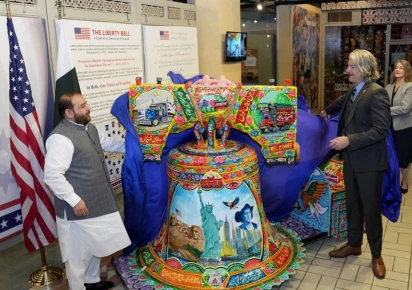
    The United States Embassy in Islamabad has launched a unique cultural exhibition in the Pakistani capital, bringing together art, history and the shared values of two nations as part of celebrations marking the 250th anniversary of American independence. The “Let Freedom Ring” Liberty Bell display was inaugurated on Thursday, July 23, at Lok Virsa Museum in a ceremony attended by US Chargé d’Affaires Andy Halus and Pakistan’s Minister for National Heritage and Culture Aurangzeb Khan Khichi. The display will run until July 27 at two of Islamabad’s most prominent cultural institutions, Lok Virsa Museum and the Pakistan Monument Museum, with members of the public invited to visit both venues throughout the five-day exhibition period. At the heart of the exhibition are 16 uniquely designed bells, each created by a Pakistani artist from across the country and each representing a distinct perspective on the concept of freedom. The artists were invited to respond to a single central question: what does freedom mean to me? The resulting collection is as diverse as the country it comes from, with each bell offering a visual and cultural interpretation of a value that sits at the core of both American history and human aspiration. The initiative was organised by the US Mission to Pakistan’s Public Diplomacy Section through its Lincoln Corners network, in collaboration with the 16 Pakistani artists whose work forms the exhibition. The collaborative nature of the project is itself a reflection of the diplomatic spirit behind it, one country celebrating its founding ideals by inviting another to contribute its own creative voice to the conversation. Speaking at the inauguration, Halus drew a direct line between the values the exhibition represents and the relationship between the two countries. “Looking at this bell, I am reminded of something that Pakistan and the US share deeply, a belief in the power of expression, of art, and of the freedom to imagine a better world,” he said. “Lok Virsa has spent decades preserving that spirit in Pakistan. Today, we are proud to add America’s own story of freedom to this special place.” Pakistan’s cultural minister welcomed the exhibition as a reflection of the longstanding ties between the two nations, highlighting the role that cultural exchange plays in strengthening bilateral relations beyond the formal channels of diplomacy. The “Let Freedom Ring” campaign forms part of the US Mission Pakistan’s year-long “Freedom 250” programme, a global initiative marking the 250th anniversary of the Declaration of Independence through events centred on the themes of freedom, innovation and excellence. The Islamabad exhibition is one of many such events being held around the world as part of this broader commemorative effort.

  • |

    Punjab CNF command changes hands

      LAHORE: The Punjab Counter Narcotics Force (CNF) held a Command Changeover Ceremony in Lahore as Brigadier Muhammad Rizwan Khan assumed charge as the new Director General, succeeding Brigadier Mazhar Iqbal. Brigadier Mazhar Iqbal completed his two-year tenure as the force’s first Director General and formally handed over command to Brigadier Muhammad Rizwan Khan during the ceremony. Secretary Excise, Taxation and Narcotics Control Department Muhammad Masood Mukhtar attended the event along with senior officers, officials and personnel of Punjab CNF. Officials praised Brigadier Mazhar Iqbal for his leadership and contributions to building and strengthening Punjab CNF. During his tenure, he helped develop the force’s operational structure, improve its professional capabilities and expand its efforts against drug trafficking and narcotics across the province. Speaking at the ceremony, Muhammad Masood Mukhtar appreciated the outgoing DG’s services and expressed confidence in the new leadership. Brigadier Muhammad Rizwan Khan pledged to continue the force’s mission and further improve its operational effectiveness. He stressed the importance of professionalism, discipline, teamwork and coordinated efforts to tackle the growing threat of narcotics. He also reaffirmed his commitment to working towards a safer, healthier and drug-free Punjab. The ceremony marked the leadership transition while reaffirming Punjab CNF’s commitment to professional enforcement and strengthening the province-wide fight against drugs.

  • | |

    Homenet Pakistan urges protection of democratic ma…

      Lahore, July 2026: HomeNet Pakistan, in partnership with AwazCDS/PDA, organized a high-level policy dialogue with Members of the Provincial Assembly (MPAs), including members of the Standing Committee on Local Government, to discuss legislative reforms aimed at promoting a stronger, more inclusive, and constitutionally compliant local government system in Punjab. The dialogue brought together parliamentarians, civil society representatives, and governance experts to exchange views on the future of local governance and explore ways to strengthen democratic institutions at the grassroots level. The session focused on ensuring political continuity, enhancing public participation, and improving the effectiveness of elected local governments.   Opening the event, Mr. Zia ur Rehman, Chief Executive of AwazCDS-Pakistan, highlighted the constitutional importance of Article 140A, which requires the devolution of political, administrative, and financial authority to elected local governments. He stressed that an effective local government system is essential for democratic governance and improved public service delivery. He urged the Punjab Assembly to introduce legal and institutional reforms that would safeguard democratic continuity, ensure the timely conduct of local government elections, and strengthen the autonomy of elected local bodies.   During the session, Ms. Ume Laila Azhar, Executive Director of HomeNet Pakistan, presented a set of policy recommendations designed to reinforce democratic governance at the local level. She emphasized the need for a stable and party-based electoral framework for local governments, noting that frequent legislative changes have weakened institutional continuity. She referred to the replacement of the Punjab Local Government Act 2022 with the Punjab Local Government Act 2025 as an example of policy shifts that have contributed to delays in restoring elected local governments across the province. She called for legal safeguards to prevent repeated delimitations and unnecessary postponements of local government elections. HomeNet Pakistan also recommended a transparent and representative mechanism for filling reserved seats allocated to women, youth, minorities, workers, persons with disabilities, and other marginalized groups. According to the organization, such measures would promote broader democratic participation and ensure that local governments better reflect the diversity of society.   In addition, the organization emphasized the importance of returning key municipal responsibilities—including water supply, sanitation, solid waste management, and local infrastructure development—to elected local governments. It proposed that provincial and district administrations should primarily provide technical guidance and institutional support rather than directly managing these essential services. The dialogue was attended by Ms. Sumbal Malik Hussain, Ms. Fizzah Maimona Rao, Ms. Somia Atta, Ms. Rukhsana Kausar, Ms. Farzana Abbas, Ms. Nasreen Riaz, and Ms. Attia Hanif, alongside representatives from civil society organizations and governance experts. Responding to the recommendations, the participating MPAs appreciated the constructive engagement and acknowledged the importance of strengthening democratic local governance. They reaffirmed the Punjab Government’s commitment to transparency, institutional reforms, and democratic accountability, expressing confidence that these principles would continue to guide the ongoing local government reform process. The parliamentarians informed participants that the delimitation process had made substantial progress, with geographical boundaries largely finalized. They stated that the remaining objections were expected to be addressed by the end of July 2026. Following the completion of the statutory process, they expressed optimism that the election schedule would be announced, paving the way for timely local government elections. The MPAs also committed to sharing the recommendations emerging from the dialogue with the Honorable Speaker of the Punjab Assembly and pledged to advocate for legislative reforms that promote constitutional compliance, political continuity, and an empowered local government system capable of responding effectively to citizens’ needs. Concluding the event, HomeNet Pakistan reaffirmed its commitment to working closely with parliamentarians, government institutions, and civil society partners to advance democratic governance, strengthen inclusive representation, and support the timely restoration of empowered elected local governments across Punjab.

Leave a Reply

Your email address will not be published. Required fields are marked *