
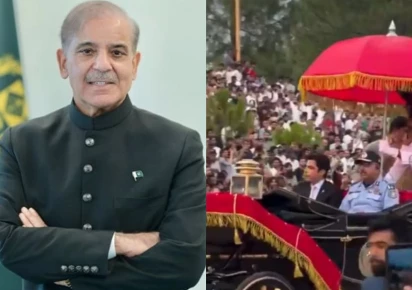
rebukes islamabad officials
| |

PM rebukes Islamabad officials over ceremonial bug…

ISLAMABAD: Prime Minister Shehbaz Sharif has expressed serious displeasure over the use of a ceremonial horse-drawn buggy by Islamabad’s chief commissioner and inspector general during the August 14 Independence Day celebrations.

An official advisory issued by the Establishment Division said the incident had attracted widespread public criticism and prompted the Prime Minister to take a serious view of the conduct. The advisory was issued to Islamabad Chief Commissioner Lt (retd) Sohail Ashraf and Inspector General of Police Syed Ali Nasir Rizvi.

According to the advisory, the prime minister believed that the display of pomp and show created an impression of privilege, ostentation and personal glorification, which was contrary to the principles of public service. It stressed that government officials entrusted with public offices were expected to demonstrate humility, restraint, dignity and sound judgment.

The Establishment Division warned that such conduct could weaken public confidence in government institutions and fall short of the standards expected from senior officials. The two officials were advised to exercise greater care in carrying out their duties and ensure that similar incidents did not happen again.

The controversy emerged after images and videos of the officials travelling in the ceremonial buggy during the Independence Day event circulated widely on social media, drawing criticism from the public.

Interior Minister Mohsin Naqvi subsequently defended the officials, saying they were not responsible for the decision to use the buggy. He explained that the vehicle had originally been arranged for the chief guest, while he and the chief guest were delayed because of a meeting involving the president and prime minister.

Naqvi said the two officials had initially been reluctant to begin the programme in the absence of the chief guest and the minister but were instructed to proceed to avoid inconvenience to the public.

Despite the clarification, the incident continued to attract attention, ultimately leading to the formal advisory from the Establishment Division.

Similar Posts

  • | | | |

    Trump reportedly left Türkiye on secret flight amid Iran threat

    US President Donald Trump reportedly left Türkiye on a military aircraft during a covert security operation last month. The move was allegedly made because of an Iranian assassination threat. According to a report citing US officials and people familiar with the operation, Trump initially boarded the older Air Force One aircraft in Ankara. Television cameras were present as he departed. Minutes later, however, Trump was reportedly moved to a smaller Air Force C-32A aircraft. The transfer was allegedly carried out using an airport catering truck. The unusual operation was designed to keep Trump’s actual location hidden. The report said the information was not shared publicly. Some journalists and even members of the White House staff were also reportedly unaware of the change. Trump had travelled to Ankara for a NATO summit held on July 7 and 8. The reported security threat emerged during his visit. The operation reportedly took place shortly after US forces resumed strikes against Iran. The strikes followed the collapse of negotiations between Washington and Tehran. White House Communications Director Steven Cheung defended the security arrangements. He said the aircraft being used as Air Force One had been equipped with advanced security measures. Cheung said the president faced threats from several enemies of the United States. He added that the administration was using all available measures to protect him. The reported security operation comes as tensions between the United States and Iran remain high. Trump has continued to leave open the possibility of stronger military action against Tehran. Oil prices rise amid escalation fears Global oil prices also climbed sharply as markets reacted to Trump’s latest comments on Iran. Brent crude rose around 5% on Monday. It reached about $87.70 per barrel, its highest level in nearly two weeks. US West Texas Intermediate crude also gained around 5.1%. It reached approximately $82.20 per barrel. The rise came after Trump said the United States still had the option of taking stronger action against Iran. Trump told reporters that Washington had the capability to pursue a major escalation if it decided to do so. His comments increased uncertainty over efforts to end the conflict. They also raised concerns about the future of shipping through the Strait of Hormuz. Trump has claimed that the strategic waterway is open and fully under US control. However, he acknowledged that Iran could still attempt to interfere with maritime traffic. Iran has taken a different position. Tehran has reportedly demanded that the US lift its blockade before it agrees to fully restore the waterway’s operations. The Strait of Hormuz is one of the world’s most important energy routes. Large volumes of crude oil and liquefied natural gas pass through the waterway. Any prolonged disruption could therefore put further pressure on global energy prices. Oil prices were also supported by reports of attacks involving energy infrastructure in Saudi Arabia and a tanker operated by Abu Dhabi National Oil Company. Meanwhile, US crude reserves remained under pressure. Stocks in the Strategic Petroleum Reserve fell below 300 million barrels last week. The reserve was reported at around 298.7 million barrels. It was the lowest level recorded since 1983.

  • | |

    Naqvi to visit KP, Balochistan over business secur…

    Interior Minister Mohsin Naqvi has announced plans to visit Peshawar and Quetta to engage directly with business leaders and provincial authorities as the government steps up efforts to address security challenges affecting trade and investment in Khyber Pakhtunkhwa and Balochistan. The announcement came during a meeting with a delegation of traders, industrialists, and representatives of chambers of commerce from both provinces. The delegation briefed the minister on the law and order situation and highlighted the security issues that continue to disrupt commercial and industrial activities. Naqvi said the government recognizes the difficulties faced by the business community and is committed to creating a safer environment for investment and economic growth. He assured participants that all available resources would be utilized to improve security and resolve issues affecting businesses. The interior minister said his upcoming visits to Peshawar and Quetta would include meetings with senior provincial officials, law enforcement agencies, and business representatives to develop practical and long-term solutions to security concerns. He emphasized that a secure business environment is essential for economic stability, adding that the success of traders and industrialists is closely linked to the country’s overall development. “The progress of the business community is the progress of Pakistan,” Naqvi said, reaffirming the government’s commitment to supporting entrepreneurs and protecting commercial activities. The meeting followed a high-level discussion held a day earlier between Naqvi and President Asif Ali Zardari, during which they reviewed the country’s overall security situation, with particular focus on Khyber Pakhtunkhwa and Balochistan. Pakistan has witnessed a rise in militant violence in recent months, particularly in the two provinces. Security forces have intensified intelligence-based operations to counter militant groups responsible for attacks on civilians, security personnel, and public infrastructure. The deteriorating security environment has also affected workers and businesses. Earlier this week, six labourers who had been abducted in Balochistan’s Kech district were found dead, while several other attacks in recent weeks targeted police officers, judges, transport routes, and public facilities. The government believes improving security is essential not only for protecting citizens but also for restoring investor confidence and advancing major regional connectivity and infrastructure projects that have been affected by instability.

  • | |

    Jaranwala tragedy remains a deep wound, says Punja…

    Punjab Minister for Minority Affairs Sardar Ramesh Singh Arora has said that the painful memories of August 16 are still fresh. He described the Jaranwala tragedy as a deep wound on the hearts of the affected families and communities. In a statement, Arora said the Punjab government stood with all victims of the tragedy. He said Chief Minister Punjab and the provincial government were committed to protecting the rights of religious minorities. Arora said the Punjab government had adopted an effective strategy to ensure the safety of minority communities. He added that security measures had been strengthened to protect people from violence and discrimination. The provincial minister said the protection of religious minorities was a priority for the government. He claimed that the government had taken steps to ensure that such an incident would not happen again. Arora warned that no individual or group would be allowed to take the law into their own hands. He said violations of the rights of religious minorities would not be tolerated. He stressed that every citizen had the right to live in safety and with dignity. He said the government was responsible for protecting the lives and property of all citizens, regardless of their religious background. The minister also said religious minorities in Punjab were being provided with all possible facilities. He said the government was working to address their concerns and improve their overall security. Arora said the Punjab government would continue taking measures to create a peaceful environment for all communities. He added that protection of minorities was essential for maintaining harmony and stability in the province. The minister’s statement came on August 16, the anniversary of the Jaranwala incident. The episode remains a painful memory for the Christian community and has continued to raise concerns about the protection of religious minorities. Arora said the government was determined to learn from the tragedy and prevent similar incidents in the future. He reiterated that no one would be permitted to violate the law or target minority communities.

  • | | |

    Parliament should focus on Pakistan’s real c…

    Pakistan is an Islamic republic whose Constitution defines not only the structure of the state but also its ideological foundation. It explicitly states that the country should create an environment in which Muslims can live their lives in accordance with the teachings of the Quran and Sunnah. Against this constitutional backdrop, it is surprising that the issue of women wearing the abaya—or an Islamic financial institution including the abaya in its employee dress code—has become a matter of concern for a parliamentary committee. This naturally raises an important question: Who is setting the country’s priorities, and are these truly the issues that deserve Parliament’s attention? Pakistan continues to face pressing challenges, including rising inflation, unemployment, an unequal tax system, a struggling economy, and serious shortcomings in education and healthcare. These are the issues that directly affect the daily lives of millions of citizens. If a parliamentary standing committee, whose primary responsibility is financial oversight, chooses to focus instead on the dress code of Islamic banks, it is reasonable for the public to question whether legislative priorities are aligned with the country’s most urgent needs. The debate also raises questions about consistency. Critics have objected to the abaya as part of an institutional dress code, yet there is little discussion about uniforms in many government departments that follow Western styles of dress. Women serving in the police, the Federal Investigation Agency (FIA), and several other public institutions are commonly required to wear trousers and shirts as part of their official uniforms. If clothing is to become a matter of parliamentary debate, then similar standards should apply across the board. Selective criticism can create the perception of bias. Supporters of Islamic dress codes argue that the issue extends beyond clothing itself and reflects broader concerns about cultural and religious identity. From this perspective, the concern is not simply about the abaya but about a mindset that views visible expressions of religious identity as obstacles to modernization. They question whether institutions with an Islamic identity should be expected to abandon their traditions in the name of progress. This leads to a broader debate: Who defines what it means to be modern? Does modernization necessarily require reducing the public expression of religious values or adopting Western cultural norms? For institutions operating within Pakistan’s Islamic banking framework, supporters argue that their identity is rooted not only in financial principles but also in ethical and religious values. If such institutions adopt internal policies that comply with Pakistani law and reflect constitutional and religious principles, they contend that those choices should be respected. The discussion also draws comparisons with international examples. In countries such as France, restrictions on religious clothing have generated significant criticism from human rights advocates. Supporters of religious freedom argue that Pakistan, which was established with a distinct religious and cultural identity, should carefully consider whether adopting similar approaches is consistent with its own constitutional framework and historical foundations. Ultimately, the central argument is that Parliament should devote its time and resources to addressing issues that directly affect governance, economic stability, and public welfare. Matters of personal attire, religious belief, and institutional identity, many argue, should not become subjects of unnecessary official intervention when the country faces far more pressing social and economic challenges.

  • | |

    AJK poll drama: PML-N, PPP neck-and-neck

    The process of announcing unofficial and unofficially unverified results has begun following polling in 13 constituencies of the Azad Jammu and Kashmir (AJK) Legislative Assembly. According to the initial results, a close contest is underway between the Pakistan Muslim League-Nawaz (PML-N) and the Pakistan Peoples Party (PPP) across several constituencies. Polling was held on Monday in 13 constituencies across Mirpur, Kotli and Bhimber. Voting officially ended at 5pm, while an additional hour was provided for voters already present at polling stations. Counting subsequently began, with initial unofficial results now being received. In LA-1 Mirpur-1, unofficial results from 107 of 139 polling stations show PML-N candidate Azhar Sadiq leading with 12,303 votes. PPP’s Muhammad Afsar Shahid is second with 7,278 votes. In LA-2 Mirpur-2, results from 49 of 149 polling stations show PPP’s Qasim Majeed ahead with 3,663 votes, while PML-N’s Azim Bakhsh Chaudhry has secured 3,570 votes. In LA-3 Mirpur-3, unofficial results from 131 of 161 polling stations put PPP candidate Chaudhry Yasir Sultan in the lead with 9,361 votes. PML-N’s Chaudhry Muhammad Saeed is close behind with 9,100 votes. In LA-4 Mirpur-4, results from 16 of 162 polling stations show PML-N’s Chaudhry Rukhsar Ahmed leading with 2,021 votes. PPP candidate Chaudhry Sohaib Arshad has received 1,288 votes. In LA-5 Bhimber-1, PML-N candidate Waqar Ahmed Noor is leading with 21,573 votes based on results from 115 of 176 polling stations. PPP’s Chaudhry Pervez Ashraf is second with 18,406 votes. In LA-6 Bhimber-2, PML-N’s Chaudhry Muhammad Razzaq has taken the lead with 21,210 votes from 100 of 195 polling stations. Ali Shan Chaudhry of the Istehkam-e-Pakistan Party is in second place with 11,354 votes. In LA-7 Bhimber-3, unofficial results from 51 of 237 polling stations show PML-N candidate Chaudhry Tariq Farooq leading with 9,178 votes. Independent candidate Chaudhry Anwar-ul-Haq has secured 5,064 votes. In LA-8 Kotli-1, PPP’s Zafar Iqbal Malik is narrowly leading with 1,221 votes based on results from 10 of 155 polling stations. PML-N’s Malik Muhammad Nawaz Khan has 1,174 votes. In LA-9 Kotli-2, PML-N candidate Umair Naeem has established a lead with 23,568 votes from 119 of 178 polling stations. PPP’s Javed Iqbal Budhanvi is second with 15,382 votes. In LA-10 Kotli-3, PPP’s Chaudhry Muhammad Yasin is leading with 6,999 votes based on results from 36 of 169 polling stations. PML-N candidate Fateh Mahmood-ul-Hassan has 3,560 votes. In LA-11 Kotli-4, initial results from just two of 206 polling stations show PPP’s Chaudhry Muhammad Akhlaq ahead with 254 votes. PML-N’s Muhammad Asif has received 148 votes. In LA-12 Kotli-5, PPP candidate Chaudhry Muhammad Yasin is leading with 2,613 votes from 40 of 207 polling stations. PML-N’s Muhammad Riasat Khan is second with 1,255 votes. In LA-13 Kotli-6, unofficial results from 110 of 193 polling stations show PML-N’s Raja Ayaz Ahmed Khan leading with 13,063 votes. PPP candidate Muhammad Waleed Inqalabi is second with 8,995 votes. The results remain unofficial and incomplete, with counting still underway in several constituencies. The final outcome will be determined after the completion of counting and the official announcement by the relevant election authorities.

  • |

    Wheat, flour prices surge in Hyderabad

    HYDERABAD: The prices of wheat and flour have witnessed a fresh increase in Hyderabad, putting additional pressure on household budgets and raising concerns among consumers already struggling with rising food costs. According to market sources, flour is currently being sold at prices ranging between Rs135 and Rs145 per kilogram in different parts of the city. The increase has triggered concern among citizens, particularly low- and middle-income families, who rely on flour as a staple food item. Flour mill owners said the price of a 10-kilogram flour bag has risen from Rs1,350 to Rs1,450, marking an increase of Rs100. They attributed the latest rise primarily to higher wheat prices in the open market. The price of wheat has also recorded a significant increase. According to grain market traders, the price of a 100-kilogram wheat sack has climbed from Rs10,800 to Rs11,800, reflecting an increase of around Rs1,000. Traders said fluctuations in wheat prices in the open market were directly affecting flour prices, leaving millers with little option but to revise their rates. Citizens have expressed frustration over the continued increase in the prices of essential food items. They urged the authorities to monitor wheat and flour markets and take effective measures to prevent unnecessary price hikes. Consumers also called for stronger market oversight and action against profiteering so that essential food commodities remain available at affordable prices.

Leave a Reply

Your email address will not be published. Required fields are marked *