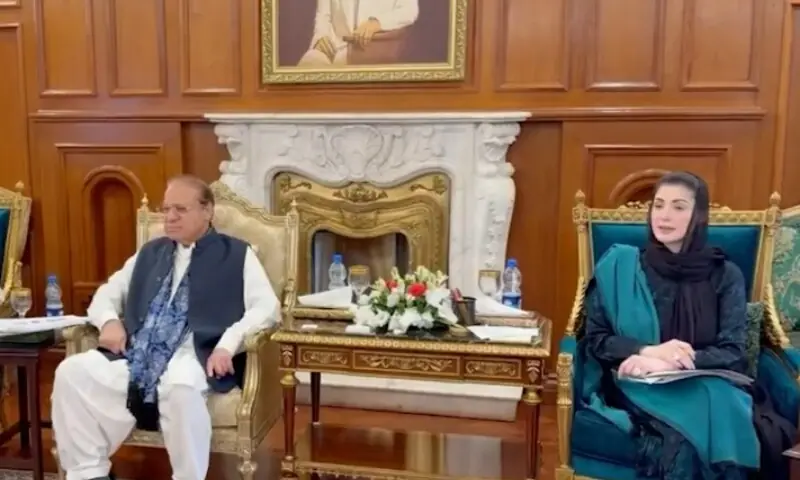
nawaz interviews candidates
| |

Nawaz interviews candidates for AJK reserved seats

Pakistan Muslim League-Nawaz (PML-N) leadership has accelerated consultations over the formation of the next government in Azad Jammu and Kashmir (AJK), with party supremo Nawaz Sharif and Punjab Chief Minister Maryam Nawaz interviewing candidates for reserved seats.

The interviews were held in Murree on Sunday for five women’s reserved seats in the AJK Legislative Assembly. PML-N AJK regional president Shah Ghulam Qadir and Prime Minister’s Adviser on Political Affairs Rana Sanaullah also attended the meeting.

The party leadership reviewed the profiles of several women seeking PML-N tickets. The interviews reportedly lasted between five and 10 minutes for each candidate.

Among those interviewed were Maryam Kashmiri, president of the PML-N AJK Women’s Wing, secretary general Nasira Azeem Khan, former reserved-seat MLA Sehrish Qamar, former Assembly member Nisara Abbasi, Maryam Idrees, Maria Iqbal Tarana and Zareeda Nisar.

The widow of late Raja Abid Khan of Dadyal also appeared before the leadership. Her son, Raja Shoaib Abid, had withdrawn from the electoral contest in support of PML-N candidate and MLA-elect Chaudhry Azhar Sadiq.

The PML-N leadership praised the participation of women in the recent AJK elections. The party said women had played an active and important role in the electoral process and described their involvement as a positive development for democracy.

The PML-N has emerged as the largest party following the recent AJK elections. It secured 25 directly elected seats and has the support of an allied member. Based on its strength in the Assembly, the party is expected to win four of the five reserved seats for women.

The party is also expected to secure the remaining three reserved seats allocated to religious scholars or Mashaikh, overseas state subjects, and technocrats and other professionals.

The AJK Election Commission has scheduled polling for all eight reserved seats for August 24. The voting will take place at the AJK Legislative Assembly Hall in Muzaffarabad from 10am to 1pm.

Candidates will submit nomination papers on August 20. The scrutiny process will be completed the same day, while appeals against decisions regarding nominations can be filed on August 21.

The Election Commission will hear the appeals on August 22. Candidates will have until August 23 to withdraw their nominations, after which the final list of contestants will be issued.

The AJK Assembly comprises 53 members. Of these, 45 are elected through direct voting, while eight seats are reserved for specific categories.

However, elections could not be held in seven constituencies because of the law and order situation in parts of Poonch and Sudhnoti districts. As a result, 38 directly elected members will take part in the process of electing candidates to the reserved seats.

Meanwhile, the Election Commission also issued notifications confirming the victories of PPP candidate Sardar Ziaul Qamar and PML-N candidate Sardar Mir Akbar in Bagh district.

Qamar was declared successful from LA-15 Central Bagh, while Akbar was declared the returned candidate from LA-16 Eastern Bagh. Their notifications formally completed the electoral process in the two constituencies.

Similar Posts

  • |

    Tom Chadbon, Game of Thrones and Doctor Who actor, dies at 80

    British actor Tom Chadbon has died at the age of 80, leaving behind a career that touched some of the UK’s most beloved television franchises, including Game of Thrones, Peep Show, and Casino Royale. News of his death was shared by Fantom Events, an organization known for running Doctor Who fan conventions where Chadbon frequently appeared as a guest. In their statement, the company remembered him warmly, describing him as easy to work with and offering their sympathies to his loved ones. Chadbon’s path into acting began far from the screen. Raised in Luton, Bedfordshire, he pursued formal training at the Royal Academy of Dramatic Art, one of the UK’s most respected drama schools. He stepped onto a professional stage for the first time in 1967, marking the start of a career that would stretch across nearly six decades. Rather than sticking to one medium, Chadbon built a reputation as a versatile performer. He took on roles at major theatrical institutions, including the Bristol Old Vic and the National Theatre, while also appearing in numerous West End productions. This theatrical grounding fed into a long and steady run on British television, where he became a familiar face across a wide range of popular series. Over the years, viewers would recognize him from shows like Casualty, Holby City, Heartbeat, Silent Witness, Midsomer Murders, Father Brown, The Bill, Blake’s 7, and Taggart. That breadth of work helped establish him as one of Britain’s most dependable and respected character actors, the kind of performer whose face was instantly familiar even if his name wasn’t always known. Two roles, though, stand out as particular fan favorites. Back in 1979, Chadbon played detective Duggan alongside Tom Baker’s incarnation of the Doctor in the classic Doctor Who serial “City of Death,” a story still fondly remembered by longtime fans of the show. Decades later, he stepped into the world of Westeros, taking on the role of High Septon Maynard in the seventh and final season of Game of Thrones in which he appeared. In the wake of his passing, tributes have poured in from fans and fellow actors alike, many taking to social media to reflect on his decades of contributions to British theatre and television, and to celebrate the warmth he brought both on-screen and off.

  • |

    Pakistan eyes PNSC ships to boost GCC trade amid shipping crisis

    ISLAMABAD: The government is considering a range of emergency measures, including the deployment of Pakistan National Shipping Corporation (PNSC) vessels, to keep Pakistan’s trade links with Gulf Cooperation Council (GCC) countries operational amid severe disruption to maritime traffic. The move comes as Pakistan’s exports to the GCC region declined significantly in July 2026, while imports also recorded a sharp fall compared with the same month last year, according to data shared by the Ministry of Commerce. The ministry’s figures show that exports to GCC countries dropped by around 12% year-on-year in July, reflecting the impact of heightened maritime security concerns and disruptions to established shipping routes. Exports to major Gulf markets decline Pakistan’s exports to the United Arab Emirates (UAE), its largest GCC trading partner, fell 9.5% in July 2026, reaching $144.6 million compared with $159.8 million recorded in July 2025. Exports to Saudi Arabia witnessed a steeper decline of 20.5%, falling to $42 million from $52.8 million a year earlier. Shipments to Oman decreased 3.7% to $15.8 million from $16.4 million. Pakistan’s exports to Bahrain suffered the sharpest percentage decline among the GCC markets, dropping 50.8% to $2.3 million from $4.2 million. Exports to Kuwait declined 7.4% to $7.4 million, while shipments to Qatar fell 4.2% to $8.7 million from $9 million in the corresponding month of 2025. The decline has raised concerns over the ability of Pakistani exporters to maintain regular deliveries to Gulf markets, particularly for goods that depend heavily on maritime transportation. GCC imports also fall sharply Pakistan’s imports from GCC countries also recorded a substantial decline during July. The Commerce Ministry reported that imports fell 32.5% year-on-year to $1.0009 billion from $1.4825 billion in July 2025. Imports from the UAE decreased 34.2%, falling to $380.7 million from $576.5 million. Imports from Saudi Arabia declined 4.7% to $295.3 million from $310 million, while purchases from Bahrain dropped 44.4% to $15.1 million from $27.2 million. The most significant declines were recorded in imports from Kuwait and Qatar. Imports from Kuwait plunged 92.8% to $9.5 million from $132.1 million, while those from Qatar fell 96.1% to $10.2 million from $261.8 million. Oman was the exception, with Pakistani imports from the country increasing 67.7% to $290.2 million from $173 million a year earlier. Month-on-month trade also weakens The trade slowdown was also visible on a month-on-month basis. Pakistan’s exports in July were 2.7% lower than in June 2026. However, the performance varied considerably across GCC destinations. Exports to the UAE increased 15.7%, while shipments to Kuwait and Qatar rose 19.4% and 88%, respectively. In contrast, exports to Saudi Arabia declined 34.5% during the month. Shipments to Oman fell 34.6%, while exports to Bahrain decreased 18.2%. Imports recorded an even sharper monthly decline, falling 32.5% in July compared with June. Imports from the UAE decreased 17.9%, while those from Saudi Arabia fell 41.4%. Imports from Oman declined 49.9%, and purchases from Qatar plunged 93.2%. Imports from Bahrain and Kuwait, however, increased during the month, rising 295.8% and 72%, respectively. Maritime security disrupts Gulf trade The Commerce Ministry linked the deterioration in trade flows to the worsening maritime security situation following the breakdown of an interim truce between the United States and Iran in July 2026. According to the ministry, the resulting security concerns severely affected international shipping movements through key maritime routes and created uncertainty for commercial vessels operating in and around the Gulf. The ministry said the waterway normally accommodates between 70 and 80 commercial vessel crossings each day. However, traffic reportedly dropped to as few as six vessels a day during the disruption, leaving hundreds of ships waiting outside the Strait of Hormuz. The ministry also referred to statements attributed to Iran’s Islamic Revolutionary Guard Corps (IRGC), according to which vessels were required to obtain permission to pass through the strategic waterway. Such developments, coupled with threats against shipping, significantly increased the risks and costs associated with maritime trade. Red Sea tensions add to shipping risks The Commerce Ministry also highlighted the impact of attacks attributed to Houthi militants on Saudi oil facilities and areas along the Red Sea coast. The resulting security threats to Saudi-linked vessels have increased concerns surrounding shipping through the Bab al-Mandab Strait, another critical maritime gateway connecting the Red Sea with the Gulf of Aden. With shipping operators facing heightened security risks, commercial maritime movement between Pakistan and GCC markets has been severely disrupted. The ministry said some Pakistani exports had consequently been shifted to air freight to ensure the delivery of goods to Gulf customers. However, air transport is considerably more expensive than sea freight, creating additional pressure on exporters and potentially reducing the competitiveness of Pakistani products in GCC markets. Government considers alternative shipping routes To reduce the impact of the disruption, the Commerce Ministry has proposed establishing dedicated feeder links between Karachi and safer maritime nodes outside the immediate Hormuz chokepoint. The proposed connections include Fujairah and Khor Fakkan in the UAE, as well as suitable Omani ports located outside the affected maritime corridor. Such routes could provide Pakistani exporters with alternative channels for moving cargo to the Gulf while reducing their exposure to disruptions around the Strait of Hormuz. The ministry has also recommended accelerating the operationalisation of multi-purpose passenger and cargo ferry services between Gwadar and GCC ports. The proposed ferry network is intended to provide another avenue for transporting commercial goods and passengers while strengthening Gwadar’s role as an alternative regional logistics hub. PNSC vessels under consideration Another option being examined by the government is the use of vessels operated by the Pakistan National Shipping Corporation to maintain trade connectivity with GCC destinations. The deployment of national-flag shipping capacity could provide greater control over cargo movement at a time when private commercial operators are facing security and logistical constraints. Officials believe that maintaining reliable access to Gulf markets is important because GCC countries remain a major destination for Pakistani exports and a key source of energy and other imported commodities. The proposed measures are therefore aimed

  • Crane Collapse on Rama II Road in Bangkok, Kills Two

    SAMUT SAKHON – A construction crane collapsed onto the busy Rama II Road southwest of Bangkok on Thursday morning, killing two people and injuring two others. The accident marks the latest in a series of incidents that have raised serious safety concerns along this critical highway. Train Collides with Collapsed Crane in Korat, Killing at […]

  • | |

    US and UK plan high level meeting in London on Str…

    The United States and the United Kingdom are reportedly planning a high-level meeting in London next week to discuss the future of the Strait of Hormuz, according to a report by Axios cited by Al Jazeera. The meeting is expected to include talks on the possible establishment of a coalition naval force to protect ships in the strategic waterway, diplomatic sources told the website. High-level European, American, and Arab officials, including defence ministers and military commanders, may participate in the meeting, which comes amid a spate of attacks in the Strait of Hormuz and the renewed conflict between the US and Iran. The strait, through which approximately 20% of global oil supplies pass, has been a flashpoint in the escalating tensions, with Iran launching attacks on commercial shipping and the US conducting strikes to keep the waterway open. The proposed coalition naval force would aim to ensure the safety of maritime traffic in the region, which has been disrupted by attacks on tankers and other vessels. The US has already enforced a naval blockade in the strait, while Iran has targeted ships that violated its rules on navigating the waterway. The situation has raised concerns about global energy supplies and the potential for a wider conflict. The meeting in London reflects the growing international concern over the instability in the region and the need for a coordinated response. The UK, a key US ally, has been actively involved in efforts to de-escalate tensions and protect shipping lanes. The potential involvement of Arab officials highlights the regional dimensions of the crisis, with Gulf states directly affected by the disruptions. The establishment of a coalition naval force would be a significant step in ensuring the safety of maritime traffic in the Strait of Hormuz and the broader Gulf region. However, the success of such an initiative would depend on the cooperation of all parties involved, including Iran, which has insisted on maintaining control over the strait. The meeting in London is expected to explore options for addressing the crisis, including diplomatic and military measures. As the situation continues to evolve, the international community remains focused on finding a resolution to the conflict. The meeting in London represents a crucial opportunity for key stakeholders to coordinate their efforts and develop a strategy to ensure the security of the Strait of Hormuz. The outcome of the discussions could have significant implications for global energy markets and regional stability. The world will be watching closely as the high-level meeting approaches, hoping for a diplomatic breakthrough that can de-escalate tensions and restore stability to the region. The coming days will be critical in determining whether the international community can unite to address the challenges posed by the conflict and protect the vital shipping lanes that are essential to global trade and energy security.

  • | |

    Kangana Ranaut renews attack on Hrithik Roshan

    Kangana Ranaut has once again addressed her long-running feud with Hrithik Roshan after a viral social media trend reignited public discussion about their 2016 controversy. The actress and BJP MP shared a strongly worded message on Instagram, accusing Roshan of encouraging online criticism directed at her and urging him to stop “adding fuel to the fire.” The renewed controversy began after Kangana faced backlash for comments she made about a recent Gen-Z protest in India over alleged corruption in the education system and examination paper leaks. During her remarks, she criticised the protesters, described them as part of a problematic generation and referred to young women as “Generation Gutter,” prompting widespread criticism on social media. As criticism of Kangana intensified, many users revisited her highly publicised dispute with Hrithik Roshan. The discussion quickly evolved into a viral online trend under the slogan: “The World owes Hrithik Roshan an apology.” The trend referred to the actors’ long-running legal and public battle that began in 2016. The dispute originated when Kangana, during an interview, referred to Hrithik as her “silly ex.” Roshan denied that the two had ever been in a relationship, after which both stars exchanged legal notices and accused each other of harassment and defamation. The case ultimately concluded without a definitive legal finding because of insufficient evidence, although public opinion remained sharply divided. As the latest trend gathered momentum, Hrithik responded by commenting on an Instagram post shared by influencer Freddy Birdy. Rather than embracing the online campaign, the actor urged people to avoid taking sides without considering the full context. He wrote: “My friend, siding with ‘A’ just cause you don’t like ‘B’ anymore is a small part of the larger systemic issue plaguing our society. I’ll wait, for when the context to it is the right one, and motivated by facts. That would be fair. But then again, who cares anymore right?” Kangana later responded through her Instagram Stories, directly addressing Roshan and urging him not to encourage those attacking her online. She wrote: “Dear Hrithik, I am happy that you have found your perfect match, Saba Azad and you both look great together, you are in a committed relationship and it doesn’t suit you to tease a woman like this. Instead, you should condemn all those who are harassing and bullying me using your name.” The actress then added another pointed remark, saying: “Stop adding fuel to fire and embarrassing your partner. Hope better sense prevails and you stop making unreasonable comments.” Her latest statements quickly went viral, generating another wave of reactions across social media. While some users supported her right to respond, many others criticised the actress, arguing that reopening the years-old dispute was unnecessary. The exchange has once again brought one of Bollywood’s most talked-about celebrity feuds back into the spotlight. Although nearly a decade has passed since the original controversy, the latest online trend and subsequent responses from both actors demonstrate that the dispute continues to attract widespread public attention whenever it resurfaces. 

  • CM sets up clean drinking water camps for flood victims

    Lahore – On the directions of Punjab Chief Minister Maryam Nawaz Sharif, the Muridke administration has established clean drinking water camps for flood-affected people. The supply of safe drinking water is continuing in the flood-hit areas of Muridke and Ferozewala. Bottled drinking water is being distributed to flood victims at the camps. Meanwhile, field staff of the Punjab Saaf Pani Authority has reached Khan Colony, Ferozewala, to facilitate and assist the affected residents by ensuring the provision of clean drinking water.

Leave a Reply

Your email address will not be published. Required fields are marked *