expresses displeasure over
| |

PM expresses displeasure over Islamabad officials?…


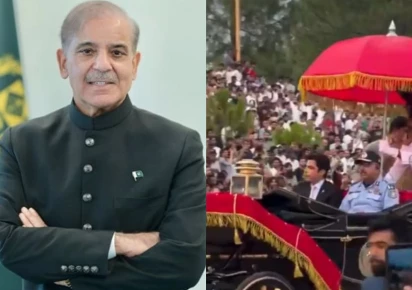
ISLAMABAD: Prime Minister Shehbaz Sharif has taken serious notice of the use of a ceremonial horse-drawn buggy by Islamabad’s Chief Commissioner and Inspector General of Police (IGP) during an official function held on August 14, according to official documents. The incident occurred during the Independence Day celebrations in Islamabad, when Chief Commissioner Lt. (Retd.) Sohail Ashraf and IGP Syed Ali Nasir Rizvi travelled to the event in the ceremonial buggy.

The display later drew criticism on social media and prompted the government to issue an advisory to both senior officials. According to documents, a formal advisory was issued on Monday by Establishment Division Joint Secretary (Discipline) Syeda Shafaq Hashmi to the Islamabad IGP and Chief Commissioner.

The advisory stated that the prime minister had expressed “disappointment and displeasure” over the incident and had taken a serious view of the matter. The document noted that the use of the ceremonial vehicle had attracted considerable public criticism and created an impression of excessive pomp and privilege. It said such a display was inconsistent with the values and responsibilities associated with public service. The advisory reminded the officials that civil servants and public office holders serve the people and are expected to maintain humility, restraint, dignity and sound judgment while performing their duties.

According to the Establishment Division, conduct that conveys an impression of ostentation or personal privilege can negatively affect public confidence in government institutions. The advisory stressed that senior government functionaries are expected to maintain high standards of propriety, discipline and responsible governance. The officials were directed to exercise greater caution in the discharge of their responsibilities and ensure that such an incident does not happen again. The instructions were issued for “strict compliance” in both letter and spirit.

The controversy gained wider attention after photographs and videos of the two officials using the buggy circulated on social media during the Independence Day celebrations. The incident prompted Interior Minister Mohsin Naqvi to clarify the circumstances surrounding the officials’ use of the ceremonial vehicle. Interior Minister Mohsin Naqvi defended the Islamabad police chief and chief commissioner, saying that neither official should be blamed for using the buggy. In a statement posted on X on August 15,

Naqvi acknowledged that the situation had not unfolded as intended but said the two officials were not responsible for the decision. Naqvi explained that the ceremonial buggy had originally been arranged for the chief guest. However, the chief guest and the interior minister were delayed because of a meeting involving President Asif Ali Zardari and Prime Minister Shehbaz Sharif. He said the two Islamabad officials had initially been reluctant to begin the programme in the absence of the chief guest and the interior minister. However, they were specifically instructed to proceed with the event so that members of the public would not face unnecessary inconvenience.

“The buggy was arranged for the chief guest but, unfortunately, due to unavoidable circumstances, it was used by the officers,” Naqvi explained. The minister further said that both officials had initially resisted proceeding without the dignitaries but ultimately followed the instructions given to them. Naqvi also thanked Islamabad residents for participating in the August 14 celebrations and helping make the Independence Day event successful.

The episode has since sparked discussion about appropriate conduct, public perception and the standards expected from senior government officials, with the prime minister’s advisory stressing the importance of maintaining humility and public trust.


Similar Posts

  • |

    Murkowski opposes Blanche, putting Trump’s AG pick at risk

    WASHINGTON: Republican Senator Lisa Murkowski of Alaska has announced that she will vote against Todd Blanche’s nomination for US attorney general, dealing another setback to President Donald Trump’s choice and leaving his confirmation prospects increasingly uncertain. Murkowski’s decision makes her the second Republican senator to oppose Blanche, following Senator Susan Collins. With the Republican majority in the Senate already facing a narrow margin, even one more GOP defection could put the nomination in serious jeopardy. Murkowski said concerns surrounding an $1.8 billion “anti-weaponization” fund played a major role in her decision. Although the fund was rescinded while Blanche’s nomination was under consideration, she questioned whether it could be restored if Blanche is confirmed. “The country needs an Attorney General who will check the worst impulses of this administration,” Murkowski said, adding that she did not have sufficient confidence that Blanche would fulfil that role. Her opposition adds to a growing political challenge for Blanche, who is seeking Senate approval to lead the Justice Department. The nomination has faced scrutiny over questions surrounding the department’s independence and its handling of politically sensitive matters. The situation is particularly delicate because Republican Senator Mitch McConnell is absent from the Senate. That leaves Blanche with little room for further defections, while attention has turned to Republican Senator Bill Cassidy, who has yet to make his position clear. Murkowski, a longtime Alaska senator known for occasionally breaking with her party, said she had met with Blanche several times and viewed him as capable. However, she ultimately concluded that his nomination raised concerns she could not overlook. Her decision could force Senate Republican leaders to intensify efforts to secure support for Blanche before the chamber’s August recess. For Trump, a failed confirmation would represent a significant political setback in his effort to shape the Justice Department with his preferred leadership. The Senate battle is now expected to remain closely watched as Republicans work to determine whether Blanche can secure enough votes.

  • |

    153mm rain puts Gujrat on high alert as new drainage interventions help avert major urban flooding

    GUJRAT: Torrential monsoon rain measuring 153 millimetres battered Gujrat, triggering a district-wide rain emergency and keeping the civil administration, Water and Sanitation Agency (WASA) and other civic departments on high alert. Despite the intense downpour, officials claimed that newly completed drainage interventions and a coordinated emergency response helped prevent widespread urban flooding in the city. Deputy Commissioner Noor-ul-Ain Qureshi remained in the field throughout the operation, inspecting drainage arrangements and monitoring the performance of five newly completed interventions executed by the Irrigation Department under the Punjab Development Programme. The projects, completed in a record five months, were designed to protect Gujrat from sheet flow entering the city from the Bhimber and Azad Jammu and Kashmir (AJK) side during heavy monsoon rains. According to the district administration, each of the five newly constructed drains has the capacity to carry 200 cusecs of water, diverting the incoming sheet flow towards Bhinder Nullah and Halsi Nullah. Officials described the projects as a significant step towards improving Gujrat’s flood resilience, saying they played an important role in reducing pressure on the city’s drainage network during the latest spell of heavy rain. Meanwhile, Managing Director WASA Gujrat Kashan Hafeez Butt supervised rain emergency operations across the city, with 20 emergency teams deployed in the agency’s three operational zones. Dewatering sets, suction machines and heavy machinery remained operational throughout the day to remove accumulated rainwater from roads, markets and residential areas. Among the worst-hit locations was Madina Bazaar Staff Gali, where rainwater accumulated to nearly one foot. WASA teams carried out continuous pumping operations before clearing the area. Water also collected at Dhakki Chowk, where approximately six inches of standing water was removed after several hours of drainage work. Officials said traffic on Rehman Shaheed Road, Shadman Colony and other major arteries remained largely uninterrupted due to the timely deployment of emergency teams. Field staff continued monitoring low-lying areas to ensure rainwater did not accumulate again as intermittent showers continued. Residents acknowledged that several streets experienced temporary waterlogging during the peak of the rainfall but said conditions improved as emergency crews reached affected areas. Commuters reported slow-moving traffic in parts of the city during the morning because of reduced visibility and rainwater on roads. The district administration maintained close coordination with WASA, the Irrigation Department, Rescue 1122 and other relevant agencies throughout the operation. Officials said emergency personnel would remain on alert as further monsoon rains are forecast, with machinery stationed at vulnerable locations for immediate deployment if required. Authorities also appealed to residents to cooperate by avoiding the disposal of garbage into storm-water drains, warning that blocked drainage channels significantly reduce the efficiency of the drainage system during heavy rainfall. The latest monsoon spell once again tested Gujrat’s urban drainage infrastructure. However, officials maintained that the combination of newly completed irrigation works, continuous field monitoring by the deputy commissioner and round-the-clock WASA operations enabled the city to withstand the 153mm rainfall without any major disruption to traffic or public life. The district administration said all departments would continue monitoring weather conditions and remain prepared to respond swiftly to any further rain-related emergencies.

  • | |

    Germany faces ICJ hearing over Nicaragua’s Gaza …

    THE HAGUE: The International Court of Justice (ICJ), the United Nations’ highest judicial body, has announced that it will hold public hearings in September to examine Germany’s preliminary objections in a case filed by Nicaragua over alleged violations of international law related to the occupied Palestinian territory, particularly the Gaza Strip. According to an official statement issued by the court, the hearings will take place from September 7 to September 10 at the Peace Palace in The Hague. The proceedings will focus solely on Germany’s objections to the court’s jurisdiction and the admissibility of parts of Nicaragua’s legal claims before the case can move forward on its merits. Nicaragua initiated the case on March 1, 2024, accusing Germany of breaching its obligations under the Genocide Convention, the 1949 Geneva Conventions, their Additional Protocols and other principles of international humanitarian law. The Central American nation argues that Germany has failed in its duty to help prevent genocide by continuing political, financial and military support for Israel during the conflict in Gaza. Nicaragua also claims Germany’s decision to suspend funding for the United Nations Relief and Works Agency for Palestine Refugees (UNRWA) contributed to worsening the humanitarian situation. According to Nicaragua, the ongoing conflict, which began in October 2023, has created what it describes as a recognized risk of genocide against the Palestinian population in Gaza, making all states party to the Genocide Convention responsible for taking preventive measures. Germany formally challenged the case on October 21, 2025, filing preliminary objections that argue the ICJ does not have jurisdiction to hear the dispute. Berlin also contends that several of Nicaragua’s claims are legally inadmissible. Under ICJ procedures, consideration of the main case has been suspended until the court decides whether it has the authority to proceed. The hearing schedule provides Germany with the first opportunity to present oral arguments on September 7, followed by Nicaragua on September 8. Germany will return for a second round on September 9, while Nicaragua will deliver its final submissions on September 10. The case is being closely watched by governments, legal experts and international human rights organizations, as the court’s eventual ruling on jurisdiction could determine whether one of the most closely followed legal disputes arising from the Gaza conflict proceeds to a full hearing on its merits.

  • | |

    Israel quietly receives advanced INS Drakon submar…

    JERUSALEM: Israel has quietly taken delivery of the advanced INS Drakon submarine, with the handover reportedly taking place without the usual public ceremony or official fanfare. According to media reports, the submarine belongs to the Dakar-class fleet and was built in Germany by Thyssenkrupp Marine Systems (TKMS). The vessel is regarded as one of the most sophisticated additions to the Israeli Navy’s underwater fleet. Defense analysts say the INS Drakon is designed for long-range covert operations, intelligence gathering, and extended deployments at sea, significantly enhancing Israel’s naval capabilities. The submarine is part of Israel’s ongoing efforts to modernize its maritime defense amid evolving regional security challenges. Some defense experts have also suggested that Israel’s Dolphin-class submarines may be capable of carrying nuclear-armed missiles, although Israeli authorities have never officially confirmed such capabilities. The arrival of the INS Drakon further strengthens Israel’s strategic naval deterrence and expands its ability to conduct long-duration missions across distant maritime regions.

  • |

    SBP to maintain focus on price stability, reforms and sustainable economic growth

    KARACHI: State Bank of Pakistan (SBP) Governor Jameel Ahmad has said the central bank will continue to prioritise price stability, structural reforms and the creation of a business-friendly economic environment aimed at boosting productivity, exports and employment. Addressing a flag-hoisting ceremony held at the SBP headquarters in Karachi to mark Pakistan’s 79th Independence Day, Governor Ahmad said the country had made notable progress towards macroeconomic stability over the past year. He attributed the improvement to disciplined fiscal and monetary policies, better economic management and continued efforts to strengthen financial and economic institutions. Inflation remains within medium-term range Speaking about the inflation outlook, the SBP governor said average inflation during fiscal year 2025-26 stood at 7.1 percent. He said the central bank believed that the prevailing monetary policy stance was appropriate for keeping inflation within its medium-term target range of 5 to 7 percent. According to Ahmad, the current policy framework also provides sufficient space for economic activity to continue, while supporting investment and employment generation. The governor said maintaining price stability would remain a central objective of the SBP as Pakistan seeks to move from short-term stabilisation towards sustained economic expansion. Growth expected to strengthen Ahmad said Pakistan’s economy recorded growth of 3.7 percent in FY26, reflecting the impact of improved macroeconomic conditions and greater fiscal and monetary discipline. Looking ahead, he projected economic growth in the range of 3.5 to 4.5 percent during FY27. He described the outlook as encouraging, saying the economy was gradually moving towards a more sustainable growth path after going through a difficult period of economic stabilisation. The governor stressed that maintaining policy discipline would be important to ensure that the gains achieved in recent years translate into durable economic development. Remittances strengthen external position The SBP chief also highlighted improvements in Pakistan’s external sector, particularly the performance of workers’ remittances. He said overseas Pakistanis had demonstrated confidence in the country by sending record amounts of money home, with remittances surpassing $41 billion during FY26. The inflow is expected to increase further, with remittances projected to reach around $44 billion in FY27, according to the governor. Ahmad said stronger remittance inflows, combined with a relatively low current account deficit, had helped improve Pakistan’s foreign exchange position. The country’s foreign exchange reserves reached $18.4 billion by the end of FY26, while the SBP expects reserves to rise above $21 billion during FY27. He said strengthening the external position would help improve economic resilience and provide greater capacity to withstand external shocks. SBP pushes digital transformation The governor also outlined measures taken by the central bank to modernise Pakistan’s financial infrastructure and expand the use of digital payment channels. He pointed to the successful launch of PRISM+, saying the upgraded payment and settlement infrastructure had brought Pakistan’s large-value payment system closer to international standards. The system has improved the speed, security and efficiency of large-value payments and settlements, he said. Ahmad added that SBP initiatives aimed at encouraging digital payments had resulted in a substantial increase in the use of electronic channels. Retail digital transactions increased from approximately 10 billion to 12 billion over the past year, reflecting growing adoption of technology across the financial system. According to the governor, the shift towards digital payments is more than a technological development. It is also contributing to greater documentation, transparency and efficiency within the economy. Self-reliance and institutions vital for progress Governor Ahmad said Pakistan’s long-term economic success would depend not only on financial and monetary policies but also on stronger institutions, economic self-reliance, respect for the rule of law and national unity. He emphasised that the country’s journey towards sustainable development required continued commitment and collective efforts from institutions, businesses and citizens. While acknowledging the progress achieved during the past year, he cautioned that Pakistan continued to face economic challenges that required sustained attention, policy consistency and determination. He said the objective should now be to convert the gains from economic stabilisation into a durable foundation for investment, productivity, exports and employment. The governor reaffirmed that the SBP would continue playing its role in supporting monetary and financial stability while contributing to broader efforts aimed at improving the welfare of the Pakistani people.

  • |

    Turkish firm to begin offshore drilling in Pakista…

    Petroleum Minister Ali Pervaiz Malik has said Turkish Petroleum will soon begin offshore drilling in Pakistan’s territorial waters, a move he described as a potential boost for foreign investment in the country’s energy sector. Speaking at a press conference in Lahore on Sunday, Malik said Pakistan currently imports nearly 90% of its energy needs. Domestic oil production stands at around 70,000 barrels per day, while the country’s daily demand is close to 500,000 barrels. The minister stressed the need to speed up oil and gas exploration within the country to reduce dependence on costly energy imports. Malik said Prime Minister Shehbaz Sharif and Chief of Defence Forces and Chief of Army Staff Field Marshal Syed Asim Munir had tasked an international company with developing a comprehensive roadmap for Pakistan’s energy sector. The plan is expected to reach the national leadership in the coming months. He also said the government had stopped the flow of circular debt and was working to settle outstanding liabilities accumulated under previous governments. The minister announced that LPG tenders would open on Monday and said the government had also made arrangements to issue new gas connections to consumers. Malik said Pakistan’s next priority after recent strategic and diplomatic achievements was sustainable economic growth. He described the Makkah defence agreement as a source of national pride and said Pakistan had strengthened its position as a regional security provider. He added that cooperation among Saudi Arabia’s economic strength, Turkiye’s technological expertise and Pakistan’s defence capabilities could help promote regional stability. Discussing global energy pressures, Malik said the Iran-US conflict had created major challenges for international energy markets and pushed crude oil and petroleum product prices to unprecedented levels. Despite the pressure, he said the government maintained uninterrupted fuel supplies across the country and took steps to shield consumers from the full impact of higher international prices. Malik reiterated that the government would continue efforts to provide maximum relief to the public while working with limited financial resources.

Leave a Reply

Your email address will not be published. Required fields are marked *