bangladesh signals interest
|

Bangladesh signals interest in joining Pakistan-Saudi Arabia-Türkiye defence framework


DHAKA: Bangladesh has indicated that it is open to joining the Makkah Joint Defence Agreement signed by Pakistan, Saudi Arabia and Türkiye, as Dhaka looks to broaden its strategic partnerships while maintaining a foreign policy centred on national interests.

According to the state-run Bangladesh Sangbad Sangstha (BSS), Bangladesh Prime Minister’s Adviser for Foreign Affairs Humayun Kobir said the country maintained a positive outlook towards the possibility of becoming part of an economic or defence framework involving Saudi Arabia, Pakistan and Türkiye.

Kobir said any decision regarding participation would be considered in light of Bangladesh’s national interests as well as changing global economic and trade dynamics. He stressed that Dhaka was pursuing a balanced foreign policy under its “Bangladesh First”approach, with national priorities remaining at the heart of its international engagement.

He said Bangladesh was also working to strengthen its bilateral relationship with Pakistan through normal diplomatic channels. According to Kobir, the two countries were particularly focusing on expanding trade and improving people-to-people contacts and connectivity.

The Bangladeshi adviser’s remarks come amid signs of improving diplomatic engagement between Dhaka and Islamabad. He also said Prime Minister Tarique Rahman’s proposed visit to Riyadh, following an invitation from Saudi Crown Prince and Prime Minister Mohammed bin Salman was expected to be finalised after the summer.

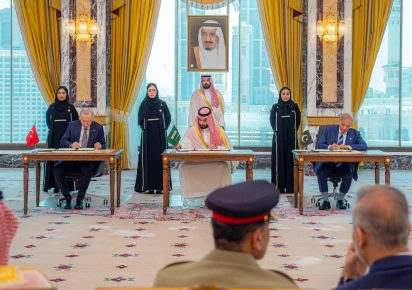
The possibility of Bangladesh joining the defence framework comes shortly after Pakistan, Saudi Arabia and Türkiye signed the Makkah Joint Defence Agreement in Makkah on August 7.

Under the agreement, an armed attack against any one of the three participating countries is to be treated as an attack against all three. The pact also provides a framework for greater defence cooperation, coordination and collective deterrence among the signatories.

The agreement has attracted regional and international attention because of its potential to expand security cooperation among key Muslim-majority countries. Turkish Foreign Minister Hakan Fidan has described the arrangement as technically comparable to NATO’s Article 5 principle of collective defence, while emphasising that the agreement is not aimed at Iran or any other specific country.

Ankara has also suggested that the framework could potentially be expanded to include additional regional states. Egypt has previously been mentioned as a possible participant in the broader security arrangement.

Pakistan has similarly maintained that the agreement is defensive in character and is not directed against any particular country. Islamabad has also indicated that the framework remains open to states that are willing to support its principles and objectives.

Deputy Prime Minister and Foreign Minister Ishaq Dar has said the agreement does not seek to replace existing bilateral or multilateral defence and security arrangements. Instead, he said, it provides an additional platform for cooperation based on mutual respect, shared interests and peaceful resolution of disputes.

Bangladesh’s latest position suggests that Dhaka is carefully assessing emerging regional partnerships while seeking to preserve strategic flexibility. Its potential participation could further broaden the Makkah agreement’s regional significance and strengthen cooperation among Pakistan, Saudi Arabia, Türkiye and other interested countries.

For Bangladesh, however, any decision to join would ultimately depend on how the proposed framework aligns with its national interests, foreign policy priorities and assessment of the evolving regional and global security environment.

Similar Posts

  • | |

    Iran rejects US claims over Strait of Hormuz control 

      Iran’s military on Thursday rejected US claims that ships were continuing to pass normally through the Strait of Hormuz, insisting that no vessel could safely transit the strategic waterway without permission from Tehran. According to news agency, Ebrahim Zolfghari, spokesperson for the Khatam al-Anbiya Central Headquarters, said the strait remained under Iran’s “full management and control.” He warned that commercial vessels and oil tankers would not be able to secure safe passage without the permission and supervision of Iran’s armed forces. Zolfghari’s remarks came amid growing tensions between Tehran and Washington over the strategically important waterway, through which a significant portion of global oil and energy shipments traditionally passes. The conflicting statements from Iran and the United States have further intensified uncertainty surrounding maritime traffic in the region. Meanwhile, US Defence Secretary Pete Hegseth said Washington had the capability to maintain a naval blockade of Iranian ports for as long as necessary. Speaking to reporters, Hegseth said the US Navy could sustain such an operation indefinitely by rotating ships in and out of the region. His comments came as Washington continued to assert its ability to control maritime activity around Iran. Tehran, however, has strongly disputed those claims and maintained that it retains authority over the Strait of Hormuz. Iranian officials have also issued increasingly forceful warnings about a potential future conflict. Brigadier General Rasoul Sanaei-Rad said on Thursday that Iran would respond more aggressively if another war occurred. Sanaei-Rad, who currently serves as a political adviser in the office of Iran’s Supreme Leader, said Iran had stood firm during the recent conflict and would be prepared to respond with greater determination in any possible future war. Although he did not directly name the United States, he accused Iran’s “enemy” of attempting to create divisions inside the country through economic pressure. According to the general, those efforts had failed to achieve their intended objective. His comments reflected the increasingly confrontational rhetoric coming from Iranian officials as tensions with Washington remain high. Iranian Foreign Minister Abbas Araghchi also criticised US assessments of the conflict, saying Washington had repeatedly miscalculated because of intelligence failures. Referring to the recent war, Araghchi said the United States had made serious errors in assessing the situation and was now making an even bigger mistake regarding the Strait of Hormuz. “Worse than fake news is fake intelligence. Be careful,” Araghchi said, warning against what he described as flawed assessments of Iran’s capabilities and intentions. His comments came a day after US President Donald Trump claimed on his Truth Social platform that the United States had “total control” over the strategic waterway. Iran has rejected the assertion, with officials continuing to emphasise Tehran’s role in regulating passage through the strait. Iranian officials have also sought to project confidence in the country’s ability to withstand continued pressure. A former Iranian diplomat, Abbas Khameyar, said the United States had failed what he described as a test of economic and military warfare against Iran. Khameyar argued that Tehran would not accept American conditions or surrender to US ambitions. He also claimed that Washington had effectively fallen into a “trap” involving the Strait of Hormuz. The latest statements from both sides underline the deepening confrontation over the waterway. While Washington maintains that it has the military capability to sustain a blockade, Tehran insists that maritime passage remains subject to its authority. With both countries issuing conflicting claims over control and navigation, the Strait of Hormuz has once again emerged as a major flashpoint in the wider regional confrontation.

  • |

    UK rejects E1 settlement plan

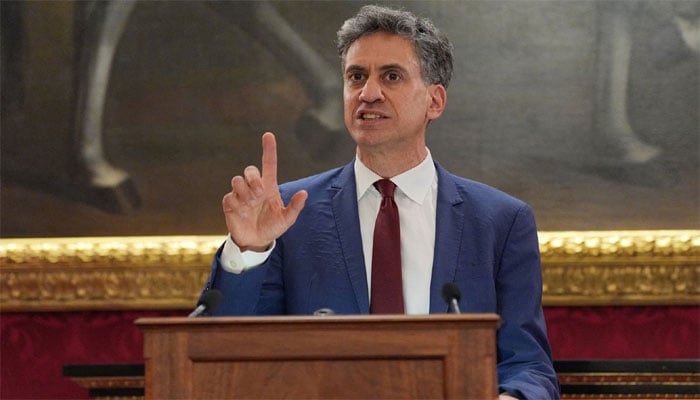
    LONDON: British Foreign Secretary Ed Miliband has strongly opposed Israel’s plan to invite tenders for the construction of 1,200 new homes under the controversial E1 settlement project, warning that the move could seriously undermine prospects for a future Palestinian state and the two-state solution. The British government has urged Israel to immediately withdraw the E1 plan, cancel the construction tenders and halt the expansion of Israeli settlements in the occupied West Bank. A UK government spokesperson said Israeli settlement activity violates international law and remains a major obstacle to achieving lasting peace in the region. The government stressed that continued settlement expansion could further weaken efforts to establish a viable and geographically connected Palestinian state. Miliband said Britain would continue to strongly support a two-state solution, arguing that it offers the best path toward lasting peace, security and stability for both Palestinians and Israelis. The E1 area, located east of Jerusalem in the occupied West Bank, has long been a sensitive issue because large-scale settlement development there could divide Palestinian communities and complicate the possibility of creating a contiguous Palestinian state. The British government’s latest warning comes amid continued international concern over settlement expansion in the occupied Palestinian territories and its potential impact on future peace negotiations.

  • | | | |

    Qatar restores maritime traffic after two-week suspension

    Qatar has fully resumed maritime navigation for all types of vessels after a two-week suspension imposed amid heightened security tensions in the Gulf and around the Strait of Hormuz. Qatar’s Transport Ministry announced that maritime activities would resume from Sunday. It urged shipping companies, vessel operators and other concerned parties to follow safety regulations and official instructions to ensure safe voyages. The ministry did not provide further details about the reasons behind the decision. Qatar had suspended maritime navigation on July 12 as regional tensions intensified. It had earlier halted maritime traffic on June 29 before partially restoring operations on July 5. The conflict also prompted several shipping companies to advise vessels to remain outside the Strait of Hormuz because of security concerns. Meanwhile, Iran said it had made progress in talks with Oman on arrangements for safe shipping through the Strait of Hormuz. Iranian Foreign Ministry spokesman Esmaeil Baqaei said officials from the two countries held discussions in Tehran on Friday and Saturday. The talks focused on common principles and practical mechanisms for ensuring the safe movement of ships through the strategic waterway. Baqaei described the discussions as productive and said progress had been achieved. He added that technical and political consultations between the two countries would continue. Iran also said there had been no change in the existing maritime traffic situation in the Strait of Hormuz. The waterway remains a key route for international energy and commercial shipments, making any prolonged disruption a major concern for global trade. At the same time, Iranian military officials claimed that Tehran had targeted US military facilities in Jordan, Kuwait and Bahrain during retaliatory operations. Brigadier General Mohammad Reza Akraminia said Iran had taken action after accusing Washington of violating previous commitments related to the Strait of Hormuz. Iranian army spokesman General Abolfazl Shekarchi also claimed that the United States had failed to achieve its objectives against Iran. He described the situation as difficult for Washington and said the US was looking for a new strategy. Iranian officials further claimed that US military infrastructure in Iraq’s Erbil suffered extensive damage during the conflict. Tehran has warned that its military operations could resume if hostilities escalate again. The United States, meanwhile, says its naval blockade against Iran remains in effect. US Central Command said American forces had redirected several commercial vessels accused of attempting to breach the blockade. It also reported disabling two vessels and boarding others to verify compliance. One oil tanker was inspected in the Arabian Sea before continuing its journey, while another vessel was reportedly disabled in the Gulf of Oman after allegedly ignoring repeated warnings. The US actions have added to concerns over the safety of commercial shipping in the region. Kuwait has rejected reports that it participated in military operations against Iran. Kuwait’s ambassador to the United States said her country had not taken part in attacks against Tehran and had not allowed its territory, airspace or territorial waters to be used for offensive operations. Kuwait has also condemned attacks against shipping in the Red Sea. Its Foreign Ministry described such attacks as a threat to maritime security, international trade and freedom of navigation. Kuwait expressed solidarity with Saudi Arabia and backed measures taken by Riyadh to protect its security and interests. The latest Red Sea tensions followed the Houthis’ announcement of a naval blockade targeting Saudi Arabia. Saudi Arabia subsequently launched strikes against Houthi-held areas, while the Houthis later claimed attacks on Saudi oil facilities. Iran’s Islamic Revolutionary Guard Corps has meanwhile warned countries supporting US military operations against Tehran. An IRGC spokesperson said countries cooperating with Washington could become targets and specifically referred to Britain and Gulf states. US President Donald Trump has also reportedly paused plans for further strikes against Iran after nearly two weeks of military action. Reports suggested concerns over the availability of US air defence supplies in the region were among the factors behind the decision. The reported pause could provide additional space for diplomatic efforts, although it remains unclear whether it represents a temporary break or a broader halt to US strikes. US forces are reportedly maintaining contingency plans should major military operations resume.

  • |

    Murkowski opposes Blanche, putting Trump’s AG pick at risk

    WASHINGTON: Republican Senator Lisa Murkowski of Alaska has announced that she will vote against Todd Blanche’s nomination for US attorney general, dealing another setback to President Donald Trump’s choice and leaving his confirmation prospects increasingly uncertain. Murkowski’s decision makes her the second Republican senator to oppose Blanche, following Senator Susan Collins. With the Republican majority in the Senate already facing a narrow margin, even one more GOP defection could put the nomination in serious jeopardy. Murkowski said concerns surrounding an $1.8 billion “anti-weaponization” fund played a major role in her decision. Although the fund was rescinded while Blanche’s nomination was under consideration, she questioned whether it could be restored if Blanche is confirmed. “The country needs an Attorney General who will check the worst impulses of this administration,” Murkowski said, adding that she did not have sufficient confidence that Blanche would fulfil that role. Her opposition adds to a growing political challenge for Blanche, who is seeking Senate approval to lead the Justice Department. The nomination has faced scrutiny over questions surrounding the department’s independence and its handling of politically sensitive matters. The situation is particularly delicate because Republican Senator Mitch McConnell is absent from the Senate. That leaves Blanche with little room for further defections, while attention has turned to Republican Senator Bill Cassidy, who has yet to make his position clear. Murkowski, a longtime Alaska senator known for occasionally breaking with her party, said she had met with Blanche several times and viewed him as capable. However, she ultimately concluded that his nomination raised concerns she could not overlook. Her decision could force Senate Republican leaders to intensify efforts to secure support for Blanche before the chamber’s August recess. For Trump, a failed confirmation would represent a significant political setback in his effort to shape the Justice Department with his preferred leadership. The Senate battle is now expected to remain closely watched as Republicans work to determine whether Blanche can secure enough votes.

  • |

    Brazil’s Lula announces fourth-term campaign…

    Brazilian President Luiz Inacio Lula da Silva has launched his campaign for a fourth term at a Workers’ Party convention in Sao Paulo, confirming it would be his final bid for office. Centring his platform on global affairs and national defence, the 80-year-old leader pledged to increase military spending and protect the country’s vast rare earth mineral reserves. He warned foreign powers that Brazil would not permit nations like China, France, or the United States to access these resources without respecting territorial sovereignty. Lula currently holds a slight lead in opinion polls against his likely main challenger, Senator Flavio Bolsonaro.

  • |

    Representative Max Miller defies Republican pressure to remain on Ohio ballot despite abuse allegations

    Republican Representative Max Miller has confirmed he will remain in the race for Ohio’s 7th Congressional District after letting Saturday evening’s withdrawal deadline pass, ignoring widespread calls from fellow party leaders to step down amid abuse allegations. Miller has repeatedly denied accusations raised by his former wife, Emily Moreno. A spokesperson for the congressman confirmed on Sunday that he intends to proceed as a candidate in the upcoming November 3 midterm election. The ongoing controversy threatens Republican efforts to secure a congressional seat long considered a GOP stronghold. Party officials had privately lobbied Miller to abandon his campaign out of concern that the scandal could harm Republican prospects in the region. Allies of President Donald Trump also advised the former president to intervene and urge Miller to exit the contest. Prominent Ohio Republicans have publicly disavowed Miller’s candidacy. US Senator Bernie Moreno, Miller’s former father-in-law, stated that Miller should not serve in Congress, describing him as a danger to his daughter. Ohio Senator Jon Husted also called on Miller to withdraw from the ballot and resign his current seat immediately. Miller acknowledged in a statement last week that Trump characterised his re-election battle as tough, but maintained he would stay in the race to clear his name. The political fallout deepened after Miller released hundreds of private text messages, photos, and video files intended to bolster his defence. His legal team subsequently acknowledged that the archive inadvertently contained sensitive family information. Miller will face Democratic nominee Brian Poindexter, a local ironworker, in the November 3 election.

Leave a Reply

Your email address will not be published. Required fields are marked *