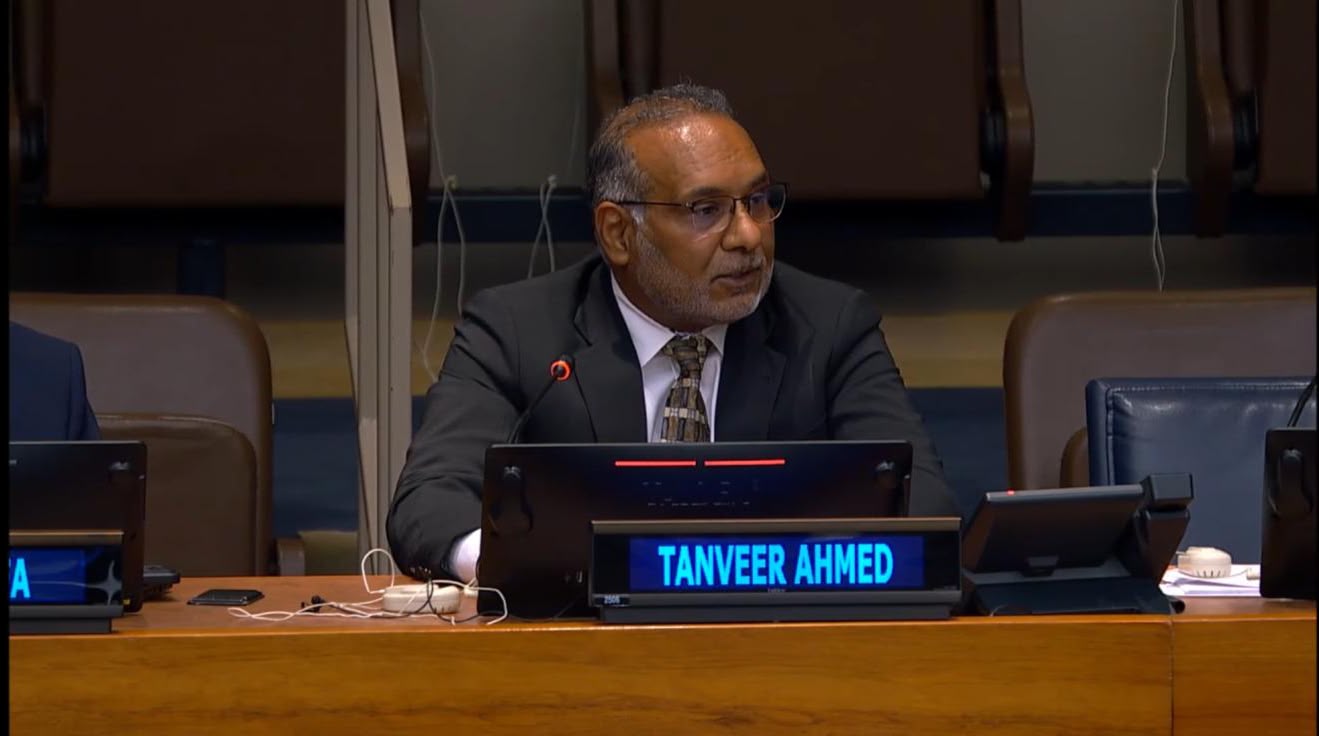
tanweer ahmed urges
| |

Tanweer Ahmed urges AI skills, MicroCerts for yout…

On International Youth Day 2026, American-Pakistani businessman and analyst Tanweer Ahmed called for greater investment in young people and highlighted ACT AI and MicroCerts as key initiatives for preparing Pakistan’s youth for an artificial intelligence-driven global economy.

Addressing a Youth and AI Summit at the United Nations, Ahmed said artificial intelligence was transforming education, employment, entrepreneurship, healthcare, public services and almost every aspect of modern economies.

He stressed that young people should not be treated merely as beneficiaries of development but as innovators, decision-makers, entrepreneurs and leaders capable of shaping the future.

“Talent is everywhere. Opportunity is not,” Ahmed said, emphasising the need to close the gap between young people who have access to advanced technology and those who remain excluded from the digital economy.

ACT AI initiative

Ahmed placed particular emphasis on ACT AI — Awareness, Competency and Tools Training for Artificial Intelligence — describing it as an important effort to expand practical AI capabilities among Pakistani youth.

He said the initiative, associated with the state-owned enterprise AXI, focuses on areas including generative AI, agentic AI systems, AI-powered productivity tools, automation and sector-specific applications.

According to Ahmed, one of the initiative’s major strengths is accessibility. Young people from different academic backgrounds can develop AI-related capabilities without necessarily having prior programming or artificial intelligence experience.

He said making AI education accessible and free of cost could help ensure that Pakistani students and young professionals are not left behind as the global economy rapidly adopts AI.

Ahmed argued that young people should acquire the ability not only to use artificial intelligence but also to understand, question, develop and responsibly apply the technology.

MicroCerts to strengthen youth credentials

Ahmed also placed strong emphasis on MicroCerts, describing micro-certifications as an important complement to traditional university degrees.

He said rapidly changing technology means education can no longer end when a student completes a conventional degree. Young people need flexible opportunities to continuously acquire and demonstrate new, market-relevant skills.

According to Ahmed, MicroCerts can provide focused credentials that demonstrate specific competencies and potentially create pathways into employment, freelancing, entrepreneurship, higher education and lifelong learning.

He highlighted the importance of making such credentials accessible to young people facing financial or geographical barriers.

“The future should not belong only to those who can afford opportunity,” Ahmed said, stressing that skills and credentials should be available to talented young people regardless of where they live or their economic circumstances.

From AI users to AI creators

Ahmed called for a shift from preparing young people simply to consume AI tools toward enabling them to become AI creators, innovators and responsible leaders.

He said technology must be combined with human judgment, ethics and responsibility, warning that artificial intelligence cannot replace compassion, character or the human responsibility to determine the kind of society people want to build.

He also called for stronger international cooperation between governments, universities, businesses, technology companies and international organisations to expand AI education and establish credible skills and certification systems.

Ahmed said Pakistan could contribute to this global effort through initiatives such as ACT AI and MicroCerts, which he described as mechanisms for developing practical AI capabilities and recognised skills among the country’s youth.

He further stressed that the expansion of AI infrastructure must be accompanied by environmental responsibility because data centres, cloud computing and AI systems require significant energy and resources.

Addressing young people around the world, Ahmed urged them to learn and question emerging technologies, use AI to solve real-world problems and build businesses and communities with a clear sense of purpose.

Similar Posts

  • |

    Israeli forces detain 48 Palestinians in West Bank raids

    Israeli forces detained at least 48 Palestinians during raids across the occupied West Bank on Saturday, while eight Palestinians were reportedly injured in a separate attack, according to Palestinian sources and the Palestinian Red Crescent Society. More than 40 young Palestinian men were detained during an ongoing military operation in the town of Tell, west of Nablus, Palestinian media reported. Israeli troops reportedly took control of a residential building in the town and used it as a temporary interrogation facility. Raids and searches of homes were also reported across Tell, with forces reportedly surrounding the town from several directions. The latest arrests came a day after Israeli authorities announced a large-scale military operation in Palestinian villages across the West Bank. The move followed an attack near the Havat Gilad settlement in which two Israeli soldiers were killed and three others were wounded. Following the attack, Palestinian communities in the Nablus area reportedly came under further attacks. Local sources said homes and other Palestinian property were set on fire. The Palestinian Health Ministry said four Palestinians were killed on Friday during violence involving Israeli forces and settlers in Tell. Meanwhile, Israeli forces carried out additional raids in Jenin city and several surrounding communities before dawn, according to Palestinian reports. Troops searched homes and detained five Palestinians in the governorate as military activity continued in several locations. Three more Palestinians were reportedly detained in the Bethlehem governorate. In a separate incident in the northern West Bank, the Palestinian Red Crescent Society said eight Palestinians were injured during an attack in Farata village, east of Qalqilya. Six of the injured were reportedly struck by live ammunition.

  • | |

    Law minister explains rules on Imran Khan’s pris…

    ISLAMABAD: Federal Law Minister Senator Azam Nazeer Tarar has defended the government’s position on meetings with Pakistan Tehreek-e-Insaf (PTI) founder Imran Khan in prison. He said matters that are pending before the courts should generally not be debated in parliament. However, he noted that the Senate was discussing such issues. Tarar made the remarks during a Senate session. Lawmakers were debating Imran Khan’s health and concerns over restrictions on meetings with him. The minister said cases related to the May 9 incidents and other cases involving Imran Khan were before the courts. He said the PTI founder and other individuals had filed appeals against decisions in their cases. According to Tarar, several legal matters remain pending before different judicial forums. He said the delay in deciding appeals and cases was a broader problem within the judicial system. The law minister pointed to delays in National Accountability Bureau (NAB) cases. He said some NAB appeals had remained undecided for as long as six years. He said Imran Khan’s petitions and applications were also pending before the relevant courts. Therefore, he argued, those matters should be addressed through the judicial process. Tarar also referred to the cases involving former prime minister Nawaz Sharif. He said Sharif had been convicted by the courts and later challenged the decisions through appeals. He added that relief was subsequently granted to Sharif by the judiciary itself. The minister said this showed that legal disputes should be settled through the courts. The Senate debate also focused on Imran Khan’s access to visitors in prison. Tarar said prison authorities had to follow the jail manual. He said the rules applied to all prisoners and could not be changed for one individual. He argued that if special permission was given to one prisoner, similar requests from other prisoners would also have to be considered. The minister said the government wanted a system in which everyone was treated equally before the law. He referred to the principle that the powerful and ordinary citizens should stand on the same footing. His remarks came after opposition lawmakers demanded that the Senate discuss Imran Khan’s health and the restrictions on meetings with him. Senator Raja Nasir Abbas had specifically called for a discussion on the PTI founder’s health. The issue has remained a major point of political disagreement between the government and PTI. The opposition has repeatedly raised concerns about Imran Khan’s health and access to family members, lawyers and political leaders. Tarar maintained that the government’s position was based on existing legal and prison procedures. He said pending court cases should not be settled through political debate.

  • | |

    52 life-saving drugs clear major approval hurdle

    ISLAMABAD: A federal cabinet subcommittee has approved the prices of 52 newly registered life-saving medicines, including treatments for cancer, diabetes, haemophilia and Parkinson’s disease, in a move aimed at improving access to essential medicines across Pakistan. The meeting was chaired by Finance Minister Senator Muhammad Aurangzeb in Islamabad. The committee reviewed pricing proposals for newly registered medicines and approved the prices for all 52 products. Officials said the approved medicines include several advanced treatments for serious and chronic illnesses. Among them is Keytruda, a modern immunotherapy drug used globally to treat more than 20 types of cancer. Other approved medicines include Nivolumab, Dasatinib, Meropenem and insulin, which are widely used to treat cancer, severe infections and diabetes. The pricing decision will now be sent to the federal cabinet for final approval. Once endorsed, the Drug Regulatory Authority of Pakistan (DRAP) will issue an official price notification, allowing the medicines to be legally marketed and sold in the country. Health Ministry officials said early approval of medicine prices was necessary to address the difficulties faced by patients. Delays in pricing had prevented several newly registered medicines from entering the local market, forcing many patients to rely on unregistered, smuggled or costly imported alternatives. Authorities believe the approval will improve the availability of high-quality medicines and reduce dependence on illegal supply channels. They said the move will also help ensure that patients have access to safe and regulated treatments through authorised healthcare providers. During the meeting, the finance minister stressed the importance of transparency and protecting the public interest in decisions related to medicine pricing. He called for a fair pricing mechanism that balances patient affordability with the availability of essential medicines.

  • | |

    Sihala Police Chief calls for sensitive rape case …

    RAWALPINDI: Commandant Sihala Police College Ashfaq Ahmad Khan has called upon police officers to adopt a compassionate, respectful and impartial attitude towards victims of rape and sexual violence. He was addressing sub-inspectors who successfully completed the one-month SSIOU course at Sihala Police College, Rawalpindi. Speaking at the concluding ceremony, Ashfaq Ahmad Khan said that rape victims, particularly women, children and girls, are already in a highly vulnerable situation, and it is the responsibility of police officers to protect their dignity and self-respect throughout the investigation process. He stressed that investigations into rape cases must be conducted professionally, sensitively and impartially. The identity and personal information of victims must be kept strictly confidential so that their dignity and reputation in society are not compromised. The Commandant urged the newly trained officers to ensure that every stage of an investigation is carried out while respecting the privacy and dignity of victims. At the same time, he said, investigations must be thorough, transparent and evidence-based so that perpetrators can be brought to justice and face the consequences of their crimes under the law. Ashfaq Ahmad Khan said the police have a crucial responsibility to provide victims with justice, protection and confidence. He added that a compassionate approach, combined with professional investigation, would help ensure that victims are treated with dignity while criminals are brought to justice. make it proper title

  • |

    Imtiaz Ali celebrates ‘Main Vaapas Aaunga’s rare 50-day run

    Main Vaapas Aaunga has pulled off something most films rarely manage. The Partition-era love story has slowly grown into one of this year’s standout box office stories. What makes it even more special is that it did so purely on word of mouth. Helmed by filmmaker Imtiaz Ali, the film brings together Diljit Dosanjh, Naseeruddin Shah, Sharvari, and Vedang Raina. It has now completed a full 50 days in theatres. The film continues to draw audiences well into its eighth week of release. Trade data from Sacnilk shows the film was made on a budget of nearly Rs 70 crore. Its collections have now touched Rs 99.21 crore worldwide. For a film that opened on a slower note, this steady climb marks a genuine turnaround. Marking the milestone, the 55-year-old director shared a warm, personal note with fans. His message centered entirely around gratitude for the audience’s support. “50 days in cinemas!! This is a rare feat for any film,” Ali wrote. He said his first thought upon reaching this milestone was one of thankfulness toward viewers. According to him, it was ordinary moviegoers who connected emotionally with the story and then encouraged friends and family to watch it too. He described this word of mouth as something that happened simply because people liked the film, with no other push behind it. Imtiaz Ali also spoke about what this success represents for the Hindi film industry at large. He called the audience’s warm response a source of encouragement for filmmakers everywhere. He also noted that this love would continue pushing him to create better, more engaging cinema going forward. The Rockstar director did not limit his gratitude to his own project. He also congratulated the broader Hindi film industry for the healthy theatre attendance seen throughout the year. Main Vaapas Aaunga initially opened across 804 screens spanning 59 countries. The film’s reach later grew further, with 15 additional European territories added to its release. Interestingly, the film also found strong footing in cities not traditionally known as Hindi cinema strongholds, including Bengaluru, Hyderabad, Chennai, and Kolkata. Given its consistent run and growing numbers, Main Vaapas Aaunga looks set to remain a major talking point in Bollywood for weeks to come.

  • |

    Sharmeen Ali, Sunita Marshall, Saima Qureshi urge parents to raise self-sufficient kids

    Sharmeen Ali, Sunita Marshall and Saima Qureshi have spoken up about raising self-reliant children. They believe both sons and daughters should learn practical life skills from a young age. The three actors shared their thoughts on Nida Yasir’s morning show. They agreed that independence has nothing to do with gender. Every child should be able to take care of themselves. Every child should also help around the house. Sunita brought up safety concerns in cities like Karachi. She said these often limit how freely kids can move outdoors. Even so, she believes parents can still teach independence at home. Simple habits matter, she said. Making the bed. Cooking a basic meal. These small tasks add up over time. She also spoke about extracurricular activities. Her son manages rowing and tuition on his own schedule. That balance, she said, teaches real time management. Saima, who is raising three sons, shared a similar approach. She has her children handle their own chores. Washing dishes. Making tea. Ironing clothes. If the house needs dusting and help isn’t around, they step in too. Without early discipline, she said, kids won’t develop that habit later. Sunita added that chores are shared across her household. She takes a turn. Her husband, Hassan, takes a turn. The kids take their own turns too. Sharmeen agreed with both actors. She said chores should never be split by gender. Working mothers can’t always be present, she pointed out. That means kids need to solve problems on their own. She then reflected on her own journey. Learning to drive after her separation gave her real independence. Now, she wants to pass that same skill on to her 17-year-old daughter. The conversation also touched on how children are growing up today. The internet, they agreed, has made kids more informed than before. Saima recalled moments when her children corrected her after learning something new online. Sunita shared how her son taught himself detailed history facts from YouTube, long before school covered the same topics. Even with all this exposure, the actors were clear about one thing. Academics still come first. Screen time and hobbies, they said, should work more like rewards. Boundaries matter, and so does staying involved in a child’s daily life.

Leave a Reply

Your email address will not be published. Required fields are marked *