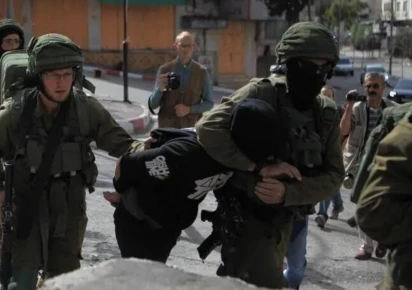
israeli forces detain
|

Israeli forces detain 48 Palestinians in West Bank raids

Israeli forces detained at least 48 Palestinians during raids across the occupied West Bank on Saturday, while eight Palestinians were reportedly injured in a separate attack, according to Palestinian sources and the Palestinian Red Crescent Society.

More than 40 young Palestinian men were detained during an ongoing military operation in the town of Tell, west of Nablus, Palestinian media reported.

Israeli troops reportedly took control of a residential building in the town and used it as a temporary interrogation facility. Raids and searches of homes were also reported across Tell, with forces reportedly surrounding the town from several directions.

The latest arrests came a day after Israeli authorities announced a large-scale military operation in Palestinian villages across the West Bank. The move followed an attack near the Havat Gilad settlement in which two Israeli soldiers were killed and three others were wounded.

Following the attack, Palestinian communities in the Nablus area reportedly came under further attacks. Local sources said homes and other Palestinian property were set on fire.

The Palestinian Health Ministry said four Palestinians were killed on Friday during violence involving Israeli forces and settlers in Tell.

Meanwhile, Israeli forces carried out additional raids in Jenin city and several surrounding communities before dawn, according to Palestinian reports. Troops searched homes and detained five Palestinians in the governorate as military activity continued in several locations.

Three more Palestinians were reportedly detained in the Bethlehem governorate.

In a separate incident in the northern West Bank, the Palestinian Red Crescent Society said eight Palestinians were injured during an attack in Farata village, east of Qalqilya. Six of the injured were reportedly struck by live ammunition.

Similar Posts

  • |

    Right-wing party proposes armed forces intervention to halt Channel crossings

    Reform UK has proposed an extensive military-led framework aimed at completely stopping small boat migration across the English Channel. The policy proposal outlines leveraging combined military and intelligence tracking technology to create a heavily monitored sea border, alongside granting emergency powers to armed forces to intercept vessels and push them back toward French territory. The plan includes expanding detention facilities to enable immediate offshore or domestic processing and deportation without eligibility for standard asylum routes. To facilitate these changes, the party stated it would pursue major legal shifts, including withdrawing the United Kingdom from the European Convention on Human Rights and replacing current national human rights legislation with a new domestic framework. Critics and legal scholars have questioned the feasibility of the measures, pointing out potential conflicts with international maritime agreements and international law. Meanwhile, Prime Minister Andy Burnham stated his administration would maintain a relentless focus on tackling immigration networks through increased enforcement and cross-border security cooperation.

  • | |

    Lahore CTO cracks down on traffic corruption

    Lahore Chief Traffic Officer (CTO) Abdul Rahim Shirazi has issued a strict warning to traffic wardens against corruption and misuse of authority. Shirazi said no traffic official would be allowed to demand money from citizens or become involved in illegal activities. He warned that anyone found guilty would face strict legal action. The CTO said some traffic officials had been involved in taking money from members of the public. He added that officials accused of such practices were being arrested. Shirazi issued a particularly strong warning against extortion. He said if any traffic official demanded extortion from a citizen, he would ensure that a terrorism case was registered against the official. The traffic chief said he was deeply concerned over cases in which traffic personnel had faced extortion charges. He described such incidents as a source of embarrassment for the traffic department. He stressed that traffic wardens were responsible for enforcing traffic laws and facilitating citizens. They must not misuse their positions for personal gain. The CTO directed traffic personnel to perform their duties honestly and professionally. He made it clear that corruption, harassment and illegal demands would not be tolerated. He also warned officials that strict action would be taken against anyone found exploiting their authority. The department would continue monitoring the conduct of traffic personnel, he said. The warning comes as Lahore traffic authorities seek to improve public confidence in traffic enforcement. Officials are also under pressure to ensure that citizens are treated fairly during routine traffic checks and enforcement operations. Shirazi said the traffic department must maintain discipline and transparency. He stressed that officials involved in wrongdoing would be held accountable under the law.

  • EASA issues urgent advisory warning airlines to avoid Jordanian airspace

    The European Union Aviation Safety Agency (EASA) has issued a security bulletin urging commercial airlines to suspend all operations within Jordanian airspace. The safety agency highlighted an escalation in cross-border military strikes and ballistic missile trajectories as primary drivers behind the severe risks currently facing civilian flights in the region. The newly released directive instructs European carriers and EASA-authorized foreign operators to avoid the Amman Flight Information Region (FIR) across all flight levels. Alongside this new warning, EASA officially extended its existing airspace warnings for several neighboring Middle Eastern territories through August 31, 2026. According to official EASA statements, security conditions across the region have deteriorated rapidly since mid-July. The airspace over and around Jordan has become increasingly hazardous due to active kinetic military engagements, including drone deployments, ballistic missile transit, and the frequent activation of heavy air defense systems. The regulatory agency highlighted several critical factors endangering high-altitude commercial flights. The heightened operational state of regional air-defense units increases the probability that radar systems could accidentally target civilian airliners. Active aerial engagements create unpredictable hazard zones caused by mid-air missile interceptions, anti-aircraft fire, and descending shrapnel. Rapid combat developments often leave local aviation authorities without adequate time to issue timely rerouting orders or close vulnerable corridors. Because Jordanian authorities have not yet published definitive local flight restrictions or comprehensive safety mitigations, European regulators felt compelled to intervene directly to protect commercial flights. Jordan’s addition to the no-fly advisory list reflects a widespread expansion of flight restrictions across key aviation transit hubs in the Middle East. EASA had previously reinstated and strengthened safety advisories for several other nations and maritime zones following intensified conflicts involving U.S. assets and Iranian forces. The full list of airspaces currently subject to EASA’s strict operational warnings includes Jordan (Amman FIR); Iran, Iraq, and Lebanon; Bahrain, Kuwait, Qatar, and the United Arab Emirates; overwater corridors in the Gulf of Oman. All related advisories, which were previously scheduled to expire on July 29, have now been synchronized and extended until at least August 31, 2026. The decision to bypass Jordan forces international airlines to implement extensive flight path revisions. Carriers are diverting long-haul journeys around extended no-fly zones, leading to longer flight durations, increased fuel consumption and higher operating costs.  Also, the potential schedule shifts for passengers traveling along major international routes. EASA emphasized that all affected air operators must continuously track real-time Notice to Air Missions (NOTAMs) and conduct rigorous safety evaluations prior to dispatching aircraft near or around adjacent flight zones. European regulators stated they will continue to monitor regional security developments closely and modify their airspace guidelines as conditions evolve.  

  • |

    Kim Yo Jong warns Japan over expanding military power

    North Korea has issued a fresh warning to Japan, saying it could adopt new military measures in response to Tokyo’s growing defence capabilities. The statement came after Japan conducted a test of a US-made Tomahawk cruise missile, a move Pyongyang described as a serious security threat. Kim Yo Jong, the influential sister of North Korean leader Kim Jong Un, accused Japan of abandoning its traditional defensive military posture and moving toward offensive capabilities. In a statement released through North Korea’s state media, she claimed Tokyo is developing the ability to carry out pre-emptive strikes and military operations beyond its borders. She pointed to Japan’s recent Tomahawk missile launch from the Aegis destroyer Chokai in the Pacific Ocean, along with other missile tests and its participation in joint military exercises led by the United States in the Philippines earlier this year. Kim warned that North Korea would take additional military steps if Japan continued strengthening its armed forces. Although she did not specify what actions Pyongyang might take, she said Japan would face greater security risks as a consequence of its military expansion. The North Korean official also blamed the United States for supporting Japan’s military modernisation. She accused Washington of supplying Tomahawk missiles, upgrading Japanese naval vessels to operate the weapons, and backing missile tests, arguing that the US is encouraging policies that increase tensions in the region. According to Kim, Japan’s acquisition of long-range strike capabilities places North Korea and other neighbouring countries within potential missile range, raising concerns over regional stability. The latest remarks are part of a broader campaign by Pyongyang against growing security cooperation between the United States, Japan and South Korea. North Korean state media has repeatedly criticised joint military exercises and defence partnerships, describing them as provocative and a threat to peace on the Korean Peninsula. Regional analysts believe the statement is aimed at portraying Japan’s military modernisation as justification for North Korea’s continued weapons development. Experts also suggest the rhetoric could signal preparations for future military demonstrations, including missile launches or other strategic weapons tests, as Pyongyang seeks to reinforce its deterrence strategy amid rising regional tensions.

  • | | | |

    Saudi-led coalition hits Houthi military sites nea…

    The Saudi-led military coalition announced on Saturday that it had carried out precision strikes against Houthi military positions in Yemen’s Al Hudaydah governorate, saying the operation was aimed at neutralizing threats to commercial shipping in the Red Sea. In a statement, the coalition said the strikes targeted military sites linked to the Houthi movement and stressed that Al Hudaydah Port was not targeted during the operation. It added that all Yemeni ports remain open to maritime traffic and international shipping. According to the coalition, the destroyed targets were associated with activities that posed a threat to commercial vessels navigating the Red Sea, one of the world’s busiest maritime trade routes. Officials said the operation was part of ongoing efforts to safeguard regional security and ensure the uninterrupted flow of global trade. The coalition warned that it would continue to respond if Houthi forces carried out further hostile actions against shipping or Saudi interests. It also reiterated its commitment to protecting merchant vessels and the Kingdom’s strategic interests, saying military operations would continue whenever necessary to counter security threats. The latest strikes come amid heightened tensions across the Middle East, where attacks on commercial shipping have raised concerns among international maritime operators and governments. The Red Sea remains a vital corridor for global energy supplies and cargo traffic, making any disruption a matter of international concern. There was no immediate response from the Houthi movement regarding the coalition’s claims or the reported strikes. The situation in Yemen continues to be closely monitored, with regional and international observers warning that any escalation around key shipping lanes could have wider implications for global trade and security. Despite the latest military action, the coalition maintained that navigation through Yemeni ports and the Red Sea remains unaffected and commercial vessels can continue operating normally.

  • |

    PERA’s proposed training academy puts 200 acres of fertile farmland, homes and wildlife breeding facilities at risk

    CHAKWAL: A proposed training academy of the Punjab Enforcement and Regulatory Authority (PERA) near Kallar Kahar has sparked concern among local residents, farmers and wildlife conservationists, as the site selected for the project comprises around 200 acres of fertile agricultural land, several homes, livestock farms and wildlife breeding facilities. The Punjab government has allocated Rs6.786 billion for the construction of the PERA training academy near Kallar Kahar, while Rs10 million has reportedly been released for the current financial year.     The proposed site, located along the Kallar Kahar-Talagang Road, was selected despite the availability of alternative locations, raising questions about the decision to choose an area that is not only inhabited but also serves as an important habitat for wildlife. The move has also left local PML-N MNA Sardar Ghulam Abbas and officials of the Punjab Wildlife Department apparently unable to prevent the proposed construction at the selected site. For 91-year-old Dost Muhammad, who has spent his life overcoming hardships, the latest development has become a source of deep anxiety. His family of around 40 members, along with their livestock, now faces the prospect of eviction from their ancestral land following a recent demarcation carried out for the proposed academy.   A few days ago, Dost Muhammad and his sons were constructing a cattle shed on their land. However, they have now abandoned the work after officials from the Punjab Revenue Department marked the boundaries of the proposed site. According to a letter available with Minute Mirror, PERA had requested the deputy commissioner of Chakwal on June 9 to initiate the process of acquiring land at a “suitable location in the pleasant hilly area of Kallar Kahar” for the construction of its training academy.   Following the request of the PERA director general, the district administration identified 1,568 kanals, or approximately 200 acres, along the Kallar Kahar-Talagang Road. Residents say the demarcation was carried out without adequately considering that the land is fertile agricultural property and is home to around 20 families. The area also serves as an important habitat for wildlife and contains two wildlife breeding farms and a private game reserve. Dost Muhammad is not the only resident facing uncertainty. At least 19 other families living in the area are also reportedly at risk of losing their homes. The demarcation has also raised concerns among wildlife conservationists, as two breeding farms for urial, chinkara and partridge have reportedly fallen within the proposed project area. “We are six brothers. We purchased 24 kanals of land in 2018 and constructed our houses after obtaining a loan of Rs3 million under a scheme launched by Chief Minister Maryam Nawaz Sharif. Now our houses are facing demolition,” said Raja Mohammad Farooq, who recently completed construction of his house. The issue is particularly serious for farmers in the hilly Kallar Kahar tehsil, where cultivable land is already limited. “I own only four acres of land, from which I produce wheat for my family and fodder for my livestock throughout the year. My entire four acres have been included in the demarcated area. If the proposed academy is built on my land, where will I get wheat for my family and fodder for my livestock?” asked 62-year-old Ghulam Shabbir, a resident of Ratta village. Imtiaz Ahmed, who operates a cement-block plant and also keeps a flock of sheep, is similarly worried about his livelihood. “I sold four rams this year, but now my farm and plant are at risk of demolition,” he said anxiously. Malik Mukhtar Haider, who has been running a community-based conservation (CBC) initiative and two wildlife breeding farms for several years, said he had devoted his life to protecting wildlife and the natural environment. “I have spent my entire life working for the protection of wildlife and the natural environment, but the proposed construction of the PERA training academy has put my decades-long efforts at risk,” he said. Officials of the Punjab Wildlife Department have also expressed surprise over the selection of the site, questioning how an area serving as a wildlife refuge could have been chosen for the construction of a training academy. “The demarcated area is not only an important habitat for various wildlife species, including the rare Punjab urial, but also contains two breeding farms and flora and fauna that have been nurtured through more than two decades of sustained efforts,” Assistant Chief Wildlife Ranger Abid Hussain told Dawn. He questioned the rationale behind selecting the area and said the development appeared to undermine the conservation efforts being carried out by Malik Mukhtar Haider through his CBC initiative and breeding farms. “If government institutions themselves are bent on destroying wildlife habitats, then who will protect them?” he asked. Meanwhile, the district administration and local parliamentarians appear to have been unable to halt the proposed construction at the selected site. When contacted, Deputy Commissioner Chakwal Sara Hayat said the district administration had proposed three possible locations, but PERA had selected the present site. “We have to comply with the directions issued by the higher authorities,” she said. The proposed project has thus triggered a debate over the selection of public land for government infrastructure, with residents questioning why fertile agricultural land, inhabited settlements and an established wildlife habitat were chosen despite the reported availability of alternative sites.

Leave a Reply

Your email address will not be published. Required fields are marked *