poetry power 038

Poetry, Power & Humanity—VI  Baba Farid: D…

The intellectual discourse initiated by Sufi philosophers was inclusive of all religions and negated mullahism. Baba Farid is said to have been persecuted by Pakpattan’s qazi and the ruler of the city for listening to music and dancing in the mosque. Guru Nanak condemned the ritualism of mullahs and the punditsOur distorted intellectual discourse, Dawn, September 9, 2011 

Our discussion of Waris Shah ended with Erich Fromm’s distinction between having and being. Heer’s family sought to have honour, status, alliances and authority over a daughter; Heer and Ranjha sought a relationship grounded in recognition rather than possession. Their tragedy arose because a possessive social order could not tolerate human beings who refused to behave as property.

To take that argument further, we must now travel backwards nearly five centuries before Waris Shah, to the beginnings of the surviving Punjabi poetic tradition and to Baba Farid (Hazrat Fariduddin Ganjshaka). Najm Hosain Syed places Farid at the opening of that tradition. What distinguishes his dohras, Najm writes, is an “austerity of tone”. Their setting is not an imaginary spiritual landscape but the “daily experience of common man”: fields, bread, dust, ageing bodies, hunger, labour and death. That austerity is precisely why Farid speaks so forcefully to an age obsessed with accumulation.
Fromm, writing in To Have or To Be?, contrasted two orientations towards existence. The having mode seeks security through possession, accumulation and control; the being mode locates fulfilment in living, loving, sharing and becoming. Farid inhabited an entirely different intellectual and spiritual universe, and it would be anachronistic to turn him into a medieval Fromm. The convergence lies elsewhere. Both question the assumption that what we possess tells us what we are.

Farid begins with the most democratic substance imaginable: dust.

Dust

Shahmukhi Roman Punjabi Literary English translation
فریدہ خاکُ ن نندیئ خاکو جیڈُ ن کوئِ
جیودیاں پیراں تلے مویاں اپرِ ہوئِ
Farida khaak na nindiye, khaako jed na koi
Jeevandeyan pairan talle, moyan upar hoi
Farid, do not despise the dust; nothing stands above it.
In life it lies beneath our feet; in death it lies above us.
 

The surviving Shahmukhi text preserves the couplet in this form.

Few lines dismantle hierarchy more economically. The earth beneath the rich man’s shoe and the poor labourer’s bare foot is the same earth that eventually covers both. Rank, office, lineage, property and beauty exist for a moment between two encounters with dust.

Farid is not preaching passivity before injustice. His image destroys the metaphysical arrogance on which inequality depends. Human beings may create distinctions of caste, wealth and status, but mortality refuses to recognise them. The person who imagines himself elevated above another discovers that both occupy the same final ground.

This is Farid’s first challenge to the mode of having. We spend our lives converting temporary control into imagined permanence: my land, my wealth, my title, my family name, my influence. Dust reveals the grammatical error. We possess these things temporarily; they do not belong to the essential self.

Farid’s poetry becomes even more striking when it turns from mortality to material inequality.

Flour for Some, Not Even Salt for Others

Shahmukhi Roman Punjabi Literary English translation
فریدہ اکناّ آٹا اگلا اکناّ ناہی لونُ
اگے گئے سننجاپسنِ چوٹاں کھا سی کؤنُ
Farida ikna aata agla, ikna nahi loon
Agge gaye sanjhaapsan, chotan khaasi kaun
Farid, some have flour in abundance; others do not even have salt.
Beyond this life it will become known who must answer for the blows.

The text occurs among the saloks attributed to Farid. This is not abstract mysticism. It is an observation about distribution.

One household possesses abundance; another lacks even the simplest accompaniment to bread. Farid does not construct an economic theory from the disparity, but neither does he treat it as morally neutral. The second line introduces accountability. Unequal possession cannot be separated from the question of how human beings acquired, used and withheld what passed through their hands.

This is an important corrective to a frequent misuse of spirituality. Poverty should never be romanticised simply because a saint practiced austerity. There is a profound difference between voluntary simplicity and involuntary deprivation. Farid could choose restraint as spiritual discipline; the person without salt may have no choice at all. His famous imagery of coarse bread makes the distinction clearer:

فریدہ روٹی میری کاٹھ کی، لاونُ میری بھکھ

His bread is hard and hunger itself becomes its relish. In the following couplet, he advises eating simple food and drinking cool water without tormenting oneself by staring enviously at another person’s richer meal.

The ethical target is excess desire, not nourishment. A society in which some cannot meet basic needs while others define themselves through conspicuous consumption cannot use Farid to sanctify deprivation. His poetry asks the possessor to examine himself before asking the deprived to accept their condition.

Here the relationship with Fromm becomes especially productive. The having mode is not merely ownership of useful things. Human life requires food, shelter, tools and security. The pathology begins when possession becomes identity—when having more means believing oneself to be more.

Farid’s answer is sabar: steadfastness, restraint, patience and sufficiency. His surviving corpus repeatedly returns to simplicity, humility and control of appetite. In contemporary political economy, however, restraint cannot be demanded only from those who possess least. An ethic worthy of Farid must speak first to those with the greatest capacity to accumulate, consume and command.

His social imagination reaches its deepest point when personal suffering becomes recognition of universal suffering.

The Fire in Every House

Shahmukhi Roman Punjabi Literary English translation
فریدہ میں جانیا دکھ مجھ کوُ دکھ سبائے جگِ
اُچے چڑھِ کے دیکھیا تاں گھرِ گھرِ ایہا اگِ
Farida main jaania dukh mujh ko, dukh sabhaai jag
Uchche charh ke dekhia, taan ghar ghar eha ag
Farid, I thought suffering belonged to me alone;
I climbed higher and saw the same fire burning in every home.

The couplet is preserved in the Farid saloks, and one modern scholarly discussion sees precisely this capacity to absorb the suffering of ordinary people into Farid’s own consciousness as central to his poetry.

This is a remarkable movement of consciousness. Pain first appears private: my grief, my hunger, my loss. Farid then climbs metaphorically to a vantage point from which individual suffering becomes social knowledge. Every house is burning.

His age had known displacement, conflict and insecurity across northern India, Afghanistan, Iran and Central Asia. One study of Farid’s poetry connects his severe vision of earthly existence with that wider world of upheaval and the suffering of ordinary people.

Our century does not need medieval invasions to reproduce the same fire. Debt, displacement, unemployment, war, ecological breakdown, loneliness and extreme inequality can leave millions experiencing what initially feels like personal failure.

The debtor thinks his humiliation is his alone. The unemployed youth regards exclusion as a private deficiency. The family unable to meet food or energy costs suffers behind its own walls. Farid asks us to climb higher.

Once we do, what appeared to be isolated suffering reveals structures. Personal distress may have social causes; hunger can coexist with abundance; insecurity may flourish beside extraordinary concentration of wealth. Compassion therefore requires more than charity. It demands that we see the fire connecting one household to another.

Farid’s humanism also refuses vengeance. In another famous salok he urges:

فریدہ برے دا بھلا کرِ غصہ منِ ن ہڈھائ

Return goodness for evil; do not allow anger to take possession of the mind.

This is not submission to oppression. Anger can alert us to injustice. Farid’s concern is what sustained hatred does to the person who carries it. If the struggle against domination reproduces the moral psychology of the dominator, liberation remains incomplete.

The deepest political meaning of Farid lies neither in a programme of government nor in an economic blueprint. It lies in the anthropology beneath both.

What is a human being?  Not the estate he controls. Not the food he can display while another goes hungry. Not the lineage through which he claims superiority. Not even the body whose strength and beauty inevitably return to dust.

The human being is revealed through humility, restraint, compassion, accountability and recognition of suffering beyond the self.

The surviving Farid Bani itself crossed boundaries that later politics hardened. The corpus attributed to the Muslim Chishti saint was preserved in the Sikh scripture; scholars also acknowledge unresolved questions about its transmission and precise authorship over the centuries.

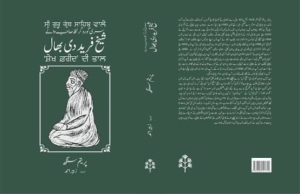
Whatever those textual debates ultimately yield, the historical fact of preservation carries its own civilisational significance: Punjab’s spiritual inheritance could not easily be confined within the religious compartments later generations constructed. For detail discussion on this subject, read monumental academic and historical research work, ‘Sri Guru Granth Sahib Wale Sheikh Farid Di Bhaal (In Search of the Sheikh Farid of the Guru Granth Sahib) by Professor Pritam Singh, converted  in Shahmukhi for Pakistani readers by renowned Punjabi writer and thinker Professor Zubair Ahmad, and published by Kitab Trinjan, Lahore.
Waris Shah showed us a society trying to possess Heer. Bulleh Shah stripped away the identities through which society possesses the individual. Baba Farid, standing near the beginning of the surviving Punjabi poetic tradition, takes us deeper still.

Farid reminds us of that possession itself is temporary, that inequality carries moral accountability, and that suffering ceases to be merely private once we acquire the vision to see the fire burning in every home.

Everything we imagine ourselves to have ultimately passes from our hands. What remains is what we managed to be. Beneath our palaces, borders, inherited privileges, titles and accumulated wealth waits the same patient dust.

Part VII will turn to Sultan Bahu and the struggle between outward religiosity and transformation of the inner self.

[To be continued]

________________________________________________________________

Dr. Ikramul Haq, Advocate Supreme Court, writer, literary critic, Adjunct Faculty at Lahore University of Management Sciences (LUMS), member Advisory Board and Visiting Senior Fellow of Pakistan Institute of Development Economics (PIDE), holds an LLD in tax laws. He was full-time journalist from 1979 to 1984 with Viewpoint and Dawn. He also served Civil Services of Pakistan from 1984 to 1996.


Similar Posts

  • Where Innovation Counts

    A couple of years back I was travelling from Karachi to Lahore after visiting some research institutions. The person sitting next to me was a federal minister. He asked me if I had been to the museum at Mohenjo Daro and seen the bullock cart on display there. To this day, the same cart is being used in the villages of Sindh with hardly any upgradation or improvement. His remarks were startling. Despite our advancements and research, the ground realities remain grim in the land of the pure. As a child growing up on the Mall very close to the Punjab University Old Campus, I have fond memories of real-time research being carried out by our scientists. Dr Niaz Ahmed, Director, Institute of Chemical Engineering and Technology, worked around the clock to upgrade the Kalabagh Iron deposits. He developed the Tanvir-Niaz process to extract iron from a low-grade deposit. Next door in Government College was Dr Sultan, the biologist, sitting on his charpoy working late hours. Dr Nazir Ahmed, the famous zoologist who rose to be the principal of the esteemed institution, worked in the zoological gardens of the college next to the zoo on the Mall. Dr Rafi Chaudhry established the first High Tension Physics laboratory in Asia. Dr Abdul Salam, the Nobel Laureate, was his student. The University of Agriculture was not too far behind, transferring its research to the farmers through its extension program. Slowly but surely, the republic was working towards technological self-reliance and food self-sufficiency. There was no external debt. By and large, corruption was contained. Institutions were strong. Order prevailed in the country. The founding fathers understood their responsibilities towards nation building. Despite initial hiccups, the nation remained on track. Through PIDC (Pakistan Industrial Development Corporation), steel was produced from the Kalabagh iron ore using the German Krupp-Renn process. A pilot plant was set up at the site to first upgrade the ore, followed by its conversion to steel. For demonstration purposes, VW cars were produced from this steel. The brilliant engineer C.M. Latif, whom I consider to be the Tata of Pakistan, established BECO (Batala Engineering Company), which was ahead of its time. Comrade Chou-En-Lai visited the plant in Kot Lakhpat during his visit to Pakistan in the early sixties. Both BECO and Ittefaq Foundry were nationalized in the seventies. The government of Zia-ul-Haq decided to denationalize both. While Ittefaq (LEFO then) was handed over to the Sharifs totally free of financial liabilities, BECO (PECO then) was not given this option. C.M. Latif refused to accept the liabilities. The Sharifs sold the land of the foundry, while PECO still stands there as a liability instead of an asset, which at one time it was. It is widely believed that the people of Pakistan are very innovative. A term “Jugaad” is used, which means to find a desi, out-of-the-box solution with minimal resources. In my personal experience, I have interacted with very able ‘Mistris’ (technicians) and theoretically able engineers and scientists who work well on paper but with limited practical application. The link between the hands and the mind is not there. Nations rise by applying their indigenous know-how. Technology is the strongest resource of our times, and its advancement and commercialization hold the key. For self-sufficiency in food, the manufacturing of agri-equipment at Daska needs technological advancement to mechanize the farms. A few years back, PAEC (Pakistan Atomic Energy Commission) developed laser land levelers for better utilization of water. The technology could have reached the farmers through Daska, but it did not. Orders have started to pour in for our armaments, which is a good sign, but massive re-organization with commercial discipline will be required for maximum utilization of the huge investments (around $20 billion) in this sector. There is a famous American saying: “The test of rubber is when it hits the road.” Similarly, the test of innovation is when it sells in the marketplace; otherwise, it remains an intellectual curiosity only, which developing nations cannot afford.

  • A Nation in Focus: The Social Contract and the Mak…

    (When the water rises, who shows up and who is left waiting?) ‎I live in Sabzazar, a neighborhood in Lahore, Pakistan, but part of my heart is always sitting along the banks of the Moxahala Creek back home in Southeast Ohio. When the water rises in Muskingum County or the Punjab plains, who shows up, and who is left waiting? I live in Sabzazar, a neighborhood in Lahore, Pakistan, but part of my heart is always sitting along the banks of the Moxahala Creek back home in Southeast Ohio. ‎ ‎My mother and brother still live right near South Zanesville, just a stone’s throw from Crooksville. When heavy rains hit Perry and Muskingum counties, I don’t need to be there to know what it looks like. I can picture the heavy, chocolate-brown water backing up into the low spots, the damp chill that settles into a basement, the fears of what if the waters reach a house trailer, and that specific, exhausting smell of river mud that takes weeks to scrub out of porch boards and carpet. The worries of if the home has structural damage.. Halfway across the world in Pakistan, the landscape couldn’t look more different. But when monsoon season swells the rivers across the Punjab, the view from the ground is hauntingly identical. ‎ ‎Standing in a flooded doorway feels the same whether you are in Ohio or Lahore. The quiet shock is the same. The ruin of things you worked years to buy is the same. And the very first instinct is to grab your coat, shovel, a chainsaw and a pair of boots and go check on the elderly woman next door.. Start hauling wet furniture, debris to the curb and giving comfort, food and basics to those in need is entirely universal. Watching both worlds at once makes you look at governance differently. It strips away abstract political jargon and leaves you asking one fundamental question: When a community is hit with a crisis, does its system build capable people who can act, or does it leave them sitting on their hands, waiting for permission to survive? ‎ ‎What a Small Ohio Village Taught Me About Governance ‎ ‎Growing up around South Zanesville and Crooksville, you learn pretty early that small-town life relies on a very specific kind of quiet, distributed agency. ‎Crooksville isn’t a rich town. It’s a hard-working Appalachian village of under 1,500 people. But when the creek overflows, nobody sits around waiting for a press conference out of Washington, D.C., or a mandate from the state capital in Columbus. ‎ ‎The response moves in waves because the connections are already wired: ‎On the local levels we see neighbor checks on neighbor. The volunteer fire department turns on the sirens, pulls out the high-water gear, and starts the door to door knocks. At the County level we have the Perry County 911 dispatch and Emergency Management Agency (EMA) start tracking water levels and routing equipment where it’s needed most. At the State level, If the county gets overwhelmed, pre set legal triggers immediately call in the Ohio EMA or the National Guard. ‎ ‎Government here doesn’t replace the community’s instinct to help itself; it validates it, organizes it, and backs it up with real resources. The system trusts the people on the ground to know their own roads. Here in Pakistan, the human spirit is just as generous, if not more so. The impulse toward hospitality, neighborly charity, and mutual support runs incredibly deep. When disaster strikes, ordinary citizens open their wallets and their homes without a second thought. It’s just what they do… ‎ ‎And Pakistan’s has one of the world’s top class military engineering, a massive national disaster agency (the NDMA), and incredible private charities. The raw capacity is immense. Yet, too often, there is a however a very heartbreaking disconnect between that high-level power and the family standing in ankle deep water in a local neighborhood. An ordinary citizen here once described the country to me using a metaphor I’ve never forgotten: a child that was never allowed to stand on its own feet. An infant isn’t helpless because it lacks potential. It’s helpless because it hasn’t been given the space to build muscle, fall over, adjust its balance, and try again. If an authority figure picks the child up every single time it tries to pull itself up, the child never learns to walk—not from a lack of ability, but because the environment denied it the chance to build strength. ‎ ‎That is how systemic learned dependency takes root: Central authorities assume total control, bypassing local municipal councils. Neighborhoods are given no real budget or authority to fix their own drainage or organize local response teams. And when a flood comes, citizens have no choice but to wait for distant, top-down relief. The authorities look at the waiting crowd and say, “See? The people can’t manage without us.” ‎We witness power centralized even further, deepening the exact helplessness it claims to fix. Over generations, people adapt to the system they are given. If a system rewards waiting for a political patron, people learn to wait for patrons. If it rewards local initiative, communities build habits of self-reliance. It is very easy to blame culture or public apathy for civic passivity, but that misses the point entirely. Culture simply reflects the structural incentives people are given to survive and adapt. It is nature vs nurture and we have a break down when these two things fail to promote a cohesiveness and inclusion of what is a community and what that actually means. ‎ ‎Across the globe, the relationship between state control and citizen participation varies wildly, proving that central authority does not have to mean public powerlessness. In China, a deeply centralized state framework actively structures and expects local neighborhood committees and civil volunteer groups to manage community-level crises. Across much of Europe, comprehensive state safety nets exist alongside highly empowered municipal councils and professionalized local volunteer forces.

  • 79 Years of Independence and What Went Wrong with …

    On 14 August 1947, Pakistan emerged as a new country with enormous challenges but also extraordinary potential. Seventy-nine years later, the question is not whether Pakistan has achieved anything, it certainly has, but why a country that began with comparable hopes to many newly independent nations has struggled to convert its human and natural potential into sustained prosperity, strong institutions and a secure future. The comparison becomes uncomfortable when we look at countries that began their modern journeys around the same period. Singapore became self-governing in 1959 and independent in 1965. Bangladesh became independent in 1971 after emerging from the same Pakistan that had been created in 1947. Taiwan’s post-war transformation accelerated from the 1950s onward. South Korea, independent since 1948, also started from extraordinary hardship. Their histories are very different from Pakistan’s, so simplistic comparisons would be unfair. Yet they demonstrate one important principle, institutions, continuity, human capital and economic strategy can transform countries even when starting conditions are difficult. Bangladesh is perhaps the most striking comparison because it began as the poorer and more politically disadvantaged wing of Pakistan. In 1971, its future looked extremely uncertain. Today, Bangladesh’s nominal GDP per capita is substantially higher than Pakistan’s, the World Bank reports about $2,593 for Bangladesh compared with about $1,479 for Pakistan in 2024. Bangladesh’s total GDP has also grown larger than Pakistan’s despite having a much smaller land area according to world bank open data. Singapore represents an entirely different model. A small island with few natural resources, it concentrated on competent administration, education, trade, infrastructure, investment and institutional discipline. Its 2024 GDP per capita was approximately $90,674, compared with Pakistan’s approximately $1,479. World bank open data says. Taiwan and South Korea followed another path, export-oriented industrialisation, investment in education and technology, strong state capacity and, eventually, increasingly democratic institutions. These countries did not become successful because their people were inherently more capable than Pakistanis. They created systems that allowed capability to produce results. So what happened to Pakistan? The first failure was institutional continuity. Pakistan spent much of its history moving between civilian governments, military rule, political confrontation and constitutional crises. Instead of allowing institutions to mature, every political transition often became a struggle over who controlled the state. The second failure was the weak rule of law. A country cannot become prosperous when laws are applied selectively, institutions are politicised and citizens do not have equal confidence in justice. Democracy is not merely the holding of elections, it requires constitutional supremacy, independent institutions, accountable government and protection of fundamental rights. The third failure was education and human capital. Pakistan has a huge young population, yet education has too often remained underfunded, unequal and disconnected from the needs of a modern economy. Countries that transformed themselves invested heavily in the quality of their people. Pakistan has frequently treated education as expenditure rather than as the country’s most important investment. The fourth failure was economic inconsistency. Pakistan repeatedly moved between economic models without developing a stable, long-term national strategy. Political governments changed priorities, economic crises produced short-term fixes, dependence on external financing repeatedly returned. Meanwhile, countries such as Bangladesh built globally competitive export sectors, particularly garments, while East Asian economies moved aggressively into manufacturing, technology and high-value exports. The fifth failure was population planning and social development. Pakistan’s population has grown enormously, while economic growth has not consistently kept pace with the needs of its people. The World Bank’s latest figures show Pakistan with a life expectancy of around 68 years, compared with 75 years in Bangladesh and 83 years in Singapore. The sixth failure has been our inability to build a culture of accountability without political revenge. Accountability is essential, but when it becomes a weapon used selectively against political opponents, it destroys trust rather than strengthening the state. The seventh and perhaps deepest failure is that Pakistan repeatedly confused national security with national development. Security is essential, but a nation’s ultimate security comes from educated citizens, a productive economy, social cohesion, constitutional government and opportunities for its young people. Pakistan’s people, however, did not fail Pakistan. Pakistanis have demonstrated remarkable resilience. They built businesses, universities, industries, hospitals, technology companies and a vast overseas community. Millions of Pakistanis work abroad and send billions of dollars home. In 2024, remittances were equivalent to about 9.4% of Pakistan’s GDP, according to the World Bank. The real tragedy is that the capacity of the Pakistani people has repeatedly been greater than the capacity of the systems governing them. Independence was supposed to mean more than freedom from colonial rule. It was supposed to mean dignity, justice, representation and opportunity. After 79 years, Pakistan therefore needs a different question. Not who is responsible for our problems? but what kind of state do we want to become? The answer cannot be another political slogan or another temporary economic package or presidential system of government . Pakistan needs constitutional supremacy, civilian and institutional stability, independent justice, free media, serious investment in education and health, economic continuity, women’s participation in the workforce, export-led growth, technological development and genuine local governance. The comparison with Bangladesh, Singapore, Taiwan and South Korea should not produce humiliation. It should produce reflection. We began with a dream. The unfinished task of Pakistan’s next generation is to turn that dream into functioning institutions, human development and dignity for every citizen. Seventy-nine years after independence, perhaps the most patriotic thing Pakistanis can do is not merely celebrate the birth of the country, but honestly ask why the promise of 1947 has still not reached every Pakistani.

  • The Great Tragedy of Partition—VIII Mountbatten,…

    The legality of a constitutional settlement cannot compensate for the absence of time, preparation and protection required to implement it The collapse of the Cabinet Mission Plan did more than extinguish the last comprehensive attempt to preserve a united India. It transformed a constitutional dispute into an administrative and humanitarian emergency. Indian National Congress proceeded with the Constituent Assembly, the Muslim League withdrew its acceptance of the Plan, and political distrust increasingly gave way to confrontation. Communal violence spread across different parts of India, demonstrating that the approaching transfer of power could no longer be treated simply as an exercise in constitutional drafting. By the beginning of 1947, Britain had reached a decisive conclusion. Its rule in India could not continue indefinitely, while no constitution acceptable to all the principal political parties had emerged. On February 20, 1947, Prime Minister Clement Attlee announced that British authority would be transferred to Indian hands no later than June 1948. The statement also acknowledged that, in the absence of an agreed constitution, Britain would have to determine whether power should pass to a central authority, provincial governments or some other arrangement. The possibility of more than one successor authority had now entered official policy. Lord Louis Mountbatten arrived as the last Viceroy in March 1947 with a mandate to supervise this transfer. He inherited a political order already close to collapse. The Cabinet Mission framework had ceased to command common confidence, the interim government was paralysed by rivalry between Congress and the Muslim League, and communal violence had exposed the fragility of provincial administration. Mountbatten’s task was not to negotiate within a stable constitutional environment. It was to construct a settlement while the institutions through which it had to be implemented were rapidly disintegrating. The central question was whether the deadline of June 1948 provided sufficient time to undertake an orderly transfer or whether delay would deepen violence and political uncertainty. Mountbatten chose acceleration. On June 3, 1947, the British Government announced a plan under which British India could be divided and power transferred to two successor governments. Punjab and Bengal would decide whether they should themselves be partitioned; separate constituent assemblies could emerge; and referendums would determine the future of the North-West Frontier Province and the Sylhet district of Assam. The date for transfer was brought forward from June 1948 to August 1947. The acceleration was defended as a response to deteriorating conditions. British authority was weakening, communal violence was spreading and the principal political parties had accepted that Partition had become unavoidable. Mountbatten and his supporters believed that a definite and immediate date would end uncertainty and compel the parties to assume responsibility. The opposing view deserves equal attention. A constitutional transformation of such magnitude required the division of provinces, armed forces, civil services, financial assets, railways, irrigation systems, records and administrative institutions. It required the establishment of two governments and the settlement of territorial boundaries affecting millions of people. Compressing this process into a few weeks inevitably reduced the time available for administrative preparation, security arrangements and the protection of vulnerable communities. The question is therefore not simply whether British withdrawal had become inevitable. It plainly had. The more difficult question is whether the decision to advance the transfer by approximately ten months converted political urgency into administrative recklessness. The Indian Independence Act received Royal Assent on July 18, 1947. It provided that two independent Dominions—India and Pakistan—would be established from August 15, 1947. It partitioned Punjab and Bengal, empowered the respective constituent assemblies to legislate for the new Dominions and terminated British responsibility for governing India. Parliamentary sovereignty, exercised from London for generations, legislated itself out of the subcontinent in an extraordinarily compressed period. The legal instrument was concise. Partition was not. An Act of Parliament could establish two Dominions, confer legislative authority and terminate imperial jurisdiction. It could not divide villages, canals, railway lines, police forces, military units, families and centuries of shared social existence with comparable simplicity. Constitutional law could provide a date for independence, but it could not by itself produce the administrative capacity necessary to manage the consequences of territorial division. The most visible illustration of this haste was the work of the Punjab and Bengal Boundary Commissions. Sir Cyril Radcliffe was appointed to chair both bodies and was required to determine the boundaries separating Muslim-majority and non-Muslim-majority areas. The task involved densely populated territories in which religious communities, agricultural systems, transport networks and commercial centres were deeply interwoven. He was given only a matter of weeks to complete it. Punjab and Bengal could not be divided by applying census figures mechanically. District-level majorities concealed substantial minorities, while economic and geographic considerations frequently pointed in directions different from religious demography. Rivers, irrigation headworks, railways and markets crossed the proposed boundaries. Sikhs were particularly vulnerable in Punjab because their population, landholdings and sacred places were distributed across areas claimed by both successor states. The commissions were expected to resolve these questions while political authority was itself being divided. Their members were nominated from opposing political sides and were unable to agree on many decisive matters. The ultimate responsibility therefore rested with Radcliffe, who was required to draw boundaries under extraordinary pressure and with limited opportunity for local investigation. More troubling was the timing of publication. The boundary awards were made public on August 17, 1947, after independence ceremonies had already taken place. Large populations in Punjab and Bengal consequently entered independence without knowing with certainty on which side of the new international frontier they would fall. The delay may have been intended to prevent the boundary controversy from overshadowing the independence celebrations or provoking immediate disorder. Its effect was to deepen uncertainty at the precise moment when administrative clarity was most urgently required. Officials responsible for security, local government and transportation had little time to prepare for the territorial consequences. Ordinary people were left to respond to rumour, fear and rapidly changing political realities. No law expressly ordered a complete exchange of populations between India

  • The Unleashed Furies

    This 14th of August, as the green and white flags go up from Karachi to Khyber and the air fills with the crackle of fireworks, there is a question every young Pakistani must ask themselves: what exactly are we celebrating? Is it merely the fact that a nation was born at the stroke of midnight 79 years ago? Or is it something far more demanding — the unfinished promise of that birth, the dream that millions carried across blood-soaked borders, the conviction that Pakistan would be not just a homeland, but a beacon? Nisid Hajari’s book Midnight’s Furies does not let us off easy. It drags us back to the raw, unvarnished truth of 1947 — and in doing so, it hands our generation something precious: the tools to understand who we are, where we came from, and what we still owe to those who paid the ultimate price for our freedom. Hajari wrote that on 9 August 1947, a train pulls out of Delhi bound for Karachi, 800 miles away. Onboard are Muslim clerks and officials who had served the British-run government of India with distinction. With them are their families, their ribbon-tied files, their children’s toys, their prayer rugs, and the gold jewellery that represented their life’s savings. They are not refugees fleeing in panic. They are pioneers, volunteers for a great experiment — the world’s first modern Muslim nation. As the train whistles out of Delhi, cheers of “Pakistan Zindabad!” drown out the engine. These men and women believe they are building something unprecedented. Something magnificent. They never arrive. Sikh saboteurs — soldiers in all but name, their tiny community having supplied the Indian Army with fighting men far beyond their numbers — have laid gelignite charges along the tracks. The mine detonates. The Pakistan Special shudders. And in that moment, the euphoria of independence meets the savagery of Partition. Hajari, who spent over a year buried in archives across New Delhi, London, and Washington, D.C., reconstructs this tragedy not from myth but from the “demi-official record” — the diaries, army sitreps, embassy cables, and informant reports that tell the real story. And the real story is this: Pakistan was born not in a garden of roses, but in a furnace. The arithmetic of that furnace defies comprehension. One British official, working from casualty reports, put the dead at 200,000. Others, accounting for disease, starvation, and exposure, insist the figure exceeds one million. At least 14 million people were uprooted — the largest forced migration in human history. Western Pakistan was virtually emptied of Hindus and Sikhs; Indian Punjab lost almost all its Muslims. This was carnage on a scale unseen until Rwanda 1994. Yet here is what Hajari forces us to confront: the killing lasted only six weeks. The violence was contained. What was not contained — what metastasised — was the psychological wound. In those weeks, something broke between India and Pakistan that has never been repaired. Leaders on both sides began suspecting each other of complicity in genocide. Mutual mistrust pushed infant nations to war within a year. And Pakistan, flooded with refugees, its economy and bureaucracy teetering on collapse, developed what Hajari calls a ‘deep-seated paranoia’ about its larger neighbour that shapes our politics to this very day. Hajari’s book is unsparing about the failures of leadership that turned Partition’s trauma into perpetual conflict. Nehru and Jinnah — the very architects of freedom — allowed vanity, prejudice, and petty dislike to poison the well. Nehru’s reckless declaration in August 1946 that a strong government would make the Muslim League’s movement “go down” — what Viceroy Wavell called tossing “a match onto dangerously dry kindling” — helped trigger the Great Calcutta Killing, the dress rehearsal for Partition’s horrors. Five thousand dead. Ten to fifteen thousand maimed. The Statesman newspaper, grasping for words, called it “a fury” — a word from mediaeval history. This Independence Day, let us do something radical. Let us honour the dead not by reliving their fears, but by fulfilling their hopes. Jinnah’s address to the Constituent Assembly on 11 August 1947 was crystal clear: ‘You are free; you are free to go to your temples, you are free to go to your mosques or to any other place of worship in this State of Pakistan.’ He envisioned a secular nation where religion was private, not political. Where Hindus, Muslims, Sikhs, and Christians would be equal before the law. Where the state would be a servant of all its citizens, not a weapon of the majority. Hajari’s book ends on a note of hard-won wisdom: ‘Only once those mistakes are properly understood and acknowledged, perhaps, will India and Pakistan begin to bridge the vast and dangerous gulf that still divides them.’ Understanding does not mean surrender. Acknowledgement does not mean apology. It means maturity. It means the confidence to say: we know our history, we honour our sacrifices, and we refuse to let the furies of 1947 dictate our future. So when the flag goes up this 14th August, let it mean something new. Let it mean that Pakistan is done being defined by what it fears. Let it mean that we are ready to be defined by what we build — by our universities and our hospitals, our clean rivers and our fair courts, our poets and our scientists, our daughters who dream without limits and our sons who know that strength comes from justice, not just arms.

  • Beyond Public Finance: Towards Constitutional Poli…

    The Part VI of this series argued that Pakistan cannot escape dependency merely by improving tax administration. Better value added taxation, digital integration and fiscal coordination are necessary, but they cannot substitute for constitutional restraints, accountable government and dismantling of systems of privilege. The same intellectual caution must be applied to the history of economic thought. Conventional accounts often move from Greek philosophy to European scholasticism, mercantilism, Adam Smith and modern economics, leaving several centuries of Muslim intellectual activity in an unexplained gap. This omission creates the false impression that systematic thinking about taxation, markets, money, public expenditure, state responsibility and economic justice developed almost exclusively in the West. Muslim scholars did not describe their work as “economics” in the modern sense. Economic questions appeared within jurisprudence, ethics, administration, history and political philosophy. Imposing contemporary categories upon them would be anachronistic. Excluding their contributions from the history of economic ideas is equally indefensible. Modern scholarship has documented a substantial body of Muslim economic thought that conventional textbooks have frequently overlooked. The purpose is not to replace a Western monopoly with a Muslim one. Knowledge has always travelled across cultures as common heritage of mankind. Muslim thinkers drew upon Islamic sources, practical experience and Greek, Persian, Roman and Indian traditions. Their works were subsequently transmitted, debated and transformed in other intellectual settings. The proper objective is to restore missing pages to a shared human history. One of the earliest important works on public revenue was Abu Yusuf’s Kitab al-Kharaj. It did not treat taxation as a ruler’s unrestricted right to maximise extraction. Tax liability had to take account of productive capacity, conditions of the land and the taxpayer’s ability to bear the burden. Abu Yusuf preferred proportional agricultural taxation where a fixed assessment would become oppressive in a poor harvest and unduly favourable during exceptional production. He insisted that collectors should be honest, collection economical and taxpayers treated justly. He opposed arrangements capable of turning revenue collection into tyranny and also emphasised irrigation, transportation and other infrastructure necessary for production. This was more than tax administration. It was an early recognition that revenue depends upon institutions, incentives and the conduct of public officials. A tax may be lawful in form and oppressive in operation. The character of the collector, method of assessment and use of revenue are therefore integral to the legitimacy of taxation. Pakistan’s fiscal debate still struggles to absorb this elementary insight. In the Land of Pure, tax laws are judged by the amounts they collect, while blocked refunds, arbitrary demands, compliance costs and damage to productive capacity are treated as secondary matters. Revenue obtained by weakening the taxpayer is celebrated as administrative success. Abu Yusuf’s approach reverses the perspective: the state must preserve the source from which sustainable revenue arises. Al-Ghazali examined markets, exchange, specialisation, division of labour, money and the interdependence of economic activities. He explained that production of even an ordinary item required the cooperation of numerous workers performing specialised functions. His examples involving bread and needle-making appeared centuries before Adam Smith’s famous pin factory. He also recognised that markets emerge from mutual need and voluntary exchange, while public authority remains necessary to maintain justice and prevent harmful practices. Economic development was not separated from education, security, infrastructure and public welfare. Prosperity, justice and legitimate political authority formed parts of an interdependent social order. This understanding is richer than the artificial contest often presented between state and market. Markets require rules, trust, reliable money and protection against fraud. The state must provide these conditions without converting regulation into a mechanism for distributing arbitrary favours. Ibn Taymiyyah similarly distinguished between price increases produced by changes in supply and demand and those caused by injustice, hoarding or monopoly. Not every increase in price justified administrative interference. Market forces had to be understood before intervention was attempted. Intervention became necessary where concentrated power allowed monopolists to exploit the public. Ibn Taymiyyah therefore combined recognition of market mechanisms with restraint upon abuse—an approach far removed from both indiscriminate price control and unregulated private coercion. Pakistan repeatedly swings between these extremes. Governments interfere through administered prices, selective subsidies and discretionary regulation, while tolerating cartels, protected industries and barriers to competition. The result is not a free market or an effective developmental state. It is a negotiated market in which access to authority frequently determines economic advantage. Al-Maqrizi’s analysis of monetary debasement and inflation provides another striking antecedent. Writing in the context of monetary disorder, scarcity and maladministration, he connected the excessive issue of inferior money with rising prices, disruption of exchange and hardship for the population. Ibn Taymiyyah had also warned that circulation of currencies with different intrinsic values could drive better money out of use. The instruments have changed. Modern states no longer depend upon metallic coins in the same manner. The underlying warning remains relevant: governments cannot conceal fiscal disorder indefinitely through manipulation of money. Inflation transfers resources without transparent legislative approval and imposes its harshest burden upon those least able to protect their savings and incomes. The most comprehensive contribution came from Ibn Khaldun. His Muqaddimah connected taxation with state formation, political authority, incentives, production, public expenditure, urban development, elite luxury and dynastic decline. Ibn Khaldun observed that during the earlier stages of a dynasty, moderate assessments could generate substantial revenue because economic activity remained vigorous. As ruling establishments expanded, expenditure increased and elites became accustomed to luxury, new taxes and higher rates were imposed. Productive incentives weakened, the tax base contracted and larger assessments produced smaller revenues. Arthur Laffer expressly acknowledged this antecedent in 2004, writing: “The Laffer Curve, by the way, was not invented by me”. He immediately referred to Ibn Khaldun’s analysis of high assessments and declining revenue. Laffer also mentioned other predecessors, so historical accuracy requires us to describe Ibn Khaldun as a major antecedent rather than the sole originator of the idea. Reducing Ibn Khaldun to the Laffer Curve would nevertheless diminish his contribution. His argument was not merely that tax cuts

Leave a Reply

Your email address will not be published. Required fields are marked *