remembering amin mughalrepublic

Remembering Amin Mughal;Republic of revolutionarie…

A rare photograph can sometimes preserve more history than an official archive. The one below brings together six extraordinary men. In the front row, from left to right, stand Zafar Iqbal Mirza—our beloved ZIM—Shafqat Tanvir Mirza, Dada Ameer Hyder and I.A. Rehman. Behind them are Major Ishaq Muhammad, remembered for the Rawalpindi Conspiracy Case, and Professor Amin Mughal. None sought celebrity. Together, they represent a moral and intellectual republic that Pakistan never formally acknowledged.

An extraordinary assembly of Pakistan’s progressive tradition. Front row, from left: Zafar Iqbal Mirza (ZIM), Shafqat Tanvir Mirza, Dada Ameer Hyder and I.A. Rehman. Second row: Major Ishaq Muhammad and Professor Amin Mughal

The photograph is remarkable not because all six belonged to a single organisation or followed an identical political line. They did not. Its power lies in the coexistence of different traditions of resistance: the revolutionary organiser, the dissident soldier, the journalist, the editor, the defender of human rights, the custodian of Punjabi language and the teacher who connected all these worlds through conversation.

Amin Mughal, standing quietly in the second row, provides the key to reading the photograph. His position is almost symbolic. He does not occupy the centre, although he belonged at the centre of the intellectual relationships represented in it. He appears as he lived: present, observant and connected to everyone, without needing to establish precedence over anyone.

Much has already been written after his passing in London on August 12, 2026. A chronological retelling of his life—his teaching, political activity, imprisonment, journalism and exile—cannot explain what made him exceptional. His real contribution lay in creating intellectual continuities. He connected the organised Left of Dada Ameer Hyder and Major Ishaq with the democratic journalism of ZIM and I.A. Rehman, the linguistic and cultural resistance of Shafqat Tanvir Mirza, and younger people like me who entered journalism without fully comprehending the inheritance placed before them.

I worked with Amin Sahib at the weekly Viewpoint between 1979 and 1984. Its modest premises at 4-Lawrence Road, Lahore, were my real university. As recalled in “Remembering Viewpoint & its stalwarts” [Minute Mirror, March 23-24, 2026], Mazhar Ali Khan had gathered people for whom journalism was an ethical commitment rather than a route to influence, wealth or political patronage. Amin Mughal belonged naturally to that environment. He did not separate editing from teaching, political analysis from literature, or intellectual disagreement from personal affection.

The men in this photograph remind us that the Left was once far more than an electoral label. Dada Ameer Hyder had travelled the world as a worker and revolutionary before most Pakistanis had encountered the language of globalisation.

Beginning as a coal-boy on a ship, Dada experienced labour, empire and racial hierarchy directly. His memoirs, Chains to Lose, reveal a world stretching from Bombay and Moscow to New York, Shanghai and Buenos Aires. He organised workers across borders long before international solidarity became the vocabulary of funded conferences.

I had the rare honour of meeting Dada at Viewpoint. He carried no theatrical aura of revolutionary greatness. His authority arose from struggle endured, not status claimed. Official histories largely excluded him because he challenged both colonial power and the class order that succeeded it. The state could accommodate elite leaders of independence; a worker who asked what independence had delivered to other workers remained dangerous.

Major Ishaq represented another uncomfortable history. A soldier capable of thinking beyond military obedience, he was implicated in the Rawalpindi Conspiracy Case and repeatedly imprisoned. After Hasan Nasir’s death in custody, he pursued the matter when silence would have been safer.

Major Ishaq later organised peasants and workers, treating revolution neither as romance nor slogan but as the slow construction of collective capacity. Even paralysis could not end his political work. His life contradicted the convenient division between soldier and dissident, patriot and critic.

Shafqat Tanvir Mirza—STM—resisted through language. Journalist, trade unionist, historian and scholar, he understood that the marginalisation of Punjabi was not a literary accident. It reflected the estrangement of a people from their own cultural memory.

STM’s  scholarship on Punjabi literature, history and the Sufi poets restored dignity to a language spoken by millions but frequently denied serious institutional space. His commitment earned imprisonment and professional hardship, but never displaced his willingness to engage in dialogue.

ZIM embodied another form of courage: fidelity to professional standards when both censorship and commercialisation encouraged surrender. In my tribute to him, I recalled him as my teacher and mentor. He was a master sub-editor, stylist and conversationalist.

When Mazhar Ali Khan, I.A. Rehman and Amin Mughal were arrested in 1981, ZIM helped ensure that Viewpoint appeared without interruption. His authority came from mastery of craft joined with an unshakable belief in free expression, equality and human dignity.

I.A. Rehman carried those commitments into the organised defence of human rights. His life demonstrated that opposition to injustice need not produce bitterness. He spoke softly, listened patiently and remained firm. At a PIDE memorial, I recalled that he spoke the truth although it sent him to prison twice.

Rehman sahib, as we all call him with respect and affection, suffered without complaint because, for him, sacrifice was the natural cost of professed principles. His advice that the struggle for human rights was “a marathon, not a sprint” remains essential in an age addicted to instant victories and equally instant despair.

What, then, distinguished Amin Mughal among these giants? He was the interpreter between their worlds. From Dada and Major Ishaq came the imperative of structural change; from STM, the inseparability of culture and emancipation; from ZIM, professional integrity; from I.A. Rehman, the defence of every person’s dignity. Amin Sahib absorbed these traditions without turning any of them into dogma.

Amin Mughal possessed a rare capacity to disagree without diminishing another person. His questions could dismantle a weak argument, but never the dignity of the person making it. For younger colleagues, this was an education in democratic conduct. He taught us that progressive politics without intellectual honesty becomes another orthodoxy, journalism without moral purpose becomes merchandise, and scholarship without human sympathy becomes vanity.

The photograph also records a lost sociology of ideas. These men met in newspaper offices, trade-union gatherings, study circles, modest homes and inexpensive cafés. Their institutions were materially fragile but intellectually abundant. They possessed neither research grants nor communication departments. Conversation was their medium; books, newspapers and political organisation were their instruments. Their disagreements did not require excommunication, nor did friendship require conformity.

Pakistan today has more universities, television channels, digital platforms and policy organisations than the country visible behind these men could have imagined. It has fewer spaces where knowledge, courage and humility meet. Intellectual life has become increasingly professionalised; dissent is often measured through visibility; and public causes can become carefully managed careers. The six men in this photograph belonged to a sterner tradition in which ideas were tested by the price one was prepared to pay for them.

Amin Mughal’s absence is especially painful because he was among the last living bridges to that tradition. He linked generations without demanding discipleship. He preserved memory without becoming its prisoner. His progressivism was not hostility towards faith, culture or inherited values; it was opposition to every structure that humiliated human beings.

This photograph should not invite nostalgia alone. Nostalgia can honour the dead while relieving the living of responsibility. The image poses a more difficult question: what became of the intellectual republic these men inhabited? Their Pakistan was never fully realised, but neither was it imaginary. It existed wherever truth was spoken without calculation, language rescued from erasure, workers organised, prisoners defended, censorship resisted and young minds treated with respect.

The six figures are no longer with us. The vacant space they leave is not something history will fill automatically. The photograph has preserved their assembly. Whether its moral meaning survives depends upon us.

______________________________________

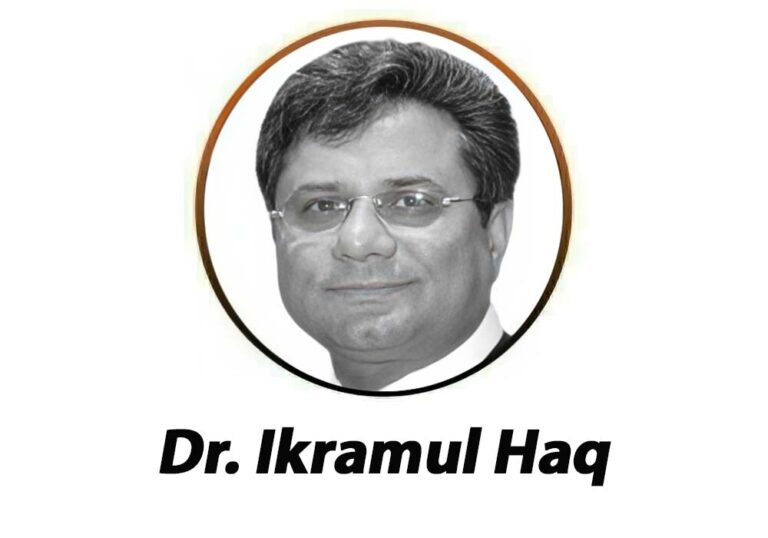
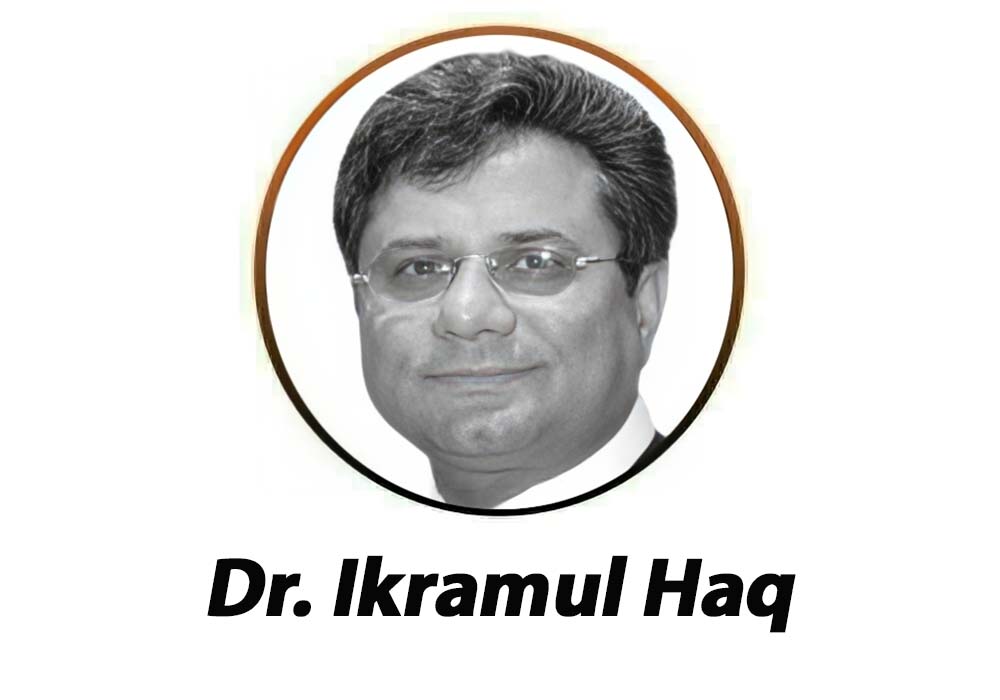
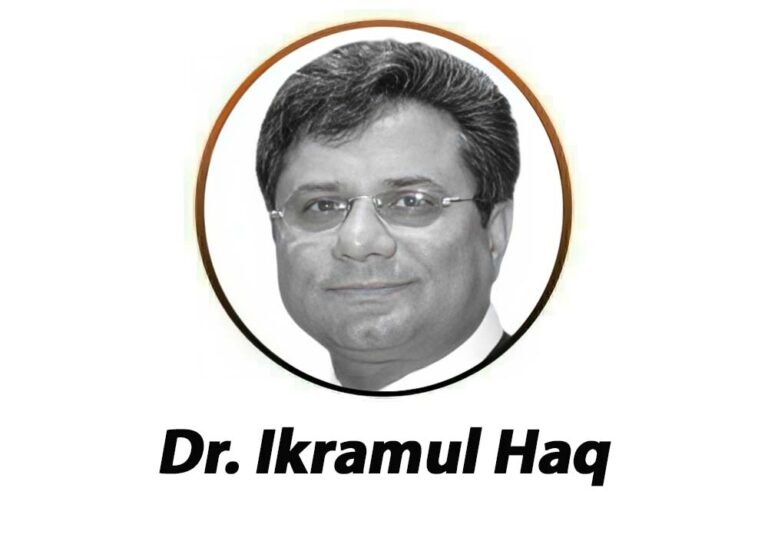
Dr. Ikramul Haq, Advocate Supreme Court, Adjunct Faculty at Lahore University of Management Sciences (LUMS), member Advisory Board and Visiting Senior Fellow of Pakistan Institute of Development Economics (PIDE), holds an LLD in tax laws. He was full-time journalist from 1979 to 1984 with Viewpoint and Dawn. He also served Civil Services of Pakistan from 1984 to 1996. He is author of over 3500 articles on variety of subjects, and many books that included, Pakistan: From Hash to Heroin and its sequel Pakistan: From Drug-trap to Debt-trap.

Similar Posts

  • A Second Great Wall of Trust: Why Only China Can F…

    By General Ghulam Mustafa & Arshad H Abbasi  We have stood together at the foot of the Great Wall of China more than once at different times, but today a thought has returned to both of us, unspoken until now. The Wall runs some 21,196 kilometres across dynasties and deserts, built stone by stone over centuries to secure a civilization’s frontier. Pakistan’s own most dangerous frontier — the Durand Line separating us from Afghanistan — runs roughly 2,625 kilometres, barely an eighth of that length. If a civilization on the scale of China could raise a barrier of that magnitude with the tools of the third century BC, then securing a border less than an eighth as long, with the tools of the twenty-first century, cannot be beyond the reach of the partnership Beijing and Islamabad have built. We do not ask China to build us a wall of stone. We ask Beijing to help us build something sturdier: a wall of enforced accountability against the militants using Afghan soil to bleed Pakistan dry. That bleeding is not a metaphor. Since the Afghan Taliban returned to power in Kabul, the Tehreek-e-Taliban Pakistan has operated with a freedom of movement across our western border that it never enjoyed before. Balochistan burns. Khyber Pakhtunkhwa buries its soldiers and its schoolchildren in the same week. And now the shockwaves have reached Punjab, the country’s demographic and economic core. Every honest accounting of this violence traces back to the same source: sanctuary, training, and logistical freedom on Afghan soil, tolerated or unchecked by an administration in Kabul that owes its survival, in no small part, to Chinese patience and Chinese capital. This is why we write to Beijing, and to Beijing specifically, rather than to Washington, Brussels, or Moscow. Survey after survey inside Pakistan finds that well over eight in ten of our citizens consider China, not any Western power, to be Pakistan’s true friend. Our leaders have called this friendship higher than the Himalayas and deeper than the ocean, and we do not repeat that line as ceremony. We repeat it because it is the only frame in which Beijing can hear what we are about to say plainly: no other country on earth holds the leverage over the Taliban that China holds, and no other country has more to lose from squandering it. Consider what China has already built in Afghanistan without formal recognition of its government. The Xinjiang Central Asia Petroleum and Gas Company signed a twenty-five-year contract to develop the Amu Darya oil basin, committing roughly $150 million annually and scaling toward $540 million over three years. State-backed firms continue to negotiate the long-stalled Mes Aynak copper concession, one of the largest untapped copper deposits on earth, alongside serious interest in Afghan lithium and iron ore. Beijing has cut tariffs on 98 % of Afghan imports. An active Chinese embassy operates in Kabul today, accepting Taliban-appointed diplomats, even as formal recognition is withheld. This is not incidental engagement. This is the deepest economic relationship any major power currently has with the Taliban administration, and it gives China something no airstrike or sanction regime has ever given anyone: the ability to make continued investment conditional on results. We are asking Beijing to use that leverage with the same discipline it has already shown in defending its own security interests. China has made clear, repeatedly and without apology, that it will not tolerate the Turkistan Islamic Party or East Turkistan Islamic Movement fighters operating from Afghan territory against Xinjiang. We are asking only that China extend that identical, non-negotiable standard to the Tehreek-e-Taliban Pakistan and its allied networks operating against us. If Kabul can be made to understand that Chinese mining contracts, Chinese tariff relief, and Chinese diplomatic cover all depend on a genuine, verifiable crackdown on TTP sanctuaries, this insurgency does not need years to end. It needs a Kabul administration that finally has more to lose from harbouring militants than from disowning them. But security pressure alone will not hold, and here we want to be honest about what Afghanistan actually needs from its neighbours, China chief among them. Afghanistan’s national literacy rate stands at just 37 % — 52 % among men, a mere 27 % among women — and UNESCO reports that more than nine in ten ten-year-olds in the country cannot read a simple sentence. Two point two million adolescent girls remain locked out of secondary school entirely, the only country on earth to enforce such a ban, at a projected cost to Afghanistan’s own economy of nearly $9.6 billion in lost potential by 2066. No pipeline, no copper mine, and no railway line will stabilize a country where the next generation cannot read the contracts, safety manuals, or engineering plans that would let them run these projects themselves. It is China’s duty, as the neighbour with the deepest economic stake and the clearest long-term interest in a stable Afghanistan, to make literacy, vocational training, and the reopening of girls’ education a hard condition of its investment — not out of charity, but because an illiterate, disenfranchised population is the same population the TTP and ETIM recruit from. Afghanistan does not need a foreign army. It needs classrooms, teachers, and a workforce equipped to build the country’s own future, backed by an investor patient and disciplined enough to insist on it. Every failed intervention in Afghanistan’s modern history has shared the same flaw: outsiders who came to fight a war, not to build a neighbour. Britain came and left. The Soviet Union came and left, at ruinous cost to itself. NATO and the United States spent two decades and did not leave functioning institutions behind them. China is different in the one respect that matters most: China is not leaving. It shares a border with Afghanistan. Its investments are measured in decades, not electoral cycles. And it has, through the Belt and Road Initiative and the China-Pakistan Economic Corridor, already built the template for what real

  • From Typewriters to Synthetic Intelligence: Why Hu…

    By Malik Khuda Bakhsh Awan, former Additional IG Punjab &  Engineer Arshad H. Abbasi In the early 1990s, operating a manual typewriter was not merely clerical work; it was a test of patience, precision, discipline and endurance. When our office typist disappeared without notice, the responsibility for preparing official reports fell upon us. There was no computer, no backspace and no “undo” button. Every word had to be typed carefully because a serious mistake could mean rewriting an entire page. We still remember spending almost eight hours preparing a single report, only to finish physically and mentally exhausted. Then, during a visit to Dubai on a different occasion, we witnessed Microsoft Office running on a modest personal computer, and it seemed almost magical. Microsoft Word could correct mistakes instantly, paragraphs could be moved without rewriting a page, and Excel could transform rows of figures into calculations, forecasts and financial analysis. We returned home convinced that technology would usher Pakistan into a new age of efficient governance, better engineering and more transparent economic management. In many ways, it did. Typewriters disappeared, computers transformed offices and the internet connected institutions. Yet another lesson gradually became clear: technology can change the tools without changing the people using them. Computers did not automatically eliminate corruption, inefficiency or institutional inertia. A powerful laptop in the hands of an uninterested official remained merely a powerful laptop. The same paradox emerged with PowerPoint. A tool designed to communicate information became, in some institutions, a substitute for serious analysis. Complex national problems were reduced to attractive slides, risks disappeared behind optimistic charts, and weak policies could be made to look impressive. “Death by PowerPoint” became more than a phrase; it became a warning about governance. We saw how major national decisions could be presented as technical successes while their long-term financial, economic and strategic consequences received insufficient scrutiny. The lesson is important because Pakistan is now entering another technological revolution, and this time the technology is far more powerful. Artificial intelligence is no longer limited to answering questions or completing simple prompts. The next generation is moving towards what we may describe as synthetic intelligence: increasingly autonomous systems that can receive an objective, break it into multiple tasks, use software tools, analyse information, check their own results, identify errors, revise their approach and continue working when a particular step fails. AI is also becoming multimodal, allowing systems to process text, images, sound, video, sensor information and structured data together. The next frontier is the integration of digital intelligence with the physical world through robotics, sensors, autonomous machines, industrial systems, medical technology, logistics and manufacturing. A system may eventually be able to observe a problem, formulate a plan, execute several steps, monitor the consequences and adapt its strategy without continuous human instruction. This is a profound transformation from statistical prediction towards increasingly structured problem-solving and autonomous action. Yet we must be careful about what this technological progress actually means. AI can calculate faster than humans, search more information than humans and identify patterns that humans may miss. It can optimise a supply chain, forecast electricity demand, analyse satellite imagery, detect anomalies in financial accounts and assist engineers in complex modelling. But none of this means that machines have acquired human wisdom. Intelligence and wisdom are not the same. A machine can calculate the most efficient way to distribute water, but it cannot independently determine what constitutes justice between competing communities. It can forecast a food shortage, but it cannot decide the moral priority between those who can pay and those who cannot. It can optimise an energy system, but it cannot decide whether a development project is worth the environmental and social cost. It can generate an economic model, but it cannot experience the hardship of a family facing inflation, unemployment or unaffordable electricity. The danger, therefore, is not simply that machines will become more intelligent. The greater danger is that human beings will begin surrendering judgement to machines. We must never confuse computational power with wisdom, information with understanding, or automation with responsibility. For Pakistan, this distinction is not an academic argument. It is a matter of national survival. Whatever happens to artificial intelligence during the next 100 years, human beings will still need food, water, energy, shelter and economic security. AI may transform the way these resources are managed, but it cannot abolish their physical foundations. An algorithm cannot manufacture a Himalayan glacier. A chatbot cannot create a river. A computer cannot grow wheat. A digital platform cannot replace a watershed. A robot cannot simply manufacture energy from nothing. AI can help us forecast rainfall, optimise irrigation, monitor groundwater, improve agricultural productivity, manage electricity demand, reduce transmission losses and identify climate risks. It can help us make better decisions, but it cannot remove our dependence on nature. This is particularly important for Pakistan because our national future is inseparable from the Indus Basin. Agriculture depends on water. Cities depend on reliable water supplies. Industry depends on energy. Food security depends on agriculture. Economic stability depends on affordable energy, productive agriculture, exports and functioning infrastructure. These systems are interconnected. Water affects food. Energy affects water. Food affects inflation. Energy affects industry. Climate change affects all of them. If water security deteriorates, agriculture suffers. If agriculture suffers, food prices rise. If energy becomes unaffordable, industry becomes uncompetitive. If industry weakens, employment and exports decline. If these pressures occur simultaneously, no AI system will magically rescue the country. This is why the belief that technology alone can solve Pakistan’s fundamental problems is dangerous. We have already made this mistake with computers and digitalisation. We must not repeat it with AI. Technology can amplify competence, but it can also amplify incompetence. If dishonest data enters an AI system, the machine may produce sophisticated dishonesty. If flawed assumptions enter the model, AI may produce a highly polished version of a flawed conclusion. If the objective is politically manipulated, the most advanced algorithm cannot convert a bad objective into good governance. The

  • No to the Division of Punjab

    Once again, the debate over the creation of new provinces has surfaced in Pakistan. In every political era, the issue is revived in one form or another. This time, however, there appears to be a growing push for creating additional provinces out of almost every major province in the country. The strongest argument being put forward is that Pakistan’s population was around 70 million in 1972, whereas it has now grown to more than three times that figure. Therefore, it is argued, new provinces have become necessary for administrative convenience. At first glance, this argument may sound convincing. But the real question is: can all of Pakistan’s problems be solved simply by creating new provinces? If population growth alone is a sufficient reason for creating new provinces, then why have all major countries in the world not followed the same path? The real issue is not the number of provinces but the quality of governance, equitable distribution of resources, an empowered local government system, transparent accountability and an effective administrative structure. When the basic system is weak, changing the map does not make the problems disappear. What is particularly concerning is that Punjab appears to be the main target of this debate. At different times, proposals have emerged for a separate South Punjab, Central Punjab and even further divisions. It seems that with every political season, Punjab becomes the centre of the debate over provincial division. This has understandably created a feeling among many Punjabis that the issue may not be merely about administrative reform, but could also weaken Punjab’s historical, cultural and political identity. Punjab is not merely another province. It is one of the strong pillars of Pakistan’s ideological, historical and economic foundations. The land played an important role in the Pakistan Movement, made enormous sacrifices for the defence of the country, strengthened Pakistan’s agriculture and industry, and has always played a key role in the national economy. Repeatedly dragging such a province into a debate over division is neither appropriate nor in the national interest. Those advocating new provinces speak extensively about administrative convenience, but remain largely silent about the financial consequences. Has anyone explained to the public that every new province would require a new governor, chief minister, cabinet, provincial assembly, speaker, deputy speaker, secretariat and numerous government departments? There would also be hundreds of new government positions, official residences, vehicle fleets, security arrangements, protocol and countless other administrative expenses. All of this would require billions of rupees. And ultimately, that money would not come from some separate source. It would come from the taxpayers and the public exchequer. Pakistan is already facing one of the most serious economic challenges in its history. The burden of domestic and external debt remains enormous, while a substantial portion of the national budget is spent every year on debt servicing and interest payments. The country continues to rely on programmes supported by the IMF and other international financial institutions, while ordinary citizens struggle with inflation, unemployment and rising electricity, gas and petrol prices. In such circumstances, would creating new provinces and expanding the size of the ruling and administrative machinery really be an act of national wisdom? Or would it simply place another burden on already stretched national resources? If the genuine objective is to serve the people, the existing system should first be made more effective. Local governments must be empowered, district administrations should be given adequate financial and administrative authority, bureaucratic reforms should be introduced, corruption must be tackled and the equitable distribution of resources must be ensured. If the existing system is not functioning to its full potential, how can simply drawing new boundaries across the map transform the lives of ordinary citizens? The issue of dividing Punjab is not merely administrative. It is also a question of identity. Punjab’s language, culture and heritage have already not received the level of official patronage and protection they deserve. If the geographical unity of Punjab is repeatedly subjected to calls for division, it could further weaken its cultural and historical identity. There is another important question: if population is to be the basis for creating new provinces, why should the same principle not be applied uniformly across the country? Will this criterion apply equally to every province, or is Punjab being singled out? National decisions should not be driven by political expediency. They should be based on constitutional requirements, the national interest and broad public consensus. In my view, Pakistan needs a new economic vision, stronger institutions, a fairer system of justice, quality education, better healthcare, greater employment opportunities and effective local governments far more urgently than it needs new provinces. People do not want more rulers; they want better governance. They do not need more official protocol; they need affordable food, quality healthcare, good education and decent employment. As a Pakistani, a journalist and a Punjabi, I believe that dividing Punjab is not in the national interest. Its unity, historical importance and cultural identity should be protected. If we genuinely want to strengthen Pakistan, we should strengthen the system rather than divide provinces, improve governance rather than expand administrative structures, and reduce the problems faced by ordinary citizens instead of placing an additional financial burden on them. The division of Punjab is, in my view, unacceptable. A strong Punjab contributes to a strong Pakistan, and a strong Pakistan should be our shared destination.

  • Poetry, Power & Humanity—VI  Baba Farid: D…

    The intellectual discourse initiated by Sufi philosophers was inclusive of all religions and negated mullahism. Baba Farid is said to have been persecuted by Pakpattan’s qazi and the ruler of the city for listening to music and dancing in the mosque. Guru Nanak condemned the ritualism of mullahs and the pundits—Our distorted intellectual discourse, Dawn, September 9, 2011  Our discussion of Waris Shah ended with Erich Fromm’s distinction between having and being. Heer’s family sought to have honour, status, alliances and authority over a daughter; Heer and Ranjha sought a relationship grounded in recognition rather than possession. Their tragedy arose because a possessive social order could not tolerate human beings who refused to behave as property. To take that argument further, we must now travel backwards nearly five centuries before Waris Shah, to the beginnings of the surviving Punjabi poetic tradition and to Baba Farid (Hazrat Fariduddin Ganjshaka). Najm Hosain Syed places Farid at the opening of that tradition. What distinguishes his dohras, Najm writes, is an “austerity of tone”. Their setting is not an imaginary spiritual landscape but the “daily experience of common man”: fields, bread, dust, ageing bodies, hunger, labour and death. That austerity is precisely why Farid speaks so forcefully to an age obsessed with accumulation. Fromm, writing in To Have or To Be?, contrasted two orientations towards existence. The having mode seeks security through possession, accumulation and control; the being mode locates fulfilment in living, loving, sharing and becoming. Farid inhabited an entirely different intellectual and spiritual universe, and it would be anachronistic to turn him into a medieval Fromm. The convergence lies elsewhere. Both question the assumption that what we possess tells us what we are. Farid begins with the most democratic substance imaginable: dust. Dust Shahmukhi Roman Punjabi Literary English translation فریدہ خاکُ ن نندیئ خاکو جیڈُ ن کوئِ جیودیاں پیراں تلے مویاں اپرِ ہوئِ Farida khaak na nindiye, khaako jed na koi Jeevandeyan pairan talle, moyan upar hoi Farid, do not despise the dust; nothing stands above it. In life it lies beneath our feet; in death it lies above us.   The surviving Shahmukhi text preserves the couplet in this form. Few lines dismantle hierarchy more economically. The earth beneath the rich man’s shoe and the poor labourer’s bare foot is the same earth that eventually covers both. Rank, office, lineage, property and beauty exist for a moment between two encounters with dust. Farid is not preaching passivity before injustice. His image destroys the metaphysical arrogance on which inequality depends. Human beings may create distinctions of caste, wealth and status, but mortality refuses to recognise them. The person who imagines himself elevated above another discovers that both occupy the same final ground. This is Farid’s first challenge to the mode of having. We spend our lives converting temporary control into imagined permanence: my land, my wealth, my title, my family name, my influence. Dust reveals the grammatical error. We possess these things temporarily; they do not belong to the essential self. Farid’s poetry becomes even more striking when it turns from mortality to material inequality. Flour for Some, Not Even Salt for Others Shahmukhi Roman Punjabi Literary English translation فریدہ اکناّ آٹا اگلا اکناّ ناہی لونُ اگے گئے سننجاپسنِ چوٹاں کھا سی کؤنُ Farida ikna aata agla, ikna nahi loon Agge gaye sanjhaapsan, chotan khaasi kaun Farid, some have flour in abundance; others do not even have salt. Beyond this life it will become known who must answer for the blows. The text occurs among the saloks attributed to Farid. This is not abstract mysticism. It is an observation about distribution. One household possesses abundance; another lacks even the simplest accompaniment to bread. Farid does not construct an economic theory from the disparity, but neither does he treat it as morally neutral. The second line introduces accountability. Unequal possession cannot be separated from the question of how human beings acquired, used and withheld what passed through their hands. This is an important corrective to a frequent misuse of spirituality. Poverty should never be romanticised simply because a saint practiced austerity. There is a profound difference between voluntary simplicity and involuntary deprivation. Farid could choose restraint as spiritual discipline; the person without salt may have no choice at all. His famous imagery of coarse bread makes the distinction clearer: فریدہ روٹی میری کاٹھ کی، لاونُ میری بھکھ His bread is hard and hunger itself becomes its relish. In the following couplet, he advises eating simple food and drinking cool water without tormenting oneself by staring enviously at another person’s richer meal. The ethical target is excess desire, not nourishment. A society in which some cannot meet basic needs while others define themselves through conspicuous consumption cannot use Farid to sanctify deprivation. His poetry asks the possessor to examine himself before asking the deprived to accept their condition. Here the relationship with Fromm becomes especially productive. The having mode is not merely ownership of useful things. Human life requires food, shelter, tools and security. The pathology begins when possession becomes identity—when having more means believing oneself to be more. Farid’s answer is sabar: steadfastness, restraint, patience and sufficiency. His surviving corpus repeatedly returns to simplicity, humility and control of appetite. In contemporary political economy, however, restraint cannot be demanded only from those who possess least. An ethic worthy of Farid must speak first to those with the greatest capacity to accumulate, consume and command. His social imagination reaches its deepest point when personal suffering becomes recognition of universal suffering. The Fire in Every House Shahmukhi Roman Punjabi Literary English translation فریدہ میں جانیا دکھ مجھ کوُ دکھ سبائے جگِ اُچے چڑھِ کے دیکھیا تاں گھرِ گھرِ ایہا اگِ Farida main jaania dukh mujh ko, dukh sabhaai jag Uchche charh ke dekhia, taan ghar ghar eha ag Farid, I thought suffering belonged to me alone; I climbed higher and saw the same fire burning in every home. The couplet is preserved in the Farid saloks, and one modern scholarly discussion sees precisely this capacity to absorb the suffering of

  • Eudaimonia: When Being Human Was Enough”

    From Laraib Zahra Once upon a time, far from Earth, beyond the reach of our skies, there existed a planet called the Worthlands. In the Worthlands, there was an equal proportion of humans and ghosts. Whenever a human was born, a little ghost was born by their side. These little ghosts were called Hounds. Every Hound possessed a superpower: it could know exactly what its human companion was thinking. The entire planet was ruled by three powerful ghosts, commonly known by humans and Hounds as the Great 3Gs. Each of the three had a separate kingdom. They were the Ghost of Guilt, the Ghost of Productivity, and the Ghost of Fear. The Ghost of Guilt was the eldest of the three. He controlled the capital of the Worthlands. He had his own Guilt Police and Guilt Pumps. Guilt was a magical liquid found inside these pumps. The Guilt Police, along with the Hounds, kept a constant check on the behaviour of the people in the capital. Their job was to make sure that nobody ever ran out of fuel—the fuel of guilt. Whenever a person was caught running out of guilt, the Hounds immediately reported them to the Guilt Police. They were then provided with more guilt fuel to make sure that nobody went “insane.” The biggest crime in the capital was the Rest Crime. As soon as a person became exhausted and decided to take some rest, the Hounds would begin fiercely whispering in their ears: “Strong people don’t stop.” They would tell them not to rest until they reached somewhere. But where exactly this “somewhere” was, nobody really knew. Sometimes, when a person was genuinely unable to work any further because of an overwhelming workload, the Hounds would call specialised therapists known as the Fear Feeders from the Kingdom of Failure for counselling—a kingdom I shall discuss in greater detail later. On the other hand, the entire north of the Worthlands was ruled by the second Great Ghost: the Ghost of Productivity. Unlike the Guilt Police, who were actually in charge of the capital, there was no such police force in the north. Instead, there was a ministry known as the Ministry of Merit. The humans there were never supposed to sit idle. Instead, they were expected to work harder and harder to make sure that they remained at the top of the list maintained by the Ministry of Merit. Every year, there was a grand ceremony known as the Annual Worth Ceremony. The humans who earned the highest number of merit points received a golden star carved with their names in the Worth Register of the Ministry of Merit. Every time a human refused to rest in order to increase their productivity, the Hounds would greet them by saying: “Congratulations! You have earned three merit points.” Humans were comparatively happier in the north than in the other two kingdoms because here, they were rewarded with golden stars bearing their names. The more golden stars a human had beside their name in the Worth Register, the more likely they were to become part of the Hounds—the most respected position in the Worthlands. After all, the Hounds had the superpower to read human minds, and they could even fly. Their slogan was: “You could be doing more.” To the south lay the third kingdom—the Kingdom of Failure, ruled by the Great Ghost of Fear. This kingdom was the most terrible of them all. The humans there were weak and diseased. Every second person was a victim of anaemia. They looked as though they had been starving for days, perhaps even weeks. On the contrary, the Great Ghost of Fear was the fattest of the three ghosts. The reason for this strange contrast was hidden in the Hounds. Unlike the Hounds in the north and the capital, the Hounds in the south had a distinct name. They were called Fear Feeders. The Fear Feeders had one duty: to sense fear-bearing thoughts in human minds and suck them out, because the Great Ghost of Fear fed on those thoughts. There were many kinds of fears that humans carried in that kingdom: The fear of not doing enough. The fear of getting left behind. The fear of failure. And many more. The Fear Feeders collected these thoughts and presented them to their master. The Great Ghost of Failure had one dish that was especially dear to him. It was his favourite dish of all: “What If” Spaghetti. “What If” Spaghetti was a special dish found in all three kingdoms, but it was particularly abundant in the Kingdom of Failure. The humans looked starved because they had to constantly produce fear in their minds so that they could feed it to the Fear Feeders. These fears were produced through a process called whispering, carried out by Hounds that were not themselves Fear Feeders. Then, one day, something unexpected happened. A few Hounds disappeared. Seven Hounds. Everyone in the Worthlands was deeply concerned about their sudden disappearance. The Guilt Police, along with other investigation departments, launched a search operation. But not even a single missing Hound was found. The humans whose Hounds were missing were arrested and questioned. The results of the investigation shocked everyone in the Worthlands. The Hounds could only exist if their humans obeyed them. This was something that neither the Hounds nor the humans had ever known before. The humans whose Hounds had disappeared were, surprisingly, close friends. During the investigation, they confessed that one day, they had decided to step back from their usual exhausting routines and take a break to rest their tired and ruptured nerves. All of a sudden, seven Hounds appeared and began whispering their usual slogans: “Strong people don’t stop.” “What if you get left behind?” And their most favourite: “You could be doing more.” The humans became lost in their thoughts once again and decided to give up on their plan to rest. But then, suddenly, a voice echoed through the room: “But

  • Concrete Jungle in the Hills: Is Unchecked High-Ri…

    For decades, Galiyat has been celebrated as one of Pakistan’s most picturesque mountain regions, renowned for its dense pine forests, breathtaking valleys, pleasant climate and rich biodiversity. Stretching across Nathia Gali, Ayubia, Dunga Gali and neighbouring hill stations, the region has long served as a sanctuary for nature lovers and a cornerstone of Khyber Pakhtunkhwa’s tourism industry. Today, however, its iconic landscape is undergoing a dramatic transformation. Multi-storey hotels, apartment complexes and commercial buildings are rapidly replacing forests and open green spaces, raising growing concerns among environmentalists, urban planners and local residents that unregulated development is threatening the ecological balance and natural heritage that have defined Galiyat for generations. Over the past decade, multi-storey hotels, apartment complexes and commercial buildings have spread across the region at an unprecedented pace. Hillsides that were once covered with forests and open green spaces are increasingly dominated by reinforced concrete structures. Critics argue that the changing skyline is gradually eroding the natural character that made Galiyat a unique tourist destination. The concerns extend beyond aesthetics. Environmental experts have long warned that excessive construction on steep mountain slopes can increase pressure on fragile ecosystems, reduce forest cover, disrupt natural drainage systems and heighten the risk of soil erosion and landslides. As climate change continues to intensify extreme weather events across northern Pakistan, many believe that poor land-use planning could further increase the vulnerability of mountain communities. These concerns have recently moved beyond public debate and into the corridors of government. A dispute has emerged between the Khyber Pakhtunkhwa Adviser on Tourism and senior officials of the Galiyat Development Authority (GDA), bringing renewed attention to the regulation of construction in one of Pakistan’s most environmentally sensitive tourism regions. During a recent visit to Galiyat, the Adviser on Tourism questioned GDA Director General Fawad Khan regarding the allotment of more than five kanals of government land at the Changla Gali Rest Area and the subsequent construction of a hotel on the site. According to officials familiar with the matter, the adviser sought clarification on the legal basis for the allotment and whether all applicable rules and procedures had been followed. The issue gained further attention later the same day when GDA Director General Fawad Khan, Director Administration Noor-ul-Haq and Director Building Control Farukh Jadun submitted requests to the Chief Secretary of Khyber Pakhtunkhwa seeking transfers on what they described as “personal grounds.” The provincial government did not approve the requests, and the officers have continued to serve in their respective positions. The developments have intensified public discussion about how construction projects are approved in Galiyat and whether existing regulatory mechanisms are adequately protecting the region’s environmental heritage. They have also revived broader questions about institutional oversight, enforcement of building regulations and the balance between tourism development and environmental conservation. For many residents, the debate is not simply about individual buildings. It is about the long-term future of a mountain region whose economy depends on preserving the very landscape that continues to attract visitors from across Pakistan and abroad. The controversy surrounding high-rise construction has exposed deeper concerns about governance and regulatory oversight in the Galiyat region. At the centre of the debate are questions over which institution bears primary responsibility for approving construction projects and whether existing laws have been consistently enforced. Speaking in the Khyber Pakhtunkhwa Provincial Assembly, Tourism Adviser Adil Iqbal announced that he intended to recommend a high-level inquiry to Chief Minister Muhammad Sohail Khan Afridi. According to the adviser, the proposed inquiry would examine how permissions were granted for the construction of high-rise hotels, apartment buildings and other commercial structures that, according to his assessment, may not fully comply with the applicable building regulations. The adviser has argued that preserving Galiyat’s ecological balance is essential not only for environmental reasons but also for the long-term sustainability of the province’s tourism industry. He has maintained that development should proceed within the framework of environmental laws and approved planning regulations. Officials of the Galiyat Development Authority, however, reject suggestions that the authority alone should be held responsible for the current situation. GDA officials maintain that construction approvals in the region are not issued exclusively by their institution. According to the authority, the Tehsil Municipal Administration (TMA), operating under the provincial Local Government Department, also possesses legal authority to approve certain categories of building plans. This overlapping administrative structure has become one of the central issues in the ongoing debate. Critics argue that multiple approval authorities operating under different regulatory frameworks have created uncertainty over accountability. Supporters of regulatory reform believe that overlapping jurisdictions make enforcement difficult and allow developers to exploit differences between separate sets of building rules. The local civil society organisation, Galiyat Tahaffuz Movement, has been among the most vocal critics of the existing regulatory system. Representatives of the movement argue that both the GDA and the TMA have failed to effectively enforce planning regulations designed to protect the region’s fragile mountain environment. According to the organisation, building permits have, in some cases, been issued under political influence or administrative pressure. It further alleges that inconsistencies between separate building regulations have enabled developers to obtain approvals that might not have been possible under a single, uniformly enforced regulatory framework. The movement has repeatedly called for a comprehensive review of construction approvals, greater transparency in land-use decisions and the adoption of uniform building regulations across the Galiyat region. It also advocates stronger environmental impact assessments before permission is granted for major commercial developments. According to government sources, the disagreement between the Tourism Adviser and senior GDA officials has reached the office of Chief Minister Muhammad Sohail Khan Afridi. While the provincial government has not publicly commented on the reported differences, officials familiar with the matter say the administration is attempting to carefully assess the issues before deciding whether to order a formal inquiry. Sources suggest that the government faces a delicate administrative challenge. On one hand, it must respond to concerns regarding environmental protection and regulatory compliance. On the other, it must avoid

Leave a Reply

Your email address will not be published. Required fields are marked *