sewage flood damages
| |

Sewage flood damages SBCA property records

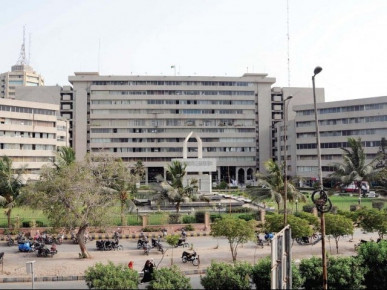
KARACHI: Sewage water has flooded the record room at the headquarters of the Sindh Building Control Authority (SBCA), damaging hundreds of land and building-related files and raising concerns over the safety of vital property records.

The affected room at the SBCA Civic Centre headquarters contains thousands of documents submitted by citizens, including approved building plans, structural drawings and other records used to verify property details.

Officials retain copies of approved residential and commercial building plans in the record room for future reference. However, sewage water reportedly entered the facility after poor maintenance and alleged negligence, submerging hundreds of files and damaging important documents.

Another important SBCA department, formerly known as Town Planning and now called Structure Planning, operates next to the affected record room. Sources said the flooding also damaged records dating back several years.

According to sources, sewage had been accumulating in the area for several days, but the maintenance department failed to resolve the issue in time, resulting in damage to critical official records.

Following a report by Express News, Additional Director General Farhan Qaiser took notice of the incident and ordered an inquiry against three officials. He directed authorities to submit a report within 24 hours and warned that officials found responsible for negligence would face suspension.

The incident has also raised questions about oversight, as the SBCA Director General’s office is located only a short distance from the affected record room. However, no immediate directives reportedly came from the DG’s office.

An SBCA spokesperson said the Director General was attending a meeting with Sindh Local Government Minister Nasir Hussain Shah regarding improvements to the authority’s one-window operation.

Citizens have expressed serious concern over the damage, saying the incident could undermine public confidence in the protection of property records. They have called on the Sindh government to take immediate steps to ensure the safety and proper preservation of such documents.

Similar Posts

  • | |

    Pakistan’s military tightens grip on Islamis…

    Munir’s family background feeds into this shift as well. He is the son of an imam and considers himself a devout, conservative Muslim, and religious identity remains deeply woven into Pakistan’s state institutions. Even so, he has pushed the country toward international engagement through cryptocurrency partnerships, foreign investment deals, a mediating role in the conflict between the United States and Iran, and a mutual defence pact with Saudi Arabia. Data shared with a foreign news agency by the Armed Conflict Location and Event Data Project, a group that tracks conflict incidents worldwide, shows the scale of the shift. Pakistan averaged more than seven blasphemy related riots or attacks annually between 2021 and 2024, but recorded only one such incident over the past twelve months. Economic pressure appears to have played a significant role in prompting the crackdown. Two Pakistani government sources said officials grew alarmed during the summer of 2025 that rising hostility from fundamentalist groups toward France and other European countries threatened to jeopardize a European Union duty waiver covering Pakistani exports. Nearly a third of Pakistan’s total exports go to the EU, and losing that preferential access could have dealt a severe blow to the national economy. Neither the European Commission nor Pakistan’s commerce ministry responded to requests for comment on the matter. Washington has added its own pressure over religious freedom concerns. The US Commission on International Religious Freedom, a government watchdog, recommended last year that Pakistan be placed back on a list of countries of particular concern due to its blasphemy laws, a designation Islamabad has firmly rejected. Analyst Abdul Basit of Singapore’s S. Rajaratnam School of International Studies said worsening insurgent violence in Balochistan and Khyber Pakhtunkhwa, Pakistan’s two most mineral rich provinces, likely added urgency to Munir’s campaign, particularly since he has pitched foreign investment in the country’s mining sector to American officials over the past year. Basit noted that religious groups have lost favor within the state’s priorities, though he cautioned that the militias driving these regional insurgencies are not formally tied to the newly banned Islamist organizations, even if both draw recruits from the same pool of young, radicalized men. Elizabeth Threlkeld, who directs the Stimson Center’s South Asia program, said the open question going forward is whether Pakistan can sustain this level of focus over time. Crackdown targets country’s largest fundamentalist movement The largest of the groups swept up in the crackdown, Tehreek e Labbaik Pakistan, built its identity around the slogan “Death to blasphemers” before authorities banned it late last year. Many of its leaders now sit in jail, its mosques have been sealed shut and its financial accounts frozen. A previously undisclosed government document that laid the groundwork for the ban argued the organization had become a serious threat to Pakistan by damaging both domestic stability and the country’s standing internationally. A spokesperson for the group pointed to a statement it issued last year describing the ban as illegal and unconstitutional. The move against Tehreek e Labbaik follows earlier crackdowns on groups such as Lashkar e Taiba and Jaish e Muhammad, which Pakistan pursued under pressure from the Financial Action Task Force, the international body that monitors terrorism financing. Basit linked the newest crackdown to a period of internal reflection within Pakistan over its historical backing of the Afghan Taliban, whom Islamabad now blames for stoking Islamist insurgencies against the Pakistani state from across the border. The Taliban government in Kabul has dismissed that accusation as baseless, and a spokesperson for its foreign ministry declined to comment further, describing Pakistan’s crackdown as an internal matter. For Pakistan’s Christian, Shia and Ahmadi communities, the change in atmosphere has been dramatic. In the past, suspects in blasphemy related killings, including police officers, were sometimes greeted with rose petals or celebratory receptions, and individuals accused of burning churches or minority mosques often received public praise. Blasphemy remains a capital offense under Pakistani law, and even a rumor of an accusation has historically been enough to spark riots or lynchings. Human rights organizations say victims’ families have rarely obtained justice, since judges and lawyers have often been too frightened to take on such cases. Officer Malik said everyone who confronted the crowd during last month’s incident in Karachi felt genuine fear. The Christian family targeted that day was eventually moved to safety, and an initial investigation has since found the accusations against them to be false. Group’s military links trace back a decade Tehreek e Labbaik formed in 2015 while its founder was imprisoned for shooting and killing a Pakistani provincial governor in 2011 over his support for a Christian woman accused of blasphemy. That gunman, a former police bodyguard, was later convicted and executed months after the group’s founding. Analysts have long suspected the group’s creation received at least tacit support from Pakistan’s military establishment, including its intelligence services, as a tool to keep civilian governments and mainstream political parties in check. Following violent riots led by the group in 2017, then army chief General Qamar Javed Bajwa referred to its protesters as the country’s own people. Pakistan’s Supreme Court later ordered the military and intelligence agencies to stay out of politics but stopped short of directly tying them to the organization. Analysts and former officials say the effects of years of tolerance for the group will not disappear simply because of a ban, and that the shock felt by its supporters could still trigger backlash. Ihsan Ghani, who served as Pakistan’s counter terrorism chief during the 2017 riots, said he worries the group could resurface at full strength if its usefulness to the state changes again. He compared decades of state backed nurturing of the movement to something that cannot simply be switched on and off at will. Within Pakistan’s minority communities, the sudden shift still feels fragile. One of the Christian women rescued during last month’s incident in Karachi said she and her family are now physically safe, but admitted the fear has not fully faded.

  • Massive Fire Engulfs Ammunition Storage Facility in Surin, Triggering Continuous Explosions

    SURIN — A massive fire broke out at an ammunition storage facility belonging to the Border Patrol Police 21 command centre in Surin province on Tuesday night, triggering continuous explosions that sent a towering wall of flames into the sky and forced the evacuation of nearby residential areas. Several People Injured Following Blast at Ammunition […]

  • | |

    Camila Mendes breaks silence on eating disorder an…

    Camila Mendes is opening up about one of the most difficult periods of her life, revealing that the intense pressure she experienced while filming the first season of Riverdale contributed to an eating disorder relapse and frequent panic attacks. The actress shared her emotional story during a recent appearance on the On Purpose with Jay Shetty podcast, where she reflected on the challenges of navigating fame at a young age.  Mendes, 32, explained that her struggle was fueled by perfectionism and the constant pressure to look flawless on camera. She admitted that she felt she had to be at her best every single day, both in terms of her performance and appearance, leaving little room for mistakes or emotional vulnerability. Those expectations, she said, intensified body image issues that had first developed during her high school years.  The Riverdale star recalled watching episodes of the show and becoming overly critical of her appearance. She said she would focus on perceived flaws instead of appreciating her work, which only worsened her unhealthy relationship with food and her body. Mendes described feeling “disgusting” on camera at times, admitting that the relentless self-criticism played a major role in triggering her eating disorder.  Alongside the eating disorder, Mendes revealed that she also experienced panic attacks while working on the hit CW series. She explained that the demanding filming schedule often left her with little time to process her emotions. Whenever she felt overwhelmed, she struggled to express what she was going through because she did not want to delay production or let the cast and crew down.  As the pressure mounted, Mendes was eventually prescribed anti-anxiety medication to help her cope. Looking back, she admitted that while the medication helped her continue working, it also left her feeling emotionally numb. She now believes it was a temporary solution rather than a long-term answer to what she was experiencing.  Despite the difficult memories, Mendes emphasized that she does not view her Riverdale journey negatively. She said she still treasures many experiences from the seven-season series and remains grateful for the opportunities it gave her. However, she acknowledged that being in her early 20s and having little control over her schedule made the experience far more challenging than it might have been later in life.  Today, Mendes says she has developed a healthier relationship with herself by prioritizing mental well-being over perfection. By sharing her story, she hopes others facing similar struggles understand they are not alone and that recovery is possible. Her candid reflections also highlight the hidden pressures that many young actors face behind the scenes, reminding fans that even successful stars can quietly battle anxiety, self-doubt and body image issues while pursuing their dreams. 

  • | |

    VC calls for global support to Kashmir cause at UO…

    The University of Okara (UO) commemorated Kashmir Exploitation Day on Wednesday by organizing a seminar and a solidarity walk to reaffirm unwavering support for the people of Occupied Jammu and Kashmir (OJK) in their struggle for the right to self-determination. The event was organized by the Directorate of Student Affairs and attended by a large number of faculty members, administrative staff, and students. The Vice Chancellor of the University of Okara, Prof. Dr. Sajjad Mubin, presided over the ceremony. Addressing the participants, Prof. Mubin highlighted the decades-long suffering of the Kashmiri people and called upon the international community to play its role in ensuring the implementation of the United Nations resolutions on Kashmir. “Kashmir is the lifeline of Pakistan and an issue that remains central to peace and stability in South Asia. The resilient people of Kashmir have made unprecedented sacrifices for their legitimate right to self-determination, and the global community must not remain a silent spectator to their plight,” he said. The VC also paid tribute to Pakistan’s armed forces for safeguarding the country’s sovereignty and territorial integrity. “Our armed forces have rendered unparalleled sacrifices to make Pakistan impregnable. Their commitment to national security enables us to stand firmly with our Kashmiri brothers and sisters in their just struggle,” he added. Speaking on the occasion, the Registrar of the University of Okara, Jamil Asim, said that observing Kashmir Exploitation Day serves as a reminder of the collective responsibility to raise awareness about the humanitarian situation in Indian Illegally Occupied Jammu and Kashmir. “We stand in complete solidarity with the people of Kashmir and reaffirm our support for their internationally recognized right to determine their own future. Universities have an important role in educating the younger generation about issues of justice, peace, and human rights,” he remarked. The Pro VC, Prof. Dr. Muhammad Wajid, and the DSA, Dr. Shoaib Saleem, also addressed the gathering and emphasized the importance of maintaining national unity and continuing moral, diplomatic, and political support for the Kashmiri people. A one-minute silence was observed to honor the sacrifices of the people of Kashmir and to express solidarity with those who have lost their lives during the prolonged conflict. The seminar concluded with a solidarity walk in which the participants carried placards and banners expressing support for the Kashmiri cause and reaffirming Pakistan’s commitment to the right of self-determination for the people of Kashmir.

  • | |

    Hilaria Baldwin shares hilarious parenting mix-up …

    Hilaria Baldwin is embracing the chaos of life as a mother of seven, admitting that raising a large family often leads to funny and unforgettable moments. During a recent interview, the wellness entrepreneur shared that keeping track of seven children can sometimes become so overwhelming that she occasionally mixes up their names, something many parents can relate to. Speaking candidly about family life, Hilaria laughed as she confessed that there are days when she accidentally calls one child by another’s name. She explained that with so many busy schedules, school activities and daily routines, moments of confusion are almost inevitable. “It’s just part of having a big family,” she joked, adding that her children have learned to laugh about the mix-ups rather than take them seriously. According to Hilaria, the occasional mistake has become a normal part of life in the Baldwin household. The 42-year-old shares seven children with actor Alec Baldwin, and together they have built a lively home filled with constant activity. While caring for such a large family may seem overwhelming from the outside, Hilaria says she and Alec have found a system that works well for them. She revealed that parenting is very much a team effort. Rather than assigning one parent to every responsibility, the couple divides tasks depending on the day’s schedule. Whether it’s preparing meals, helping with homework, attending school events or putting the children to bed, they support each other to ensure everything gets done. Hilaria explained that flexibility has become the key to managing their household. Some days Alec takes on more responsibilities, while on other days she steps in to handle the majority of the family’s needs. Their ability to communicate and adapt has helped them navigate the demands of raising seven children together. The author also acknowledged that parenting is rarely perfect. She said there are moments of exhaustion, unexpected challenges and plenty of laughter along the way. Instead of striving for perfection, she believes it’s more important to create a loving environment where children feel supported and understood. Her honest comments resonated with many parents online, who praised her willingness to discuss the realities of family life rather than presenting an unrealistic image of perfection. Many social media users admitted they also mix up their children’s names, even in much smaller families. Hilaria has frequently shared glimpses of her home life on social media, offering followers a look at both the joyful and challenging moments of parenting. Her latest interview continues that tradition, highlighting the humor that often comes with raising a large family. Despite the occasional name mix-up, Hilaria made one thing clear: every moment with her children is meaningful. While life with seven kids can be hectic, she says the laughter, love and unforgettable memories make every challenge worthwhile. Her candid reflections offer a reminder that even celebrity families experience the same everyday parenting moments as everyone else.

  • | |

    IHC reserves verdict on judges’ appointments ple…

    The Islamabad High Court (IHC) on Thursday reserved its verdict on the maintainability of a petition challenging the delay in the approval of judicial appointments for high courts across the country. Justice Arbab Muhammad Tahir heard the petition filed by advocate Luqman Zafar Chaudhary through his counsel Zahid Asif Chaudhry. The petitioner requested the court to direct President Asif Ali Zardari to approve a summary forwarded by the prime minister for the appointment of 19 additional judges and the confirmation of five judges in the Islamabad, Lahore, Sindh, Balochistan and Peshawar high courts. During the hearing, the petitioner’s lawyer argued that the Judicial Commission of Pakistan (JCP) had recommended the appointments during its meetings held on July 20 and 21. He said the summary was later sent to the president for approval, but no decision has been made despite the passage of more than two weeks. The counsel maintained that the delay is affecting the functioning of the superior judiciary. He informed the court that the tenure of an additional judge of the Sindh High Court has already expired, while the terms of four additional judges of the Peshawar High Court are expected to end within the coming days. The lawyer also told the court that reports suggest the government may issue notifications regarding the appointments within the next 48 hours. Justice Tahir repeatedly questioned whether a constitutional petition could legally be maintained against the president. He asked the petitioner’s counsel to cite any previous court ruling in which a writ had been issued against the president regarding the exercise of constitutional powers. The court observed that the judgments presented by the petitioner did not support the argument that courts could direct the president in matters governed by Article 48 of the Constitution. Justice Tahir asked whether any legal precedent existed requiring the president to act on such matters through a judicial order. The petitioner’s counsel argued that Article 48 requires the president to act on the advice of the prime minister or the cabinet. He maintained that the president has no independent authority to indefinitely delay judicial appointments once the Judicial Commission has completed its recommendations. The lawyer further argued that the Ministry of Law is the competent authority to issue appointment notifications after the completion of the constitutional process. He claimed that the president’s role in the appointment process is largely formal and that unnecessary delays should not hinder the functioning of the judiciary. The petitioner requested the court to seek responses from the federal government, the Prime Minister’s Office and the Ministry of Law regarding the status of the pending summary. However, the court declined to issue notices at this stage.

Leave a Reply

Your email address will not be published. Required fields are marked *