
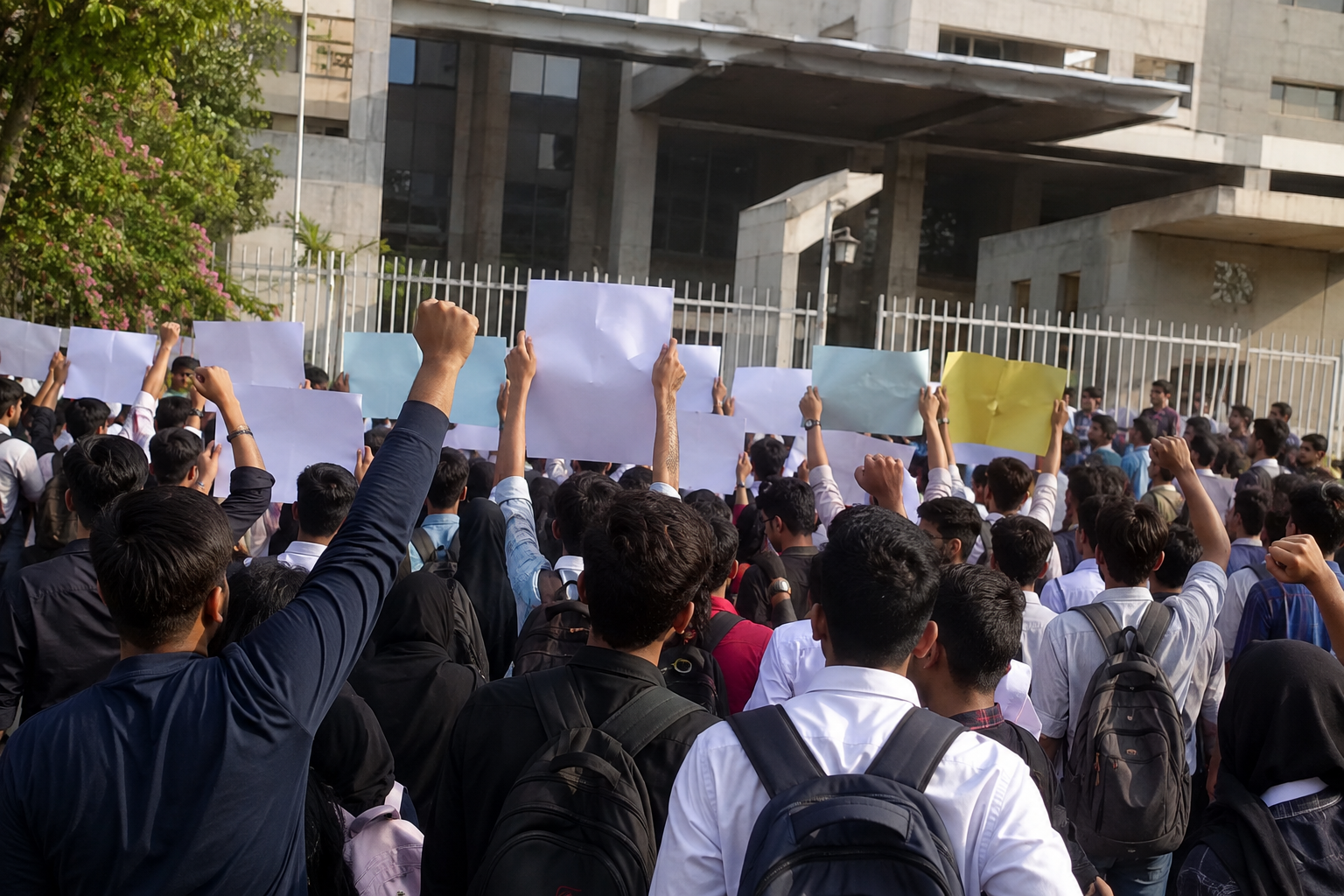
students protest cambridge
|

Students protest Cambridge exam leaks

ISLAMABAD: Accountability4Cambridge has called for a student protest against Cambridge Assessment International Education (CAIE) over alleged examination paper leaks during the 2026 examination cycle, saying the incidents have raised serious concerns about fairness and the credibility of Cambridge examinations.

The student group said reports of leaked papers emerged in 2024 and increased in 2025, but Cambridge failed to provide sufficient public explanations or demonstrate that it had effectively strengthened its examination security system.

According to Accountability4Cambridge, leaked material from several major papers circulated before scheduled examination times in 2026. The group compiled evidence from 17 alleged cases, including screen recordings showing time-zone information that it says established that the material was available before the relevant examinations.

Cambridge recognised four cases and took action, but the students say the remaining evidence was not adequately addressed.

The group raised the issue before the Senate Standing Committee on Federal Education and Professional Training on May 18 and again on June 16. Following the meetings, a sub-committee comprising IBCC, Cambridge, Accountability4Cambridge, the British Council, the Ministry of Education and NCCIA was formed.

During a July 13 meeting, the students presented the 17 recordings and asked Cambridge to respond. After Cambridge questioned the reliability of the videos, Accountability4Cambridge sought forensic verification from the National Cyber Crime Investigation Agency (NCCIA).

The group said NCCIA’s report, received on July 29, found no evidence of tampering in the submitted recordings.

Accountability4Cambridge subsequently requested another sub-committee meeting to present the forensic findings. The meeting was initially scheduled for August 7 but was postponed to August 12 after Cambridge said it was unavailable.

The students have also criticised Cambridge’s decision to use S1 paper marks instead of assessed marks. They argue that using compromised papers for grading could unfairly benefit students who accessed leaked material while disadvantaging those who did not.

Accountability4Cambridge is demanding reversal of the S1 marking decision, lower grade thresholds for Computer Science and Mathematics, recognition of additional leaks supported by forensic evidence, publication of a detailed investigation report and a transparent mechanism for handling compromised examinations.

The group has also urged schools to demand greater accountability from Cambridge.

Founder Samaak Iqbal Malik said the dispute concerns the integrity of the entire examination system rather than a few individual papers.

The organisation has announced a student demonstration outside the IBCC office in G-10, Islamabad, at 1pm on Wednesday, August 12, calling for immediate action before the controversy further affects students’ academic futures.

Similar Posts

  • Oil prices hold above one-week highs as US-Iran te…

    Global oil prices remained largely steady on Tuesday near their highest level in more than a week as uncertainty over a possible ceasefire agreement between the United States and Iran continued to weigh on market sentiment. Brent crude futures were little changed at $87.81 per barrel by 0013 GMT, while US West Texas Intermediate (WTI) crude futures stood at $82.20 per barrel. Both international benchmarks had climbed more than 5% during Monday’s trading session, reaching their highest levels since July 31. The sharp increase came after US President Donald Trump issued fresh demands in response to Iran’s conditions for a potential peace agreement, raising concerns that diplomatic efforts to end the conflict could face further obstacles. Trump has demanded compensation from Iran for deaths and damage linked to wars, attacks and protests, a position that analysts say could make negotiations more difficult. His comments have also increased uncertainty over the future of the Strait of Hormuz, one of the world’s most important oil shipping routes. Later, Trump said the United States was in control of the strategic waterway and had carried out operations to clear Iranian mines from the strait. The remarks added to concerns among energy traders about the security of commercial shipping in the region. “There appears to be a gulf, no pun intended, between the U.S. and Iran over what any agreement would actually look like,” said Tim Waterer, chief market analyst at KCM Trade. According to Waterer, the lack of progress has caused some of the optimism that had supported oil prices in the previous week to fade. The possibility of prolonged disruption to crude shipments has instead provided additional support to prices. Hormuz and Bab el-Mandeb Remain Key Risks The Strait of Hormuz remains a major focus for global energy markets because of its importance to international crude and petroleum-product shipments. Any prolonged disruption in the waterway could tighten global supplies and push up transportation and insurance costs. Market concerns have also extended to the Bab el-Mandeb, another critical maritime route connecting the Red Sea with the Gulf of Aden. Waterer said the risks surrounding both waterways remained significant, warning that even temporary restrictions or the threat of further attacks could raise insurance premiums and force shipping companies to take longer routes. Such disruptions could reduce the volume of energy supplies reaching international markets in the near term, adding further volatility to crude prices. Data cited by Barclays showed that crude oil and refined petroleum product net exports through the Strait of Hormuz averaged around 3 million barrels per day in the week ending August 7. That was significantly below the 4.4 million barrels per day recorded during the previous week. The decline highlights the potential impact of regional security risks on energy flows and has heightened concerns about supply availability if disruptions continue. Jazan Refinery Restart Delayed Supply concerns were also reinforced by developments in Saudi Arabia, where state oil giant Saudi Aramco has postponed the restart of its Jazan refinery. The refinery, which has a processing capacity of around 400,000 barrels per day, is now expected to resume operations on August 30 after the Iran-aligned Houthis claimed responsibility for two attacks on the facility on Sunday. The delay could further complicate regional fuel supply conditions at a time when traders are already closely monitoring disruptions to shipping routes. Iraq Raises Basra Medium Price Meanwhile, Iraq has increased the official selling price for its Basra Medium crude for Asian buyers for September. The price was raised by $2.50 to a discount of $4 per barrel against the average of Oman and Dubai crude benchmarks. The adjustment comes as Asian refiners and international traders continue to assess supply risks arising from tensions in the Middle East. With diplomatic uncertainty between Washington and Tehran, disruptions around major shipping routes and refinery-related setbacks continuing to influence the market, oil prices are likely to remain sensitive to developments in the region.

  • | |

    GCU goes fully paperless, embracing digital govern…

    LAHORE: Government College University (GCU) Lahore has become fully paperless after shifting its administrative operations to a cloud-based digital system, marking a major step towards modern and technology-driven governance. The transformation has been achieved through the successful implementation of the Punjab Information Technology Board’s (PITB) e-Filing and Office Automation System. The platform has been provided to the university free of cost on the special directives of the Punjab government. Under the new digital framework, administrative activities across all university departments will now be managed online through a single platform. Faculty and staff can submit leave applications, travel requests and annual performance reports, while official orders and administrative correspondence will also be processed digitally. The system will also replace conventional paperwork for departmental digital notes, approval of visiting faculty payments, purchase requests and meeting agendas. As a result, the traditional practice of physically moving files from one office to another will be eliminated. Vice Chancellor Professor Muhammad Umar Chaudhry described the move as an important milestone in the university’s digital transformation. He said paperless administration was not merely an environmental initiative but represented a structural shift towards greater transparency, efficiency and accountability. He added that eliminating administrative delays and manual file tracking would allow faculty members and heads of departments to devote more time and attention to teaching and research. He said the initiative could position GCU as a leading example of digital transformation among public-sector universities in Punjab. According to a university spokesperson, the paperless system is part of a broader digitalisation programme launched under the vice chancellor’s leadership during the previous academic year. The university had already introduced online approval mechanisms for student society events and digital billing for payments to visiting faculty. GCU is also preparing to launch a comprehensive e-Services Portal aimed at improving campus facilities. The upcoming platform will enable staff to submit maintenance requests and seek other support services digitally, helping resolve infrastructure-related issues more efficiently without disrupting academic activities. The university’s digital transformation is also extending beyond the campus. Work is underway to digitise the records of its alumni, further expanding the institution’s efforts to establish a modern, technology-based administrative system.

  • | | |

    New committee to review Mir Raza case today

    A new investigation committee will hold an important meeting today to review the Mir Raza Ali murder case. The meeting will be chaired by DIG Aamir Farooqi. The committee will conduct a fresh and impartial investigation into the case. It will examine all aspects of the incident. Investigators will identify and collect any new evidence linked to the case. The evidence will be properly preserved and examined. Physical, technical, circumstantial and forensic evidence will also be reviewed. The committee will closely examine the victim’s injuries and clothes. It will also compare the two conflicting post-mortem reports. Investigators have been directed to take all possible steps to reach a conclusion. The team will submit its findings to the relevant court within the given timeframe. Daily progress reports will also be prepared. Additional officers may be included in the investigation if required. The committee will also record statements from members of the medical board involved in the first post-mortem. Doctors and experts who conducted the first post-mortem are expected to be questioned. They may also be given a detailed questionnaire. Investigators will try to determine the evidence behind the first post-mortem findings. The report had stated that the bullet entered through the chest and exited through the back. The team will also examine how forensic evidence was documented and preserved during the initial investigation. The second post-mortem report gave a different assessment of the bullet’s direction. Investigators will therefore compare both reports in detail. They will also examine the injuries, clothing and other forensic material. Meanwhile, investigators have obtained details about Mir Raza Ali’s movements on the night of July 28. Details of his final phone calls and messages have also been collected. According to the investigation, Mir Raza spoke to two people through three phone calls that night. He reportedly spoke to a person named Ali at 2:13am and again at 2:16am. His final call was answered by his friend Abdullah. The two spoke for more than three minutes.

  • Travelers Cautioned When Crossing the Chiang Rai-Myanmar Border in Tachileik

    CHIANG RAI – The Mae Sai District Chief is currently sending a very strong warning to Thai citizens and tourists traveling across the border to Myanmar. If you plan to visit the bustling city of Tachileik, you must strictly follow all local rules. Doing so will help you avoid severe legal trouble and unexpected detentions […]

  • |

    Eggs fly in Kosovo parliament as political crisis …

    PRISTINA: Kosovo’s parliament descended into chaos after opposition lawmaker Time Kadrijaj threw eggs toward acting Prime Minister Albin Kurti during a heated session, highlighting the deep political divisions gripping the country. Kadrijaj, a member of the Alliance for the Future of Kosovo, reportedly threw four eggs in Kurti’s direction while shouting “shame” as lawmakers debated the stalled formation of parliamentary institutions. The dramatic confrontation prompted security personnel and other lawmakers to intervene, and the session was suspended. The incident came after Kurti asked lawmakers for additional time to continue negotiations before proposing a candidate for the speaker of parliament. Kosovo has remained caught in a political deadlock following the June snap elections, with disagreements among political parties preventing the new institutions from being fully established. Kurti’s request for more time has angered opposition parties, which argue that the constitutional deadline has already expired. They have questioned the legality of continuing the parliamentary session under the circumstances. The confrontation inside parliament underscored the increasingly tense political atmosphere in Kosovo, where repeated disagreements have delayed key constitutional and institutional processes. Despite the disruption, Kurti appeared to remain composed. Reports said he indicated that he was willing to face criticism if it helped bring political rivals to the negotiating table. The political impasse follows June’s parliamentary election, in which Kurti’s Vetëvendosje movement emerged as the largest political force but failed to secure enough support to move forward without cooperation from other parties. Kosovo has experienced repeated political instability in recent years, with disagreements over the formation of institutions contributing to uncertainty over the country’s political direction. The egg-throwing incident has now become a striking symbol of that frustration, turning an already tense parliamentary dispute into an extraordinary scene that quickly attracted international attention. For Kosovo, however, the bigger issue remains unresolved: whether political parties can overcome their differences and break the institutional deadlock before the crisis deepens further.

Leave a Reply

Your email address will not be published. Required fields are marked *