death toll rises
|

Death toll rises to 254 after powerful Colombia earthquake

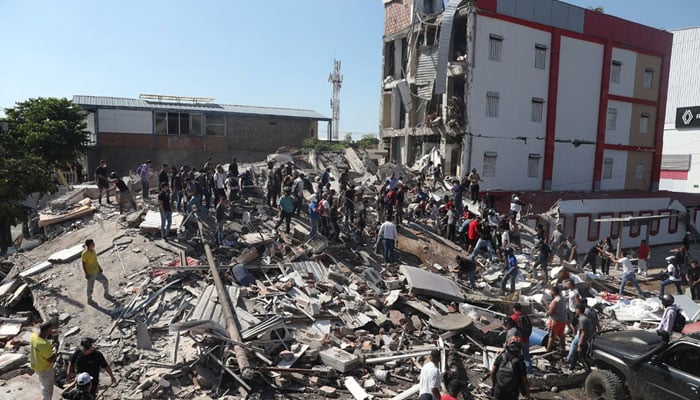
The death toll from a powerful earthquake that struck western Colombia on Monday has risen to 254, according to foreign media reports, as rescue teams continue searching through devastated areas for survivors.

The 7.4-magnitude earthquake caused widespread destruction across the affected region, with dozens of buildings collapsing and significant damage reported to infrastructure. Several communities remain without electricity and access to essential services, making rescue and relief operations increasingly difficult.

Colombian authorities have warned that the full scale of the disaster may not become clear for several days. Rescue workers are still assessing damaged areas, while officials are working to determine the exact number of casualties and the extent of property damage.

The earthquake also disrupted basic services in several affected communities, leaving residents struggling to access electricity and other necessities. Emergency teams have been deployed to assist victims, search damaged buildings and provide immediate relief to people who have lost their homes.

Officials expect the death toll and damage estimates to change as rescue crews reach areas that remain difficult to access. Authorities have urged residents to remain cautious and follow emergency instructions as assessments and relief efforts continue.

The 7.4-magnitude tremor stands among the most destructive earthquakes to hit western Colombia in recent years, causing severe damage and a major humanitarian challenge for local authorities.

Similar Posts

  • |

    Houthi attacks kill 38 Yemeni troops, dozens injured

    Houthi missile and drone strikes killed at least 38 Yemeni government soldiers and injured 29 others on Thursday in one of the deadliest attacks in recent years, according to medical sources. The assaults targeted military camps in Marib and Hadramawt provinces, including positions near the Saudi Arabian border. Security officials said one of the missiles struck troops during their morning assembly at a military camp in Marib, causing heavy casualties. Military sources said the attacks hit camps in the Al-Ruwaik area of Marib as well as Al-Abr and Al-Wadiah in Hadramawt. The strikes left dozens of soldiers dead or wounded, with officials warning that the casualty toll could rise as some of the injured remain in critical condition. The latest violence comes as Yemen’s long-running conflict has intensified following recent regional tensions. Last month, the Iran-backed Houthi movement expanded its military actions after renewed hostilities involving Iran and the United States. The group resumed attacks after a period of relative calm, including strikes on government forces and maritime targets. In a separate incident last month, Houthi fighters killed 16 government-aligned soldiers during an attack south of the strategic port city of Hodeidah. Yemen has been devastated by conflict since 2014, when the Houthis seized the capital, Sanaa, forcing the internationally recognised government to relocate. The rebels continue to control much of northern Yemen, while government forces hold large parts of the south. Although a UN-brokered truce reached in 2022 significantly reduced large-scale fighting, the agreement eventually expired, and sporadic clashes have continued. The latest attacks highlight the fragile security situation and raise fears of further escalation in a war that has already claimed hundreds of thousands of lives and created one of the world’s worst humanitarian crises.

  • |

    Nine dead after Thai teenager mounts deadly rampage at home and school

    The death toll from a mass shooting in Thailand has risen to nine after a 12-year-old girl died in hospital from injuries sustained during Friday’s attack. Police confirmed that the 14-year-old perpetrator spent up to two years researching firearms online and consuming violent media. The teenager shot and killed his two grandparents at their Bang Bua Thong residence in the early hours of Friday morning before travelling to Debsirin Nonthaburi School, northwest of Bangkok. Armed with a legally registered 9mm handgun belonging to his grandfather, a knife, and additional ammunition, the student opened fire inside the school, killing staff and injuring dozens before turning the weapon on himself. Over a dozen victims, mostly aged between 12 and 14, remain hospitalised with critical injuries. Deputy Commissioner of Province 1 Police Region Atthapol Anusit stated that detectives have interviewed 17 witnesses so far. While police noted the boy had shown signs of school-related stress, relatives claimed they were unaware of any prior behavioral issues. In response to the tragedy, Thailand’s Ministry of Education announced plans to implement comprehensive campus safety reforms within three months, including emergency response training, weapons restrictions, and mental health screening mechanisms. Meanwhile, Prime Minister Anutin Charnvirakul pledged to introduce stricter legislative controls on gun ownership across the country.

  • | |

    Iran pressures Gulf allies to rein in Trump, threa…

    Iran has launched an intensive diplomatic campaign targeting Gulf states, warning them directly that Tehran will strike their oil, power and water facilities unless they persuade President Donald Trump to halt US military action and pursue a negotiated end to the war instead. According to a senior Iranian official, the warning covers potential attacks on energy facilities, oil fields, refineries, electricity grids, water systems, transport networks and other strategic infrastructure belonging to Washington’s closest Arab partners in the region. The message formed part of a wider Iranian strategy to discourage further American military action by raising the specter of significant economic damage across the Gulf. Sources familiar with the matter said the warning traveled through a wave of high level diplomatic contacts following Trump’s July 28 threat to strike Iran’s energy network and broader infrastructure. Two senior Iranian officials, two Gulf sources and a senior regional diplomat, all speaking on condition of anonymity given the sensitivity of the discussions, said Iranian Foreign Minister Abbas Araqchi held conversations with his Saudi, Turkish and Qatari counterparts as well as Pakistan’s army chief. The senior diplomat said Araqchi pressed Washington’s Gulf allies to use their influence with Trump to head off renewed strikes, cautioning that any attack on Iran would trigger retaliation against American assets and critical infrastructure throughout the Gulf. The diplomat said Araqchi delivered a consistent message in each conversation, expressing readiness to retaliate while stressing that a diplomatic solution offers the best chance of avoiding wider regional destruction. One Gulf source described the Iranian position as unambiguous, saying Tehran made clear that any American strike on Iranian infrastructure would draw retaliation against Gulf energy facilities and other regional targets. The campaign illustrates how Iran is attempting to convert Gulf vulnerability into diplomatic leverage, presenting regional governments with the prospect that a renewed confrontation between Washington and Tehran could put the infrastructure their economies depend on directly at risk. Saudi Crown Prince Mohammed bin Salman subsequently spoke with Trump directly, urging him to hold off on military action, return to the negotiating table, pursue a ceasefire and seek a diplomatic resolution, according to the senior diplomat and Gulf sources. Another Gulf source said the warning was meant for every Gulf state but traveled primarily through Saudi Arabia and Qatar, both of which have rebuilt ties with Iran in recent years after a long period of regional rivalry. Qatar, Oman and Saudi Arabia have each urged Washington to resume talks with Tehran and prevent a fresh round of conflict, with Iran cautioning that further strikes could turn the region into what one Iranian official called a fireball. On August 2, Trump said he had agreed to call off a planned attack on Iran, provided a deal could be reached quickly. Concerns over wider escalation A Gulf source said Saudi Arabia believes additional escalation would only cause further destruction, explaining why Riyadh pushed Trump to give diplomacy more room to work. At the same time, Saudi officials made clear the kingdom would defend itself if directly threatened, with a second Gulf source saying Riyadh warned that any strike on Saudi territory would draw a military response of its own. Ali Shihabi, a Saudi analyst with ties to the royal court, said the kingdom’s assessment holds that further escalation is unlikely to produce the outcome Washington wants. He said Saudi officials believe a mix of proportionate military responses combined with sustained pressure on Iran around the Strait of Hormuz offers the most realistic route toward a workable diplomatic settlement. Iran’s clerical leadership has repeatedly called for the closure of US military bases across the Gulf and urged Gulf Arab states to stop sharing intelligence with Washington, which Tehran believes has enabled strikes against Iranian targets. Shihabi noted that memories of the September 2019 drone and missile strikes on Saudi Arabia’s Abqaiq and Khurais oil facilities still shape regional thinking, since that attack temporarily cut more than half the kingdom’s crude output and exposed how vulnerable Gulf energy infrastructure remains. A separate Iranian official reiterated that any damage inflicted on Iran would be met with far greater retaliation, again citing power grids and refineries among potential targets. From Tehran’s perspective, the senior Iranian official said, Trump now confronts two difficult options: escalate a conflict that risks engulfing the wider Gulf and disrupting global energy markets, or accept a negotiated settlement that falls short of the decisive win Washington has sought. The senior regional diplomat identified Washington’s reluctance to let Tehran claim any form of victory as one of the central obstacles blocking an agreement, noting that American officials want tangible proof they prevailed in the conflict.

  • |

    Cambridge professor Jason Arday resigns following plagiarism and CV investigation

    Professor Jason Arday, who became the youngest Black professor appointed in the history of the University of Cambridge, has resigned from his post with immediate effect following escalating accusations of academic misconduct and misrepresentation of his qualifications. In a statement released on Wednesday via the Good Law Project, the 41-year-old sociologist said he had “concluded that the only way to bring this chapter to an end is to step away”, citing the severe personal cost of public scrutiny. Arday maintained that his resignation should not be interpreted as an admission of guilt or an acceptance of the allegations against him. The resignation coincided with an official announcement from the University of Cambridge confirming the launch of an investigation into new details surrounding Arday’s academic credentials and honorary titles, alongside ongoing complaints handled under its research misconduct policy. Jesus College, where Arday held a fellowship, confirmed a parallel internal review. The controversy began when former Cambridge researcher Nathan Cofnas published allegations detailing extensive textual overlap in Arday’s published academic papers using plagiarism-detection software. Cofnas also questioned several public claims made by Arday regarding his charitable activities, including assertions of running 30 marathons in 35 days and raising more than £5 million for charity. Arday previously acknowledged editorial oversights in his earlier work, attributing textual similarities to processing methods linked to his neurodivergence and autism, while strongly denying intentional deceit or dishonesty. He argued that the scrutiny was part of a racially motivated campaign targeting his position and diversity initiatives within academia. Publisher Simon & Schuster, which is slated to publish Arday’s memoir later this month, issued a statement defending his professional integrity, while Cambridge officials stressed that formal review processes will proceed in accordance with employment law and institutional guidelines.

  • | | | |

    Iran says Pakistan-Turkey-Saudi pact not aimed at Tehran

    Iran has said it has no reason to believe that the new security agreement between Pakistan, Turkey and Saudi Arabia is aimed against Tehran. Iranian Foreign Ministry spokesperson Esmaeil Baghaei said the agreement should not be viewed as a direct threat to Iran. He said the new regional security arrangement reflects a broader change in how countries in the Middle East are approaching their security needs. Baghaei said regional states are increasingly recognising that the United States cannot guarantee long-term security in the region. He also accused Washington of contributing to instability in the Middle East. He said regional security arrangements could help strengthen stability if they take into account the political and historical realities of the region. He also called for such arrangements to be broad and inclusive. Baghaei said Iran would not resume direct negotiations with the United States while Washington continues to violate an interim agreement between the two sides. Iran has also linked the reopening of the Strait of Hormuz to several demands from Washington. Iranian Foreign Minister Abbas Araghchi said Tehran and Oman were close to finalising an agreement on new shipping routes through the strategic waterway. He said the agreement was in its final stages. However, Araghchi stressed that an agreement with Oman would not automatically lead to the reopening of the strait. He said the United States would first need to meet several conditions set by Tehran. Iran is demanding compensation for damage caused by US attacks. It is also calling for an end to US military threats and sanctions against Iran. Iran has further demanded an end to attacks against its regional allies. Other demands include the removal of restrictions on Iranian shipping and the release of frozen Iranian assets. The Strait of Hormuz is a major international route for oil and gas shipments. Its prolonged closure has raised concerns over global energy supplies and shipping. Iran and the United States are currently not holding direct talks. Tehran says it will not enter direct negotiations while Washington continues to breach the interim agreement reached earlier this year. Messages between the two countries are being exchanged through intermediaries. Iran has also made a major change in its national security leadership. Former Revolutionary Guards commander Mohsen Rezaei has been appointed secretary of the Supreme National Security Council. Rezaei replaces Mohammad Bagher Zolghadr, who had been appointed to the position in March. No official reason was given for the change. The move, however, comes at a sensitive time for Iran as tensions with the United States and Israel remain high. Rezaei, 71, is a senior figure in Iran’s political and security establishment. He led the Islamic Revolutionary Guard Corps from 1981 to 1997. He served during much of the Iran-Iraq war. He later spent more than two decades as secretary of Iran’s Expediency Discernment Council. Rezaei also served as vice president for economic affairs from 2021 to 2023 under former President Ebrahim Raisi. Iran’s Supreme Leader Mojtaba Khamenei has also appointed Rezaei as his representative on the Supreme National Security Council. Zolghadr has been appointed as Khamenei’s political adviser. The Supreme National Security Council coordinates Iran’s security and foreign policy. It includes senior military, intelligence and government officials. Meanwhile, differences between the United States and Israel are reportedly growing over military operations across the region. Israeli broadcaster Channel 13 reported that Washington is pushing Israel to move toward ending fighting on three fronts. These include Gaza, Lebanon and Iran. US Central Command chief Admiral Brad Cooper reportedly conveyed the message during a visit to Israel. Washington wants progress toward reducing military operations and closing the three active fronts. Israeli officials, however, have indicated that they want to maintain freedom to act against Iran. Israeli military officials reportedly told their US counterparts that Israel intends to retain the ability to strike Iran if Tehran continues developing its nuclear programme or rebuilding its ballistic missile capabilities. Washington is also pushing for further Israeli withdrawals from positions in southern Lebanon. In Gaza, the United States is seeking progress toward a broader settlement. It is also supporting the deployment of a multinational force in the territory. Israeli security officials have reportedly objected to some US demands. These include reducing military operations and targeted killings in Gaza. The developments point to growing differences between Washington and Tel Aviv over how to manage conflicts involving Iran, Lebanon and Gaza. At the same time, the United States appears to be adopting a more cautious approach toward Iran. Tehran, however, continues to link the reopening of the Strait of Hormuz to major concessions from Washington.

  • |

    Christopher Nolan nears a monumental career achievement

      Christopher Nolan is on the verge of a monumental career milestone. On Friday, August 7, Deadline confirmed that his latest film, The Odyssey, is crushing the worldwide box office, enjoying massive commercial success that adds yet another triumph to his legendary filmography. In a resurfaced interview, Nolan admitted the project was deeply nerve-racking despite years of careful work. He humbly noted that while filmmakers pour their hearts into their creations, movies ultimately belong to the audience, and their value lies in the eye of the beholder. This perspective reveals his rare respect for viewers, acknowledging that a film’s meaning is completed only when it reaches them. Beyond this epic, Nolan has gifted cinema with modern masterpieces like Oppenheimer, Interstellar, Inception, Batman Begins, and The Dark Knight Rises. Each film showcases his signature blend of intellectual ambition and visual spectacle, cementing his status as a visionary director who consistently pushes boundaries. The Odyssey, which Nolan both wrote and directed, adapts Homer’s ancient Greek epic into an action-packed fantasy. In a historic first, the entire film was shot using IMAX cameras, bringing this foundational saga to screens with breathtaking grandeur. The story tracks King Odysseus on his perilous ten-year journey home after the Trojan War. Along the way, he confronts terrifying mythical foes—the giant Polyphemus, the enchanting Sirens, and the sorceress Circe—before finally reuniting with his devoted wife, Penelope, on his native island of Ithaca. The film boasts an extraordinary ensemble cast, including Matt Damon, Tom Holland, Anne Hathaway, Robert Pattinson, Lupita Nyong’o, Samantha Morton, and Zendaya. This stellar lineup ensures Homer’s legendary characters are portrayed with charisma and emotional depth, elevating the ancient tale for modern audiences. With such a powerhouse combination of director, source material, and talent, The Odyssey has already become one of the year’s biggest cinematic events. Its box-office domination not only highlights Nolan’s commercial clout but also reaffirms his unique ability to marry intellectual storytelling with blockbuster spectacle, captivating global audiences and reshaping what epic filmmaking can achieve.

Leave a Reply

Your email address will not be published. Required fields are marked *