
Fiction

  • |

    The architecture of world-building in fiction

    When readers choose a speculative novel or immerse themselves in a literary landscape, they are considering than following a character’s journey. They are stepping into a fully realized alternate reality. The imaginary reality is complete with its own geography, social hierarchies, natural laws, and cultural mythologies. While world-building is often discussed as a technical craft of maps, timelines, and terminology, its true power lies in psychology. The most compelling fictional universes merely inform readers. They subtly reshape how the human brain processes space, identity, and meaning. Psychologists refer to the mental phenomenon of becoming lost in a narrative as narrative transportation. When world-building is executed with precision, readers undergo a temporary shift in consciousness. Their immediate physical surroundings fade, and their working memory fully commits to the sensory and spatial details of the fictional environment. This process relies heavily on cognitive schemas. The mental blueprints the brain uses to organize information about the real world. Effective authors exploit these schemas. They purposefully present familiar elements of human behavior or physics to evoke wonder. What makes world-building psychologically resonant is the sheer volume of factual detail an author creates. Above all, the emotional truth that lies within those details. A fantasy city or distant alien colony feels authentic. Especially, its architecture, customs, and laws reflect the lived anxieties and aspirations of its inhabitants. Consider how fictional societies address scarcity, power, memory, or grief. When a setting’s internal logic mirrors fundamental human dilemmas, the brain accepts the setting as tangible. The world becomes a living stage rather than a static backdrop. Furthermore, immersive world-building fulfills a profound psychological need for safe exploration.  Well-crafted settings safely ask readers to navigate complex political systems, environmental collapses, or unfamiliar norms from a comfortable distance. Fiction acts as cognitive testing where readers can process real-world existential fears without experiencing direct danger. The sense of discovery that comes from decoding a world’s hidden rules releases dopamine. The experience rewards the reader’s curiosity and keeps them engaged across hundreds of pages. Ultimately, world-building is an exercise in mutual trust between writer and reader. The author provides the architectural framework. However, the reader’s mind brings the bricks and mortar. They use their own memories, visual imaginations, and emotional experiences to bring the landscape to life. When done right, a well-built fictional world never truly leaves the reader. Long after the final page is turned, its echoes linger in the mind. The immersive imagination forever alters how we view the boundary between what is real and what can be imagined.  
  • |

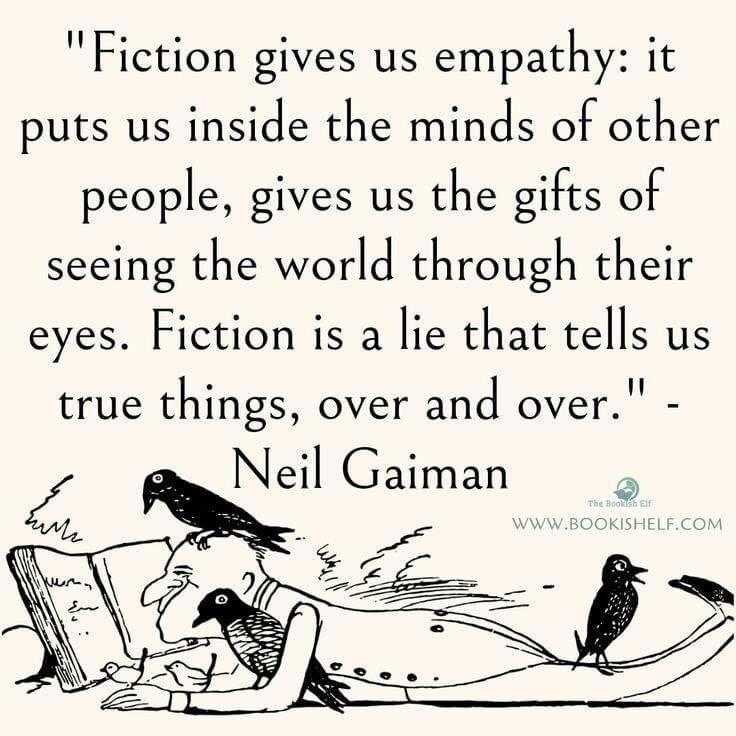
    How fiction brain-trains compassion

    Empathy is the capacity to understand and share the feelings of another. It’s not merely an inherent personality trait; it is a cognitive muscle that requires exercise. While there are many ways to practice compassion in daily life, neuroscientists and psychological researchers have uncovered a uniquely powerful tool for training this mental capacity: reading deep, character-driven fiction. For decades, society viewed reading literature as a purely intellectual or escapist hobby. However, recent scientific studies using functional magnetic resonance imaging (fMRI) have revealed that when we read a story, our brains process the experience in ways remarkably similar to real-world social interaction. When an author describes a character running through a dark forest, struggling with heartbreak, or feeling a sharp pang of injustice, the sensory and emotional centers in the reader’s brain light up as if the reader were experiencing those events directly. This neural simulation allows us to step entirely out of our own shoes and temporarily inhabit the subjective reality of someone else. Psychologists often refer to this ability as theory of mind. It’s the cognitive skill that enables human beings to attribute mental states (beliefs, intents, desires, emotions, and knowledge) to themselves and others. Life only permits us to live a single, localized existence defined by our specific background, culture, and circumstance. Literary fiction breaks through those physical and social barriers. Through the pages of a novel, a reader living in a quiet suburban town can intimately experience the internal struggles of an immigrant navigating a new city, an incarcerated individual fighting for dignity, or a historic figure facing a agonizing moral dilemma. Crucially, fiction tells us what people do. Also, it exposes why they do it. It grants us unprecedented access to the secret thoughts, doubts, and vulnerabilities that real people rarely reveal in public. By witnessing a character’s internal contradictions, readers learn that human behavior is rarely black-and-white. We develop a tolerance for ambiguity and a healthier skepticism toward snap judgments. When we close the book, that expanded perspective lingers in our conscious mind, subtly altering how we interact with co-workers, strangers, and loved ones. Furthermore, reading fiction builds emotional stamina. It asks us to sit quietly with uncomfortable emotions like grief, fear, longing, and regret without fleeing into digital distractions. In doing so, it expands our capacity to hold space for others when they undergo difficult seasons in real life. Literary fiction, therefore, is far more than entertainment. It is a quiet, radical act of bridge-building. Every time we turn a page and immerse ourselves in a stranger’s story, we perform a vital neurological exercise that softens our defenses, broadens our horizons, and reminds us of our shared humanity.  

  • | |

    Modern fiction Is turning to non-human storytellers

    In contemporary literature, narrative perspective is being handed over to dogs, octopuses, whales, birds, and endangered wildlife. Talking animals have long been a fixture of children’s fables and folklore.  However, today’s literary fiction is doing something far more ambitious. Authors are adopting animal vantage points to grasp  profound existential questions, ecological grief, and the bewildering complexity of human society. Why readers and writers alike are suddenly captivated by animal narrators? This interest reveals much about our current cultural moment and the unique psychological role that fiction plays in times of global crisis. One of the most compelling reasons for the rise of animal storytellers is their ability to cut through human cynicism. We live in a world saturated with social media fatigue, and moral ambiguity. So, human characters often arrive with heavy psychological baggage. Readers may instantly judge a human narrator based on their socio-economic background, political leanings, or lifestyle choices. An animal narrator, by contrast, operates outside these human constructs. Whether it is a rescue dog observing a broken family or a pelican observing coastal transformation, an animal offers a clean perception. Their observations are rooted in immediate sensory experience: hunger, instinct, weather, fear, affection, and loyalty. Non-human narrators re-open channels of emotional honesty by stripping away political pretense. They allow readers to engage with burdening themes like grief, isolation and love. In literary theory, the concept of defamiliarization refers to the art of making the familiar look strange so that readers can see it clearly for the first time. Human beings have become accustomed to concrete jungles, light pollution, plastic waste, and digital distraction. To us, these phenomena are simply the backdrop of daily life. When we view through the eyes of a non-human entity, modern human habits suddenly appear bizarre. A bird that’s trying to navigate glass skyscrapers. Whale interpreting the deafening sonar of industrial ships. Forest mammal trying to cross a highway. They all illuminate the bizarre artificiality of human civilization. By shifting the vantage point, authors force readers to step outside their anthropocentric bubble. Thus, readers recognize how dramatically human choices disrupt the living ecosystem. We live in an era marked by accelerating biodiversity loss and climate instability. We own a reality that frequently induces emotional paralysis or denial in human populations. Directly reading about ecological devastation in news reports can lead to apathy or fatigue. Fiction narrated by animals offers a way to process ecological mourning on a deeply personal level. The abstract concept of climate change transforms into an immediate tragedy when the perspective is of an animal suffering habitat destruction. The non-human perspectives give dignity to  creatures that are seen as collateral damage in human progress. It transforms passive statistics into active, feeling individuals whose survival matters to the reader. At its core, the novel has always been an engine for cultivating empathy. For centuries, that empathy was restricted to other human beings of different cultures, genders, or eras. Modern fiction is taking the logical next step by stretching the boundaries of empathy beyond our own species. How do you depict a mind that experiences the world primarily through smell, echolocation, or instinct rather than human logic? Successful books navigate this by taking an imaginative leap with scientific understanding. Thereby, resisting the urge to turn animals into simple humans in fur or feathers. In doing so, they remind us that human intelligence is not the only valid way of experiencing reality. The surge in animal-led fiction reflects a growing realization that human stories do not exist in a vacuum. Our reluctance to listen to non-human perspectives has come at a high cost. Modern literature is not retreating from reality into fantasy. It is confronting our reality with clarity. It is reminding us of the wild world we share and the urgent need to preserve it.