lahore

  • Treasure hunt at Mayo landa in old Lahore

    Behind the 19th-century Victorian red-brick arches of Mayo Hospital exists one of Lahore’s most vibrant bazaars: Mayo Landa. First-time visitors might expect a simple fleece and jacket bazaar through the narrow lanes behind Mayo Hospital. However, it reveals something far richer. Mayo Landa has transformed into a bustling open-air ecosystem where global fashion, imported household goods, rare oddities, and genuine historic antiques intersect at prices that defy modern inflation. The word landa originates from the Punjabi term for roofless or uncovered. It usually refers to the early informal stalls that traders set up along open alleys without permanent shopfronts. The origins of Lahore’s landa market trace back to the pre-partition British colonial era. It is located strategically between the Lahore Railway Station and bustling medical hub of Mayo Hospital (established in 1871). The area naturally became a high-traffic junction for travelers, laborers, and rural migrants. Vendors began setting up wooden crates and blankets to sell low-cost textiles and goods to working-class families who could not afford stuff otherwise. Following the partition in 1947, the market expanded rapidly to accommodate millions of resettling families seeking affordable essentials. Over the decades, small family-run stalls grew into an organized nationwide wholesale network. Today, Mayo Landa operates as a major locality for imported pre-owned items. These are sourced globally from North America, Europe, Japan, South Korea, and Australia. While everyday apparel from heavy winter coats to designer sneakers remains a staple, the modern Mayo Landa experience goes far beyond clothing. Collectors regularly scour the market for genuine heavy-leather jackets, vintage denim, and retro sports gear that would cost hundreds of dollars internationally. Stalls feature everything from Japanese porcelain and European glassware to high-end kitchenware and functional electronics. Antique items are hidden within subtle corner stalls and old storerooms. Victorian brass lamps, mid-century mechanical clocks, classic cameras, old vinyl records, and hand-carved wooden artifacts. Prices are mostly negotiated through traditional haggling. Shoppers can frequently pick up valuable, high-grade collectibles at a fraction of their market value. What makes the backside of Mayo Hospital particularly captivating is its extraordinary cultural overlap and unique spatial atmosphere. Mayo landa alleyways & antique stalls. There roaming doctors & med students in scrubs. Then NCA art students searching for props across the area. Amongst, pashtun traders sorting bales. Hidden under the shade of century-old banyan trees behind the hospital compounds are secretive, multi-room vintage stores disguised as crumbling brick structures. Step inside, and you might find an operational 1920s gramophone playing vintage orchestra records right next to a pile of modern winter coats. Mayo Landa is more than just a flea market to the frequent visitors. It is a living archive of economic resilience, sustainable reuse, and cultural heritage. In a world dominated by fast fashion and mass-produced plastic, this historic corner of Old Lahore offers something rare. It’s the thrill of real discovery backed by over a century of history.  

  • | | |

    One missed bill enough for Lesco to pull the plug?…

    The month of July brings heat and humidity to Lahore. It also brings frequent power cuts, mainly from weather related issues. When it rains, and the atmosphere is muggy, power breakdown occurs and people expect that power will return soon after it goes. But there is a different kind of fear. This fear grows when a house sits dark while every other house on the street still has light. This means the power meter has been disconnected. Recent reports say that field staff of the Lahore Electric Supply Company (LESCO), have been harassing consumers. These reports say that officials are disconnecting power for people who have missed just one month of bill payment. This goes against the normal rule. Under the normal rule, a meter can only be disconnected after two months of non-payment. LESCO spokesperson Rabia Qadir has denied these reports. She said the company has not received any complaint about this issue. She said that rules made by the National Electric Power Regulatory Authority (Nepra), protect the rights and safety of consumers. Under these rules, a meter cannot be disconnected simply because one month of bill payment was missed. She also said that Lesco has not received any formal complaint against any sub-divisional officer, executive engineer, or lineman of any of its circle regarding such incidents. However, she said that some linemen may try to scare or pressure consumers. These linemen may threaten to disconnect a meter if the consumer does not pay the outstanding bill right away. She said this could happen in some cases and this was not the company’s policy. But she stressed that Lesco has a consumer complaint cell. All complaints are recorded there. She said that according to these records, no such complaint has come in. The situation on the ground appears more complicated. This reporter visited the consumer cell at the office of the Lesco chief officer. Several consumers were present there. Their complaints were about different issues. Some wanted correction of industrial bills. Others reported broken meters. When asked about the reports of meters being cut for a single month of default, one officer gave an important detail. They said this practice usually happens in June or July. They said the ministry gives instructions during these months to speed up bill recovery. The goal is to reduce financial losses. Staff at the office suggested that a proper response should come from Lesco Chief Executive Officer Ramzan Butt or his public relations office. However, the public relations office said that Ramzan Butt was in Islamabad for a meeting at the time. This problem is not limited to LESCO areas. Similar reports have come from areas covered by the Multan Electric Power Company. In Muzaffargarh, consumers who missed one month of payment received strict warnings from field staff. These staff members told consumers to avoid another default. If they defaulted again, they were told, their meters would be disconnected. According to the rules, a power connection cannot be cut through meter removal unless bills for both the current and the previous month remain unpaid. Yet for several months now, Lesco teams have continued cutting connections even when only one month of payment was missing. Other than power severe threats, the other main issue people face is take notice of a major problem in the new electricity bill format. The Pakistan Hosiery Manufacturers and Exporters Association in a letter to the prime minister said the revised bill has removed a lot of information that consumers used to see. He said this makes it hard for people to check their meter readings, units consumed, tariff calculations and other charges on their own. They say the changes seem to have been made without following the proper process set by the National Electric Power Regulatory Authority, known as NEPRA. No formal request for changing the bill format was filed with NEPRA and that consumers were never asked for their objections, nor were they given a chance to take part in a public hearing before the change was made. They say that bills are supposed to show the date when the connection or meter was installed, but this information is now missing. The removal of the meter reading snapshot is a serious problem, because consumers can no longer check if the reading used for their bill matches the actual reading at their home. Also, information about the meter reader, along with the date and time of the reading, has also disappeared. They say that when a meter is changed, the bill should show a snapshot of the final reading from the old meter, but distribution companies are not properly doing this. The new bills carry a QR code instead, but this cannot replace information that should be clearly printed on the bill itself. Many senior citizens, people living in rural areas, and low income households may not have smartphones or the internet access needed to scan a QR code. Economist and corporate lawyer Dr Ikramul Haq commented on this situation. He said that the conduct of power distribution companies is not simply a small technical mistake. He called it as a form of pressure against ordinary citizens. These citizens are already struggling with rising prices, high electricity rates, and falling purchasing power. He said that reports of field teams arriving at homes, treating consumers badly, and threatening immediate disconnection show the real human cost of this careless approach. He added that in some cases, meters were removed without any prior notice being given. Dr said explained that the legal position on this matter is very clear. Under the revised Consumer Service Manual issued by Nepra, electricity cannot be disconnected only because the bill for the current or previous month remains unpaid. A notice of seven days must be given along with the bill for the second month of default. Only after this notice period passes, and the default continues, can disconnection take place. He said that removing a meter involves even more safeguards under the rules. He

  • |

    Alliance Française de Lahore exhibits ‘What…

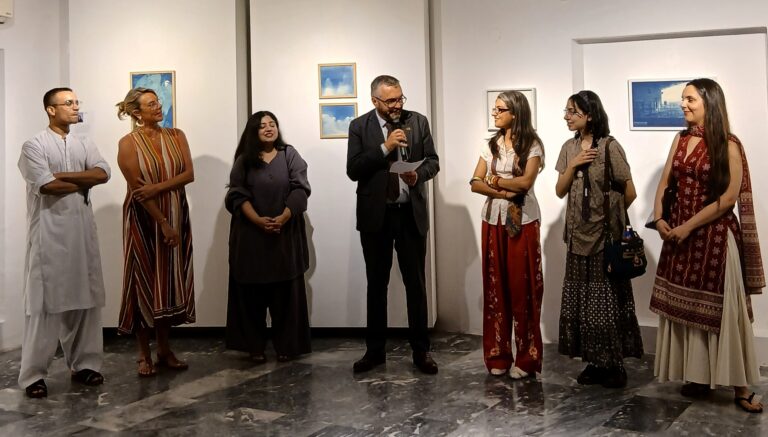
    LAHORE — The gallery at Alliance Française de Lahore opened its doors to art enthusiasts on August 10, 2026. The exhibition presented “What’s Remains”  curated by Anne Sophie Français. The evening paired thought-provoking artworks installations with a lively Kathak dance showcase. The multidisciplinary art offered attendees a rich space and human experience. The art exhibition was curated as a inquiry into what lingers after a place is traversed or a voice is silenced. “What’s Remains“ features new works by three emerging Pakistani visual artists: Rabya Khalid, Sarim Syed and Yumna Salman. They worked across diverse mediums ranging from cyanotypes and charcoal drawings to intricate textile sculptures. Rabya Khalid anchors her compositions in rich cyanotype blues overlaid with soft pastels and color pencils. Rabya focuses on urban architectural features. Water towers, elevated rooftops and quiet watchtowers dominate her skyline studies. Her works cast functional city infrastructure as silent or watchful witnesses to human activity. Sarim Syed utilized delicate charcoal rendering. Sarim creates dreamlike, atmospheric landscapes that occupy the boundary between remembering and forgetting. Her works evoke the lingering sensation of places once inhabited, capturing moments suspended between presence and absence. Yumna Salman brings a tactile, social critique to the gallery space. Yumna knots loose threads onto rigid metal wire mesh. Her labor-intensive textile installations reinterpret traditional weaving techniques to question inherited social norms, gender roles and collective memory. She turned each deliberate knot into an act of quiet resistance. Following the gallery preview, the evening changed into a vibrant 7:30 PM Kathak performance. The performance featured dedicated dance students. They celebrated an intensive month of rhythm, classical movement and expressive storytelling. The fluid footwork and rhythmic precision of the dancers created a unified dialogue with the silent, lingering themes of the surrounding artwork. Alliance Française de Lahore continues to act as an essential platform for emerging talent. The institution provides artists a non-commercial environment to showcase work, inspire public dialogue and strengthen cultural ties between Pakistani and Francophone creative communities. “What’s Remains” invites viewers to engage with stories that endure through art, memory and movement.