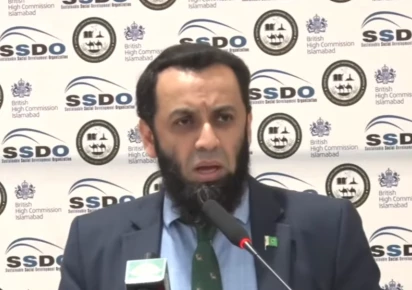
tarar calls stronger
| |

Tarar calls for stronger narrative against terrori…

Information Minister Attaullah Tarar has called for a stronger national effort to counter terrorism, extremism and misinformation, saying Pakistan’s fight against militancy cannot be limited to security operations.

Addressing a capacity-building workshop in Islamabad, Tarar said the country also needed to win the battle of narratives by addressing misinformation and reducing the gap between public perception and facts.

He said Pakistan had made considerable progress against terrorism through coordinated efforts by the federal and provincial governments, security forces and other state institutions. The National Action Plan, he added, had played an important role in bringing stakeholders together.

According to Tarar, Pakistan’s security situation had improved significantly by 2017, allowing economic activity and investment to recover. However, he argued that a subsequent policy shift weakened years of counter-terrorism efforts.

The minister stressed that national security policies should have continuity and should not change with changes in government. He called for political parties to develop consensus on major national policies so that long-term strategies could continue regardless of which party was in power.

Tarar also highlighted the importance of Pakistan’s international narrative. He said the country had suffered heavily from terrorism and had made significant sacrifices involving security personnel, political figures, professionals and civilians.

He said Pakistan had increasingly used international media platforms to present its position and challenge what it described as misleading narratives about terrorism and regional security.

Discussing tensions with India following the Pahalgam incident, Tarar questioned the version of events presented by New Delhi. He reiterated Pakistan’s call for a transparent and internationally conducted investigation and said the country had sought to address the issue through diplomatic and media channels.

The minister said terrorism had no religion, colour or ethnicity and maintained that the state would not allow violent groups to impose their ideologies on society.

He warned that militant organisations were increasingly shifting their focus towards vulnerable and “soft” targets after facing pressure from security forces. He cited the Jaffar Express attack as an example and praised security agencies for their response.

Tarar also raised concerns over the role of digital platforms in spreading extremist material and misinformation. He said the government was strengthening its legal and institutional mechanisms to deal with cybercrime and harmful online narratives.

He said a Digital Communication Department had been established using modern technologies, including artificial intelligence-based monitoring and speech-to-text systems, to identify emerging narratives in the digital space.

According to the minister, provincial governments were also being offered assistance in establishing similar communication structures.

Tarar said state institutions also needed to promote Pakistan’s positive image by highlighting its culture, tourism, music, cuisine and arts. He praised Pakistan Television for contributing to efforts aimed at presenting a broader image of the country.

He also stressed the need for better communication and timely reporting from Balochistan. The government, he said, was willing to support television networks in establishing bureaux in the province’s southern districts.

Speaking about Balochistan, Tarar said development and security remained key government priorities. He highlighted infrastructure and counter-terrorism measures and said political stability and economic development were essential to addressing long-term challenges.

The minister also cited Rescue 1122 as an example of a public policy that continued beyond political changes. He argued that successful national programmes should be preserved and expanded rather than discontinued because of political differences.

Similar Posts

  • | |

    Mystery deepens over 2 girls’ deaths in Lahore p…

    LAHORE: The deaths of two young women in police custody have raised fresh questions after their autopsy reports revealed black spots on their lungs and blood clots in their hearts, while failing to find visible signs of physical assault or torture. The two women, identified as Amina and Anmol, died while in the custody of Lahore’s Township police. According to sources, their post-mortem examinations found no external injuries or marks suggesting physical violence. Samples of their blood and internal organs have now been sent for histopathological testing, which is expected to help establish the final cause of death. The autopsies were conducted two days after the deaths and the reports were finalised after the medical board reached a consensus. Doctors found the women’s livers, kidneys and stomachs to be in normal condition, while black spots were observed on both sets of lungs and clots were detected in their hearts. The findings have not yet provided a definitive explanation for the deaths. Authorities are waiting for the histopathology results before determining the final cause. The families of the deceased have meanwhile called for an independent and transparent investigation. Tajamul Hussain, the father of one of the women, rejected the police version that the deaths were linked to a medical condition. He questioned how both women could have suffered fatal heart problems while in custody and alleged that they were killed. Police have denied the allegations. SSP Investigation Naveed Ahmed said the women had previous criminal records and were arrested after a passerby contacted Police Emergency 15 and reported that they had allegedly snatched an earring. The officer also claimed that the women used drugs but firmly rejected allegations that they were tortured or mistreated during their detention. With the histopathology reports still awaited, the investigation is expected to focus on the women’s medical condition, their treatment while in custody and the circumstances leading up to their deaths.

  • | |

    Maryam Nawaz, Xinjiang leader discuss stronger Pun…

    LAHORE: Punjab Chief Minister Maryam Nawaz Sharif and Secretary of the Communist Party of China’s Xinjiang Uygur Autonomous Regional Committee He Zhongyou held a meeting in Urumqi and discussed ways to expand cooperation between Punjab and Xinjiang. The meeting focused on strengthening economic relations and developing greater collaboration in areas of mutual interest. During the meeting, Maryam Nawaz highlighted Punjab’s importance to Pakistan’s economy and agriculture. She said Punjab has the distinction of being the country’s “food basket” because of its major contribution to national food production. The chief minister said Punjab was keen to benefit from China’s experience, technology and expertise, particularly in sectors linked to agriculture and economic development. She proposed launching pilot projects in different parts of Punjab in cooperation with Chinese partners. According to the chief minister, such initiatives could help introduce modern practices and technologies while providing practical models that could later be expanded across the province. The discussions also covered opportunities for closer economic cooperation between Punjab and Xinjiang. Both sides expressed interest in strengthening institutional links and expanding collaboration in areas that can contribute to development and economic growth. Maryam Nawaz said cooperation with China could help Punjab improve productivity and make better use of modern technology. She also stressed the importance of developing partnerships that produce practical benefits for people and businesses. The meeting is part of Maryam Nawaz’s official visit to China, during which Punjab is seeking to strengthen ties with Chinese institutions and explore new areas of cooperation. Xinjiang’s experience in agriculture, infrastructure, water management and modernisation could provide opportunities for Punjab to develop joint projects and exchange expertise. The two sides also discussed the importance of maintaining regular engagement between Punjab and Xinjiang. Greater exchanges between officials, experts and business representatives could facilitate the transfer of knowledge and encourage new investment opportunities.

  • |

    Indian ex-editor jailed 10 years for rape

    An Indian court has sentenced former investigative magazine editor Tarun Tejpal to 10 years of rigorous imprisonment after convicting him in a rape case involving a junior colleague, bringing a high-profile legal battle that has spanned more than a decade to a major turning point. The case stems from allegations that Tejpal sexually assaulted a female journalist inside a lift at a luxury hotel in the coastal state of Goa during a media event in November 2013. A trial court had acquitted Tejpal in 2021 of charges including rape, sexual harassment and wrongful restraint. However, the Goa government challenged the verdict before the Bombay High Court, which overturned the acquittal and found him guilty. The court ordered Tejpal to surrender within two weeks to begin serving his sentence. In addition to the prison term, he was directed to pay a financial penalty imposed by the court. Following the verdict, Tejpal announced that he would challenge the conviction before India’s Supreme Court. He maintained that the case against him was politically motivated and claimed he had faced a prolonged campaign against him over the past 13 years. Tejpal was first arrested in 2013 after the allegations surfaced and spent several months in custody before being granted bail by the Supreme Court. Throughout the proceedings, he consistently denied the allegations and argued that the prosecution was driven by political considerations. The case attracted nationwide attention because it emerged during a period of heightened public concern over violence against women in India. Public debate over sexual assault had intensified following the 2012 gang rape and murder of a young woman in New Delhi, which led to widespread protests and significant reforms to India’s criminal laws on sexual offences. The conviction also had a lasting impact on Tehelka, once regarded as one of India’s leading investigative publications. The scandal severely damaged the magazine’s reputation and influence, despite continuing operations under new management.

  • |

    Electricity tariff may rise by Rs1.34 per unit

    ISLAMABAD: Electricity consumers across Pakistan may face another increase in power tariffs as the National Electric Power Regulatory Authority (NEPRA) considers a quarterly adjustment that could raise electricity prices by Rs1.34 per unit each month for three months. NEPRA has reserved its decision on a request submitted by power distribution companies seeking to recover around Rs34 billion from consumers under the quarterly tariff adjustment mechanism. According to sources, the proposed adjustment could increase the electricity tariff by Rs1.34 per unit for each of the next three months. If approved, consumers would see the additional charge reflected in their monthly electricity bills during the applicable period. The distribution companies have sought the adjustment to recover costs incurred during the relevant quarter. NEPRA reviewed the request and heard the stakeholders’ positions before reserving its decision. Sources said the regulator will conduct a detailed assessment of the claims before issuing its final decision. The authority will determine the exact amount to be passed on to consumers after reviewing the companies’ financial data and adjustment claims. The final decision will clarify whether NEPRA approves the full requested amount and how the additional cost will affect electricity consumers.

  • | |

    Paris Jackson shares rare insights into first meet…

    Paris Jackson is opening up about one of the most personal moments of her life: meeting her mother, Debbie Rowe, for the first time when she was 15. The singer and actress discussed the experience during a recent appearance on the Call Her Daddy podcast. Looking back, Paris revealed that the meeting was much more relaxed than people might expect. Rather than being an emotional or dramatic reunion, their first encounter unfolded in a surprisingly natural way. (People.com⁠) Paris explained that she had started asking questions about her mother when she was around 10 or 11. At the time, she was given enough information to satisfy her curiosity, including Rowe’s name, and she simply moved on. Several years later, however, Paris and Rowe finally connected when Paris was about 15. The reunion happened after years of limited contact. Rowe is the biological mother of Paris and her older brother, Prince Jackson. She was married to Michael Jackson from 1996 until their divorce in 2000, after which Michael retained full custody of their children. (EW.com⁠) Paris recalled that when she first encountered Rowe, she was with her grandmother. Instead of making the moment overly serious, Paris greeted her mother casually, reportedly saying, “Hey, Mom.” The two then spent time together talking and getting to know each other. (Page Six⁠) Interestingly, Paris said she did not approach the reunion with many expectations. She believes that keeping expectations low helped their relationship develop naturally instead of placing pressure on either of them. Over time, the mother-daughter relationship became stronger. Paris has previously spoken about discovering similarities between herself and Rowe, including their personalities and shared interest in music. She has also noted that they look alike and enjoy similar genres, particularly country and folk music. (Yahoo⁠) Their bond became especially meaningful as the years passed. Paris supported Rowe during her battle with breast cancer in 2016, further strengthening their connection. More recently, Paris has continued to share glimpses of their relationship, including rare photos of the two together. The actress has also reflected on how different her relationship with Rowe is from a traditional mother-daughter bond. Because they were separated during much of Paris’ childhood, their connection developed more gradually as she grew older. Now, Paris appears grateful for the relationship they have built. Her latest comments offer a rare glimpse into a deeply personal chapter of her life and show how a simple first meeting at 15 eventually grew into a meaningful bond between mother and daughter.

  • | |

    Federal Shariat Court to hear challenge to under-1…

    ISLAMABAD: A legal challenge to Punjab’s recently enacted law criminalising marriages involving individuals under the age of 18 has moved forward after the Federal Shariat Court cleared procedural objections and directed that the petition be fixed for hearing. The petition, filed by Mufti Muhammad Aslam through his counsel Mudassar Chaudhry Advocate, questions key provisions of the Punjab Child Marriage Restraint Act 2026. The Governor of Punjab, through the provincial secretary, and other relevant authorities have been named as respondents in the case. According to the petition, Sections 2(d), 2(c) and other provisions of the law are inconsistent with the Constitution and Islamic principles. The petitioner argues that declaring marriages involving individuals under the age of 18 as a criminal offence is contrary to Shariah and contends that the state has no authority to interfere in matters governed by Islamic law. The petitioner has requested the court to declare the provisions prescribing criminal penalties for under-18 marriages unlawful and strike down the disputed sections of the Act. The plea also seeks a stay on the implementation of the law until the Federal Shariat Court reaches a final decision. The case had initially faced a procedural objection because it challenged an ordinance that has since been passed by the Punjab Assembly and enacted as law. After the legislation was formally approved, the petitioner amended the plea to challenge the Act instead of the ordinance and resubmitted it before the court. Following the amendment, the Registrar of the Federal Shariat Court removed the objection and ordered that the matter be scheduled for hearing before the bench. The upcoming proceedings are expected to attract significant legal and public attention, as they concern the interpretation of child marriage laws, constitutional provisions and Islamic jurisprudence. The court’s eventual ruling could have important implications for the implementation of the Punjab Child Marriage Restraint Act 2026 and the broader debate surrounding the legal age of marriage in Pakistan. Until the court hears the matter, the law remains in force unless a stay order is granted during subsequent proceedings.

Leave a Reply

Your email address will not be published. Required fields are marked *