thailand extends permitted

Thailand Extends Permitted Alcohol Sales Hours To 11am–midnight In Regulatory Update

BANGKOK, Thailand — Thailand’s Alcoholic Beverage Control Committee has officially extended permitted hours for alcohol sales to between 11:00 a.m. and midnight, according to an announcement published in the Royal Gazette on Thursday.

Thailand Imposes Stiff Fines on Drinkers in Tightened Alcohol Laws

The regulatory change, signed by Public Health Minister Pattana Promphat on May 27 in his capacity as chairman of the Alcohol Control Committee, takes effect immediately and formally repeals the committee’s previous sales-hour prohibition announced on December 1, 2025. The revision follows a recent 180-day trial period that temporarily eased a decades-old afternoon sales ban and forms part of broader governmental efforts to modernize alcohol regulations in support of tourism and retail sectors.

Under the updated framework, retailers across Thailand may now sell alcoholic beverages during the expanded window of 11:00 a.m. to 12:00 a.m. daily. Authorities have paired the extended hours with enhanced controls in sensitive public areas, responding to ongoing concerns regarding drink-driving incidents and underage access to alcohol.

Specific exemptions permit sales outside the standard 11:00 a.m. to midnight window in designated locations, including international airport passenger terminals, licensed hotels, service establishments operating under the Service Establishments Act, and officially designated event or service zones. These include specified areas within Rayong province’s Eastern Aviation City Promotion Zone. Retailers operating under these exemptions are required to implement screening protocols and safety measures to maintain public order and prevent access by minors.

The Royal Gazette announcement outlined four key provisions governing the updated regulations. The first article establishes that the announcement takes effect the day following its publication. The second article formally revokes the committee’s previous announcement regarding prohibited sales hours. The third article stipulates that no person may sell alcoholic beverages except between 11:00 a.m. and 12:00 a.m., subject to the exemptions noted above. The fourth article requires sellers operating during exempted hours to implement appropriate screening and safety measures to maintain social order, ensure public safety, and restrict minors’ access to alcohol, the Bangkok Post reported.

Public health officials have emphasized that the regulatory adjustment is designed to balance economic considerations with responsible consumption objectives. The extension of sales hours aims to support hospitality businesses and accommodate visitor preferences while maintaining safeguards against alcohol-related harm.

Enforcement agencies have indicated that compliance monitoring will continue across retail venues, with particular attention to establishments serving younger demographics or operating in high-traffic tourist areas. Violations of sales-hour restrictions or failure to implement required screening measures may result in administrative penalties, license suspensions, or other enforcement actions under applicable Thai law.

For businesses in the hospitality and retail sectors, industry associations have welcomed the regulatory clarity while encouraging operators to maintain responsible service practices. Training resources and guidance materials regarding compliance with the updated framework are being disseminated through relevant commercial and tourism channels.

Thailand’s alcohol regulations have evolved periodically in response to public health data, economic considerations, and international tourism trends. The current adjustment reflects ongoing dialogue among government agencies, industry stakeholders, and public health advocates regarding appropriate frameworks for alcohol policy.

Thai Government Plans to Lift Alcohol Sales Restrictions and Extend Nightlife Hours

As the updated regulations take effect, authorities have indicated that further guidance regarding implementation details, enforcement protocols, or related policy considerations will be communicated through official channels.

-Thailand News (TN)

Similar Posts

  • | |

    KP CM launches mobilisation campaign for September…

    PESHAWAR: Khyber Pakhtunkhwa Chief Minister Muhammad Sohail Afridi has launched a province-wide street mobilisation campaign from Khyber district ahead of the September 27 long march. Addressing a rally in Khyber, Afridi said the campaign had formally begun from the historic Bab-e-Khyber and would continue across the country before culminating in Islamabad. The movement has been given the name “Long March Bil-Qist — A Long March for Justice.” According to the chief minister, its stated objectives include seeking the release of PTI founder Imran Khan through constitutional and peaceful means, demanding equal application of the law and calling for accountability for those responsible for alleged injustice and oppression. Afridi urged young people across Pakistan to participate in the September 27 march, saying the youth had an important role in determining the country’s political future. He said the mobilisation launched in Khyber would gradually be expanded to other parts of the country and continue until the movement achieved its declared objectives. The chief minister praised residents of Khyber for their participation in the campaign. He said rally participants had travelled around 30 kilometres while demonstrating enthusiasm and commitment to the movement. Afridi claimed that preparations were under way to mobilise two million people for the September 27 march. He said more than 100,000 participants from Khyber district alone were expected to join the Islamabad-bound movement. He also claimed that membership of the campaign seeking Imran Khan’s release had reached 520,000, with Punjab currently having the largest number of members. The chief minister expressed confidence that large numbers of people from different parts of Pakistan would participate in the march. Speaking about the role of young people, Afridi said frustration with the existing political and governance system was growing among the younger generation. He called on the youth to remain determined despite political and other challenges. He argued that if young people demonstrated their strength and determination collectively, the movement could become a major political force. Afridi also criticised those he accused of contributing to Imran Khan’s imprisonment, weakening democratic institutions and affecting the country’s governance system. He maintained that the movement would remain peaceful and constitutional while pursuing its political demands. The chief minister described September 27 as a potentially significant day for Pakistan, saying participants would seek to influence the country’s political direction and play a role in determining its future.

  • | | |

    91 trade exhibitions, 11 foreign delegations but n…

    Islamabad:Pakistan has preferential trade arrangements with 93 countries. Its trade promotion authority participated in 91 international exhibitions and sent 11 trade delegations abroad in the last financial year, yet the country still has no registered Pakistani trade representative organisation or joint chamber in China. The absence of a formal Pakistani commercial organisation in China became a major point of concern before the Senate Standing Committee on Commerce, as senators questioned why Pakistan has not established a stronger private sector trade presence in one of its most important international markets. The committee, chaired by Senator Anusha Rahman, was told that no Pakistani joint chamber is currently registered in China and no Pakistani trade representative organisation is operating there. The Secretary Commerce said a Pakistani chamber could be established in China either as a joint chamber or as a branch, but it would have to meet the requirements set by Chinese authorities. He further explained that only one joint chamber from Pakistan could register itself in China under the relevant arrangements. Senators questioned why such an organisation had not been established despite the large scale business relationship between Pakistan and China. The Secretary Commerce said the reason could best be explained by the trade organisations themselves. The issue became more important when senators asked what real benefit Pakistan would gain from establishing a joint chamber or representative office. The Secretary Commerce said the Ministry of Commerce could not give a clear position on the matter and suggested that the Federation of Pakistan Chambers of Commerce and Industry and other chambers should provide their views. He said Pakistani private sector organisations could establish a chamber in major Chinese commercial centres such as Beijing or Shanghai, while the Ministry of Commerce would provide full support to interested chambers if they fulfilled Chinese requirements. Senator Anusha Rahman said a chamber could help Pakistani companies follow up more effectively on commercial opportunities in China. The discussion exposed a gap between Pakistan’s growing trade ambitions and its physical commercial presence in an important foreign market. The committee also examined the performance of the Trade Development Authority of Pakistan and its efforts to increase exports. The Chief Executive of TDAP said the authority was often blamed whenever Pakistan’s exports failed to grow, but export performance depended on several factors beyond the authority’s direct control. He pointed to production costs, electricity prices and the cost of financing as major factors affecting the ability of Pakistani businesses to compete in international markets. This means that simply sending trade delegations or participating in international exhibitions cannot guarantee higher exports if Pakistani products remain expensive to produce. The Commerce Minister, Jam Kamal Khan, told the committee that the Ministry of Commerce regularly sends policy proposals and recommendations to the government to improve the country’s trade environment. He said he had also proposed to the Prime Minister that reciprocal incentives should be pursued to increase exports. The minister said the Ministry of Commerce was working on new proposals to improve international marketing and increase Pakistani exports. He stressed that Pakistan could not become more competitive in international markets without dealing with the underlying costs faced by businesses and improving the investment environment. The figures presented by TDAP showed that the authority remained active in promoting Pakistani products abroad. During the last financial year, TDAP participated in 91 international exhibitions. The authority also organised or supported 11 trade delegations to foreign countries to search for new markets and strengthen business connections. Pakistan currently has preferential trade arrangements with 93 countries, giving Pakistani businesses access to special trade opportunities in international markets. However, the Senate committee stressed that trade agreements and international relationships must produce visible economic results. Members said Pakistan’s trade agreements should not remain only on paper. They should lead to higher exports, more investment and greater access for Pakistani businesses in foreign markets. The Chief Executive TDAP also clarified an important point about the authority’s financing. TDAP does not receive funding from the Export Development Fund. Instead, it receives government financing for specific projects. The committee also discussed the importance of stronger cooperation between Pakistani and Chinese institutions and private sector organisations. Senator Saleem Mandviwalla highlighted the role that Chinese international cooperation and trade specialists could play in developing stronger business and investment links. The discussion suggested that Pakistan needs to connect several areas of economic policy instead of treating export promotion as a separate activity. Lower production costs, cheaper and reliable electricity, easier access to finance, stronger investment policies, better international marketing and effective trade representation are all important if Pakistani companies are to compete successfully abroad. TDAP’s participation in 91 international exhibitions and 11 foreign trade delegations shows that the authority is actively trying to open doors for Pakistani exporters. But the Senate discussion also made clear that opening doors is only the first step. Pakistan must ensure that its businesses are able to walk through those doors with competitive products, attractive prices and the capacity to supply international buyers. The committee appreciated TDAP’s efforts but stressed the need for a coordinated national strategy linking trade policy, investment, industrial competitiveness, export promotion and overseas market representation.

  • Huai Khwang Police Crack Down on Nightlife After Raid

    BANGKOK, Thailand – Huai Khwang Police Station has launched a major operation to inspect high-risk entertainment venues and karaoke bars across four zones, following a raid on a club allegedly operating without a licence where drugs and foreign workers were found. The operation, conducted on August 31, targeted nine establishments in the district, focusing on […]

  • | |

    Pakistan’s civil awards triple in nine years…

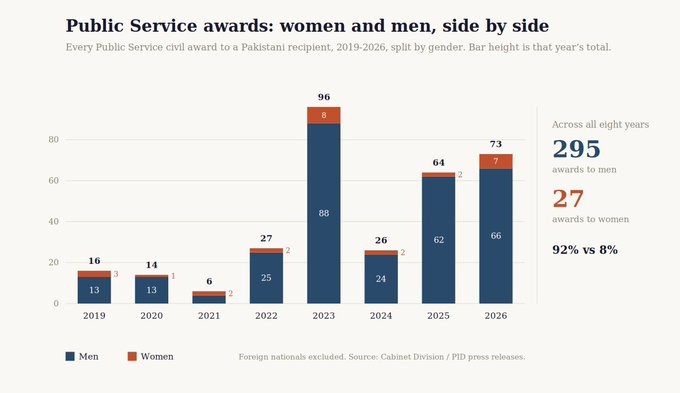
    ISLAMABAD: The number of people receiving Pakistan’s civil awards has increased sharply over the past nine years, but the share of women among the recipients has remained almost unchanged, according to an analysis by economist Zehra Farooq. Farooq, who has analysed civil award lists from 2018 to 2026, said she compiled all 2,209 awards announced during the nine-year period and examined each award by field, gender, level of award and nationality. Her analysis shows that the number of award recipients increased more than three times during the period, rising from 73 people in 2018 to 372 in 2026. However, the share of women receiving the awards did not show a similar increase. Women made up between roughly 10% and 16% of civil award recipients in each year from 2018 to 2026. Ms Farooq said the figures show that while the size of the annual awards lists changed greatly, the share of women remained within almost the same range. The lowest share was around 10% in 2023, while the highest was 16% in 2018 and 2021. The share stood at 15% in 2024 before falling to 12% in 2025 and 11% in 2026. Her analysis also looked at the figures after excluding gallantry awards. Gallantry awards were kept separate because they mainly relate to military and police roles. Even after removing these awards, the overall share of women increased only from around 12% to 14%, according to the analysis. This suggests that the low share of women is not limited to gallantry awards. Farooq said the same pattern can also be seen in civilian awards. Public service awards show a wider gap The Public Service category is the largest civilian category in the dataset and shows a particularly large difference between men and women. Among Pakistani recipients of Public Service awards, 295 were men and only 27 were women. This means men received about 92% of these awards, while women received only around 8%. Farooq noted that in several years, the entire Public Service list included only one or two women. The figures raise questions about how women are represented among people being recognised for public service. The analysis does not, however, establish why the gap exists. Farooq suggested that one possibility worth examining is whether the awards reflect the existing structure of Pakistan’s civil bureaucracy. She noted that the quota for women in the civil bureaucracy is around 10%, while the share of awards going to women remains below or around that level. This raises a question about whether the civil awards are reflecting the existing gender structure in public institutions rather than creating a separate pattern of their own. Major changes in fields The analysis also found major changes in the fields represented in the civil award lists. Science and engineering together accounted for close to one-third of the 2021 list. However, by 2025 and 2026, the two fields together made up less than 2% of the list. At the same time, some new categories appeared. Information technology appeared as a category for the first time in 2021, while climate appeared in 2025. Farooq said these changes raise questions about how the state decides which areas deserve recognition. She asked whether the decline in science and engineering awards reflects fewer major contributions in these fields, fewer people entering these professions, or a change in the areas where the state looks for achievement. The appearance of IT and climate-related awards also raises another question: whether official recognition is beginning to follow changes in the areas where Pakistan’s talent and work are growing. Women receive fewer top-level awards The analysis also examined the civil awards according to their level. The awards are divided into different levels, with Nishan and Hilal at the senior end, followed by Sitara and Tamgha. Ms Farooq found that the share of women becomes smaller as the level of the award becomes higher. At the two highest levels, women account for less than 5% of recipients. At the more common lower levels, the share of women is higher, generally ranging between 11% and 14%. This means that the overall percentage of women receiving civil awards does not tell the full story. Women may represent around 10% to 16% of all recipients in a year, but their representation becomes much smaller when only the highest-level honours are considered. The findings therefore point to two separate issues: the overall number of women receiving civil awards and the level of recognition they receive. Nine years provide a wider picture Ms Farooq said looking at the awards over several years gives a clearer picture than looking at a single annual list. The civil awards are announced every August, and each year’s list can show changes in the number and type of recipients. But when the lists are combined over nine years, longer-term patterns become visible. The biggest pattern in the data is the contrast between the rapidly growing number of awards and the almost unchanged share of women. From 73 recipients in 2018, the annual list reached 372 in 2026. Yet women remained within roughly the same 10% to 16% range throughout the period. The analysis also shows that the composition of the awards has changed in other ways, including the fields being recognised and the introduction of new categories. She said the data does not provide all the answers, but it raises questions that can be examined further.

  • | |

    Attack on one is an attack on all’: Ishaq Dar ex…

    Pakistan’s Deputy Prime Minister and Foreign Minister Ishaq Dar has highlighted the key provisions of the landmark Makkah Joint Defence Agreement, stressing that any external armed attack on Pakistan, Saudi Arabia or Türkiye will be considered an attack on all three countries. Dar said the agreement, signed in Makkah Mukarramah on 7 August 2026, reflects the depth of the brotherly relations between the three nations and is the culmination of years of consultations and strategic coordination. Under the accord, an external armed attack against any one of the three countries will be considered an attack against all, consistent with the right of individual and collective self-defence under Article 51 of the UN Charter. The Foreign Minister stressed that the agreement is purely defensive in nature and is not directed against any country. He said the accord is intended to strengthen cooperation in confronting shared peace and security challenges while promoting regional stability and prosperity. Dar also clarified that the Makkah Accord does not replace or abrogate any existing bilateral or multilateral agreements between Pakistan, Saudi Arabia and Türkiye, or their agreements with other countries and international organisations. Another significant provision, he said, is that the agreement remains open to other countries in the region willing to uphold its fundamental principles and resolve differences through mutual respect, cooperation and peaceful means. Dar reaffirmed that the agreement is consistent with Pakistan’s foreign policy and said Islamabad would continue working with all brotherly countries towards lasting peace and stability. He reiterated Pakistan’s commitment to the peaceful resolution of conflicts and to building a more secure, stable and prosperous future for the peoples of the region.

  • | |

    Bushra Ansari urges people to understand the respo…

    Veteran Pakistani actress Bushra Ansari has sparked discussion with her recent comments about multiple marriages in Islam, urging people to focus on the responsibility and fairness that come with such a decision. While discussing the subject, Ansari emphasized that people often highlight the permission for a man to have up to four wives but pay less attention to the requirement of treating those wives fairly. Her remarks have renewed conversation about how Islamic teachings on marriage are understood and practiced in society. The Quran permits a Muslim man to marry up to four women, but it places an important condition on that permission. If a man fears that he will not be able to deal justly with multiple wives, the Quran directs him to marry only one. (IslamQA⁠) This requirement of justice is at the heart of the discussion surrounding polygamy. It means that multiple marriage cannot simply be viewed as a privilege without responsibilities. A husband is expected to fulfill the rights of each wife and treat them fairly in matters within his control. Ansari’s comments appear to highlight this often-overlooked aspect. In societies where discussions about multiple marriages can become emotionally charged, her message encourages people to consider the consequences for everyone involved rather than focusing only on the number of marriages allowed. Islamic scholarship also emphasizes that justice between wives is a serious obligation. Financial responsibilities, living arrangements, time and other practical rights are among the areas in which fairness is expected. If a person believes he cannot fulfill these responsibilities, choosing one marriage is the safer course. (IslamQA⁠) The subject is particularly sensitive because marriage involves more than a legal relationship. It affects spouses, children and extended families. A decision that is made without careful consideration can create emotional and financial difficulties for everyone involved. Pakistan’s legal framework also places regulations around multiple marriages. Under the Muslim Family Laws Ordinance, a man seeking another marriage while already married is subject to specific legal requirements, including approaching an Arbitration Council for permission. Pakistani courts have also upheld the importance of these legal procedures. (Pakistan Lawyer⁠) Ansari’s remarks therefore arrive amid an ongoing conversation about the difference between religious permission and personal responsibility. The fact that something is permitted under certain conditions does not mean those conditions can simply be ignored. Her comments have encouraged audiences to look at the broader principles behind marriage: fairness, responsibility, respect and protection of rights. For couples and families, these principles can be just as important as the legal question of whether another marriage is permitted. Ultimately, the discussion surrounding Bushra Ansari’s statement is less about simply counting marriages and more about understanding the responsibilities that accompany them. Her message serves as a reminder that when people discuss religious rights, they should also acknowledge the duties and accountability that come with those rights.

Leave a Reply

Your email address will not be published. Required fields are marked *