pakistan8217s civil awards
| |

Pakistan’s civil awards triple in nine years…

ISLAMABAD: The number of people receiving Pakistan’s civil awards has increased sharply over the past nine years, but the share of women among the recipients has remained almost unchanged, according to an analysis by economist Zehra Farooq.

Credit: Zahra Farooq @ZehraFarooq

Farooq, who has analysed civil award lists from 2018 to 2026, said she compiled all 2,209 awards announced during the nine-year period and examined each award by field, gender, level of award and nationality.

Her analysis shows that the number of award recipients increased more than three times during the period, rising from 73 people in 2018 to 372 in 2026.

However, the share of women receiving the awards did not show a similar increase.

Women made up between roughly 10% and 16% of civil award recipients in each year from 2018 to 2026.

Ms Farooq said the figures show that while the size of the annual awards lists changed greatly, the share of women remained within almost the same range.

The lowest share was around 10% in 2023, while the highest was 16% in 2018 and 2021. The share stood at 15% in 2024 before falling to 12% in 2025 and 11% in 2026.

Her analysis also looked at the figures after excluding gallantry awards.

Gallantry awards were kept separate because they mainly relate to military and police roles. Even after removing these awards, the overall share of women increased only from around 12% to 14%, according to the analysis.

This suggests that the low share of women is not limited to gallantry awards.

Farooq said the same pattern can also be seen in civilian awards.

Public service awards show a wider gap

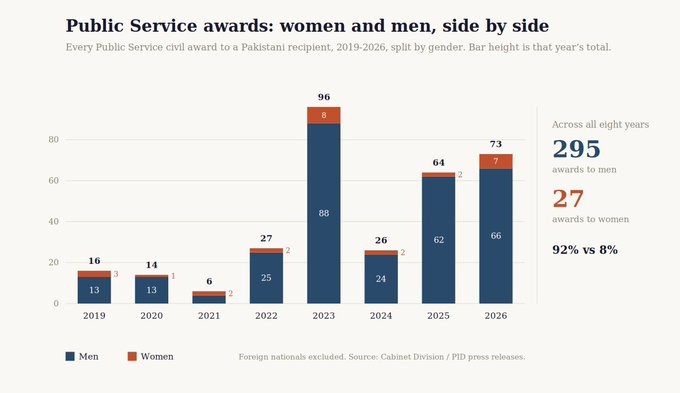
The Public Service category is the largest civilian category in the dataset and shows a particularly large difference between men and women.

Among Pakistani recipients of Public Service awards, 295 were men and only 27 were women.

This means men received about 92% of these awards, while women received only around 8%.

Farooq noted that in several years, the entire Public Service list included only one or two women.

The figures raise questions about how women are represented among people being recognised for public service.

The analysis does not, however, establish why the gap exists.

Farooq suggested that one possibility worth examining is whether the awards reflect the existing structure of Pakistan’s civil bureaucracy.

She noted that the quota for women in the civil bureaucracy is around 10%, while the share of awards going to women remains below or around that level.

This raises a question about whether the civil awards are reflecting the existing gender structure in public institutions rather than creating a separate pattern of their own.

Major changes in fields

The analysis also found major changes in the fields represented in the civil award lists.

Science and engineering together accounted for close to one-third of the 2021 list.

However, by 2025 and 2026, the two fields together made up less than 2% of the list.

At the same time, some new categories appeared.

Information technology appeared as a category for the first time in 2021, while climate appeared in 2025.

Farooq said these changes raise questions about how the state decides which areas deserve recognition.

She asked whether the decline in science and engineering awards reflects fewer major contributions in these fields, fewer people entering these professions, or a change in the areas where the state looks for achievement.

The appearance of IT and climate-related awards also raises another question: whether official recognition is beginning to follow changes in the areas where Pakistan’s talent and work are growing.

Women receive fewer top-level awards

The analysis also examined the civil awards according to their level.

The awards are divided into different levels, with Nishan and Hilal at the senior end, followed by Sitara and Tamgha.

Ms Farooq found that the share of women becomes smaller as the level of the award becomes higher.

At the two highest levels, women account for less than 5% of recipients.

At the more common lower levels, the share of women is higher, generally ranging between 11% and 14%.

This means that the overall percentage of women receiving civil awards does not tell the full story.

Women may represent around 10% to 16% of all recipients in a year, but their representation becomes much smaller when only the highest-level honours are considered.

The findings therefore point to two separate issues: the overall number of women receiving civil awards and the level of recognition they receive.

Nine years provide a wider picture

Ms Farooq said looking at the awards over several years gives a clearer picture than looking at a single annual list.

The civil awards are announced every August, and each year’s list can show changes in the number and type of recipients.

But when the lists are combined over nine years, longer-term patterns become visible.

The biggest pattern in the data is the contrast between the rapidly growing number of awards and the almost unchanged share of women.

From 73 recipients in 2018, the annual list reached 372 in 2026. Yet women remained within roughly the same 10% to 16% range throughout the period.

The analysis also shows that the composition of the awards has changed in other ways, including the fields being recognised and the introduction of new categories.

She said the data does not provide all the answers, but it raises questions that can be examined further.

Similar Posts

  • Police Rescue University Students Held Hostage by Phone Scam Gang

    BANGKOK – Police in central Thailand successfully rescued two university students on July 15, 2026. A ruthless call center gang tricked the students into hiding and staging their own kidnappings. The criminals used these fake situations to extort heavy ransoms from the victims’ families. The drama unfolded near a prominent university campus in the Rangsit […]

  • |

    ‘Incredibles 3’ shifts spotlight to Violet, Dash, teases new villain

    Fans got their first real look at “Incredibles 3” during D23, where Pixar director Pete Docter offered a preview of what to expect from the franchise’s next chapter. The reveal took place at Friday’s fan event in Anaheim. According to multiple reports, the new film picks up just a few weeks after “Incredibles 2.” This time, though, the focus shifts away from the parents and toward the family’s superpowered kids. After Bob led the original film and Elastigirl took centre stage in the sequel, “Incredibles 3” will finally put the spotlight on the family’s eldest children. Docter confirmed that Violet and Dash are eager to prove themselves as capable Supers in their own right. He explained that the siblings want to show they are ready for real hero work, even though their parents are not entirely convinced. As a result, the kids have been sneaking out at night to protect the city on their own. That decision, Docter noted, does not go over well once their parents find out. Making matters more complicated, the family is also struggling to keep Jack Jack’s unpredictable powers under control. Beyond the family dynamics, Docter teased a new threat that is taking a serious toll on Bob emotionally. He explained that Bob is grappling with his own relevance in a world of Supers that may have moved past him. According to Docter, the story explores how legality does not automatically mean morality within this world. He pointed out that even though Supers are now legal again, that doesn’t guarantee all of them are good. The filmmaker nearly revealed more about the film’s central villain, describing the character as more powerful than the entire Parr family and every other Super combined. Before he could share further details, Edna Mode actress interrupted him, urging him not to spoil the movie ahead of release. “Incredibles 3” is currently scheduled to hit theatres in June 2028, giving fans plenty of time to speculate about the new villain’s true identity and abilities.

  • | |

    Sewage flood damages SBCA property records

    KARACHI: Sewage water has flooded the record room at the headquarters of the Sindh Building Control Authority (SBCA), damaging hundreds of land and building-related files and raising concerns over the safety of vital property records. The affected room at the SBCA Civic Centre headquarters contains thousands of documents submitted by citizens, including approved building plans, structural drawings and other records used to verify property details. Officials retain copies of approved residential and commercial building plans in the record room for future reference. However, sewage water reportedly entered the facility after poor maintenance and alleged negligence, submerging hundreds of files and damaging important documents. Another important SBCA department, formerly known as Town Planning and now called Structure Planning, operates next to the affected record room. Sources said the flooding also damaged records dating back several years. According to sources, sewage had been accumulating in the area for several days, but the maintenance department failed to resolve the issue in time, resulting in damage to critical official records. Following a report by Express News, Additional Director General Farhan Qaiser took notice of the incident and ordered an inquiry against three officials. He directed authorities to submit a report within 24 hours and warned that officials found responsible for negligence would face suspension. The incident has also raised questions about oversight, as the SBCA Director General’s office is located only a short distance from the affected record room. However, no immediate directives reportedly came from the DG’s office. An SBCA spokesperson said the Director General was attending a meeting with Sindh Local Government Minister Nasir Hussain Shah regarding improvements to the authority’s one-window operation. Citizens have expressed serious concern over the damage, saying the incident could undermine public confidence in the protection of property records. They have called on the Sindh government to take immediate steps to ensure the safety and proper preservation of such documents.

  • | |

    SC seeks lawyers’ appearance for 49 suspects in …

    The Supreme Court of Pakistan has resumed hearing a case seeking the cancellation of bail granted to 49 suspects allegedly linked to the suicide attack on Chinese engineers in Bisham. A prosecution appeal has been filed before the top court. It seeks the cancellation of bail granted to the suspects in the case. During the hearing, Justice Naeem Akhtar asked whether the suspects were regularly appearing before the trial court. The judge also asked whether the suspects wanted to engage lawyers to represent them in the proceedings. The court directed the suspects to appear at the next hearing with their lawyers. It made it clear that failure to comply with the order could result in the cancellation of their bail. The court did not cancel the bail at the latest hearing. Instead, it gave the suspects an opportunity to ensure their appearance and legal representation. The Supreme Court then adjourned the proceedings until August 20. The case relates to the suicide attack in Bisham, where Chinese engineers were targeted. The incident had raised serious security concerns and prompted investigations into those allegedly involved in the attack. The prosecution has challenged the bail granted to 49 suspects and wants the Supreme Court to overturn the relief provided to them.

  • | |

    Punjab launches Integrated Safe City network

    LAHORE: Punjab Chief Minister Maryam Nawaz Sharif on Friday formally inaugurated the Punjab Integrated Safe City Network, describing it as a major step towards protecting citizens and reducing crime across the province. Punjab has become the first province in the country to establish an integrated Safe City network covering all 41 districts and two tehsils. Officials said coordinated efforts by the police, Crime Control Department (CCD) and Safe Cities Authority had contributed to an estimated 80 per cent decline in crime. Safe Cities Authority Managing Director Ahsan Younas briefed the chief minister on the province-wide smart surveillance system. He said artificial intelligence (AI) was strengthening monitoring and enabling authorities to respond more quickly to potential threats. The network combines intelligent surveillance, Emergency Helpline 15, traffic management, real-time command and control, and predictive policing. It also offers services through the Virtual Women Police Station, Child Safety Centre and Blood Bank, along with traffic and environmental monitoring facilities. The government plans to install another 1,500 panic buttons across Punjab and equip every police station with the facility. Smart screens will also be installed at public locations. AI-powered cameras will support facial identification and weapon detection, helping law-enforcement agencies improve surveillance and respond to security threats. Maryam Nawaz said the government would expand the Safe Smart Cities project to every union council in Punjab. She said the province had made significant progress in technology, smart policing and predictive policing. The chief minister said the government had transformed every district into a Safe City within the past two and a half years. She termed the ability to monitor the entire province through a single system a major achievement. She said AI-based surveillance and predictive policing were helping authorities identify developments early and take timely action. Speaking about the security situation, Maryam Nawaz said more than 70 areas of Punjab had previously been considered no-go zones, where people avoided travelling after sunset. She claimed that the government had now eliminated such areas across the province, including the riverine belt. She added that the riverine region had recorded no serious crime or kidnapping for ransom for nearly 10 months. The administration also recently organised a cricket tournament there, which she described as a sign of improving law and order. The chief minister said the provincial government would spend Rs30 billion on development projects in the riverine belt, including healthcare and other facilities, with the aim of bringing the area closer to the development standards of Punjab’s cities.

  • | |

    Zelensky removes army chief Syrskyi after week of …

    Ukrainian President Volodymyr Zelensky has dismissed the country’s commander in chief, Oleksandr Syrskyi, just days after removing popular Defence Minister Mykhailo Fedorov in a move that triggered widespread street protests across Ukraine. Early speculation that Fedorov’s removal stemmed from tension between him and Syrskyi was soon confirmed. Fedorov, 35, has drawn broad praise for reenergizing the defence ministry, driving reforms across the armed forces and pushing an anti corruption campaign. Syrskyi, 60, has been viewed by many in Ukraine as a Soviet trained commander resistant to sweeping changes within the military. In a farewell message posted on Telegram, Syrskyi defended his record, noting that the army he led through a difficult defensive campaign two years ago now stands on the offensive. He said he was handing over to his successor a force that is not just holding ground but advancing, and expressed hope that the offensive would continue. Zelensky named Mykhailo Drapatyi, 43, a popular and battle tested general, as Syrskyi’s replacement. Drapatyi said on Facebook that he would approach the role with full focus, responsibility and respect for those currently defending the country. He also thanked Syrskyi for his consistent work strengthening the Ukrainian army, saying he had grown up within it professionally. In a video posted late Tuesday, Zelensky thanked Syrskyi for his military leadership, including his role defending Kyiv during the earliest days of Russia’s full scale invasion in 2022. Zelensky also said he met with Fedorov earlier that day and offered him a worthy position within the government, though he did not specify whether Fedorov had accepted. Fedorov had been replaced last week by Yevhenii Khmara, a former senior official at Ukraine’s Security Service. Zelensky said all decisions would be formalized the following day. Fedorov congratulated Drapatyi on his new role, describing the appointment as a new source of hope in the broader fight of free people for freedom and justice, and calling it the voice of change that could no longer be ignored. Fedorov also said he called Syrskyi personally to thank him for defending the Kyiv region and for other significant battles, while adding that Ukraine needs to move even faster and correct past mistakes. Fedorov had only taken over as defence minister in January but quickly earned praise for using data driven analysis to improve battlefield performance. A former minister of digital transformation, he built a volunteer cyber unit known as the IT Army of Ukraine early in the full scale invasion. He later led a successful fundraising initiative called the Army of Drones and introduced elements of gamification into the war effort, creating a system that rewarded Ukrainian military units with credits for striking Russian targets. Fedorov’s removal sparked six days of widespread protests, placing mounting pressure on Zelensky to dismiss Syrskyi. Zelensky appeared to respond to that pressure by replacing him with Drapatyi, viewed as a younger and more innovative commander who is also considered a close friend of Fedorov’s. Fedorov’s clear support for Drapatyi’s appointment is likely to help ease the political tension that built up over the past week. Acting Defence Minister Khmara remains in his position for now, with Zelensky asking him and Drapatyi to develop a new defence strategy addressing issues including reform of the military corps system, weapons supply and drone capabilities. In an op-ed published Monday on the Militarny website, Syrskyi described his relationship with Fedorov as strictly professional and offered an apology if he had offended him. He said decisions surrounding military contracts, procurement and mobilization involve far more complexity than most people recognize, arguing that real progress, not public drama, ultimately determines the outcome of the war. Protesters are expected to continue pushing for Fedorov’s return to a position of genuine authority where he can keep driving innovation in Ukraine’s fight against Russia. Should that happen, Zelensky may succeed in repairing much of the immediate political damage, though many Ukrainians remain unlikely to forgive what they viewed as his original misstep in removing Fedorov in the first place.

Leave a Reply

Your email address will not be published. Required fields are marked *