thailand8217s government complex

Thailand’s Government Complex Sets a Global Benchmark for Sustainable Public Architecture

Dhanarak Asset Development Co., Ltd. (DAD), has officially unveiled the “21st Century Government Complex,” a national milestone that redefines how architecture, technology, and nature coexist within the public sector. Spanning 378 rai (60 hectares), the Government Complex Bangkok is developed under the vision Regenerative Government Complex Bangkok :“A Low-Carbon City Working with Nature,” a model for future cities where people, clean energy, and the environment interact in harmony.

New government building to open in August

As global cities grapple with climate challenges, Bangkok is transforming from its bureaucratic core outward. The Government Complex Bangkok on Chaeng Watthana Road now serves as Thailand’s prototype for a “regenerative city” — an urban ecosystem that breathes, adapts, and generates its own clean energy. The project aligns with the country’s Bio-Circular-Green (BCG) Economy Model and national goal of carbon neutrality by 2050.

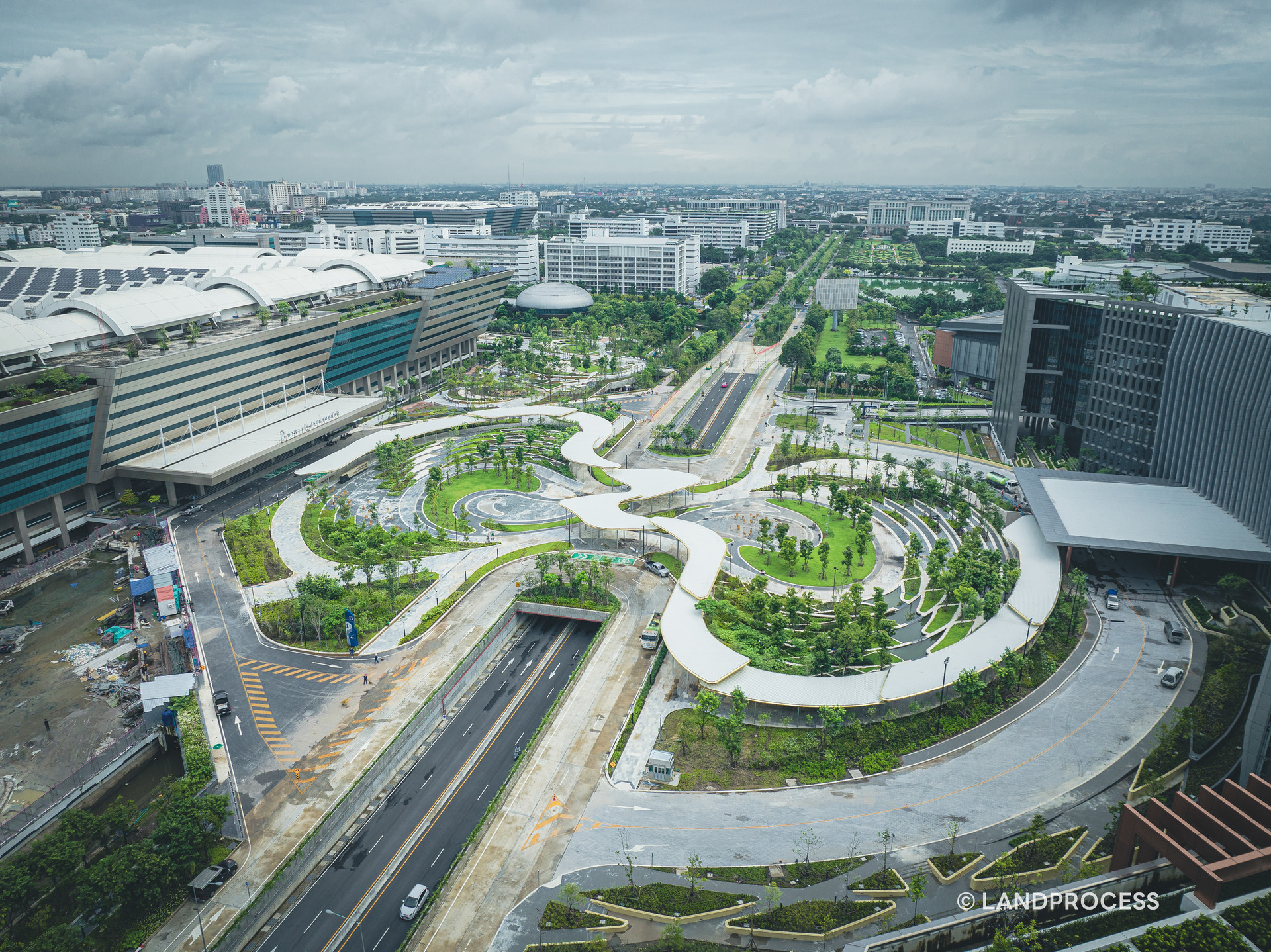
Government complex new welcoming plaza on top or existing parking garage.
Government complex new welcoming plaza on top or existing parking garage. Photo: Dhanarak Asset Development (DAD) – Public Relations Team.

The transformation is driven by four core strategies that reshape urban development from the ground up:

• From Cars to Feet – A 205-meter Skywalk links the Pink Line MRT Train to the Complex, supported by EV shuttle buses and a network of green canopy walks that prioritize pedestrians.
• From Grey to Green – Former parking decks have been transformed into green terraces that capture rainwater and absorb heat.
• From Concrete to Biodiversity – More than 5,500 native trees from over 100 species restore urban cooling corridors and pollinator habitats.
• From Energy Consumer to Producer – The complex now generates over 3.9 million kWh of solar electricity annually, saving THB 16 million per year and reducing CO₂ emissions by more than 2,000 tons.

At the heart of this new urban ecosystem stand two landmark structures that embody DAD’s commitment to sustainable design and clean energy innovation:

1. The Expansion of the Government Complex, Building C – A Symbol of Future Prosperity

Shaped after the traditional Thai “pod duang” coin, the building represents prosperity, economic value, and social stability. Its high-efficiency Solar Shield façade reduces heat gain by up to 37 percent and is supported by passive cooling technology, radiant floor systems, and a central district cooling plant. Indoor air quality meets MERV-13 standards, while more than 60 percent of construction materials are sourced locally. The 12-rai rooftop garden incorporates solar panels that generate approximately 2,200 kilowatt-hours of clean energy per day.

2. Sky Decks and Sponge Parking – Reimagining Urban Infrastructure

The rooftop of Parking Building A has been transformed into an 8,000-sq.m. A-D Sky Park, serving as a social gateway for commuters arriving from the Pink Line MRT Station. The landscape design integrates bioswales, rain chains, and blue–green design inspired by the following curves of the Chao Phraya River.

Building D has been reimagined as a “giant urban sponge” that stores stormwater to reduce flood risk. Its rooftop functions as a productive urban farming space and hosts a solar power system that generates more than half of the building’s daily electricity demand.

Together, these elements show how infrastructure can cool the city, manage water sustainably, and generate clean power while enhancing public life.

Dr. Nalikatibhag Sangsnit, President of DAD., stated that “Our mission is to prove that the public sector can genuinely lead the sustainability agenda. The Government Complex Bangkok is not just a cluster of office buildings, it’s a prototype of a low-carbon society where architecture, people, and nature thrive together.”
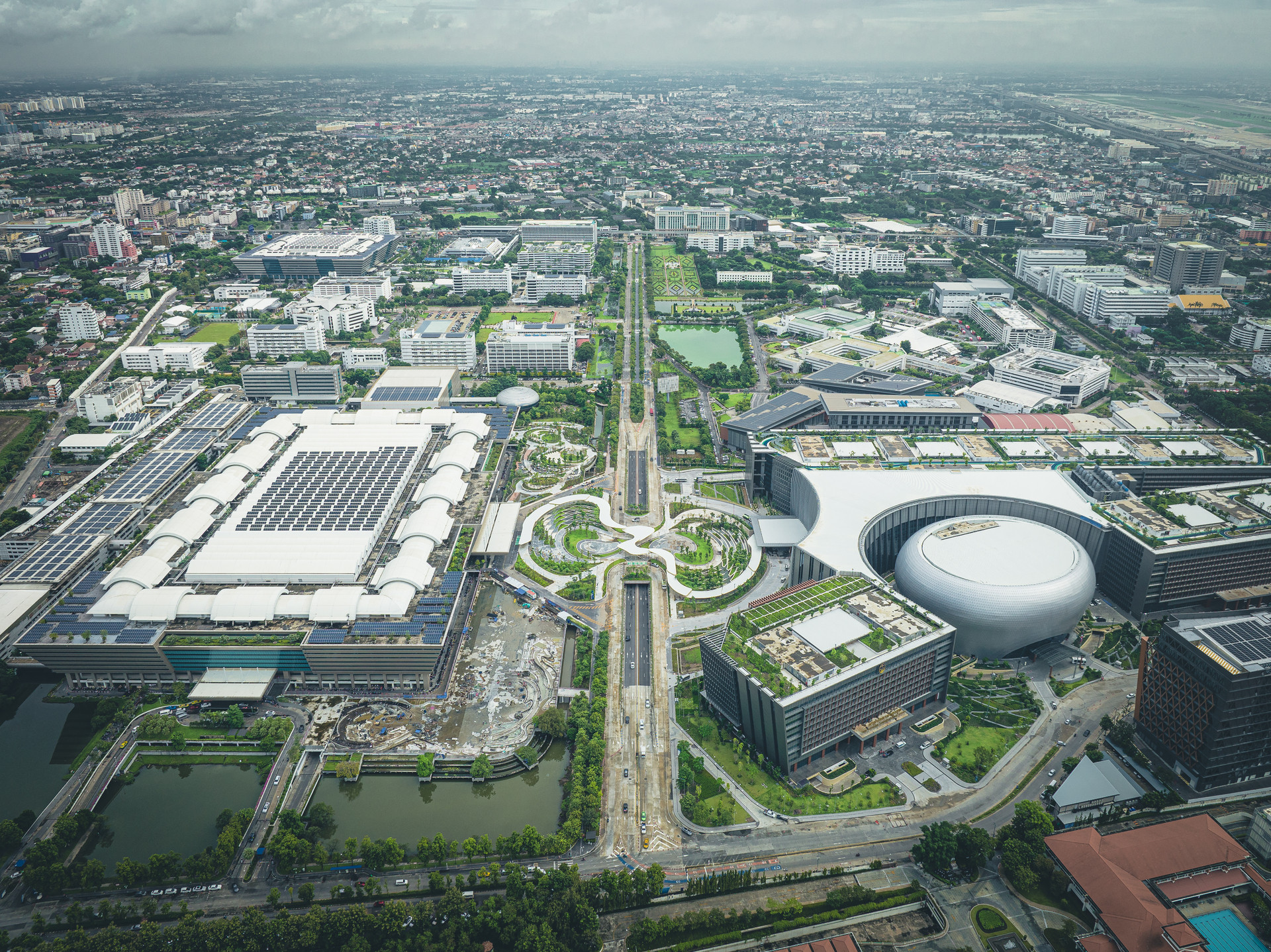
Overall government campus.
Overall government campus. Photo: Dhanarak Asset Development (DAD) – Public Relations Team.

Both areas are now officially open to the public aimed at enhancing the quality of life for everyone within the complex including government officials, employees, vendors, and visitors. The initiative also supports Associate Professor Dr. Chadchart Sittipunt, Governor of Bangkok’s “15-minute Park” policy and the citywide campaign to plant one million trees.

New reception building opens behind Government House

The moment marks a major milestone in the transforming the Government Complex Bangkok from a concrete-dominated district into a truly living urban ecosystem. With green space expanded from 36 rai to 138 rai, and clean-energy systems powering ten major buildings, the “21st Century Government Complex” sets a new global benchmark for public architecture. It signals Thailand’s transition into an era of government infrastructure that breathes, a living city designed for both people and planet.

By Dhanarak Asset Development (DAD) – Public Relations Team
Similar Posts

  • | |

    Pakistan rise in WTC standings after West Indies w…

    Port of Spain: Pakistan breathed new life into their ICC World Test Championship (WTC) 2025-27 campaign after defeating the West Indies by eight wickets in the second and final Test, a victory that lifted them off the bottom of the standings and restored confidence under new captain Babar Azam. The convincing win helped Pakistan move up to seventh place in the WTC table with a points percentage of 22.22, replacing the West Indies, who dropped to the bottom after another disappointing result. Pakistan have now won two of their six matches in the current championship cycle, while the Caribbean side have managed just two victories in 12 Tests. At the top of the standings, Australia remain the dominant force with seven wins in eight matches and a remarkable winning percentage of 87.50. Defending champions South Africa occupy second place, followed by New Zealand, Bangladesh, India, Sri Lanka, England, Pakistan and West Indies. Pakistan entered the Caribbean series under fresh leadership after Babar Azam replaced Shan Masood as Test captain. However, the new chapter began on a disappointing note as the visitors suffered a 90-run defeat in the opening Test at Tarouba. The Green Shirts responded in style in the second Test at Queen’s Park Oval with an impressive all-round performance. After electing to bat, the West Indies posted 344 thanks to fighting half-centuries from captain Roston Chase and Justin Greaves. Pakistan answered with determination as opener Abdullah Shafique produced a magnificent unbeaten 160, anchoring the innings from start to finish. Captain Babar Azam added a composed half-century as Pakistan reached 387, taking a valuable first-innings lead of 43 runs. The turning point came in the West Indies’ second innings when Pakistan’s spin duo completely dominated the hosts. Sajid Khan and Ali Usman claimed four wickets each to dismiss the West Indies for just 117, leaving Pakistan a modest target of 75. Pakistan completed the chase comfortably with eight wickets to spare. Shafique and Babar remained unbeaten on 24 each, guiding their team to its first away Test victory since July 2023. Teams Matches Wins Losses Draw Points Winning Percentages Australia       8    7      1     0    84        87.50 South Africa       4    3      1     0    36           75 New Zealand       6    4      1     1    52        72.22 Bangladesh       4    2      1     1    28        58.33 India       9    4      4     1    52        48.15 Sri Lanka       4    1      1     2    20        41.67 England      13    4      8     1    38        24.36 Pakistan       6    2      4     0    16        22.22 West Indies      12    2      8     2    30        20.83   The morale-boosting triumph not only squared the two-match series 1-1 but also revived Pakistan’s hopes in the World Test Championship race. With Babar Azam’s captaincy beginning to take shape and key players delivering under pressure, Pakistan will now look to build momentum in the remainder of the WTC cycle.

  • | |

    Lebanese troops move into first pilot zone as Isra…

    Lebanon’s army began deploying troops into a designated pilot zone in the country’s south on Tuesday, following an Israeli withdrawal from part of the area under a framework agreement reached last month with US backing. The army command said engineering units entered the village of Zawtar al Gharbiyeh in Nabatieh district on Tuesday morning. Later, the command reported that Israeli forces had opened fire near the troops. Israel’s military said its soldiers fired warning shots after Lebanese troops crossed into what Israel considers a security zone. The pilot zone arrangement envisions Israeli forces withdrawing from a limited portion of territory occupied during the conflict with Hezbollah, alongside the disarmament of the Iran backed Lebanese group. Tuesday’s deployment began ahead of a scheduled meeting in Washington between President Donald Trump and Lebanese President Joseph Aoun. Aoun was expected to press Trump to push Israel toward withdrawing from the remainder of southern Lebanon and to back the Lebanese army as it works to establish full control over areas currently under Hezbollah’s influence. Speaking to reporters in the Oval Office, Aoun said he told Trump he needed two things from him, political support and backing for the Lebanese Armed Forces. Trump, speaking alongside Aoun, pledged that the United States would help a country he said had been hit hard for decades, adding that Lebanon has been badly treated and deserves proper treatment and respect going forward. The US State Department announced Monday afternoon that pilot zone operations had begun in Zawtar al Gharbiyeh along with two other villages, Froun and Srifa, consistent with the trilateral framework agreed by Israel, Lebanon and the United States at the end of June. The department described the development as a milestone stemming directly from talks held last week between Israeli and Lebanese representatives in Rome. Later Monday, an Israeli military official confirmed that Israeli forces would adjust their posture in one of the pilot areas to allow the Lebanese army to carry out its mission, while also protecting Israeli soldiers and preserving the military’s right to self defense and to eliminate threats. The official said the goal of the pilot programme and the broader agreement remains the disarmament of Hezbollah and the removal of its illegal weapons, adding that Israeli forces would stay in the security zone, a strip of occupied Lebanese territory roughly ten kilometers deep along the border, for as long as necessary to protect communities in northern Israel. On Tuesday, Lebanon’s army command said its units began deploying to Zawtar al Gharbiyeh based on ongoing coordination with the Military Coordination Group for Lebanon, the trilateral body established to support implementation of the framework. The command urged Lebanese citizens to avoid traveling to the village until the security situation stabilizes and to follow instructions from deployed military units for their own safety. Later Tuesday, the army command said Israeli forces opened fire near these units and warned that the incident hinders progress on deployment across the pilot zones. Israel’s military said its soldiers fired warning shots into the air after Lebanese troops and an engineering vehicle crossed roughly 150 meters into the security zone and breached barriers in the neighboring area of Zawtar al Sharqiyeh. The military said Lebanese troops then withdrew from the area and that no injuries occurred. The Lebanese army said its troops were already carrying out missions in the nearby villages of Froun and Srifa following Monday’s announcement from Washington. An Israeli source told a regional newspaper that no Israeli troops remained stationed in those villages. Separately on Tuesday, Lebanon’s state news agency reported that Israeli forces caused two large explosions near the villages of Beit Yahoun and Kounine in Bint Jbeil district, along with blasts from Israeli controlled demolitions in the town of Majdal Zoun in Tyre district. In areas still under Israeli occupation, numerous villages have suffered extensive destruction from strikes and demolitions. Israel’s military says it has been dismantling Hezbollah infrastructure, though human rights organizations have said some of the destruction amounts to deliberate targeting of civilian infrastructure, potentially constituting a war crime. Hezbollah has rejected the trilateral agreement between Lebanon’s government, Israel and the United States, saying provisions linking Israeli withdrawal to its own disarmament cross what it called all red lines. Israel has said it will not fully withdraw from Lebanon until Hezbollah disarms completely. Trump said the United States has concrete plans to help Lebanon build the capacity needed to disarm Hezbollah, though he offered no specific details. He also said the Lebanese army is becoming increasingly self sufficient, and added that he would speak directly with Hezbollah representatives if Aoun requested it. Lebanon became entangled in the broader war between Israel, the United States and Iran on March 2, when Hezbollah launched rockets into Israel in retaliation for a strike that killed Iran’s supreme leader. Israel responded with a bombing campaign across Lebanon and an invasion of a significant portion of the country’s south. More than 4,300 people have died in Lebanon since then, including nearly 800 children, women and medics, according to Lebanon’s health ministry. Israeli authorities say 37 Israeli soldiers and four civilians have been killed on both sides of the border during the conflict. The pilot zone deployment marks the first tangible step toward implementing the trilateral framework since its signing, though continued friction between Lebanese and Israeli forces on the ground, along with Hezbollah’s outright rejection of the agreement’s terms, points to a difficult path ahead for a plan meant to end one of the region’s longest running conflicts.

  • | | |

    President delays assent for 19 high court judges

    The appointment of 19 additional judges to four high courts remains pending as President Asif Ali Zardari has yet to approve the summary. The Judicial Commission of Pakistan (JCP) approved the nominations during meetings held on July 20 and 21. The proposed appointments involve the Lahore High Court, Sindh High Court, Balochistan High Court and Islamabad High Court. Nine days have passed since the JCP approved the nominations. However, the president has not yet given his assent to the summary. The delay has caused concern within the government. A senior cabinet member questioned why the approval had not yet been granted. The official argued that the summary was initiated by the JCP rather than the prime minister. Therefore, according to the government’s position, the president could not send it back to the prime minister for reconsideration. The official also warned that continued inaction could create further tension within the superior judiciary. The government’s legal team is reportedly examining possible options to address the issue. The matter has also exposed differences between the government and the Pakistan Peoples Party (PPP). According to government officials, the PPP leadership is unhappy with the JCP because some of its preferred nominees were not considered for judicial appointments. The PPP had shown particular interest in securing the appointment of two candidates to the Sindh High Court. However, neither the judicial nor executive members of the JCP supported their nominations. Officials said the candidates were below the age of 45. Both government and judicial representatives reportedly agreed that nominees below that age should not be approved. PPP Senator Farooq H Naek, a senior legal figure and member of the JCP, had proposed 33 candidates for the four high courts. His proposed list included 16 candidates for the Sindh High Court, 10 for the Lahore High Court, five for the Balochistan High Court and two for the Islamabad High Court. A member of the commission said the PPP could potentially have secured appointments for other candidates from interior Sindh. Some of those candidates were considered sympathetic to the party. However, the commission member claimed that the party’s insistence on its two preferred nominees affected the outcome. The dispute comes amid wider political and judicial developments involving Sindh. JCP judicial members have already reached a consensus on the performance of constitutional benches in the Sindh High Court. The judges serving on those benches were given three months to demonstrate their performance. The commission’s judicial members also opposed the confirmation of Sindh High Court Additional Judge Syed Fiaz ul Hassan Shah. The development was viewed by some political circles as another setback for the PPP. The party has historically sought influence over judicial appointments in Sindh and other provinces. Last year, the PPP was able to influence appointments in several high courts, including the Sindh High Court, Peshawar High Court and Lahore High Court. The judicial landscape has also changed following the 27th Constitutional Amendment. After the amendment, Justice K K Agha was elevated to the newly established Federal Constitutional Court. Another judge of the Sindh High Court was transferred to the Islamabad High Court.

  • | |

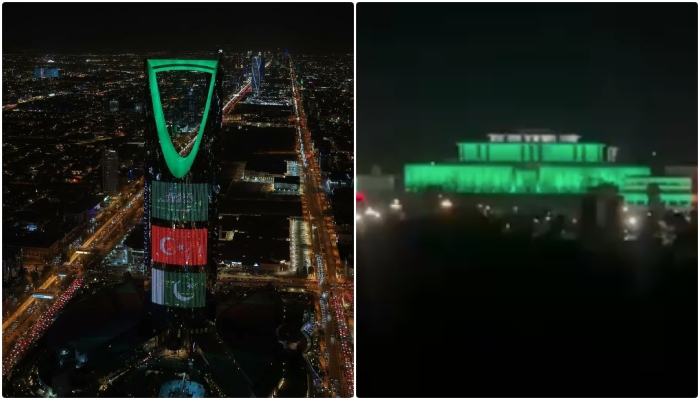
    Pakistan, Saudi Arabia landmarks lit up after defe…

    Major landmarks in Pakistan and Saudi Arabia were illuminated with the national flags of Pakistan, Saudi Arabia and Türkiye following the signing of a landmark defence agreement between the three countries. The agreement was signed in Makkah a day earlier by the leaders of Pakistan, Saudi Arabia and Türkiye, marking a significant development in defence cooperation among the three countries. In Islamabad, key government buildings, including the President’s House, Prime Minister’s House and Parliament House, were decorated with the flags of the three nations to mark the agreement. The flags of Pakistan, Saudi Arabia and Türkiye were also displayed along major roads across the federal capital. Welcome banners highlighting the Makkah defence agreement were placed at prominent locations across the city. The celebrations extended to Saudi Arabia, where major landmarks and towers in Riyadh and other cities were illuminated and decorated with the flags of all three countries. The coordinated displays reflected the close ties and growing strategic cooperation between Pakistan, Saudi Arabia and Türkiye following the signing of the defence pact.

  • | |

    US appeals court allows thousands of social media …

    SAN FRANCISCO: A US appeals court has cleared the way for thousands of lawsuits against major social media companies, including Meta Platforms, Google parent Alphabet, TikTok owner ByteDance and Snap, rejecting an attempt by the technology firms to use federal online protections to halt litigation over allegations that their platforms are deliberately designed to keep young users hooked. The ruling was issued Monday by the 9th US Circuit Court of Appeals, which declined to immediately consider an appeal filed by Meta and TikTok challenging a lower court decision that had allowed more than 3,000 lawsuits to continue in federal court. The lawsuits, brought by parents, children, school districts, local governments and state authorities, accuse social media companies of designing products and features that encourage excessive use among children and teenagers. Plaintiffs argue that the companies were aware of potential risks associated with prolonged social media use but failed to adequately protect young users or warn families about those risks. At the center of the companies’ legal argument is Section 230 of the Communications Decency Act of 1996. The law generally protects online platforms from being held liable for content created and posted by their users. Meta and TikTok argued that the protection should also prevent lawsuits alleging that the companies failed to warn users about the allegedly addictive characteristics of their platforms. However, the appeals court determined that the companies had sought appellate review too soon. The court said Section 230 provides a defense against liability but does not give companies immunity from having to defend themselves in litigation. As a result, the companies cannot use the current appeal to stop the cases from proceeding through the lower courts. Meta’s attempt to delay multistate trial rejected The appeals court also rejected Meta’s request to postpone a major trial involving 29 US states. The case, brought by state attorneys general, accuses Meta of unlawfully collecting and using information relating to children, designing its platforms to encourage young users to remain engaged for extended periods and making misleading statements concerning the safety of its services. Meta had sought to delay the trial while its appeal concerning Section 230 was pending. The court rejected that request, meaning the proceedings can move forward as scheduled. The development represents another significant legal challenge for Meta, which has faced growing scrutiny from regulators, lawmakers and families over the impact of its platforms on children and teenagers. A Meta spokesperson declined to comment on the appeals court’s decision. TikTok representatives did not immediately respond to requests for comment. Lawyers say trials could reveal what companies knew Attorneys representing thousands of individuals and school districts involved in the federal litigation welcomed the ruling. Lawyers Lexi Hazam and Previn Warren said the decision would allow the multistate case to proceed and would also clear the path for a separate trial involving school districts that is scheduled for February. The attorneys said court proceedings could provide the public with evidence about what social media companies knew regarding the potential effects of their products on children, when they became aware of those concerns and how they responded. The lawsuits have become part of a much broader legal battle in the United States over the responsibilities of technology companies toward minors. Plaintiffs contend that social media platforms can contribute to serious problems among young people, including anxiety, depression, eating disorders and concerns about body image. They argue that companies intentionally use features such as recommendation algorithms, notifications and engagement mechanisms to encourage repeated and prolonged use. The technology companies have generally denied allegations that they deliberately designed their platforms to harm children. Thousands of cases consolidated The federal lawsuits have been centralized before US District Judge Yvonne Gonzalez Rogers in Oakland, California. The cases involve claims brought by a wide range of plaintiffs, including families, school districts, municipalities and state governments. They seek financial damages, penalties and other forms of relief from the technology companies. Meta and TikTok previously appealed rulings issued by Judge Rogers in 2023 and 2024 that largely permitted the litigation to continue. The companies also face hundreds of similar cases in state courts. Around 3,300 related cases have been consolidated in California state court, underscoring the scale of the legal challenge confronting the social media industry. Jury verdict adds pressure on technology companies The latest appeals court decision comes after several significant courtroom developments involving the alleged impact of social media on young users. In March, a Los Angeles jury found Meta and Google negligent in connection with claims that their social media products were designed in ways that could harm young people. The jury awarded $6 million to a young woman who said she became addicted to Instagram and YouTube after using the services as a child. The verdict was closely watched because it represented an early test of how juries may respond to similar allegations against major technology companies. Meta and Google have denied wrongdoing in the case and said they intend to appeal. New Mexico ruling increases scrutiny Meta has also suffered a major legal setback in New Mexico. A judge in the state recently ruled that the company had created a public nuisance and ordered it to pay $567 million into a fund intended to support teen mental-health initiatives, while also requiring the company to implement additional measures aimed at protecting young users. The New Mexico proceedings followed an earlier stage of litigation in which a jury found that Meta had misled consumers about the safety of its platforms and ordered the company to pay $375 million. Meta has rejected the allegations and indicated that it will challenge the findings through the appeals process. The growing number of lawsuits reflects increasing pressure on social media companies in the United States to explain how their platforms are developed, marketed and operated for younger audiences. The latest 9th Circuit decision does not resolve whether Meta, Google, TikTok or Snap will ultimately be held liable. Instead, it allows the underlying lawsuits to continue, potentially setting the

  • | | |

    PARCO, Cnergyico lead $1bn refinery exports

    Pakistan’s oil refining sector has achieved a major milestone. The country’s five major refineries exported petroleum products worth around $1.046 billion during the fiscal year 2025-26. This is the first time that the refinery sector has crossed the $1 billion export mark. The development has also strengthened the sector’s role as a source of foreign exchange for Pakistan. The achievement comes as the country continues to face pressure from a large trade deficit. Pakistan’s trade deficit is estimated at around $40 billion, increasing the importance of exports and import savings. The five major refineries made a significant contribution to the overall export earnings. Pakistan Arab Refinery Company (PARCO) recorded exports of around $277 million. Cnergyico Pakistan Limited exported petroleum products worth approximately $258 million. National Refinery Limited (NRL) recorded exports of around $238 million. Pakistan Refinery Limited (PRL) exported products worth approximately $200 million. Meanwhile, Attock Refinery Limited (ARL) exported petroleum products worth nearly $73 million. PARCO and Cnergyico remained the biggest contributors. Their combined exports reached approximately $535 million. This accounts for more than half of the total exports recorded by the five refineries. The development is particularly significant because the refining sector has traditionally been viewed mainly as a means of reducing Pakistan’s dependence on imported petroleum products. The latest figures show that the industry is increasingly contributing to both sides of the equation. It is helping reduce the import burden while also generating foreign exchange through exports. Cnergyico has also entered the global marine fuel market. The move could provide the company with new export opportunities and help expand Pakistan’s presence in the international fuel market. Industry modernization is expected to further improve the sector’s performance. Upgraded refinery facilities can increase production efficiency and enable companies to produce products that meet international market requirements. Further investment in refinery upgrades could therefore lead to higher exports in the coming years. It could also increase savings on petroleum imports. The latest performance highlights the growing importance of Pakistan’s refining industry. With continued modernization, better efficiency and access to international markets, the sector could become an increasingly important source of foreign exchange for the country. The development also comes at a critical time for Pakistan’s economy. Higher exports and lower import dependence are essential for reducing pressure on the country’s external account.

Leave a Reply

Your email address will not be published. Required fields are marked *