
great tragedy partitionix

The Great Tragedy of Partition—IX   Was the tra…

History does not become inevitable merely because it happened

The Partition of British India is frequently narrated backwards. Because India and Pakistan emerged as separate states in August 1947, every disagreement preceding their creation is treated as another step towards an unavoidable conclusion. Political demands become fixed destinies, failed negotiations appear predestined to fail, and the violence accompanying the transfer of power is presented as the inevitable consequence of ancient communal hostility.

The documentary record examined in this series suggests a different conclusion. To ask whether Partition was inevitable is, in fact, to combine three distinct questions. Was the political division of British India unavoidable? Was the accelerated timetable chosen for the transfer of power unavoidable? Was the mass displacement and violence accompanying Partition unavoidable? These questions are related, but they do not admit the same answer.

The constitutional division of India was not historically inevitable from the beginning of the anti-colonial struggle. Competing political visions existed, but so did repeated attempts to accommodate them. The possibility of a united constitutional order survived the Lahore Resolution, the Cripps Mission and even the failure of the Simla Conference. The Cabinet Mission Plan of 1946 came remarkably close to obtaining acceptance from both Congress and the Muslim League by proposing a weak centre, autonomous provinces and compulsory provincial groupings.

That arrangement might have survived; it might also have collapsed under the weight of its own ambiguities. History cannot establish with certainty what would have happened under a constitutional plan that was never fully implemented. It can establish that an alternative existed and that, for a brief period, both principal political parties considered it preferable to immediate Partition.

The collapse of that opportunity did not result from one sentence, one leader or one political organisation. Congress feared that compulsory groupings would weaken the future Union and prevent the construction of an effective national government. The Muslim League feared that Congress would use its strength in the Constituent Assembly to dismantle the safeguards upon which Muslim-majority provinces had relied. British negotiators used ambiguity to secure agreement but failed to create a mechanism capable of resolving the conflicting interpretations that followed.

Political trust disappeared faster than constitutional ingenuity could replace it. By early 1947, division had become increasingly probable. The Cabinet Mission framework had collapsed, the interim government was paralysed, communal violence had spread and the principal political parties no longer shared a common conception of India’s constitutional future. An increasingly probable outcome, however, is not the same as an historically predetermined one. It was the cumulative product of decisions taken, compromises rejected, assurances doubted and opportunities lost.

The Second World War had accelerated this process. Britain’s strategic dependence upon India strengthened the bargaining positions of Indian political parties while weakening imperial authority. Congress demanded effective power and national independence. The Muslim League used the altered constitutional balance to secure recognition of Muslims as a political nation.

The Communist Party of India (CPI), approaching the question from an entirely different intellectual tradition, acknowledged the “just essence” of the Pakistan demand through the principle of national self-determination.

Muslim intellectuals were simultaneously debating what Pakistan would mean. The discussions in Tarjuman-ul-Qur’an and Tolu-e-Islam demonstrated that support for a Muslim homeland did not produce agreement about the nature of the future state. The political demand for Pakistan and the constitutional content of Pakistan were related questions, but they were never identical.

British policy also evolved. The Raj did not simply devise Partition according to a predetermined imperial design. Nor can it be treated as a neutral referee unable to influence events. British constitutional arrangements had shaped political representation, while wartime policy altered the balance between Congress and the Muslim League.

Cripps introduced the possibility that provinces might remain outside a future Union. Simla exposed the struggle over who could represent Indian Muslims. The Cabinet Mission attempted to preserve unity through decentralisation. Mountbatten ultimately concluded that division offered the fastest route to British withdrawal.

Responsibility was therefore differentiated, but it was not absent. Congress and the Muslim League made decisions with consequences they could not fully control. British authorities retained formal power, controlled the timetable and supervised the division of the state.

Provincial governments failed to protect vulnerable communities. Communal organisations, militias and local groups transformed political antagonism into killings, abductions and forced migration. Ordinary Hindus, Muslims and Sikhs, most of whom had exercised no influence over constitutional negotiations, paid the greatest price. This brings us to the second question. Even if political Partition had become unavoidable by the middle of 1947, was its hurried implementation equally unavoidable?

The evidence permits a firmer answer. Britain had initially announced that power would be transferred by June 1948. Mountbatten brought the date forward to August 1947. This acceleration left only weeks to divide provinces, assets, armed forces, civil services, railways, irrigation systems and administrative records.

The boundary awards were disclosed after the new states had formally come into existence. Political leaders could reasonably fear that prolonged uncertainty would intensify disorder, but haste was a choice made within difficult circumstances, not an irresistible law of history.

The third question concerns the violence itself. No provision of the Indian Independence Act ordered a compulsory exchange of populations. Nothing in constitutional separation required refugee trains to become moving graveyards, women to be abducted or families to abandon ancestral homes.

Violence arose from fear, organised attacks, retaliatory killings, administrative collapse and the failure to provide adequate security. Its precise course could not have been predicted, but its scale was not constitutionally necessary. The tragedy was therefore greater than Partition. It lay in the manner in which Partition was conceived, accelerated and implemented.

The Indian Independence Act legally created two Dominions, but independence did not immediately erase the institutions of empire. Section 8 allowed the governmental machinery of the Government of India Act, 1935, as adapted, to continue until the new Dominions framed their own constitutions. Pakistan would remain governed under that inherited framework until its first Constitution came into force in 1956. Political sovereignty had changed hands, while much of the administrative architecture remained colonial.

This produced one of the central paradoxes of independence. Two states created after decades of constitutional struggle began their existence without completed constitutions of their own. Their Constituent Assemblies inherited not merely legislative authority but the responsibility to convert political freedom into constitutional citizenship.

Muhammad Ali Jinnah confronted that responsibility in his address to Pakistan’s Constituent Assembly on August 11, 1947. He identified the framing of the Constitution and functioning as the sovereign federal legislature as the Assembly’s two principal tasks. He placed law and order first, condemned corruption, black-marketing and nepotism, and called upon Pakistan to proceed on the principle that its people were “all citizens and equal citizens of one State.”

Jawaharlal Nehru, addressing India’s Constituent Assembly at the moment of independence, similarly connected freedom with responsibility. He spoke of ending poverty, ignorance, disease and inequality of opportunity and affirmed that Indians, irrespective of religion, were entitled to equal rights, privileges and obligations.

The speeches emerged from different national movements, but both recognised the same constitutional truth: a state may be created through political mobilisation, but it can endure only by converting populations divided by history into citizens equal before the law.

Partition did not itself answer that challenge. It created a Muslim-majority Pakistan but did not create a religiously, linguistically or ethnically homogeneous society. It preserved a formally united India but left millions of Muslims within its borders. Minority rights, federalism, provincial autonomy, language, economic justice and the relationship between religious identity and citizenship remained unresolved on both sides.

For Pakistan, these questions soon moved from political speeches into constitutional conflict. The Objectives Resolution of March 1949 introduced a new formulation connecting divine sovereignty, authority exercised through the people’s chosen representatives, Islamic principles and safeguards for minorities. Its debates demonstrated that the intellectual questions examined in Pakistan before Pakistan had not ended with the achievement of statehood. They had entered the Constituent Assembly itself.

The constitutional history after 1947 would therefore be shaped by a question already present before independence: was Pakistan merely a territorial refuge for the Muslims of British India, an Islamic constitutional project, a democratic federation of its constituent peoples, or some combination of all three?

The failure to settle that question swiftly and consensually would have profound consequences. The tension between the centre and provinces, the search for parity between East and West Pakistan, the role of unelected institutions, the protection of minorities and the contest over popular sovereignty all arose from the unfinished constitutional inheritance of Partition.

The evidence examined in this series consequently permits a measured conclusion. Partition was not inevitable throughout the long history of the anti-colonial struggle. By 1947, it had become increasingly difficult to avoid because competing constitutional visions were no longer supported by sufficient political trust. The accelerated timetable was not inevitable. The scale of the resulting violence was certainly not inevitable.

This conclusion neither romanticises a united India nor denies the legitimacy of Muslim political aspirations. It recognises that nations are formed through historical choices rather than metaphysical necessity. Pakistan was achieved because millions of Muslims came to believe that their political, cultural and constitutional future required a separate state. The tragedy lay not in their aspiration for security and self-government, but in the failure of all concerned to secure those objectives without exposing millions of innocent people to displacement, violence and permanent hostility.

This series began by asking how a common anti-colonial struggle ended in communal division. The documents reveal no single conspiracy, villain or moment of irreversible destiny. They reveal a cumulative failure of constitutional accommodation, political trust, imperial responsibility and administrative preparation. British rule ended in August 1947. The constitutional debate did not.

The creation of Pakistan answered the question of whether a separate Muslim state would exist. It did not answer the more enduring question of what kind of state Pakistan would become. That is the history to which Pakistan after Pakistan (upcoming series) must now turn.

References: Principal Documents and Sources

His Majesty’s Government, Cabinet Mission Statement, May 16, 1946.

His Majesty’s Government, Plan for the Transfer of Power, June 3, 1947.

Indian Independence Act, 1947.

Muhammad Ali Jinnah, Address to the Constituent Assembly of Pakistan, August 11, 1947.

Jawaharlal Nehru, Tryst with Destiny, August 14, 1947.

Constituent Assembly of Pakistan, Debates on the Objectives Resolution, March 1949.

Nicholas Mansergh (ed.), The Transfer of Power 1942–47.

Stanley Wolpert, Shameful Flight: The Last Years of the British Empire in India.

Yasmin Khan, The Great Partition: The Making of India and Pakistan.

Gowher Rizvi, Linlithgow and India.

[Concluded]

____________________________________________________________________

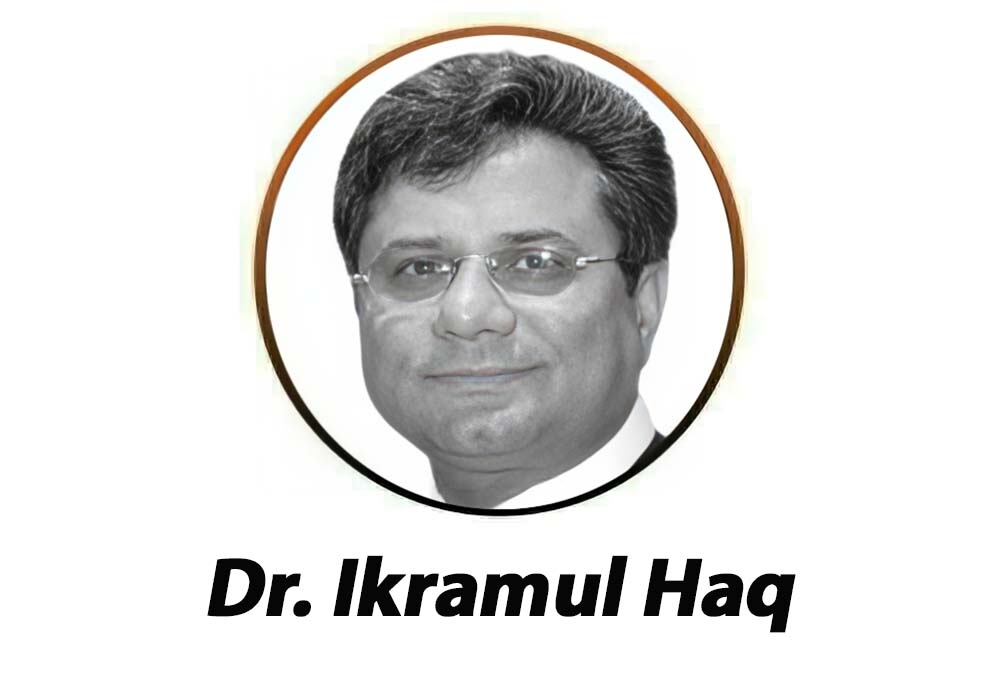
Dr. Ikramul Haq, Advocate Supreme Court, Adjunct Faculty at Lahore University of Management Sciences (LUMS), member Advisory Board and Visiting Senior Fellow of Pakistan Institute of Development Economics (PIDE), holds an LLD in tax laws. He was full-time journalist from 1979 to 1984 with Viewpoint and Dawn. He also served Civil Services of Pakistan from 1984 to 1996.

Similar Posts

  • The AJK Crisis 

    Azad Jammu and Kashmir has recorded at least 40 deaths since early June in clashes tied to the Joint Awami Action Committee’s campaign against the region’s twelve refugee assembly seats, a toll that predates the events of July 27-28, when JAAC and AJK police gave conflicting counts of 14 to 21 more killed in Rawalakot. The combined total since June likely sits in the high 40s to high 50s, though no independent body has confirmed a single figure; every clash in this sequence has produced a JAAC count and a police count that don’t match, and neither has been verified from outside. The July violence fell during the first phase of a legislative election that AJK’s election commission split into three stages because of the unrest, a break from the territory’s usual practice of voting in a single day. Mirpur division cast ballots on July 27. Rawalakot, in Poonch division, was deliberately held back for the third phase because it has been the epicenter of the agitation. The clashes there on July 27-28 came as JAAC’s long march tried to push through the city toward Muzaffarabad, not on a day its own constituents were voting. That the state felt it necessary to stagger an election by geography to manage a protest movement is itself a measure of how far the crisis had already gone. Law enforcement personnel have been repeatedly targeted through the unrest. Police say an armed JAAC contingent opened fire on officers near Combined Military Hospital Rawalakot in a planned attack, which the region’s police chief called outright terrorism. JAAC disputes this, as it has disputed nearly every account of nearly every clash, saying its own people came under fire after power was cut to the area. Neither version has been independently verified, and the Human Rights Commission of Pakistan has called for an impartial probe into the Rawalakot deaths for that reason. What is not contested is that a movement now banned under anti-terrorism law has been in near-continuous confrontation with police for eight weeks, and that officers have died in it. The dispute traces back to a structural question the state has already answered through the proper channel. Six of the twelve seats go to refugees from the Jammu division, numbering around 434,000; six more go to refugees from the Kashmir Valley, numbering around 30,000. JAAC calls this disproportionate and argues the seats let people who do not live in AJK shape its politics from outside. The AJK Supreme Court ruled on June 7 that the seats are constitutionally protected and can only be altered through a formal amendment, not by administrative order or by protest. The government’s proscription of JAAC under anti-terrorism law came two days earlier, on June 5, ahead of a planned June 9 protest; the worst of the killing followed the ban rather than preceding it. Both sides of that sequence can be argued. What can’t be argued is that the state waited for a body count before invoking the law , it acted first, and the deaths followed. On the demands themselves, the government reports 24 of JAAC’s 44 total demands fully implemented and 16 more partially complete or in process, with 4 at an impasse. That record is substantial, larger than most governments manage against a protest charter. But it does not settle the argument on its own, because none of the 24 completed demands is the refugee-seat question. That one sits among the 16 still unresolved, and it is the demand driving the current violence. A compliance rate built mostly from other line items ; subsidies, cabinet size, judicial commissions, demonstrates the state’s good faith in general. It does not demonstrate its handling of the one issue JAAC is dying and killing over, and that distinction should not be blurred. Even so, the seat question has been settled by the only body with authority to settle it. Abolishing the seats to appease pressure tactics would be unconstitutional on its face, and it would tell any future movement in Pakistan that enough disruption can override a court and a negotiated settlement alike. A state that has followed its own constitutional process, implemented most of an agreed reform charter, and still faces an intensifying campaign of blockades and attacks on security personnel has grounds to hold its position; grounds that rest on the process it followed, not on an implementation statistic that doesn’t reach the actual grievance. The state’s strongest move now is to negotiate from the position it has already earned, not concede from a position of weakness. Reweighting the seats toward Jammu’s larger population, pursued through the amendment process the Supreme Court has itself outlined, would resolve the proportionality complaint on the state’s own terms and timeline, not JAAC’s. Offered now, immediately after a disputed mass-casualty event, it would read as capitulation. Offered once the group’s remaining leadership either accepts the court’s authority or is dealt with through the law, it becomes a demonstration of a functioning constitutional order rather than a retreat from one. The state does not owe JAAC a seat at the table it has spent eight weeks helping to blow up. It owes AJK’s residents a government that can enforce the law, account honestly for its own role in how this got this bloody, and eventually fix what is fair within the constitution , in that order.

  • The Makkah Defence Pact and the Making of a New Re…

    Saudi Arabia, Pakistan and Türkiye have signed the Makkah Joint Defence Agreement on 7 August in 2026 and this signing is far more significant than what ceremony and symbolism it carries. Signed in Makkah by Saudi Crown Prince Mohammed bin Salman, Turkey’s President Recep Tayyip Erdoğan and Pakistani Prime Minister Shehbaz Sharif, the deal provides that an armed attack against any one of the three countries will be considered as an attack against all the three countries.  But its sincerity was greatest not in the denouncing of a specific enemy but in an understanding of the strategic environment which has produced an enemy. It is not a moment for defining the agreement as an “anti-Iran, anti-Israel, anti-American pact. There’s no mentioning of any of these states being specifically called out as the target state. Instead, the agreement seems to be part of a larger strategic pivot amid a more complicated security landscape in the Middle East. Saudi Arabia, Türkiye and Pakistan have divergent agenda in foreign-policy, but all three countries have an interest in lessening strategic vulnerability while gaining more ‘room for manoeuvre’. For the capital of the Hejaz, the key strategic priority is defending its territory, which contains important military bases, energy resources and trading lines, set in a much-changing environment. Saudi Arabia has close relations with Washington, but its foreign policy in recent years has been firmly founded on a strong sense of need for building more than one strategic partnership with the outside world. As such, the Makkah deal is more a tool for “strategic hedging” and less a statement of opposition to a specific regime. The participation of Türkiye is especially significant. While Ankara is a NATO country, it is also developing an autonomous regional foreign policy. In particular the dealings of its government with Iran, Russia, the Gulf monarchies, Europe, and the United States make it difficult to pigeonhole current Turkish strategy into a neat geopolitical box. The importance of this in the context of Türkiye’s presence in the country is such that shooting multi-alignment rather than sectarian or bloc confrontation. On the other hand, Pakistan has years of defence cooperation with Saudi Arabia and a growing institutionalized strategic ties with Türkiye. The deal provides Islamabad a chance to take the existing military cooperation into a larger strategic partnership. However, Pakistan needs to prudently guard its ties with the neighbouring country Iran as well as its ancestral ties with Saudi Arabia and also protect and carry forward its strategic partnership with China. The most sensible thing for Pakistan to do, then, is not bloc politics but calibrated multi-alignment. Particularly noted is Egypt’s non-participation in the defence pact, but it is too early to draw a clear conclusion that the country had been denied its membership due to the influence of any other country, including the United States and Israel. Indeed, Egypt has been continuing its strong partnerships with Saudi Arabia, Türkiye and Pakistan within the framework of R4. In June 2026, all four countries’ foreign ministers met in Cairo and reiterated their efforts in the realm of consultation and regional stability and coordinated diplomacy.  This isn’t necessarily a foreign veto in action, then, that Egypt is not a party to a certain military arrangement, but could be partly because of its own strategic decisions. The same level of skepticism should be applied towards the general pronouncements about Israel. As Türkiye’s rival relationship with Tel Aviv and the Saudi Arabia’s major role in the Arab-Israeli conflict weighs in, Israel will increasingly be considered a part of the “strategic equation” of the region. However, to date there is no visible evidence that the Makkah agreement was essentially a plan against Israel. Likewise, any potential Pakistani naval base at Pasni or the potential major shift of Pakistan’s maritime strategy should be viewed currently not as policy, but as potential options. The rising significance of geography at sea is much more evident. National security is entangling in increasing ways with the Arabian Sea, the Gulf of Oman, the Red Sea and network of commercial and energy corridors. Nowadays, ports and shipping routes are not just economic infrastructure, but strategic assets, in a world of geopolitical dynamics and fragile supply networks. This geographical locational aspect highlights the significance attributed to Pakistan as going beyond its geographical limelight in geography. Chances are on the rise that China will play a key role in this new order. Beijing has already got noticeable economic presence in Pakistan and the Gulf countries, and importantly, it has built a long-term strategic presence in the Indian Ocean via the Belt and Road Initiative and CPEC. However, China has tended towards more flexible economic and diplomatic ties rather than military alliances. Saudi-Türkiye-Pakistan cooperation thus puts Beijing in a stronger position to maintain room for manoeuvre within the new framework without having to join it formally. The emerging picture is rather not that of a straightforward American power-substitution than one of an American power-displacement. Instead, the Middle East seems to be shifting towards a more pluralist and networked security configuration, in which governments have multiple relations with rival entities at the same time. Saudi Arabia can cooperate with the US and work towards closer ties with Pakistan and Türkiye; Türkiye can be in NATO and yet have a policy of its own in the region; Pakistan can have closer relationship with China, and Saudi Arabia and Türkiye; and at the same time take part in the dialogue between Pakistan and Iran and the West. After signing the Makkah agreement, its ultimate effect will be determined. Though it might turn into a regular framework of intelligence sharing, joint exercises, defence production and operational co-ordination it could serve as a lasting centrepiece of regional security. Its impact will be more limited, if it is kept largely declaratory. But at this time the most credible inference is that the Makkah pact is far from being an alliance against a common enemy but rather a strategy for the breakdown of one

  • Second Darkest Day For Kashmiris

    Kashmiris including men, women, youth and children who underwent the second longest lockdown, complete curfew, for a pretty long time, are observing it as the second darkest day in their history on August 05, 2026. On August 05, 2019, the Indian Government of Prime Minister Narendra Modi had quite unexpectedly, illegally and unilaterally scrapped the special status of Jammu and Kashmir under Article 370 of the Indian Constitution making it an integral part of the country. These measures had ended the occupied territory’s limited autonomy and sought to alter the internationally recognized disputed status of Jammu and Kashmir in blatant violation of the United Nations Security Council resolutions and international law. The second darkest day in Kashmiris’ history is now better known and is observed every year on August 05 as Youm-e-Istehsal (Day of Exploitation). The observance of Youm-e-Istehsal not only serves as a reminder of the continued sufferings of the Kashmiri people but also reaffirms Pakistan’s unflinching solidarity with their just struggle for the realization of their right of self-determination. Pakistan’s civil and military leadership has all along been extending moral, diplomatic and political support to the Kashmiris in their just and indigenous freedom struggle. Kashmiris on both sides of the Line of Control (LoC), around the world as well as the Pakistan government and the people are observing yet another Youm-e-Istehsal on August 05, 2026 to mark the 7 years of quite regretful, deplorable Indian siege of its illegally occupied Jammu and Kashmir valley and denying the Kashmiris their birth right of self-determination in accordance with the UN Security Council resolutions. Needless to mention here that Kashmir conflict continues to remain as perhaps the oldest lingering and unresolved international dispute dating back to 1947. It also continues to be recognized by the world body, the United Nations, as an issue requiring peaceful settlement in accordance with its Security Council resolutions and the wishes of the Kashmiri people who were engaged in one of the longest unarmed struggles for freedom from the Indian shackles. Kashmiris in the occupied valley, on both sides of the Line of Control, in the world over are observing August 5, 2026 as the second darkest day of their history. The first one being observed every year on October 27 is to continue marking their protest and agitation against illegal and forcible occupation of their territory by India on this day in 1947 after its last Dogra ruler Maharaja Hari Singh, one of as many as 565 princely states, had an Instrument of Accession signed in Delhi, had opted to join India in accordance with the provisions of the Sub-Continent Partition Plan against the wishes and aspirations of the valley residents. Following this ugliest development, India had airlifted its security forces into the occupied territory. Since August 05, 2019, India has accelerated its efforts for consolidating its control over its Illegally Occupied Jammu and Kashmir (IIOJK) through a series of political, legal, and administrative measures. The Indian Government was also making attempts, which are a great source of concern for everybody, to engineer demographic changes in its occupied territory through the issuance of forged domicile certificates to non-Kashmiris, mainly Hindus, changing the land ownership laws, and electoral delimitation measures which were designed to arbitrarily alter the region’s demographic and political landscape. There were reports that in pursuance of Indian PM Narendra Modi’s devilish intentions of promoting Hindutva more than 350,000 fake and forged domicile certificates have been issued to non-Kashmiris (Hindus) enabling them to settle in the occupying territory since August 05, 2029. These measures, quite obviously, were a crude attempt to dilute the identity of the indigenous Kashmiri population, undermining their political representation, and creating irreversible changes to the disputed territory in flagrant violation of all international laws and the Fourth Geneva Convention. The years following August 5, 2019, have also witnessed a worsening and quite alarming human rights situation in IIOJK. Reports of arbitrary detentions, extrajudicial killings, enforced disappearances, custodial torture, women’s rapes, restrictions on freedom of expression and peaceful assembly, and systematic curbs on media freedom continue to surface and emerge frequently. Observance of another Youm-e-Istehsal on August 05, 2026 as such is not only a painful and tragic commemoration of August 05, 2019 events but also a reminder of the ongoing challenges being faced by the Kashmiris but will also highlight the urgent and dire need for the international community to take cognizance of the situation in IIOJK and exert pressure on India to respect international law and human rights and firmly support the efforts aiming at achieving a just and peaceful resolution of the Jammu and Kashmir dispute. Observance of the Youm-e-Istehsal by the government and the people of Pakistan is also a renewed commitment of Pakistan to continue extending political, diplomatic and moral support to the Kashmiris until they are enabled to exercise their inalienable right of self-determination in accordance with the UN Security Council resolutions. Kashmiris all over the world earnestly believe that their observance of the darkest days on August 5 and October 27 besides other protests and rallies in occupied territory and elsewhere will sooner or later awake the sleeping conscience of the international community and they will be getting their birth right of self-determination in accordance with UN Security Council resolutions and they will be free to either stay with India or join Pakistan. They are hopeful that this will happen but are unable to say surely as to when this is going to happen.

  • Pakistan deserves better, Call for responsible gov…

    By Mehak Ali Pakistan is a country united by diverse cultures, languages, and provinces. Sindh, Punjab, Balochistan, Khyber Pakhtunkhwa, Gilgit-Baltistan, and Azad Jammu and Kashmir together form a nation blessed with breathtaking mountains, mighty rivers, vast deserts, fertile plains, and a strategically significant location. These natural blessings make Pakistan one of the most important countries in South Asia. ‎Yet, despite these advantages, millions of citizens continue to struggle with basic issues. Every day, news headlines report murders, sexual violence, malnutrition, unemployment, floods, illiteracy, inflation, gas shortages, electricity outages, and rising fuel prices. These are not isolated incidents; they are challenges that affect the daily lives of ordinary Pakistanis. ‎Citizens pay taxes with the expectation that the government will provide quality education, healthcare, infrastructure, security, and economic opportunities. When these expectations remain unfulfilled, frustration naturally grows. Good governance is not measured by speeches or publicity but by improvements in the lives of the people. ‎The condition of Sindh, particularly in many rural areas, reflects these concerns. Damaged roads, overflowing garbage, poor sanitation, and inadequate public services make everyday life difficult. Similar concerns are voiced by people in Balochistan, Khyber Pakhtunkhwa, and other regions, where many continue to demand better facilities, development, and equal opportunities. ‎Farmers work tirelessly under the scorching sun to feed the nation. Employees spend long hours in offices to support their families. Students invest years in education, yet many remain unemployed even highly qualified graduates and researchers struggle to find suitable jobs. Meanwhile, poverty, heat-related illnesses, and malnutrition continue to claim innocent lives. ‎In a democratic society, peaceful protest is a constitutional right. When citizens raise their voices for justice, development, or equal treatment, they deserve to be heard with dialogue rather than confrontation. The unrest in Azad Jammu and Kashmir reminds us that citizens’ grievances whether related to economic hardships, political representation, or governance must be addressed through dialogue, accountability, and peaceful solutions rather than allowing frustration to turn into violence. Listening to the concerns of the people strengthens democracy and builds trust between the government and its citizens. ‎Despite these challenges, Pakistan remains our home, and we are proud to be Pakistanis. Criticizing shortcomings does not mean we love our country any less. On the contrary, it reflects our hope for a better future. We dream of a Pakistan where every citizen enjoys equal rights, where public resources are used responsibly, where justice prevails, and where no one is left behind because of their province, ethnicity, or economic status. ‎Pakistan has immense potential. What it needs is sincere leadership, transparent governance, and policies that place the welfare of the people above all else. Only then will every citizen be able to say with confidence and pride: Yes, we are Pakistanis, and we are truly united.

  • Jalalpur Canal: Politics, Procedure and Sindh&#821…

    Just as the BRB Canal is often regarded as Lahore’s lifeline, the Indus River occupies a similar position for Sindh. It is, therefore, unsurprising that the river has remained at the center of the province’s political discourse for decades. Yet, since the passage of the 18th Constitutional Amendment, few issues have continued to unite Sindh’s population across political divides and enable a collective political stance at the federal level. Today, the province’s politics remains broadly divided between urban and rural Sindh. In rural Sindh, apart from disputes over canals and water resources, there appears to be no issue capable of sustaining political mobilization against either Punjab or the federal government. As a result, water politics has become the principal rallying point for several nationalist parties. At times, this has also led to exaggerated claims or misleading narratives. The political logic is evident: abandoning canal politics would require these parties to confront more entrenched issues within Sindh itself, including feudal dominance, decades of corruption and the continued exploitation of ordinary citizens. The recent trial inauguration of the Jalalpur Canal briefly generated political unrest in Sindh. However, the initial wave of anger faded almost as quickly as it emerged. As videos showing water flowing through the canal circulated on social media, several anti-Punjab groups directed their criticism primarily towards Punjab rather than questioning the Sindh government. Arguably, the first questions should have been asked of the province’s own elected representatives. Why was the public not adequately informed about the project’s legal and administrative status? And why was Sindh unable to pursue its case more effectively through political and institutional channels? The concerns expressed by Sindh are neither new nor insignificant. By the time the Indus reaches the province, river flows have already declined substantially, affecting agriculture, fisheries and the livelihoods of communities living in the lower riparian region. At the same time, the Indus Delta continues to deteriorate while groundwater levels have fallen to alarming levels. Against this backdrop, many in Sindh believe that any additional diversion of water through projects such as the Jalalpur Canal could further reduce the province’s already constrained water availability. Punjab, however, has consistently maintained that the Jalalpur Canal is not among the six canal projects over which Sindh has formally raised objections. It further argues that the Indus River System Authority (IRSA) issued the Water Availability Certificate for the project in 2014, when Sindh was represented on the authority by Mazhar Ali Shah. If Sindh considered the project objectionable, Punjab argues, why were those objections not raised at that stage? Likewise, why was the issue not pursued more effectively when the project was placed before the   Executive Committee of the National Economic Council (ECNEC) for approval and when construction subsequently commenced? Sindh, for its part, maintains that the Provincial Assembly adopted a formal resolution against the canal in 2021. Three years later, in 2024, the provincial government formally placed the matter before the Council of Common Interests (CCI). Punjab nevertheless rejected Sindh’s objections there as well, reiterating that the Jalalpur Canal did not fall within the six disputed canal projects that remain under contention between the two provinces. Politically, however, the episode exposed the Sindh government’s difficult position before its own electorate. The documentary record indicates that the provincial government had registered its reservations through official forums. Yet it failed to convert those institutional objections into an effective political narrative because Punjab’s position appeared stronger from both procedural and technical standpoints. This became particularly evident when Sindh Chief Minister Syed Murad Ali Shah acknowledged during a press conference that the Jalalpur Canal was not among the six canal projects to which Sindh had consistently objected. That admission effectively defused the anti-Punjab momentum that had briefly gathered pace following the canal’s trial inauguration. For years, the Pakistan Peoples Party (PPP) has sought to accommodate Sindh’s nationalist parties within the framework of mainstream politics by assuring them political representation at both the provincial and federal levels. At the same time, nationalist parties themselves appear conscious of the electoral limitations of their own rhetoric. Many recognise that slogans traditionally associated with nationalist politics, including “Pakistan Na Khappay”, may have limited appeal when competing with mainstream political parties in electoral politics.

  • Privatization of DICSOs. Why Pakistan Should Hand …

    Pakistan is about to privatise three of its distribution companies — FESCO, GEPCO and IESCO — and call it reform. It is not reform. It is triage, dressed up by three institutions that have run out of the credibility to call it anything else. The government picked these three not because they are the future of Pakistan’s grid, but because they are the only ones healthy enough to survive being sold. Their transmission and distribution losses sit around 9–10 percent, low by Pakistani standards, and their books are clean enough to attract a buyer. That is not a privatisation strategy. That is a garage sale of the family’s least broken furniture while the roof still leaks — supervised by the very carpenters who let the roof rot. And look who is showing up to bid. Expressions of interest have come from a handful of Pakistani business houses — conglomerates looking for a new asset class. Not one of them has run a national distribution network at scale, with the theft, the political interference, and the feeder-level rot that defines an ex-WAPDA DISCO. We have seen this film before. It was called K-Electric. At the time of its 2005 privatisation, KE was drawing a subsidy of roughly Rs 8 billion. Two decades later, it needed a Rs163 billion tariff differential subsidy in the FY2026–27 federal budget just to keep its consumers’ bills from reflecting its own inefficiency. Twenty-fold growth in the subsidy bill is not what privatisation was sold as. If that is what “successful” privatisation looks like, Pakistan should be terrified of doing it two, or eleven, more times. The rot is institutional, and it has three addresses. NEPRA has spent years rubber-stamping tariff hikes, capitulating to circular debt, and failing to enforce performance standards on the DISCOs it already regulates — a ceremonial regulator that confuses notifying a tariff with governing a sector. CPPA-G, sitting at the centre of the power purchase and settlement system, has presided over a circular debt mountain that keeps climbing regardless of who is nominally in charge, and has never been made to answer for it. And the Ministry of Power itself has spent a decade approving capacity contracts, rejecting cheaper foreign offers, and rotating leadership through the same small circle of appointees who preside over one crisis and then the next. None of these three institutions has the standing left to supervise a privatisation of this scale. Handing FESCO, GEPCO and IESCO to private buyers while NEPRA still writes the tariff rules, CPPA-G still runs settlement, and the Ministry still calls the shots is not privatisation — it is a death sentence dressed in a share-purchase agreement, executed slowly, one quarterly tariff adjustment at a time, on the very consumers this reform claims to protect. A regulator that could not discipline a state-owned utility is not going to discipline a private one with dollar-indexed tariff protections and lawyers on retainer. Investors bidding for FESCO, GEPCO and IESCO are already demanding exactly that: payment guarantees in US dollars, contractual protection against future renegotiation, and freedom to slash staff. Pakistan is not privatising its grid. It is handing three of its most valuable state assets to whoever negotiates the toughest exit clause, under a regulator, a market operator, and a ministry with no track record of holding anyone to account. There was a better road, and Pakistan turned it down. In 2016, Chinese Smart Grid firms — brought to the table personally (Engineer Arshad H Abbasi) in that effort — offered to bring smart grid technology into Pakistan’s distribution network, the same technology that helped State Grid Corporation of China push national transmission and distribution losses down to roughly the mid-single digits in recent years. The proposal on the table was a shared-risk model: China would modernise the DISCOs into smart grids over a decade, splitting recovered losses fifty-fifty with the state. It would have cost Pakistan almost nothing upfront and aligned China’s incentives directly with reducing theft and technical loss — the two diseases actually killing Pakistan’s grid. The Ministry of Power and the Planning Commission rejected it. A parallel 2015 pitch to interconnect Pakistan’s grid with China’s has sat on the drawing board for over a decade. Meanwhile Pakistan built its way into the LNG and imported-coal trap that now drives the very capacity payments crushing consumers and taxpayers alike — a trap Chinese engineers, who have spent thirty years wiring one of the largest and most loss-efficient grids on earth, would likely have steered Pakistan away from. Compare the region. India already exports power to Nepal, Bhutan and Bangladesh and is deepening links with Sri Lanka and Myanmar. Bhutan alone hosts roughly 3,156 MW of Indian-financed hydropower capacity across five major projects — a model of a regional power partner investing in generation rather than merely trading finished electricity. Pakistan, by contrast, cannot even get its own national grid properly connected into Gilgit-Baltistan or Gwadar, a port city that still runs short of reliable power despite sitting at the centre of a multi-billion-dollar Chinese economic corridor. China already has more than 5,000 MW of committed CPEC power capacity inside Pakistan, selected and negotiated by the Planning Commission, and a demonstrated willingness to build hydropower in difficult terrain. It is time to stop pretending Pakistan can manage this alone. Invite China to finance and build the hydropower across GB, AJK and KPK the way India financed Bhutan, and let Pakistan’s surplus eventually be wheeled toward Afghanistan, toward India, even toward China itself — which still needs to retire coal capacity and would gladly take clean power off a friend’s grid. Because that is what China has been, in a relationship most Pakistanis do not need convincing about: a friend when the ledger was empty, a builder when nobody else would build, a partner sweeter than honey and, on the balance sheet of sixty years of cooperation, standing taller than Everest over every other option on the table. NEPRA and CPPA-G have failed

Leave a Reply

Your email address will not be published. Required fields are marked *